CORAL GABLES, Fla. (AP) — Miami safety Jakobe Thomas enjoyed seeing the Hurricanes at their worst.
He was with Middle Tennessee State in 2022 when the Blue Raiders — four-touchdown underdogs that day — came into Hard Rock Stadium and used big play after big play to beat Miami 45-31, part of the Hurricanes’ spiral to a 5-7 season in Mario Cristobal’s first year back at his alma mater.
And it wasn’t like that MTSU team was some juggernaut, either. It went 0-3 in its next three games, losing by a combined 60 points. But it had no trouble with Miami.
That was then.
Miami’s resurrection from that bad day and a lot of others over the last 20 years — a period during which the Hurricanes have had six coaches, three other interim coaches, 17 seasons that didn’t include a bowl win, countless headaches and zero Atlantic Coast Conference championships — is just about complete. The Hurricanes (13-2, No. 10 College Football Playoff) play for the national championship on Monday night against Indiana (15-0, No. 1 CFP) at that same Hard Rock Stadium that was practically empty at the end of MTSU's win four years ago.
“It’s completely different,” said Thomas, who transferred to Tennessee for 2024 before coming to Miami for his final college season. “The Miami team we played back in ’22 was not this team now. I think coach Cristobal changed the culture around this place.”
Make no mistake: Swagger is still a thing at Miami. These Hurricanes are brash and aggressive and tackle hard and play harder. Cristobal's intensity is constant. Same goes for his staff. But there's a balance now as well, a demand for accountability and carrying yourself the right way at all times.
Some examples — wide receiver Malachi Toney, the best freshman in America this season, gave away turkeys at Thanksgiving; star defensive lineman Rueben Bain Jr. organized a toy drive at Christmas and made a $5,000 donation to the elementary school he attended years ago; and receiver CJ Daniels did an event to raise awareness of epilepsy, something that has touched his family.
And ever since Cristobal came back to Miami, the team has broken two records each year: one for fall-semester GPA, then one for spring-semester GPA.
“We have good people,” Cristobal said. “No, we have great people. It starts there. Surround yourself with great people, like-minded people and see what happens.”
Cristobal didn't use some unheard-of, wacky formula to bring Miami back to the national title picture. It was really quite simple: outwork everyone, make honesty and transparency fundamental principles of the program, hire the best people and fight like hell to win recruiting battles — nationally, of course, but also the ones waged in the Hurricanes' talent-rich backyard, which sends tons of kids to the highest levels of college football every year.
Landing Bain — a Miami guy who stayed home for college and who should be a sure-fire first-round NFL draft pick — in 2022 was a huge get. Cristobal was on a plane when Bain called him to commit. He threw his phone across the plane when he heard the words. Luckily, it was a private plane. The phone didn't hit anyone.
“We’re used to winning and that’s what we’re going to bring back to Miami,” Bain said in 2022 when he announced his college choice. “They need help bad, they need help right now, and I’m willing to come in right now and make a change.”
Changes were made.
After that 5-7 first season, Miami went 7-6 in 2023. Better, but nowhere near good enough. In 2024, the Hurricanes started 9-0 then lost three of their last four games. Better again, but still not good enough.
So, Cristobal hired defensive coordinator Corey Hetherman away from Minnesota to shore up that side of the ball. Carson Beck signed and took over for No. 1 draft pick Cam Ward at quarterback. Miami kept landing key pieces in the transfer portal — Thomas, Keionte Scott and Mohamed Toure are some who'll play big roles on defense Monday night, while Keelan Marion, James Brockermeyer, Marty Brown, Daniels and Beck are just a few of the names who'll be on the offensive side.
“It was just getting the brotherhood right,” said linebacker Wesley Bissainthe, who played for Miami in that loss to MTSU. “I feel like we’re all in there. Every person in that locker room is playing for each other. That’s what it looks like when we’re out there. No one is just playing for themselves. The brotherhood, I feel like it’s one of the most important things in a team’s culture. You’ve got to play for the person beside of you.”
Miami has put together back-to-back seasons of double-digit win totals — it had four consecutive 10-or-more-win seasons from 2000 through 2003, then exactly one such season from 2004 through 2023. It will have back-to-back season-ending appearances in the AP Top 25 for just the second time since 2005. Win or lose on Monday, Cristobal will inevitably say more work needs to be done.
But the dark days at Miami, finally, seem to be over.
“A care factor that’s through the roof and a die-hard belief in the University of Miami, bleeding orange and green through all of us, I think that’s what has really forged our progress forward as we continue to try to get better,” Cristobal said. “And we certainly have a long ways to go.”
Get poll alerts and updates on the AP Top 25 throughout the season. Sign up here. AP college football: https://apnews.com/hub/ap-top-25-college-football-poll and https://apnews.com/hub/college-football
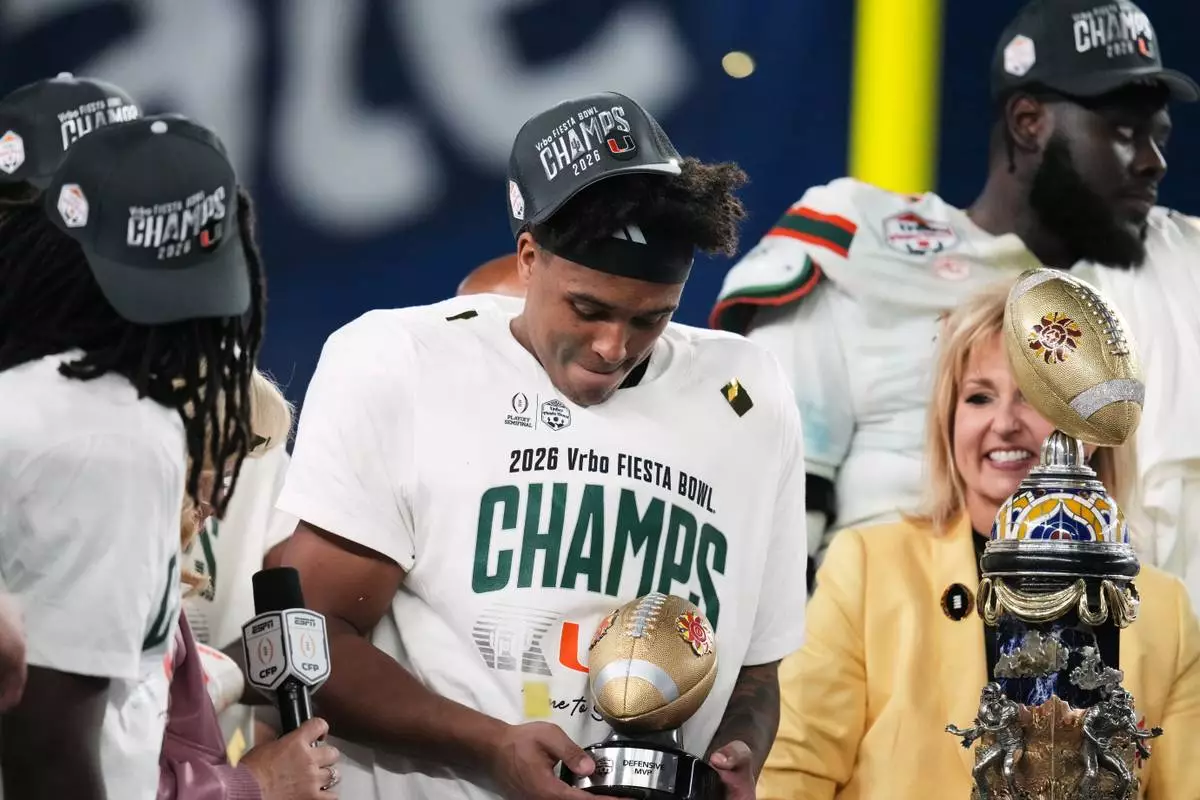
Miami defensive back Jakobe Thomas holds the defensive player of the game trophy after the Fiesta Bowl NCAA college football playoff semifinal game against Mississippi, Thursday, Jan. 8, 2026, in Glendale, Ariz. (AP Photo/Ross D. Franklin)

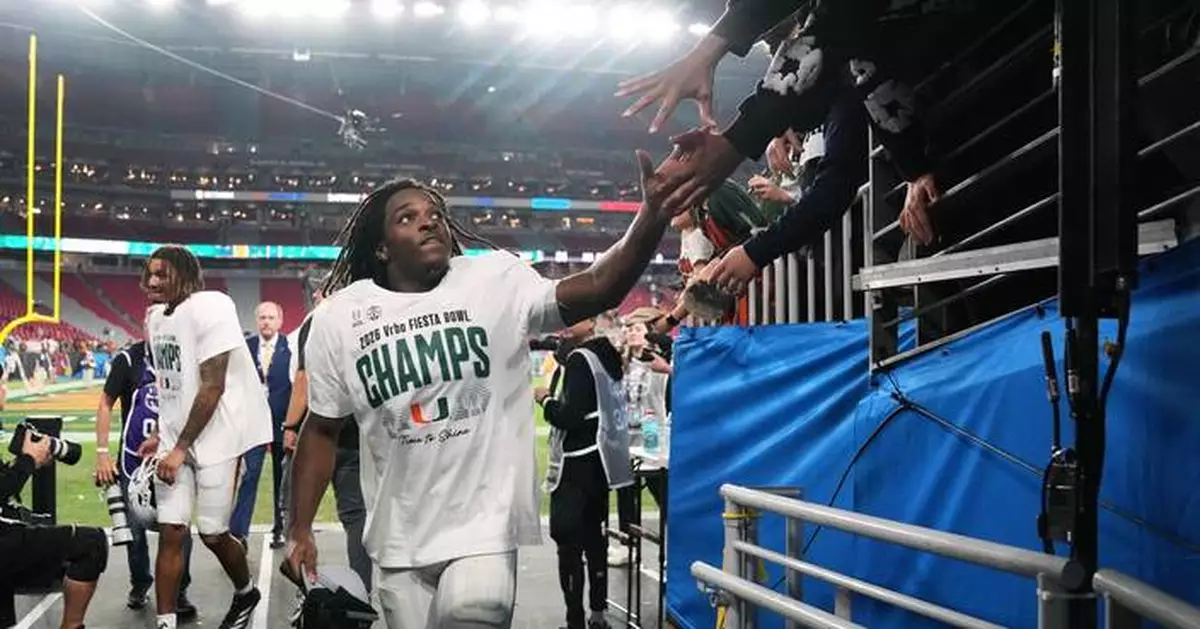
Miami wide receiver Malachi Toney leaves the field after the Fiesta Bowl NCAA college football playoff semifinal game against Mississippi, Thursday, Jan. 8, 2026, in Glendale, Ariz. (AP Photo/Rick Scuteri)
WASHINGTON (AP) — The Food and Drug Administration commissioner's effort to drastically shorten the review of drugs favored by President Donald Trump's administration is causing alarm across the agency, stoking worries that the plan may run afoul of legal, ethical and scientific standards long used to vet the safety and effectiveness of new medicines.
Marty Makary's program is causing new anxiety and confusion among staff already rocked by layoffs, buyouts and leadership upheavals, according to seven current or recently departed staffers. The people spoke to The Associated Press on the condition of anonymity because they were not authorized to discuss confidential agency matters.
At the highest levels of the FDA, questions remain about which officials have the legal authority to sign off on drugs cleared under the Commissioner’s National Priority Voucher program, which promises approval in as little as one month for medicines that support “U.S. national interests.”
Traditionally, approval decisions have nearly always been handled by FDA review scientists and their immediate supervisors, not the agency’s political appointees and senior leaders.
But drug reviewers say they've received little information about the new program's workings. And some staffers working on a highly anticipated anti-obesity pill were recently told they can skip certain regulatory steps to meet top officials' aggressive deadlines.
Outside experts point out that FDA drug reviews — which range from six to 10 months — are already the fastest in the world.
“The concept of doing a review in one to two months just does not have scientific precedent,” said Dr. Aaron Kesselheim, a professor at Harvard Medical School. “FDA cannot do the same detailed review that it does of a regular application in one to two months, and it doesn’t have the resources to do it.”
On Thursday Reuters reported that FDA officials have delayed the review of two drugs in the program, in part due to safety concerns, including the death of a patient taking one of the medications.
Health and Human Services spokesman Andrew Nixon said the voucher program prioritizes “gold standard scientific review” and aims to deliver “meaningful and effective treatments and cures."
The program remains popular at the White House, where pricing concessions announced by the Republican president have repeatedly been accompanied by FDA vouchers for drugmakers that agree to cut their prices.
For instance, when the White House announced that Eli Lilly and Novo Nordisk would reduce prices on their popular obesity drugs, FDA staffers had to scramble to vet new vouchers for both companies in time for Trump's news conference, according to multiple people involved in the process.
That’s sparked widespread concern that FDA drug reviews — long pegged to objective standards and procedures — have become open to political interference.
“It’s extraordinary to have such an opaque application process, one that is obviously susceptible to politicization,” said Paul Kim, a former FDA attorney who now works with pharmaceutical clients.
Many of the concerns around the program stem from the fact that it hasn't been laid out in federal rules and regulations.
The FDA already has more than a half-dozen programs intended to speed up or streamline reviews for promising drugs — all approved by Congress, with regulations written by agency staff.
In contrast, information about the voucher program is mostly confined to an agency website. Drugmakers can apply by submitting a 350-word “statement of interest.”
Increasingly, agency leaders such as Dr. Vinay Prasad, the FDA’s top medical officer and vaccine center director, have been contacting drugmakers directly about awarding vouchers. That’s created quandaries for FDA staffers on even basic questions, such as how to formally award a voucher to a company that didn’t request one.
Nixon, the HHS spokesman, said that voucher submissions are evaluated by “a senior, multidisciplinary review committee,” led by Prasad.
Questions about the legality of the program led the FDA’s then-drug director, Dr. George Tidmarsh, to decline to sign off on approvals under the pathway, according to several people with direct knowledge of the matter. Tidmarsh resigned from the agency in November after a lawsuit challenging his conduct on issues unrelated to the voucher program.
After his departure, Sara Brenner, the FDA’s principal deputy commissioner, was set to have the power to decide, but she also declined the role after looking further into the legal implications, according to the people. Currently the agency’s deputy chief medical officer, Dr. Mallika Mundkur, who works under Prasad, is taking on the responsibility.
Giving final approval to a drug carries significant legal risks, essentially certifying that the medicine meets FDA standards for safety and effectiveness. If unexpected safety problems later emerge, both the agency and individual staffers could be pulled into investigations or lawsuits.
Traditionally, approval comes from FDA drug office directors, made in consultation with a team of reviewers. Under the voucher program, approval comes through a committee vote by senior agency leaders led by Prasad, according to multiple people familiar with the process. Staff reviewers don't get a vote.
“It is a complete reversal from the normal review process, which is traditionally led by the scientists who are the ones immersed in the data,” said Kesselheim, who is a lawyer and a medical researcher.
Not everyone sees problems with the program. Dan Troy, the FDA’s top lawyer under President George W. Bush, a Republican, says federal law gives the commissioner broad discretion to reorganize the handling of drug reviews.
Still, he says, the voucher program, like many of Makary’s initiatives, may be short-lived because it isn't codified.
“If you live by the press release then you die by the press release,” Troy said. “Anything that they’re doing now could be wiped out in a moment by the next administration.”
Initially framed as a pilot program of no more than five drugs, it has expanded to 18 vouchers awarded, with more under consideration. That puts extra pressure on the agency’s drug center, where 20% of the staff has left through retirements, buyouts or resignations over the past year.
When Makary unveiled the program in October there were immediate concerns about the unprecedented power he would have in deciding which companies benefit.
Makary then said that nominations for drugs would come from career staffers. Indeed, some of the early drugs were recommended by FDA reviewers, according to two people familiar with the process. They said FDA staffers deliberately selected drugs that could be vetted quickly.
But, increasingly, selection decisions are led by Prasad or other senior officials, sometimes unbeknownst to FDA staff, according to three people. In one case, FDA reviewers learned from GlaxoSmithKline representatives that Prasad had contacted the company about a voucher.
Access to Makary is limited because he does not use a government email account to do business, according to people familiar with the matter, breaking with longstanding precedent.
Once a voucher is awarded, some drugmakers have their own interpretation of the review timeline — creating further confusion and anxiety among staff.
Two people involved in the ongoing review of Eli Lilly's anti-obesity pill said company executives initially told the FDA they expected the drug approved within two months.
The timeline alarmed FDA reviewers because it did not include the agency's standard 60-day prefiling period, when staffers check the application to ensure it isn’t missing essential information. That 60-day window has been in place for more than 30 years.
Lilly pushed for a quicker filing turnaround, demanding one week. Eventually the agency and the company agreed to a two-week period.
Nixon declined to comment on the specifics of Lilly's review but said FDA reviewers can “adjust timelines as needed.”
Staffers were pushed to keep the application moving forward, even though key pieces of data about the drug's chemistry appeared to be missing, according to one person involved in the process. When reviewers raised concerns about some of the gaps during an internal meeting, the person said, they were told by a senior official: “If the science is sound then you can overlook the regulations.”
Former reviewers and outside experts say that approach is the opposite of how FDA reviews should work: By following the regulations, staffers scientifically confirm the safety and effectiveness of drugs.
Skipping review steps could also carry risks for drugmakers if future FDA leaders decide a drug wasn’t properly vetted. Like other experts, Kesselheim says the program may not last beyond the current administration.
“They are fundamentally changing the application of the standards, but the underlying law remains what it is,” he said. “The hope is that one day we will return to these scientifically sound, legally sound principles.”
The Associated Press Health and Science Department receives support from the Howard Hughes Medical Institute’s Department of Science Education and the Robert Wood Johnson Foundation. The AP is solely responsible for all content.
FILE - The Food and Drug Administration seal is seen at the Hubert Humphrey Building Auditorium in Washington, April 22, 2025. (AP Photo/Jose Luis Magana, File)
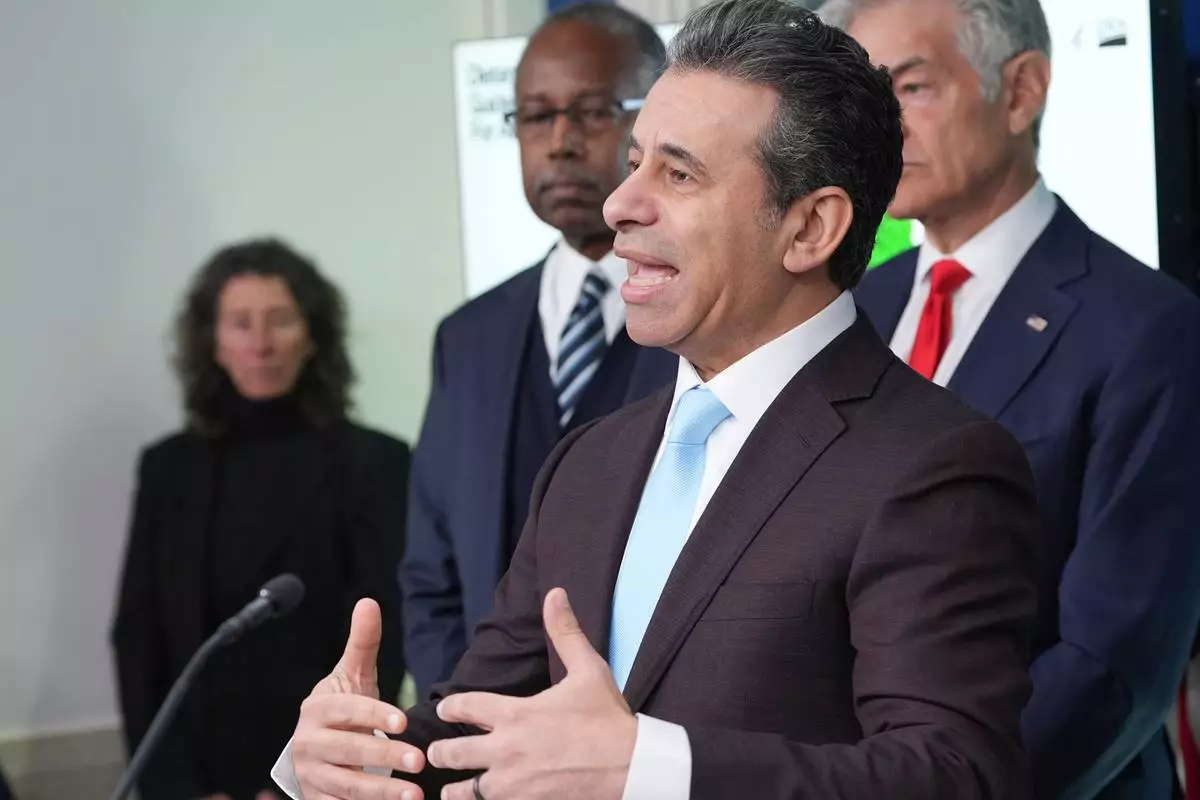
Dr. Marty Makary, commissioner of the Food and Drug Administration, speaks during a press briefing at the White House, Wednesday, Jan. 7, 2026, in Washington. (AP Photo/Jacquelyn Martin)