Skip to Content Facebook Feature Image

Why Thailand's deadly construction accidents are sparking outrage and scrutiny

News

Why Thailand's deadly construction accidents are sparking outrage and scrutiny
News

News

Why Thailand's deadly construction accidents are sparking outrage and scrutiny

2026-01-17 00:44 Last Updated At:00:50

BANGKOK (AP) — Thailand’s construction industry is under intense scrutiny following a series of high-profile deadly accidents. These include a crane falling onto a moving passenger train this past week and the collapse of an office tower a year ago that killed nearly 100 workers.

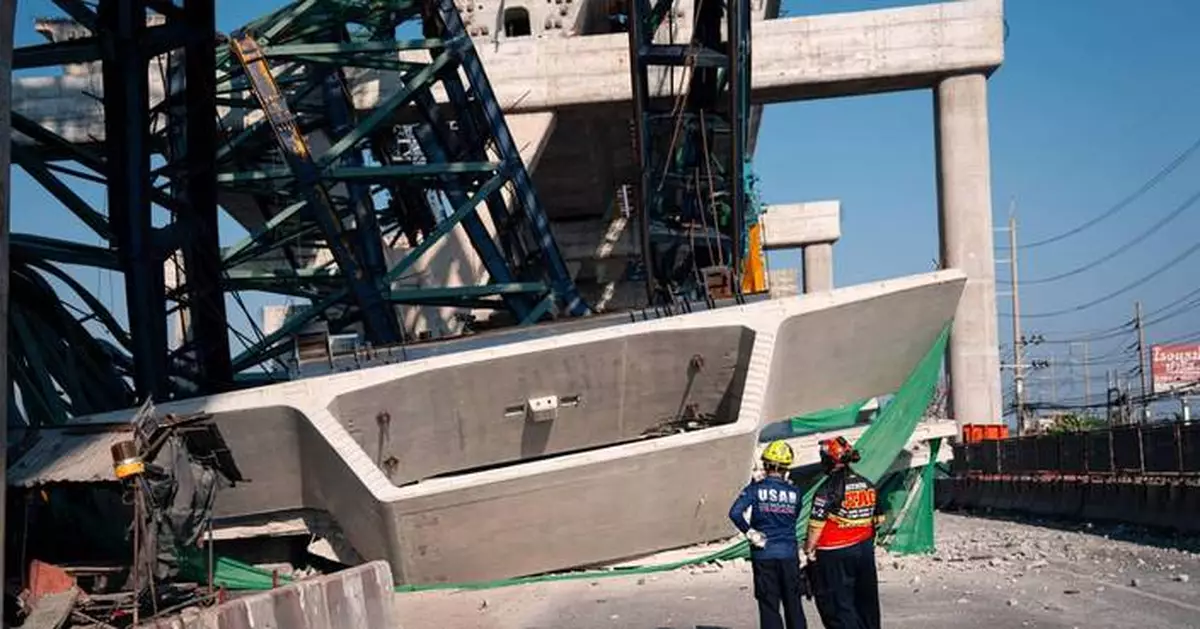
Public concern is particularly high in Bangkok due to the frequent and sometimes fatal construction accidents on major road projects. In the latest case, a construction crane collapsed on Thursday, killing two people, just a day after the train tragedy in which 32 people died.

Public outrage has centered on Italian-Thai Development, the contractor responsible for both sites where the past week's accidents occurred. The company, also known as Italthai, was also the joint lead contractor for the 33-story State Audit Office building, which toppled while under construction in March, killing about 100 people.

It was the only major structure in Thailand to collapse from an earthquake whose epicenter was in Myanmar, more than 1,300 kilometers (800 miles) away.

Twenty-three individuals and companies were indicted in that case, including Italthai’s President Premchai Karnasuta, on charges including professional negligence causing death and document forgery. Italthai, a major developer in Thailand which has won many government projects, has denied wrongdoing in that case as well as the more recent crane crashes.

Prime Minister Anutin Charnvirakul has responded to the latest incidents by ordering the Transport Ministry to terminate contracts with, blacklist and prosecute the companies involved. Unfinished projects will be funded by seizing performance bonds and bank guarantees, with the government reserving the right to sue for extra costs. Additionally, a “scorecard” system to keep track of contractors’ performance records should be enforced by early February.

Investigators can often find the technical cause of accidents, such as human error or equipment failure.

But critics say construction safety faces broader systemic problems, pointing to lax regulation, poor enforcement, and corruption. A lengthy investigation determined that the building collapse in March, though triggered by an earthquake, was fundamentally caused by flawed structural design and effort to evade regulations.

“I don’t think Thailand fails in terms of the body of knowledge in engineering or even in the technical aspects,” said Panudech Chumyen, a civil engineering lecturer at Bangkok’s Thammasat University. “I think there’s a failure in our system; there are so many gaps that I don’t know where we should begin to close them.”

He said the safety challenges range from laxity in law enforcement to red tape and the lack of integration in safety policies among different stakeholders in projects. He also pointed to a shortage of independent assessors without conflicts of interest, which often results in performance reports that do not reflect reality.

The involvement of Chinese companies in the building collapse, as well as troubled rail and road projects, has also drawn attention.

Wednesday’s train accident took place on a line that is part of a Thai-Chinese high-speed railway project linking the capital to northeastern Thailand. It is associated with an ambitious plan to connect China with Southeast Asia under Beijing’s Belt and Road Initiative, which has caused controversy in many of its activities around the world, including corruption scandals.

Concern over Chinese construction practices increased after the collapse last year of the State Audit Office project, in which the Chinese company China Railway No. 10 was co-lead contractor with Italthai. Its Bangkok representative, Zhang Chuanling, was charged with violating Thailand’s Foreign Business Act by using Thai nationals as nominee shareholders to hide Chinese control of its local affiliate.

Thais were outraged by the collapse. Many took to social media to post criticism and images of the so- called “tofu-dreg projects” or “tofu buildings,” a term used to describe shoddy buildings or infrastructure built too hurriedly or with payoffs to allow them to evade regulatory standards. The phrase was popularized to describe such a damage after the 2008 earthquake in Sichuan, China.

China’s ambassador to Thailand, Zhang Jianwei, said Thursday that China requires its companies to follow the rules when participating in overseas projects, and that Beijing is willing to “guide Chinese companies to actively cooperate with the Thai authorities’ investigation.”

AP researcher Shihuan Chen in Beijing contributed to this report.
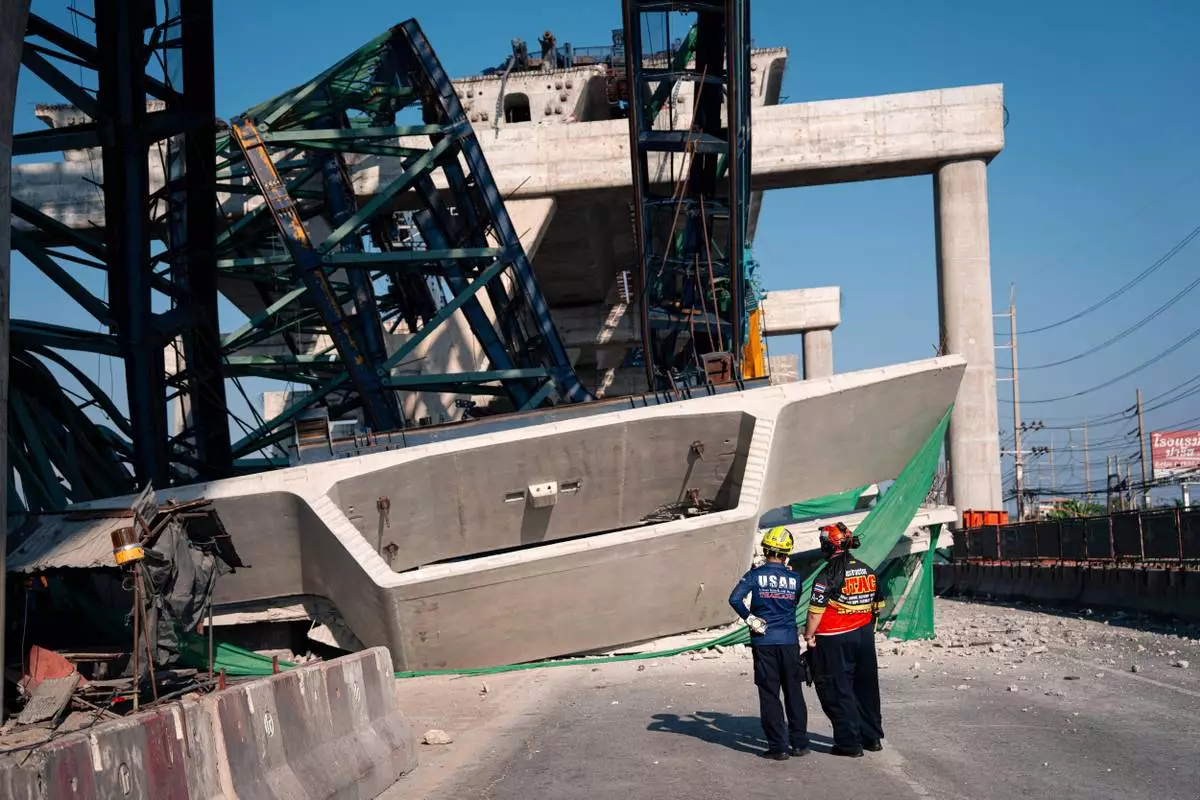
Rescuers look at a construction crane that collapsed on the Rama 2 Road elevated expressway in Samut Sakhon province, Thailand on Thursday, Jan. 15, 2026. (AP Photo/Arnun Chonmahatrakool)

Rescuers look at a construction crane that collapsed on the Rama 2 Road elevated expressway in Samut Sakhon province, Thailand on Thursday, Jan. 15, 2026. (AP Photo/Arnun Chonmahatrakool)
HAVANA (AP) — Tens of thousands of Cubans demonstrated Friday outside the U.S. Embassy in Havana to decry the killing of 32 Cuban officers in Venezuela and demand that the U.S. government release former Venezuelan President Nicolás Maduro.

They crowded into the open-air “José Martí Anti-Imperialist” plaza across from the embassy in a rally organized by the Cuban government as tensions between Cuba and the U.S. spike following the U.S. attack Jan. 3 on Venezuela.

The 32 Cuban officers were part of Maduro’s security detail killed during the raid on his residence in Caracas to seize the former leader and bring him to the U.S. to face drug trafficking charges.

“Humanity is experiencing something very complex, and (the U.S.) is governed by a president who considers himself an emperor,” said René González, 64, one of the protesters.

“We must show him that ideas are worth more than weapons," he said. "This march is a message of our unity. Independence is sacred, and we will defend it tooth and nail if necessary.”

Cuba’s national anthem rang out at Friday’s demonstration as large Cuban flags waved in the chilly wind and big waves broke nearby along Havana’s famed sea wall. Cuban President Miguel Díaz-Canel shook hands with members of the crowd clad in jackets and scarves before speaking to them.

“The current U.S. administration has opened the door to an era of barbarism, plunder and neo-fascism,” he said.

The demonstration was a show of popular strength after U.S. President Donald Trump recently demanded that Cuba make a deal with him before it is “too late.” He did not explain what kind of deal.

Trump also has said that Cuba will no longer live off Venezuela’s oil and money. Experts say the move could have catastrophic consequences since Cuba is already struggling with severe blackouts.

“No one here surrenders," Díaz-Canel said. “The current emperor of the White House and his infamous secretary of state haven’t stopped threatening me.”

Washington has maintained a policy of sanctions against Cuba since the 1960s to pressure the island's government to improve its human rights record, end its one-party communist system and allow democracy. The sanctions have been further tightened during Trump’s presidency, suffocating the island’s economy.

“Cuba does not have to make any political concessions, and that will never be on the table for negotiations aimed at reaching an understanding between Cuba and the United States,” Díaz-Canel said. “It is important that they understand this. We will always be open to dialogue and improving relations between our two countries, but only on equal terms and based on mutual respect.”

After the president's speech, the demonstration transitioned into a parade that Cubans call a “combatant march,” a custom that originated during the time of the late leader Fidel Castro. The crowd was led by a line of people holding pictures of the 32 officers killed.

“Down with imperialism!” the crowd yelled. “Cuba will prevail!"

The demonstration was organized a day after tens of thousands of Cubans gathered at the headquarters of the Ministry of the Armed Forces to pay their respects to the 32 officers slain.

Their remains arrived home on Thursday morning, and they are scheduled to be laid to rest on Friday afternoon in various cemeteries following memorial ceremonies in all of Cuba’s provincial capitals.

Associated Press reporter Dánica Coto in San Juan, Puerto Rico contributed to this report.

Cuban President Miguel Diaz-Canel marches during a rally to protest the killing of Cuban officers during the U.S. operation in Venezuela that captured Venezuelan President Nicolas Maduro in Havana, Cuba, Friday, Jan. 16, 2026. (AP Photo/Ramon Espinosa)

Cuban President Miguel Diaz-Canel marches during a rally to protest the killing of Cuban officers during the U.S. operation in Venezuela that captured Venezuelan President Nicolas Maduro in Havana, Cuba, Friday, Jan. 16, 2026. (AP Photo/Ramon Espinosa)

Cuban President Miguel Diaz-Canel marches during a rally to protest the killing of Cuban officers during the U.S. operation in Venezuela that captured Venezuelan President Nicolas Maduro outside the U.S. Embassy in Havana, Cuba, Friday, Jan. 16, 2026. (AP Photo/Ramon Espinosa)

Cuban President Miguel Diaz-Canel marches during a rally to protest the killing of Cuban officers during the U.S. operation in Venezuela that captured Venezuelan President Nicolas Maduro outside the U.S. Embassy in Havana, Cuba, Friday, Jan. 16, 2026. (AP Photo/Ramon Espinosa)

Cuban President Miguel Diaz-Canel, fourth from right, holds up a Cuban flag during a rally to protest the killing of Cuban officers during the U.S. operation that captured Venezuelan President Nicolas Maduro, outside the U.S. Embassy in Havana, Cuba, Friday, Jan. 16, 2026. (AP Photo/Ramon Espinosa)

Cuban President Miguel Diaz-Canel, fourth from right, holds up a Cuban flag during a rally to protest the killing of Cuban officers during the U.S. operation that captured Venezuelan President Nicolas Maduro, outside the U.S. Embassy in Havana, Cuba, Friday, Jan. 16, 2026. (AP Photo/Ramon Espinosa)

Soldiers march outside the U.S. Embassy during a rally to protest the killing of Cuban officers during the U.S. operation in Venezuela that captured Venezuelan President Nicolas Maduro in Havana, Cuba, Friday, Jan. 16, 2026. (AP Photo/Ramon Espinosa)

Soldiers march outside the U.S. Embassy during a rally to protest the killing of Cuban officers during the U.S. operation in Venezuela that captured Venezuelan President Nicolas Maduro in Havana, Cuba, Friday, Jan. 16, 2026. (AP Photo/Ramon Espinosa)

People carry a Cuban flag during a government-organized rally protesting the killing of Cuban officers in Venezuela while U.S. forces captured Venezuelan President Nicolas Maduro and his wife, in Havana, Cuba, Friday, Jan. 16, 2026. (AP Photo/Ramon Espinosa)

People carry a Cuban flag during a government-organized rally protesting the killing of Cuban officers in Venezuela while U.S. forces captured Venezuelan President Nicolas Maduro and his wife, in Havana, Cuba, Friday, Jan. 16, 2026. (AP Photo/Ramon Espinosa)

Soldiers carry photos of Cuban officers killed during the U.S. operation in Venezuela that captured Venezuelan President Nicolas Maduro, during a rally outside the U.S. Embassy in Havana, Cuba, Friday, Jan. 16, 2026. (AP Photo/Ramon Espinosa)

Soldiers carry photos of Cuban officers killed during the U.S. operation in Venezuela that captured Venezuelan President Nicolas Maduro, during a rally outside the U.S. Embassy in Havana, Cuba, Friday, Jan. 16, 2026. (AP Photo/Ramon Espinosa)

Urns containing the remains of Cuban officers, who were killed during the U.S. operation in Venezuela that captured Venezuelan President Nicolas Maduro, are displayed at the Ministry of the Revolutionary Armed Forces in Havana, Cuba, Thursday, Jan. 15, 2026. (AP Photo/Jorge Luis Banos)

Urns containing the remains of Cuban officers, who were killed during the U.S. operation in Venezuela that captured Venezuelan President Nicolas Maduro, are displayed at the Ministry of the Revolutionary Armed Forces in Havana, Cuba, Thursday, Jan. 15, 2026. (AP Photo/Jorge Luis Banos)

Recommended Articles