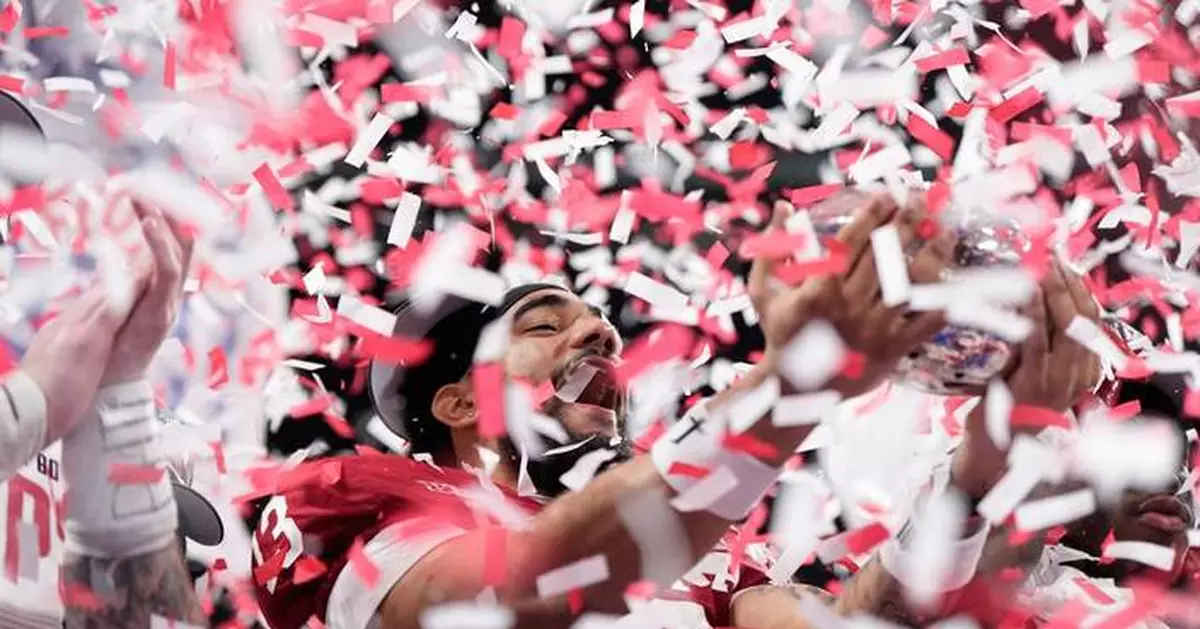
Long before Angelo Pizzo penned the scripts for two of America's most iconic sports movies, he and his father would make the one-block walk from their home to Indiana's football stadium.
The strolls home usually seemed to take a bit longer because even then, in 1955, losses were the norm. Eventually, the man who introduced the world to such motivational flicks as “Hoosiers” and “Rudy” accepted the reality Indiana's program may be permanently stuck in mediocrity — or worse.
Click to Gallery
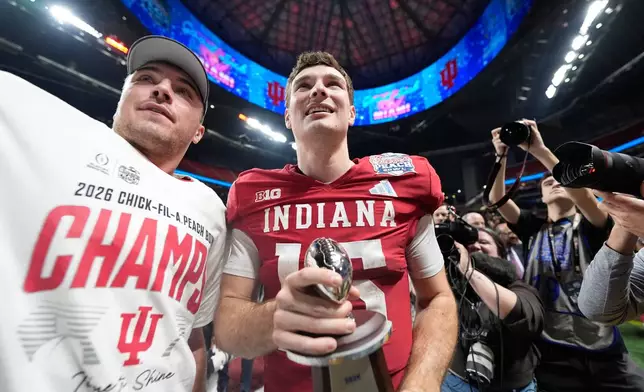
Indiana quarterback Fernando Mendoza (15) celebrates after the Peach Bowl NCAA college football playoff semifinal against Oregon, Friday, Jan. 9, 2026, in Atlanta. (AP Photo/Brynn Anderson)
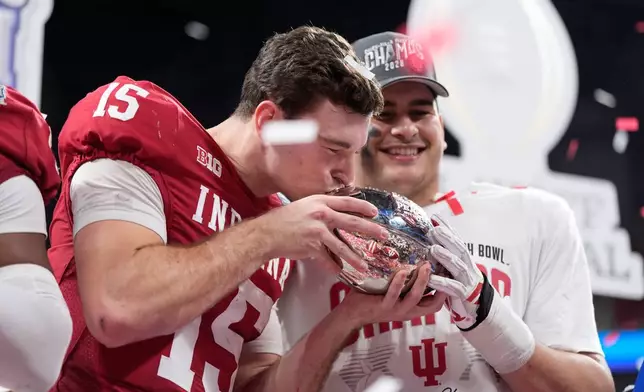
Indiana quarterback Fernando Mendoza (15) kisses the trophy after the Peach Bowl NCAA college football playoff semifinal against Oregon, Friday, Jan. 9, 2026, in Atlanta. (AP Photo/Brynn Anderson)
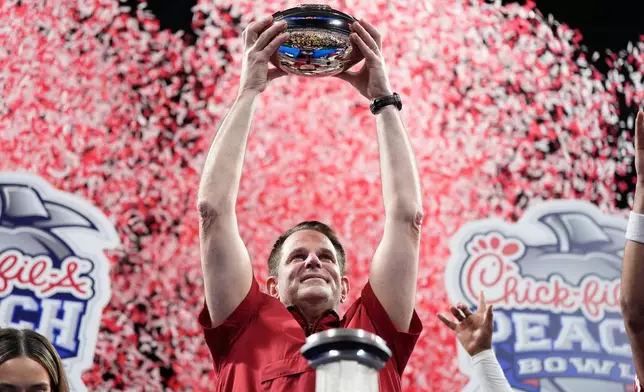
Indiana head coach Curt Cignetti holds up the trophy after the Peach Bowl NCAA college football playoff semifinal against Oregon, Friday, Jan. 9, 2026, in Atlanta. (AP Photo/Brynn Anderson)
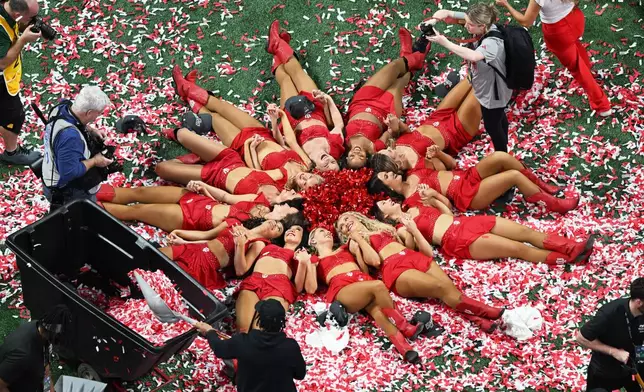
Indiana cheerleaders celebrate after the Peach Bowl NCAA college football playoff semifinal against Oregon, Friday, Jan. 9, 2026, in Atlanta. (AP Photo/Danny Karnik)
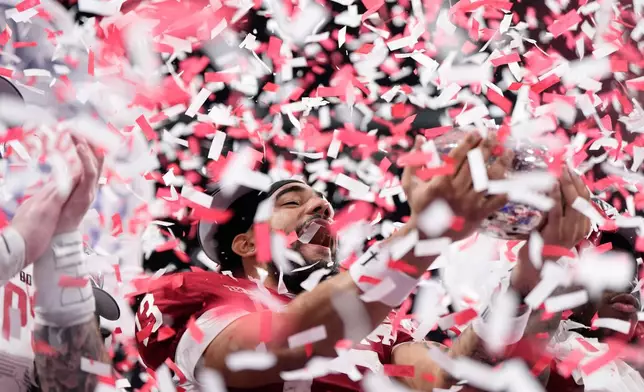
Indiana wide receiver Elijah Sarratt (13) holds up the trophy after the Peach Bowl NCAA college football playoff semifinal against Oregon, Friday, Jan. 9, 2026, in Atlanta. (AP Photo/Brynn Anderson)
Pizzo found himself in good company in these parts.
Seventy-one years later, he — like so many other long-suffering Indiana fans — has a new perspective. Suddenly, the Bloomington native is bursting with excitement, enthusiasm, even a sense of disbelief as the Hoosiers have gone 26-2 over the past two seasons and he's now heading to Miami to watch his beloved alma mater try to pull off a “Hoosiers”-like ending by beating the 10th-ranked Hurricanes on their home field for the program's first national championship.
“One of my first memories, talk about being in my DNA, was we always lost,” Pizzo told The Associated Press this week. “That's kind of like, except for a couple blips along the way — certainly the (1968) Rose Bowl team, I was in school there and the boys Jade Butcher, John Isenbarger, Harry Gonso were all good friends of mine — so that was a great adventure. I thought we'd turned the corner and then it went back down. It returned to what was normal and we went back to losing.”
Curt Cignetti promised to change Indiana's image from the moment he took the job five days after the end of the 2023 season. The no-nonsense 62-year-old coach neither minced words nor wasted them when asked at his first news conference why people should believe he'd end all this losing.
“I win. Google me,” he famously boasted that day.
It was a brash, bold statement from someone tasked with fixing a program that hadn't won a bowl game since 1991, an outright conference title since 1945 and carried the banner of losingest major college team in the country.
Rather than tamp down the expectations, though, Cignetti doubled down at a basketball game.
“Purdue sucks, but so does Ohio State and Michigan,” Cignetti said to roaring cheers.
Pizzo and other fans were understandably skeptical.
For decades, they'd seen hopeful coaches come promising big turnarounds only to depart when they failed to achieve such lofty goals in front of half-filled stadiums.
How bad was it?
When coach John Pont had the Hoosiers fighting for Big Ten crowns in the 1960s, fans enjoyed chanting “Punt, John, Punt.” In 1976, then-coach Lee Corso called timeout in the second quarter to snap a photo of the scoreboard with Indiana leading Ohio State 7-6. They lost 47-7.
In the 1990s and 2000s, some tailgaters never made it inside the stadium, which prompted coaches to rally students to show up. And twice, Indiana took aerial photographs of sellout crowds clad in red — when the Buckeyes came to town.
On the field, it was equally abysmal.
In addition to the 713 all-time losses Cignetti inherited, the Hoosiers also had lost five of its previous six against dreaded rival Purdue and was 9-18 since 1997 against the Boilermakers. Plus, they had only one win over the Wolverines since 1988 and none over the Buckeyes since 1989 — the longest active skid against one team in the Football Bowl Subdivision.
Athletic director Scott Dolson had a different vision for the program, one Cignetti shared.
“I remember even during our first conversation, I said to him, ‘Curt, do you really believe you can win here?’" Dolson told the AP. “He just said, ‘Scott, if I have average resources, I’m 100% sure I will win here. There's no question about it.'”
Perhaps the greatest impediment to success was the perception Indiana wasn't fully invested in football. Salaries for head coaches consistently lagged near the bottom of the Big Ten and each new coach seemed to be fighting to get their assistants paid, too.
The change began when former athletic director Fred Glass started upgrading facilities. But when NIL money and the transfer portal changed the college football world, Indiana didn't adapt quickly and the delay led, in part, to the firing of coach Tom Allen in 2023.
According to the Knight-Newhouse database, Indiana's football budget has increased from $24 million in 2021 to more than $61 million last year.
Allen, who grew up in Indiana and whose father was a longtime high school coach in the state, landed at Penn State as defensive coordinator in 2024 and then took the same job at Clemson last season. Today, he's impressed with the results — and the commitments.
“Just really, really happy for those guys and just really, really happy they've chosen to invest in football,” Allen said in December. "That's something they know they needed to do. They had not done that in the past to the level necessary, and it's been awesome to see them recognize that and invest and be able to be rewarded for that.”
Honestly, though, Indiana didn't have a choice.
Schools need football revenue to make athletic departments function. So empty seats, even at a basketball, can be costly.
But winning has helped Indiana strike gold.
School attendance and admission applications are both up. So are donations, which includes a significant contribution from billionaire Mark Cuban, an alum. In addition to shedding the label of America's losingest team in November, it also surpassed Penn State in October for the nation's largest living alumni base. And over the past two seasons, Memorial Stadium has drawn eight of the largest 10 crowds in school history.
So Dolson isn't about to let Cignetti — or his key staff members — get away if he can help it.
Cignetti has earned contract extensions each of the past two seasons, pushing his average annual salary to $11.6 million, No. 3 in the nation. Bryant Haines and Mike Shanahan also have received contract extensions pushing their salaries to upwards of $3 million per year.
Indiana fans will tell you they're worth every penny. Yet Dolson believes it's not just about cash.
“He didn't come in with demands, like saying ‘Hey, I’d only come here if I get this, that and the other.' We laid out, 'This is what our commitments are, this is what our plan is,'" Dolson said of Cignetti. “One of the misnomers out there is that it's not just a spending contest. It's more of having a comprehensive strategic plan for football and that's what we really put together.”
Sure, Cignetti came to Indiana with a resume and a track record. He also brought most of his previous coaches and about two dozen James Madison players, too.
Why? They believed in the man and his principles.
“Coach Cig just does such a great job of bringing out the best in his players, and obviously his coaches as well,” said All-American linebacker Aiden Fisher, one of the followers from JMU. “But there’s something about coach Cig that just makes you want to play your heart out for him and he does a great job getting the best out of everybody.”
It explains how he's taken self-proclaimed “misfit” recruits on the wildest journey of their lives.
Cignetti seemed to be built for this job.
He grew up learning the craft from his father, Frank Sr., a Hall of Fame coach at the Division II level. He spent more than two decades evaluating and developing players before he joined Nick Saban’s staff at Alabama in 2007, where he served as the recruiting coordinator for Saban's first title team.
Somewhere along the way, though, Cignetti developed his own style — the short, punchy phrases, the quick quips and the unchanging facial expression that have created their own internet memes.
But Dolson was interested in Cignetti for other reasons.
He liked the notion of who Cignetti could bring with him and Dolson detected some similarities between Cignetti and another title-winning coach at Indiana, the late Bob Knight.
“Certainly, different personalities, but similarities in terms of their commitment to their blueprint, their plan, the focus on details and just the mental approach to competitive success,” Dolson said. “I feel like there's an elite approach to that. I definitely see the way coach Cig runs things, the way he coaches, there are a lot of similarities.”
Pizzo's phone started ringing repeatedly almost from the moment Cignetti responded to a post-Rose Bowl game question about Indiana's remarkable ascension.
"It would make a hell of a movie,” he cracked.
Perhaps no filmmaker understands the Cinderella story better than Pizzo, who introduced the world to his home state's 1954 Milan Miracle team and captivated the nation by turning a previously little-known walk-on at Notre Dame into a recognizable star.
But Pizzo has no plans to make “Hoosiers 2.” He thinks the story of Indiana's two-year football run needs to marinate for a decade or two, like his other two box office hits.
Besides, Pizzo has turned into a full-throttle believer, even suggesting the final chapter of this incredible run may not come Monday night.
"Last season was the season of a lifetime, to get into the College Football Playoff. But I thought we had hit our ceiling because we were going up against teams like Ohio State and Notre Dame that had more four- and five-star talent and NFL players than we did,” he said. “I'm not going to even think about Miami. I think we should win, but again, you know, it's just too good to be true.”
Yes, the Hoosiers have exorcised their demons.
They've won two straight against the Boilermakers. They've beaten Michigan and Ohio State. They've won the Big Ten title and the Rose Bowl. They have a Heisman Trophy winner, quarterback Fernando Mendoza.
Now they're one win away from a title nobody saw coming, except perhaps Dolson and Cignetti.
“Everything he said in his interview, everything he articulated in his blueprint is the same as you see today,” Dolson said. “In fact, everything he said during the interview has come true.”
Get poll alerts and updates on the AP Top 25 throughout the season. Sign up here. AP college football: https://apnews.com/hub/ap-top-25-college-football-poll and https://apnews.com/hub/college-football
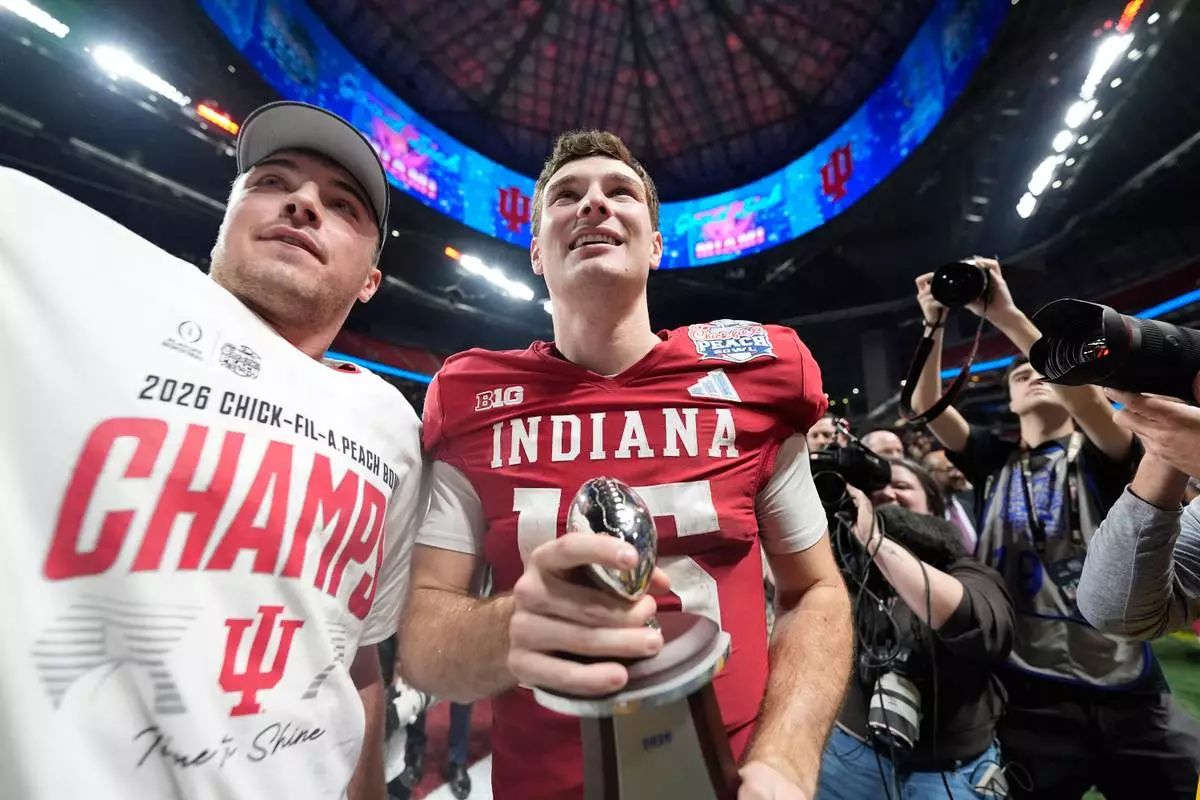
Indiana quarterback Fernando Mendoza (15) celebrates after the Peach Bowl NCAA college football playoff semifinal against Oregon, Friday, Jan. 9, 2026, in Atlanta. (AP Photo/Brynn Anderson)
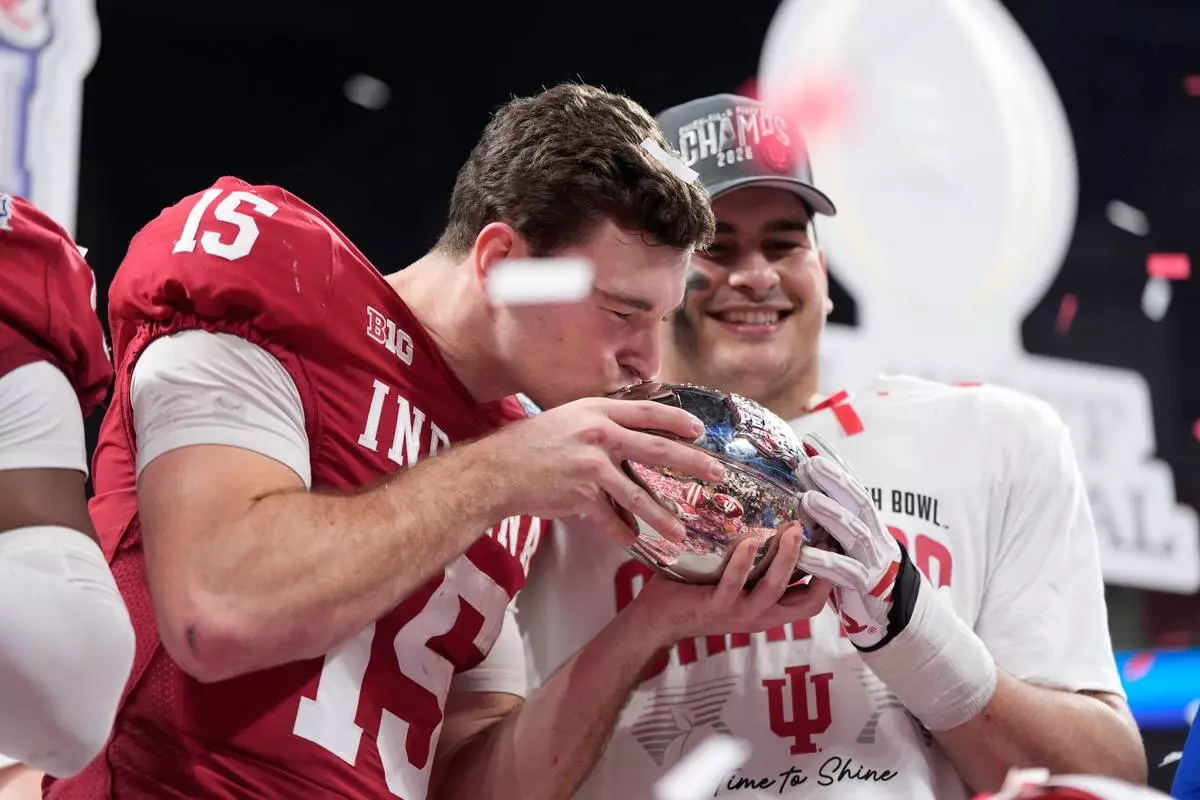
Indiana quarterback Fernando Mendoza (15) kisses the trophy after the Peach Bowl NCAA college football playoff semifinal against Oregon, Friday, Jan. 9, 2026, in Atlanta. (AP Photo/Brynn Anderson)
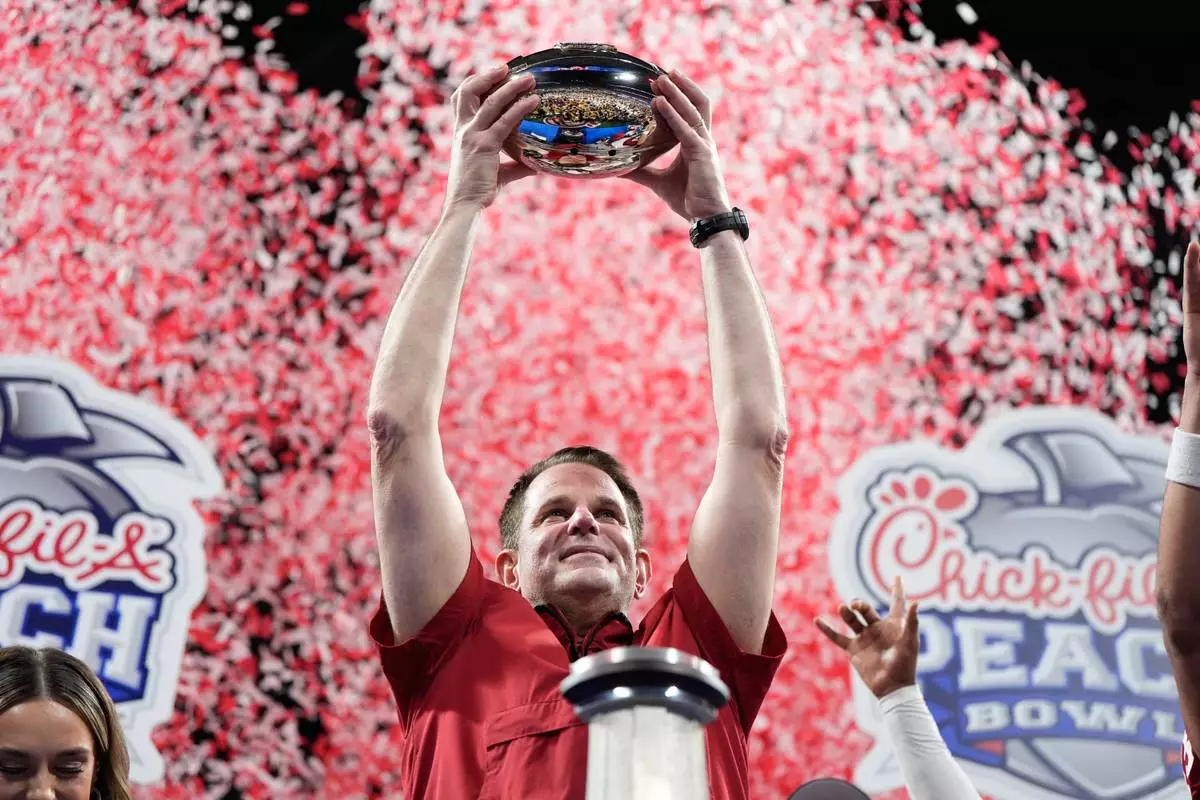
Indiana head coach Curt Cignetti holds up the trophy after the Peach Bowl NCAA college football playoff semifinal against Oregon, Friday, Jan. 9, 2026, in Atlanta. (AP Photo/Brynn Anderson)
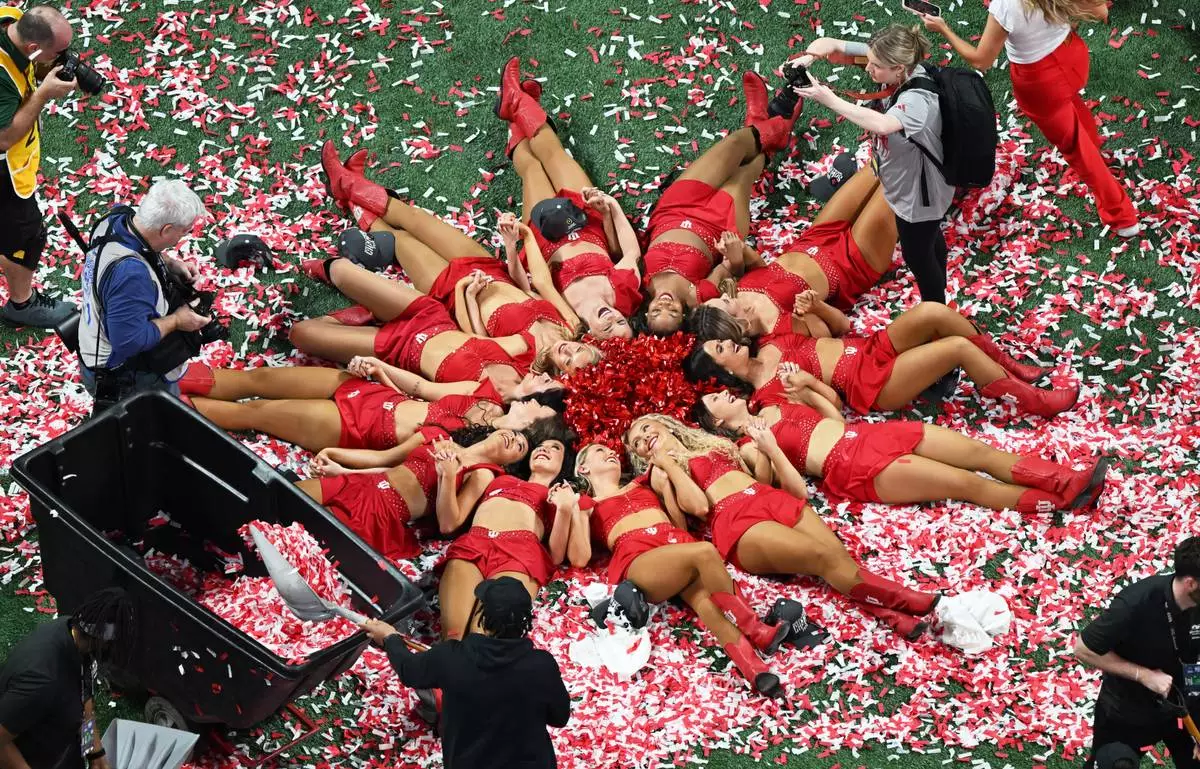
Indiana cheerleaders celebrate after the Peach Bowl NCAA college football playoff semifinal against Oregon, Friday, Jan. 9, 2026, in Atlanta. (AP Photo/Danny Karnik)
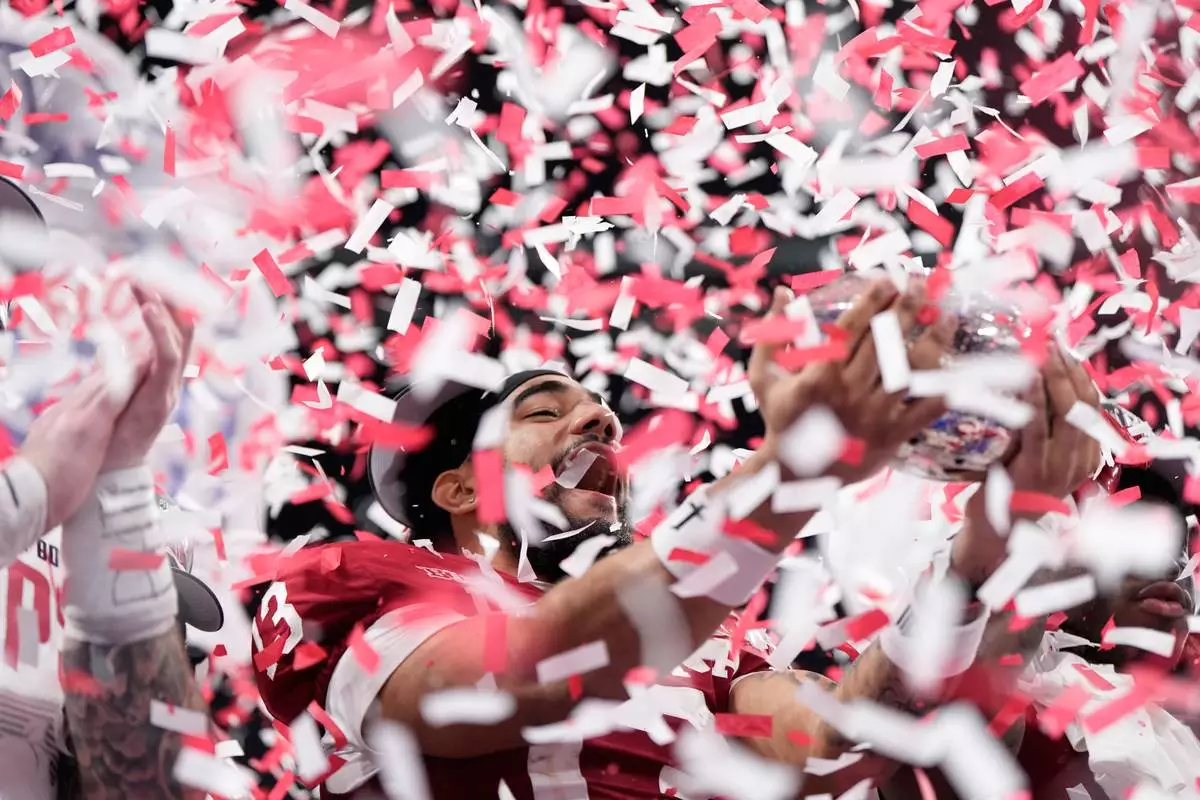
Indiana wide receiver Elijah Sarratt (13) holds up the trophy after the Peach Bowl NCAA college football playoff semifinal against Oregon, Friday, Jan. 9, 2026, in Atlanta. (AP Photo/Brynn Anderson)