LAS VEGAS, Jan. 17, 2026 /PRNewswire/ -- At CES 2026, Flowtica was not the loudest presence on the show floor. Over the course of the week, however, the Singapore-based AI company became one of the most closely watched, drawing sustained attention from media, investors, and industry observers.
That attention has now translated into availability. Following its appearance as a CES 2026 Innovation Award Honoree, Flowtica has officially opened sales of Flowtica Scribe, its AI recording pen that quietly stood out in a field dominated by phone-dependent and screen-heavy solutions.
Flowtica Scribe did not make its first public appearance at CES. The product launched on Kickstarter several months earlier, where it attracted thousands of users and established early validation. CES marked a different stage for the company. The focus shifted away from introduction and toward closer examination, with many observers asking whether the idea could hold up beyond early enthusiasm.
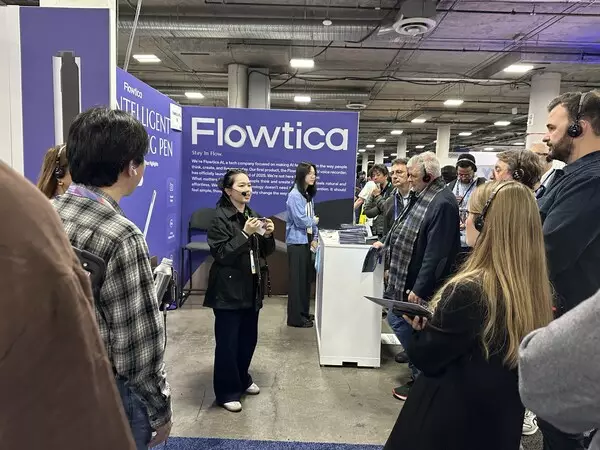
Throughout the exhibition, Flowtica's booth at Eureka Park became a steady meeting point for investors and journalists. Conversations rarely centered on specifications or feature lists. Instead, discussions focused on a more fundamental question: whether AI recording tools are beginning to converge on forms that genuinely fit into professional life.
Flowtica's answer was visible in its choice of form. By embedding AI into a pen, an object already accepted in boardrooms, consultations, investor meetings, and sales conversations, the company avoided many of the social and practical frictions that continue to limit phone-based recorders. The result was a device that felt less like a new category of gadget and more like a natural extension of existing behavior.
This restraint is deliberate. Flowtica Scribe is designed to remain unobtrusive, with no screen and no demand for user attention during conversations. Recording, organization, and interpretation take place quietly in the background, allowing users to remain focused on the discussion itself. Among on-site observers, this approach positioned Flowtica as one of the more pragmatic entrants in an increasingly crowded AI recording market.
Hardware, however, represents only part of Flowtica's differentiation. The company places equal emphasis on what happens after recording ends. Its AI functions as a continuously evolving insight system that can operate autonomously while remaining responsive to clear user guidance when needed. Over time, it adapts to individual working rhythms and priorities, shifting the emphasis from capturing everything to identifying what truly matters.
Rather than simply storing conversations, Flowtica helps determine which moments should be retained, revisited, and translated into next actions. Key insights are designed to integrate naturally with existing productivity tools, including calendars and task systems, allowing them to fit into established workflows rather than compete with them.
As interest in Flowtica Scribe built during CES, one question surfaced repeatedly. When would the product be available beyond the show floor?
With sales now officially open through Flowtica's website, the company moves from exhibition attention to real-world deployment. For Flowtica, this moment appears less like a conclusion and more like a transition, from being observed to being used.
As the AI recording market continues to mature, competition is shifting away from novelty and early adoption toward durability. The defining question is no longer whether a system can record conversations, but whether it can remain useful over time.
Flowtica enters this next phase with an approach that is measured and quietly confident, placing its bet not on spectacle, but on long-term relevance.
** The press release content is from PR Newswire. Bastille Post is not involved in its creation. **
The AI Recording Pen That Turned Heads at CES Is Finally for Sale
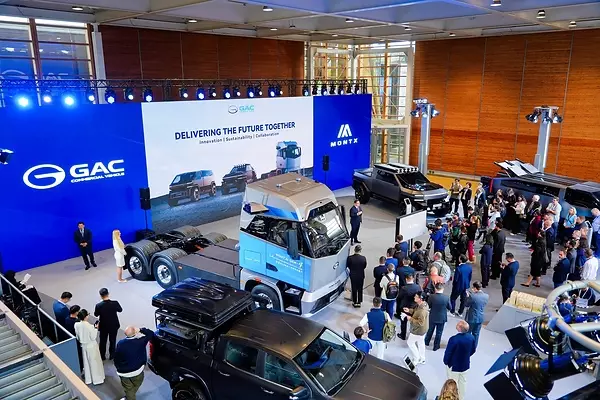
HANNOVER, Germany, Sept. 15, 2026 /PRNewswire/ -- GAC Commercial Vehicle debuted at IAA TRANSPORTATION 2026 under the theme "Delivering the Future Together", showcasing products, technologies and open-ecosystem achievements across its new-energy heavy and light commercial vehicle businesses.
GAC Commercial Vehicle partners with Pony.ai and Aulton to showcase L4 autonomous driving and efficient battery-swapping solutions based on GAC's T9 truck. The company's new light commercial vehicle brand MONTX made its overseas debut with its P10 and V10 concept vehicles, All-Domain Adaptive Architecture (ADAA) and MONTX Makers, its global user product co-creation initiative. The production SMILODON Pro pickup was also displayed.
"Our debut at IAA TRANSPORTATION, one of the world's most important stages for the commercial vehicle industry, is a key milestone in GAC Commercial Vehicle's globalization journey. Taking products global is only the starting point; taking our ecosystem global represents a new stage of value co-creation. Leveraging GAC Group's global resources and working with partners worldwide, we will bring both our vehicle technologies and collaborative ecosystem to global markets, jointly advancing the new-energy commercial vehicle industry toward a more efficient, intelligent and sustainable future," said Jimmy Du, COO of GAC Commercial Vehicle.
Building on Strength to Accelerate Global Expansion
Building on the mature systems developed through the long-standing GAC Hino joint venture, GAC Commercial Vehicle has nearly two decades of commercial vehicle expertise in R&D, manufacturing and quality management and benefits from the Group's supply chain and global resources.
GAC Commercial Vehicle's sales soared 205% year-on-year in the first half of 2026. It is accelerating its global expansion by taking both its products and ecosystem global, building on its domestic new-energy business and leveraging the GAC Group's sales and service network across 110 countries and regions.
Advancing Through Intelligence to Create Operational Value
GAC's heavy commercial vehicle business focuses on new-energy heavy-duty trucks. The T9 Robotruck combines Pony.ai's 4th Generation Autonomous Driving Technology with GAC's fully redundant drive-by-wire chassis. Its automotive-grade suite includes nine LiDARs, three radars and 13 cameras. Compared with the previous generation, hardware costs are 70% lower and autonomous-driving transportation cost per ton-kilometer is approximately 30% lower, improving efficiency in long-haul, dedicated-route and port transportation.
The T9 Battery Swap EV Tractor combines an electric drive axle with a 603 kWh lithium iron phosphate battery, delivering up to 475 km of range with combined energy consumption as low as 1.2 kWh/km. Aulton's system enables a full-vehicle battery swap in approximately three to five minutes, reducing downtime and improving vehicle utilization. Charging and battery swapping are complementary solutions for different scenarios, with swapping particularly valuable for fixed-route, high-frequency operations.
Together, GAC Commercial Vehicle, Pony.ai and Aulton have integrated vehicle + autonomous driving + energy capabilities to shorten technology deployment cycles and accelerate scaled application in real-world operations.
MONTX Opens New Growth Opportunities in Light Commercial Vehicles
MONTX expands GAC Commercial Vehicle into new light commercial vehicle categories, exploring new scenarios and user needs for global users. Its P10 and V10 concept vehicles embody All-Domain Aesthetics, All-Domain Adaptability and All-Domain Intelligence.
The MONTX P10 is positioned as the All-Domain Integrated Mobility Platform. It targets explorers and outdoor professionals and is tailor-made for extreme environments. Four distributed drive motors, AI Camp Mode and Intelligent Trailering Assist enhance adaptability across complex terrain for remote exploration, field research and off-road expeditions.
The MONTX V10, positioned as The All-Domain Mobile Station, addresses the needs of digital nomads, creators and travelers. Its modular interior, Dual-Drive Smart Cabin and off-grid self-sustaining capabilities enable seamless transitions between work, rest, socializing and exploration, extending the vehicle into a platform for mobile work and living.
MONTX also unveiled its All-Domain Adaptive Architecture (ADAA). Built with a Multi-Energy by Design, Body-on-Frame by Design and Adaptive Intelligence by Design philosophy, ADAA enables one architecture to accommodate multiple energy types, vehicle forms and applications, improving development efficiency and adaptability across diverse global markets.
MONTX also launched MONTX Makers, its global user co-creation initiative, under "Ideas In. Drive Out." The program lets users help define future products by incorporating their needs early on in its product design and development process. MONTX Makers may receive MONTX Pioneer Co-Creator recognition, opportunities to attend global brand events and exclusive owner benefits.
The SMILODON Pro production model complements the MONTX concept cars, offering cargo capacity, ride comfort and multi-scenario adaptability for business and everyday life. Already available in Central and South America and the Middle East, it is planned to be available in around 30 countries by the end of 2026.
Delivering the Future Together
GAC Commercial Vehicle will continue strengthening its products through vehicle R&D and manufacturing while connecting global users and partners through its open ecosystem to create greater value and advance its international growth.
Official Website: https://www.gaccv.com/
** This press release is distributed by PR Newswire through automated distribution system, for which the client assumes full responsibility. **
GAC Commercial Vehicle Accelerates Global Expansion with IAA TRANSPORTATION 2026 Debut