As the first nuclear power unit launched during China's 15th Five-Year Plan period (2026-2030) for national socioeconomic development, construction of the Xuwei Nuclear Power Plant started in Lianyungang City, east China's Jiangsu Province on Friday.
It stands as the world's first project integrating the Hualong One pressurized water reactor with a high-temperature gas-cooled reactor.
This facility not only generates electricity but also supplies high-quality steam.
The main construction phase began on Friday, with the first major task being the concrete pouring for No.1 nuclear power unit.
Construction of the project is planned in two phases, with the current construction being Phase I which involves building two Hualong One units and one high-temperature gas-cooled reactor unit.
The project will see the installation of two Hualong One units which employ China's fully independently developed third-generation nuclear power technology and one high-temperature gas-cooled reactor which uses the fourth-generation nuclear power technology.
Once the project is put into operation, seawater will undergo desalination before being heated by the Hualong One units to produce medium-pressure saturated steam with the temperature exceeding 270 degrees Celsius.
The steam is then reheated using heat from the high-temperature gas-cooled reactor, raising its temperature to beyond 460 degrees Celsius.
This high-quality industrial steam will be supplied to chemical enterprises in Xuwei New District of Lianyungan.
Upon the entry into operation of Phase I, the project will annually supply 32.5 million tonnes of industrial steam and generate over 11.5 billion kilowatt-hours of electricity.
This will reduce annual standard coal consumption by 7.26 million tonnes and cut carbon dioxide emissions by 19.6 million tonnes.
It will not only support low-carbon development in Lianyungang's petrochemical base but also advance China's nuclear energy transition from power generation to diversified supply.
Phase I is projected to start operation in 2032.
The Hualong One is a Chinese Generation III pressurized water nuclear reactor developed by the China General Nuclear Power Group (CGN) and the China National Nuclear Corporation (CNNC).
It has obtained European Utility Requirements certification and passed the UK Generic Design Assessment. Each unit generates over 10 billion kilowatt-hours annually -- enough to power one million people in a moderately developed country -- while reducing carbon dioxide emissions by 8.16 million tonnes.
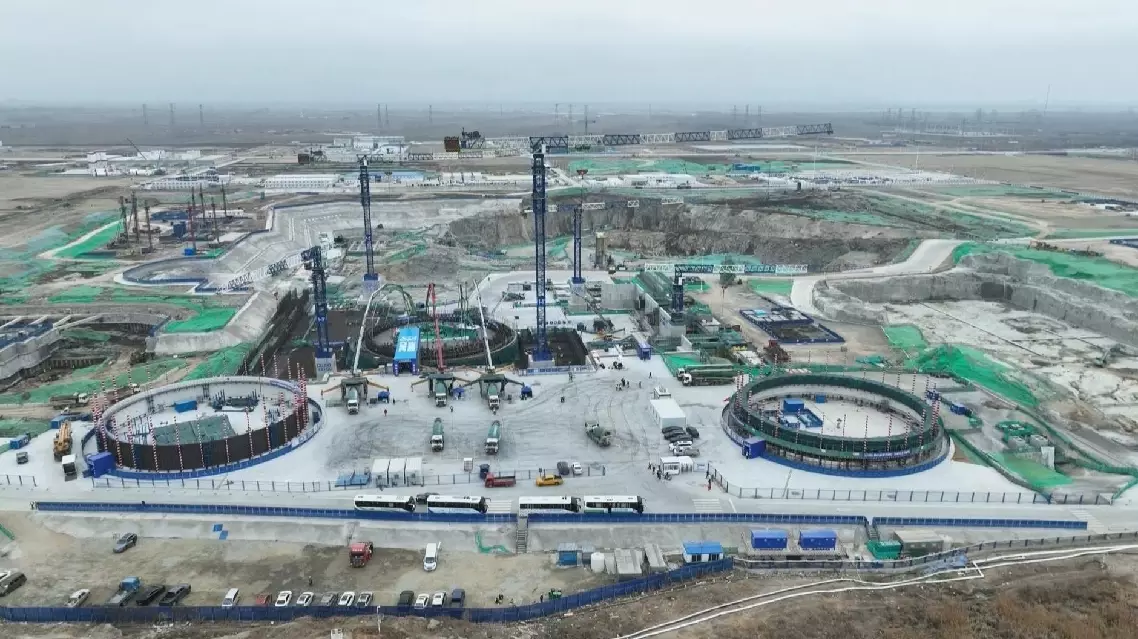
Construction of new nuclear power plant starts in east China
China's first 500-kV cross-border alternating-current power interconnection project entered service Monday, creating the highest voltage grid tie between the two countries and advancing Belt and Road energy cooperation.
The project raises two-way power transfer capacity between the two countries from 50,000 kW to 1.5 million kW, enabling the annual transmission of about 3 billion kWh of clean electricity, roughly 30 times the capacity of previous lines, according to China Southern Power Grid.
As the largest cross-border grid project and the highest-voltage power link between China and Laos, it connects southwest China's Yunnan Province with Oudomxay and Luang Namtha provinces in northern Laos.
Cross-border electricity trading began as the project entered operation. About 4.81 million kWh of power from clean energy bases in northern Laos was transmitted to Yunnan through the new line, marking a more regular and institutionalized phase of power connectivity between the two countries.
It is also the first time an overseas new energy project has participated in China's electricity market, the company said. The power involved in the transaction came from a large mountain photovoltaic project in Laos, one of the core supporting power sources for the interconnection line.
"This project is the cross-border power grid project with the highest voltage level between China and Laos. Leveraging the China-Laos power grid interconnection and the power markets in southern China, surplus hydropower from Laos can be transmitted to China during the rainy season, while China can supply supplemental power to northern Laos during the dry season. This project represents yet another landmark achievement between China and Laos in deepening power cooperation and jointly advancing the high-quality development of the Belt and Road Initiative," said Li Jingru, general manager of Electricite du Laos Transmission Company Limited (EDL-T), a joint venture of China Southern Power Grid and Lao state-run Electricite du Laos.
The solar project has an average annual power generation capacity of about 1.65 billion kWh. In 2026, it is expected to transmit about 1.1 billion kWh of solar power across the border, supporting energy complementarity between the two countries.
"In the future, efforts will be made to further promote normalized cross-border electricity trading, meet the trading needs such as electricity transmission from Laos to China's Yunnan, from China's Yunnan to Laos, and from Laos to China's Guangdong, and facilitate the optimal allocation of energy resources in the Lancang-Mekong region," said Li Minhong, marketing director of China Southern Power Grid.
Construction of the interconnection project began in late February last year. Spanning a total length of 177.5 km, the transmission line includes a 145-km Chinese section and a 32.5-km Lao section.
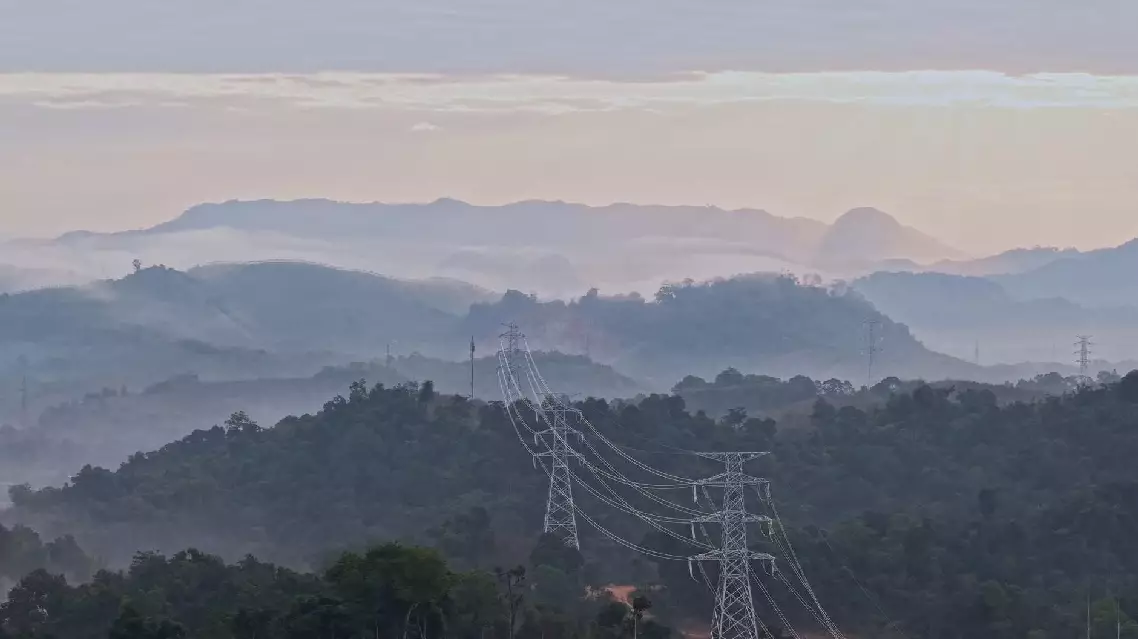
New China-Laos power link expands transfer capacity 30-fold, boosts electricity trading