RIYADH, Saudi Arabia (AP) — Yemeni politicians met Sunday in Saudi Arabia’s capital in their first public gathering since a southern separatist group backed by the United Arab Emirates was disbanded following weeks of clashes.
The meeting in Riyadh discussed the future of southern Yemen ahead of a Saudi-sponsored conference, the dates of which haven't been announced yet.
The separatist demands in southern Yemen are one element in a complex civil war that has gripped the county since 2014, when Houthi rebels backed by Iran descended from their northern stronghold and seized the capital, Sanaa, forcing the internationally recognized government to flee first southward, then into exile in Saudi Arabia. The war involves a complex interplay of sectarian and tribal grievances and the involvement of regional powers.
“This meeting expresses a unified southern will, represented by southern leaders from all segments of society and governorates, seeking a just, secure and guaranteed solution to our cause,” the politicians said in a statement following their meeting.
Saudi Arabia had bombed the positions of the now-dissolved Southern Transitional Council after the separatist group refused to withdraw from areas it seized in its December offensive, including Hadramout on the border with Saudi Arabia. Government forces, backed by Saudi Arabia, have regained control of Hadramout and Mahra provinces.
The escalation exposed cracks within a Saudi-led coalition fighting against the Iranian-backed Houthis in Yemen’s civil war. Ties also frayed between Saudi Arabia and the UAE.
Aidarous al-Zubaidi, who led the STC, had reportedly declined to attend the talks in Riyadh and instead sent a delegation. Saudi Arabia has accused the UAE of smuggling him to Abu Dhabi through Somalia, after the Saudi-backed Presidential Leadership Council expelled him and charged him with treason.
Sunday’s meeting included members of the STC leadership who have been in Riyadh for about two weeks. Their participation was apparently meant to refute claims by al-Zubaidi supporters that the delegation was kidnapped in Saudi Arabia.
“There is no doubt that today’s moment is historic, and we are at a juncture that requires everyone’s cooperation,” said Abdel-Rauf al-Saqaf, who was a senior STC official. “The southern demand is clear: the restoration of the southern state.”
The STC was established in April 2017 as an umbrella organization for groups that seek to restore South Yemen as an independent state as it was between 1967 and 1990. It gained financial and military support from the UAE. The STC leadership dissolved the council earlier this month.
A statement from Sunday’s meeting said the participants received “direct and practical assurances” from Saudi officials that members of forces allied with the STC will receive their salaries and “support to enhance their capabilities.”
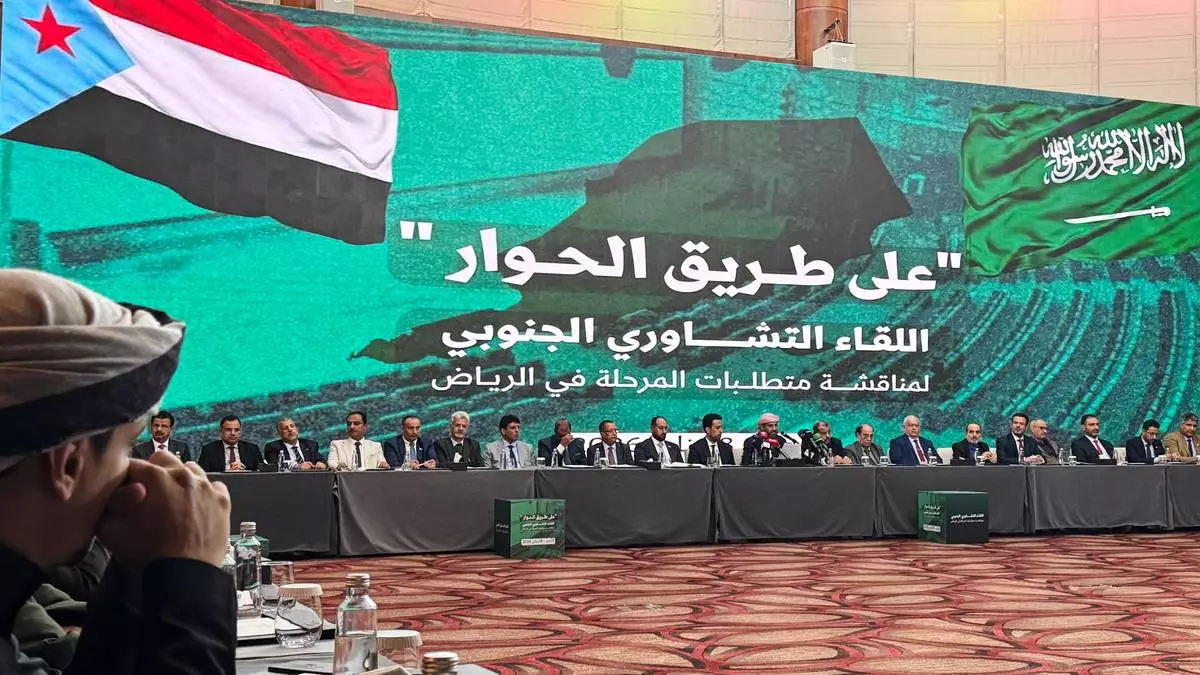
Yemeni politicians from the Southern Transitional Council attend a meeting on the future of southern Yemen in Riyadh, Saudi Arabia, Sunday, Jan. 18, 2026. (AP Photo/Baraa Anwer)
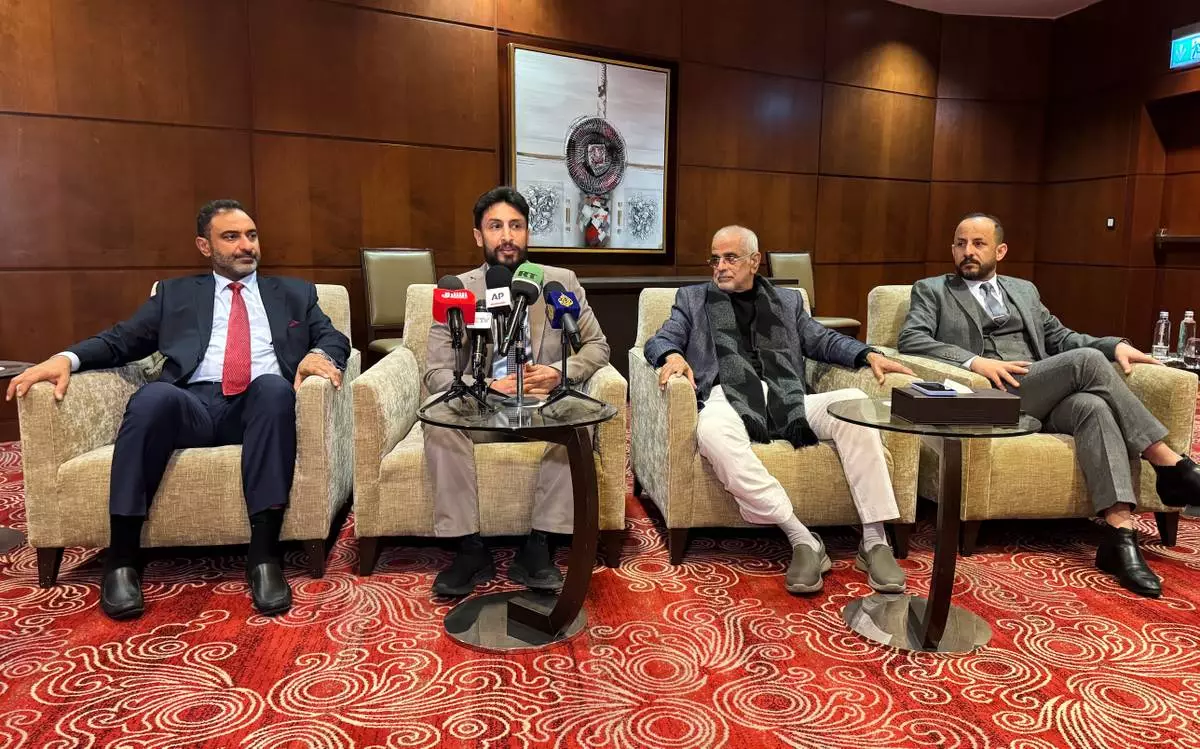
From left, Abdulaziz Aljifri, Alkhudor Suliman, Hussain Laqwer, and Ahmed Tuhaif of Yemen's Southern Transitional Council speak during a press briefing in Riyadh, Saudi Arabia, Sunday, Jan. 18, 2026. (AP Photo/Baraa Anwer)
BERLIN (AP) — The eight European countries targeted by U.S. President Donald Trump for a 10% tariff for opposing American control of Greenland blasted the move Sunday, warning that his threats “undermine transatlantic relations and risk a dangerous downward spiral.”
The joint statement by some of America’s closest allies signaled a possible turning point in the recent tensions over sovereignty and security nearly 24 hours after Trump’s threat.
It was also the most forceful rebuke of Trump from the European allies since he returned to the White House almost a year ago. In recent months, Europeans have mostly opted for diplomacy and flattery around him, even when seeking an end to the war in Ukraine. Sunday’s statement, as well as some European countries sending troops to Greenland for a Danish military training exercise, appeared to be a step away from that strategy.
The unusually strong joint statement from Denmark, Norway, Sweden, France, Germany, the United Kingdom, the Netherlands and Finland said troops sent to Greenland for operation “Arctic Endurance” pose “no threat to anyone.”
Trump's Saturday announcement sets up a potentially dangerous test of U.S. partnerships in Europe. He appeared to indicate that he was using the tariffs as leverage to force talks over the status of Greenland, a semiautonomous territory of NATO ally Denmark that he regards as critical to U.S. national security.
“We stand in full solidarity with the Kingdom of Denmark and the people of Greenland," the group said. “Building on the process begun last week, we stand ready to engage in a dialogue based on the principles of sovereignty and territorial integrity that we stand firmly behind. Tariff threats undermine transatlantic relations and risk a dangerous downward spiral.”
There are immediate questions about how the White House could try to implement the tariffs because the European Union is a single economic zone in terms of trading. It was unclear, too, how Trump could act under U.S. law, though he could cite emergency economic powers that are currently subject to a U.S. Supreme Court challenge.
EU foreign policy chief Kaja Kallas said China and Russia will benefit from divisions between the U.S. and Europe. She added in a post on social media: “If Greenland’s security is at risk, we can address this inside NATO. Tariffs risk making Europe and the United States poorer and undermine our shared prosperity."
Europe has been trying to keep Trump on its side to ensure American support for Ukraine, including Washington sharing intelligence with Kyiv and its involvement in security guarantees if a peace agreement is reached with Russia.
French President Emmanuel Macron wrote on social media that “no intimidation or threats will influence us, whether in Ukraine, Greenland or anywhere else in the world when we are faced with such situations.” He added that “tariff threats are unacceptable and have no place in this context.”
Trump's move was also panned domestically.
U.S. Sen. Mark Kelly, a former U.S. Navy pilot and Arizona Democrat, said Trump’s threatened tariffs on U.S. allies would make Americans “pay more to try to get territory we don’t need.”
“Troops from European countries are arriving in Greenland to defend the territory from us. Let that sink in,” Kelly wrote on social media. “The damage this President is doing to our reputation and our relationships is growing, making us less safe. If something doesn’t change we will be on our own with adversaries and enemies in every direction.”
Six of the countries targeted are part of the 27-member EU, which operates as a single economic zone in terms of trading. It was not immediately clear if Trump's tariffs would impact the entire bloc. EU envoys scheduled emergency talks Sunday evening to determine a potential response.
The tariff announcement also drew blowback from Trump's populist allies in Europe.
Italy’s right-wing premier, Giorgia Meloni, considered one of Trump’s closest allies on the continent, said she had spoken to him about the tariffs, which she described as “a mistake.”
The deployment to Greenland of small numbers of troops by some European countries was misunderstood by Washington, Meloni said, adding it was not a move against the U.S. but aimed to provide security against “other actors” that she didn’t identify.
Jordan Bardella, president of Marine Le Pen’s far-right National Rally party in France and a European Parliament lawmaker, posted that the EU should suspend last year’s tariff deal with the U.S., describing Trump’s threats as “commercial blackmail.”
Trump also achieved the rare feat of uniting Britain’s main political parties — including the hard-right Reform UK party — all of whom criticized the tariff threat.
“We don’t always agree with the U.S. government and in this case we certainly don’t. These tariffs will hurt us,” said Reform UK leader Nigel Farage, a longtime champion and ally of Trump. His social media post stopped short of criticizing Trump's designs on Greenland.
Meanwhile, U.K. Prime Minister Keir Starmer, who leads the center-left Labour Party, said the tariffs announcement was “completely wrong” and his government would “be pursuing this directly with the U.S. administration.”
The foreign ministers of Denmark and Norway are also expected to address the crisis Sunday in Oslo during a news conference.
__
Lawless is in London and Burrows is in Nuuk, Greenland. John Leicester in Paris, Lorne Cook in Brussels, Barry Hatton in Lisbon, Portugal, Aamer Madhani in Washington and Josh Boak in West Palm Beach, Florida, contributed.
A woman pulls her children on a sled during a protest against Trump's policy towards Greenland in front of the US consulate in Nuuk, Greenland, Saturday, Jan. 17, 2026. (AP Photo/Evgeniy Maloletka)
A crowd walks to the US consulate to protest against Trump's policy towards Greenland in Nuuk, Greenland, Saturday, Jan. 17, 2026. (AP Photo/Evgeniy Maloletka)
A boy holds a crossed out map of Greenland topped by a hairpiece symbolizing U.S. President Donald Trump, during a protest against Trump's policy towards Greenland in front of the US consulate in Nuuk, Greenland, Saturday, Jan. 17, 2026. (AP Photo/Evgeniy Maloletka)
People protest against Trump's policy towards Greenland in front of the US consulate in Nuuk, Greenland, Saturday, Jan. 17, 2026. (AP Photo/Evgeniy Maloletka)