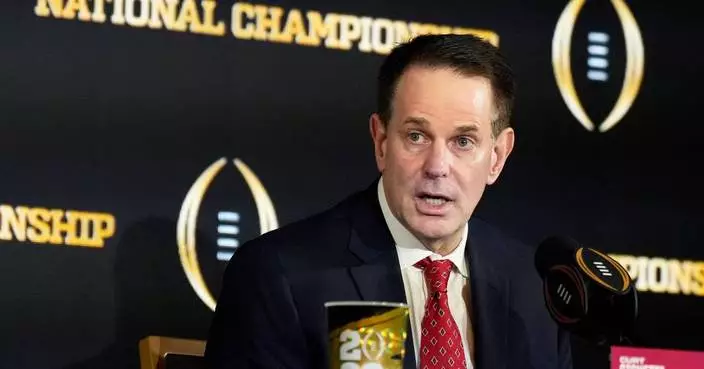
MIAMI BEACH, Fla. (AP) — College football leaders gave every indication Sunday that they remain stuck in a yearlong debate about expanding the playoff from 12 teams to 16 or beyond.
Commissioners and school presidents met on the eve of the College Football Playoff title game, facing a Friday deadline from ESPN — the $7.8 billion bankroller of the postseason — to decide on changing or staying at the current 12-team model.
The debate boils down to two conferences, the Big Ten and SEC, that both want to expand but have widely different visions of how far expansion should go.
“I think that's up to two people,” American Conference Commissioner Tim Pernetti said.
He was speaking of Tony Petitti of the Big Ten and Greg Sankey of the SEC, who did not reach any agreement during the last scheduled meeting before Friday's deadline.
“Still more work to do,” Pettiti said as he quickly made his way toward an escalator at the Miami Beach hotel where the meeting was held. “One-hundred percent, we're still working.”
The Miami-Indiana final Monday night will mark the end of the current contract, and a six-year deal worth $1.3 billion a year kicks in next season. Its revenue-distribution model doles out more to the SEC and Big Ten than the Atlantic Coast and Big 12, among the power conferences. Just as importantly, it leaves the two biggest leagues squarely in charge of what comes next.
The SEC is pushing for an expansion to 16 teams, with an emphasis on at-large bids — a format favored by the other Power Four leagues and most of the smaller conferences that are hoping for access into whatever comes next.
The Big Ten has pushed for a bracket of up to 24 teams with multiple automatic qualifiers from each conference. It could do away with the need for conference title games and replace them with seeding games to determine, say, two or three of the automatic spots.
“It's a system that would keep a lot of teams in it, put some more value into the regular season,” Indiana athletic director Scott Dolson said in an interview Saturday. “This is really about quality people coming together" to make a decision.
If the commissioners can't agree on a new number, the tournament would automatically stay at 12, with a deadline of Dec. 1, 2026, to make any changes for the following season.
The only real news coming out of the weekend was a social media post from President Donald Trump saying he would sign an executive order to give an exclusive four-hour window to the Army-Navy game, which takes place the second Saturday in December — a date currently wedged between conference title games and the start of the playoff.
A move to 16 or more games could put the playoff in conflict with the annual meeting between service acadamies.
“This national event stands above Commercial Postseason Games,” said Trump, who will attend Monday night's final.
Mississippi State president Mark Keenum, the chair of the CFP board of managers, tried to strike a tone of calm, not commiting to the idea that any chance for compromise is dead.
“This was not a deadline day of any kind, so they're still talking, and we anticipate the discussions will continue,” Keenum said.
Get poll alerts and updates on the AP Top 25 throughout the season. Sign up here and here (AP News mobile app). AP college football: https://apnews.com/hub/ap-top-25-college-football-poll and https://apnews.com/hub/college-football

FILE - The College Football Playoff National Championship Trophy is shown before the Cotton Bowl College Football Playoff semifinal game between Texas and Ohio State, Friday, Jan. 10, 2025, in Arlington, Texas. (AP Photo/Gareth Patterson, File)
DUBAI, United Arab Emirates (AP) — A U.S.-based activist agency said Sunday it has verified at least 3,919 deaths during a wave of protests that swept Iran and led to a bloody crackdown, and fears the number could be significantly higher.
The Human Rights Activists News Agency posted the revised figure, up from the previous toll of 3,308. The death toll exceeds that of any other round of protest or unrest in Iran in decades, and recalls the chaos surrounding the 1979 revolution.
The agency has been accurate throughout the years of demonstrations in Iran, relying on a network of activists inside the country that confirms all reported fatalities. The Associated Press has been unable to independently confirm the toll.
Iranian officials have not given a clear death toll, although on Saturday, the country’s Supreme Leader Ayatollah Ali Khamenei said the protests had left “several thousand” people dead — and blamed the United States for the deaths. It was the first indication from an Iranian leader of the extent of the casualties from the wave of protests that began Dec. 28 over Iran’s ailing economy.
The Human Rights Activists News Agency says 24,669 protesters have been arrested in the crackdown.
Iranian officials have repeatedly accused the United States and Israel of fomenting unrest in the country.
Tension with the United States has been high, with U.S. President Donald Trump repeatedly threatening Tehran with military action if his administration found the Islamic Republic was using deadly force against anti-government protesters.
Iranian President Masoud Pezeshkian, in a post Sunday on X, blamed “longstanding enmity and inhumane sanctions” imposed by the U.S. and its allies for any hardships the Iranian people might be facing. “Any aggression against the Supreme Leader of our country is tantamount to all-out war against the Iranian nation,” he wrote.
During the protests, Trump had told demonstrators that “ help is on the way ” and that his administration would “act accordingly” if the killing of demonstrators continued or if Iranian authorities executed detained protesters.
But he later struck a conciliatory tone, saying that Iranian officials had “canceled the hanging of over 800 people” and that “I greatly respect the fact that they canceled.”
A family member of detained Iranian protester Erfan Soltani said Sunday that the 26-year-old is in good physical health and was able to see his family days after his planned execution was postponed.
Somayeh, a 45-year-old close relative of Soltani who is living abroad, told AP that his family had been told his execution would be set for Wednesday but it was postponed when they reached the prison in Karaj, a city northwest of Tehran.
“I ask everyone to help in securing Erfan’s freedom,” Somayeh, who asked to be identified by first name only for fear of government reprisal, said in a video message.
On Saturday, Khamenei branded Trump a “criminal” for supporting the rallies and blamed the U.S. for the casualties, describing the protesters as “foot soldiers” of the United States.
Trump, in an interview with Politico on Saturday, called for an end to Khamenei’s nearly 40-year reign, calling him as “a sick man who should run his country properly and stop killing people.”
No protests have been reported for days in Iran, where the streets have returned to an uneasy calm. Instead, some Iranians chanted anti-Khamenei slogans from the windows of their homes on Saturday night, the chants reverberating around neighborhoods in Tehran, Shiraz and Isfahan, witnesses said.
Authorities have also blocked access to the internet since Jan. 8. On Saturday, very limited internet services functioned again briefly. Access to some online services such as Google began working again on Sunday, although users said they could access only domestic websites, and email services continued to be blocked.
Associated Press writer Farnoush Amiri in New York contributed.
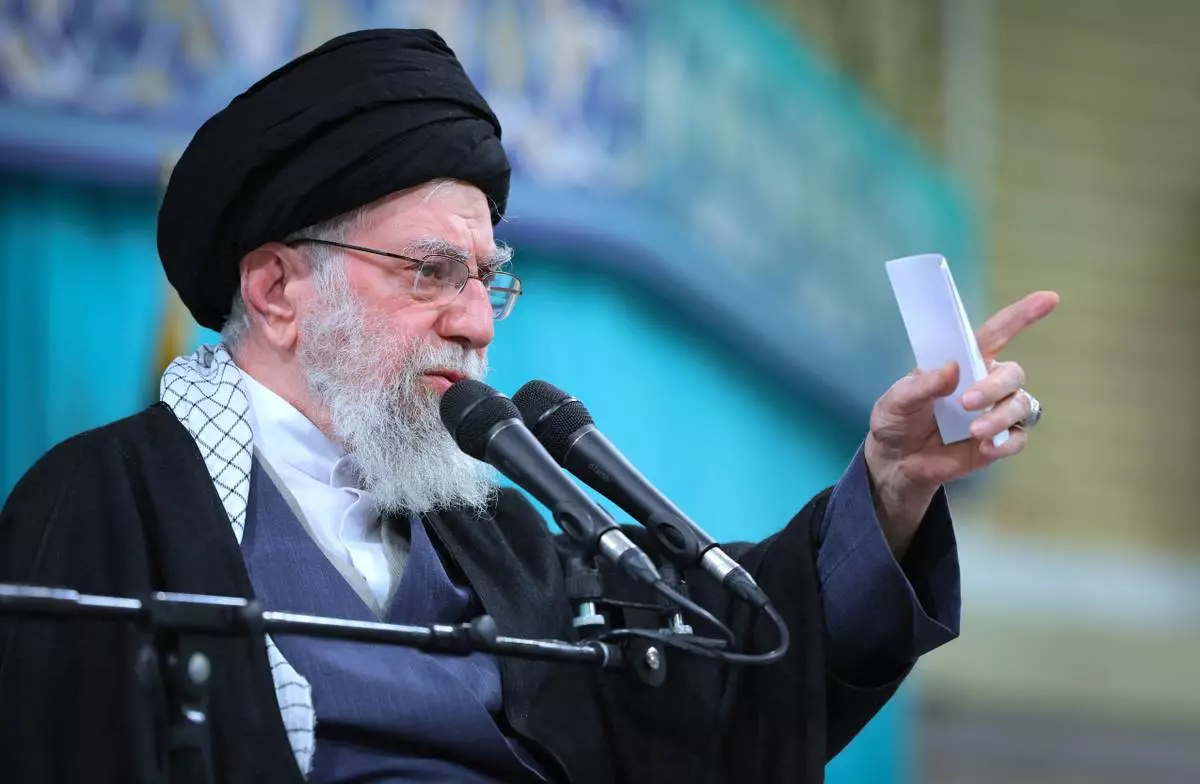
In this photo released by an official website of the office of the Iranian supreme leader, Supreme Leader Ayatollah Ali Khamenei speaks in a meeting, in Tehran, Iran, Saturday, Jan. 17, 2026. (Office of the Iranian Supreme Leader via AP)