As a recent heavy snowfall affected greenhouse facilities in central China's Henan Province, farmers in Shangqiu City turned to plant-protection drones, using the powerful downdraft generated by these aircraft to clear snow from greenhouse roofs. This innovative approach allowed the farmers to deal with accumulated snow quickly and efficiently, reducing labor-intensive manual clearing.
To balance between a maximum efficiency and avoiding damaging the facilities, local drone operators figured out their secret manual.
"The key lies in precise control of the altitude and angle. Flying too close risks damaging the greenhouse covering, while flying afar weakens the airflow. Through repeated practice, we found that directing airflow just above the side ridge of the greenhouse produces the best result, allowing wind to push snow smoothly down the roof surface," said drone operator Zhang Qing.
The method works best when snow has not yet compacted and is around 10 centimeters thick, and is particularly effective for large clusters of modern greenhouses with solid structures.
"The approach offers obvious advantages -- speed and cleanliness. Drones are used first to remove most of the loose snow, while workers then move in to handle corners, thicker accumulations, or weaker greenhouses vulnerable to external shocks, using support poles from inside," said Zhang Xinzhi, a senior agronomist with the Liangyuan District Bureau of Agriculture and Rural Affairs in Shangqiu.
With snowfall continuing, experts noted that snow removal is only a part of safeguarding agricultural production. Measures to maintain warmth and prevent diseases are equally important.
"Amid current heavy snowfall and temperature drops, we must first inspect greenhouse foundations and supporting pipes, reinforcing them promptly when issues are identified, and adopt multiple warming measures to keep temperatures warm and ensure healthy growth of vegetables," said Zhang.

Farmers in Henan use drones to protect greenhouse against heavy snowfall
The Gaza Strip has suffered severe casualties and heavy economic losses during the past three years of Palestinian-Israeli conflict, according to a statement from the Hamas-run Gaza Government Media Office.
The media office on Wednesday issued a statement saying that the ongoing conflict has claimed the lives of more than 74,000 people in the Gaza Strip, displaced more than 2 million people from their homes, and caused direct economic losses totaling over 80 billion U.S. dollars.
The statement said that in terms of economic damage, the residential sector had suffered the heaviest impact, amounting to approximately 34 billion dollars; healthcare and municipal public services had each sustained losses of around 6 billion dollars; the commercial, industrial, and agricultural sectors had incurred combined losses of approximately 13 billion dollars; and sectors such as telecommunications and education had also suffered severe losses.
The statement noted that the ongoing blockade and conflict have dealt a devastating blow to local livelihoods; over 87 percent of the Gaza Strip's agricultural land and greenhouses has been destroyed, and 8,700 agricultural wells have been rendered inoperable, causing annual fruit and vegetable yields to plummet from 524,000 tons to just 20,000 tons.
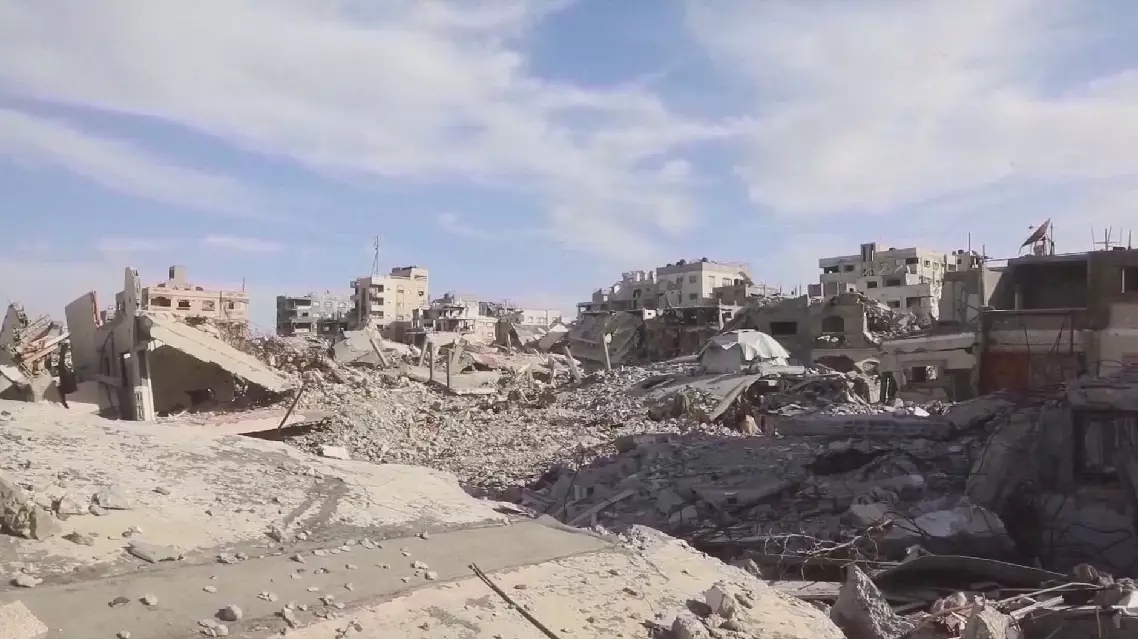
The statement said that over the three years of conflict, the Israeli military has dropped more than 230,000 tons of explosives on the Gaza Strip, resulting in damage to over 90 percent of the Strip, including the complete destruction of more than 335,000 buildings.
Through its military operations and forced displacement, the Israeli military now effectively controls more than 80 percent of the territory in the Gaza Strip, the statement said.
The recorded death toll in the Gaza Strip has reached 74,250, with approximately 9,500 others believed to be still buried under the rubble or missing, the statement said, adding that more than 55 percent of those killed were children, women, and the elderly.
The ongoing conflict has also claimed the lives of 1,723 healthcare workers, 149 civil defense and rescue personnel, and 262 media professionals, according to the statement.
Only 19 of the 38 hospitals in the Gaza Strip remain partially operational, while medical services in northern Gaza and the Rafah area have completely collapsed, the statement said.
Across the Gaza Strip, 97 percent of school buildings have sustained damage, and more than 740,000 students have been deprived of their right to education, according to the statement.
The statement also blamed Israel's obstruction of aid corridors for a severe humanitarian disaster, resulting in 460 deaths -- including 164 children -- due to acute hunger and malnutrition.
Gaza suffers severe casualties, economic losses in three-year conflict