SAN FRANCISCO, Jan. 21, 2026 /PRNewswire/ -- As enterprise AI adoption moves beyond experimentation and into production, the industry is entering a new phase where system reliability, governance, and long-term operability matter more than model performance alone. WhaleFlux today announced its positioning as an AI system builder, reflecting a broader shift in how organizations deploy AI at scale.
Over the past decade, rapid advances in foundation models have driven widespread AI experimentation. However, many enterprises now face a different bottleneck: building AI systems that can operate continuously within real-world constraints such as compliance, cost control, and operational stability. As a result, the focus is shifting from developing better models to engineering better systems.
From Model-Centric AI to System-Centric AI
WhaleFlux began as a GPU infrastructure management company and initiated a strategic expansion in early 2025 to address this emerging gap. Rather than focusing on standalone tools or individual models, the company has developed a system-level platform designed for long-running, workflow-oriented enterprise AI.
"At scale, AI systems fail not because models are weak, but because systems are fragile," said Jolie Li, COO of WhaleFlux. "The challenge is no longer model development — it's system engineering."
To support this transition, WhaleFlux consolidated its platform into a unified Compute–Model–Knowledge–Agent architecture, designed to provide enterprises with a stable foundation for production AI.
- Compute Layer — An autonomous scheduling and management engine for private GPU environments, enabling predictable performance, cost efficiency, and operational visibility across heterogeneous hardware.
- Model Layer — An optimized runtime environment for model serving, fine-tuning, and inference, ensuring the scalable deployment and optimization of LLMs and embeddings.
- Knowledge Layer — A secure enterprise knowledge foundation combining Retrieval-Augmented Generation (RAG) with structured access control, allowing AI agents to reason over private data while maintaining strict governance.
- Agent Layer — A workflow orchestration engine that enables multi-step, policy-aware execution, ensuring AI agents operate within predefined operational and compliance boundaries.
Together, these layers support AI workflows that are traceable, controllable, and designed to run reliably over time.
Validated in High-Stakes Industry Environments
Throughout 2025, WhaleFlux deployed its system architecture across regulated and mission-critical settings. In finance, institutional teams used on-premise AI agents for strategy evaluation and risk analysis while keeping sensitive data within private infrastructure. In healthcare, research institutions adopted federated learning workflows to enable collaborative pathology research without transferring patient data. In manufacturing, industrial producers applied AI-assisted modeling to complex chemical and reaction environments, improving visibility where traditional sensing methods are limited.
These deployments reflect growing demand for AI systems designed to operate under real-world constraints rather than controlled laboratory conditions. WhaleFlux also shared system-level insights at global industry events including NVIDIA GTC and GITEX Global.
Looking Ahead
As enterprises enter 2026, WhaleFlux expects AI adoption to increasingly shift toward agent-driven, workflow-oriented systems composed of multiple coordinated components. The company positions itself as an AI system builder, providing the architectural foundation enterprises use to design, deploy, and govern AI systems over time.
About WhaleFlux
Headquartered in San Francisco, WhaleFlux builds system platforms for enterprise AI environments. By integrating GPU compute scheduling, private knowledge management, and intelligent agent orchestration, WhaleFlux helps organizations transform AI capabilities into stable, production-ready systems.
For more information, visit www.whaleflux.com or follow us on LinkedIn
Media Contact:
Niki Yan
Head of Marketing, WhaleFlux
Email: niki@whaleflux.com
Website: www.whaleflux.com
** The press release content is from PR Newswire. Bastille Post is not involved in its creation. **

WhaleFlux Signals a Shift Toward Architecting Enterprise AI Systems as Enterprise AI Enters a New Phase in 2026
|
Announced alongside M Series Smart Assist Module launch on Kickstarter
NEW YORK, April 4, 2026 /PRNewswire/ -- Yarbo, a company focused on intelligent yard robotics, today announced the Yarbo Open Platform, a long-term initiative currently under development and planned for release in early 2027. Designed to expand Yarbo's modular yard robot system across both software and hardware, the platform is intended to support deeper customization, broader smart home connectivity, and new forms of user and developer-driven functionality over time. The announcement coincides with the launch of the Smart Assist Module (SAM) for the M Series on Kickstarter.
The Open Platform is not available today. Instead, it reflects Yarbo's roadmap for how its ecosystem may evolve over time, including a three-layer software architecture built around an Open API, SDK, and no-code Automation Editor, as well as a hardware expansion framework designed to support future user-built and developer-built modules.
A Structured Approach to Software Integration and Automation
The Yarbo Open Platform is structured to accommodate different levels of technical expertise, from everyday users to experienced developers. It is designed to provide multiple entry points into the Yarbo ecosystem, enabling both software-driven automation and hardware-level expansion.
On the software side, the platform consists of three layers:
- Yarbo Open API — intended to enable connectivity between Yarbo devices and external platforms, allowing them to participate in broader home automation scenarios.
- Yarbo SDK — a set of development tools, including code libraries and documentation, designed for developers building custom features or integrations.
- Yarbo Automation Editor — a visual, drag-and-drop interface within the Yarbo app that allows users to create automation workflows without writing code.
Together, these components are intended to make automation accessible to a wide range of users, while also supporting more advanced development use cases.
The platform is also designed to support compatibility with widely used smart home ecosystems, including Home Assistant, Google Home, and Amazon Alexa, enabling users to incorporate Yarbo into existing connected home setups.
Extending Capability Through Hardware
In addition to software capabilities, the Open Platform introduces a hardware expansion approach designed to extend Yarbo's functionality beyond its existing modules.
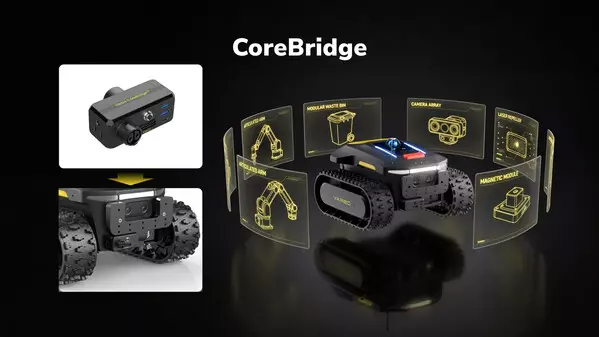
At the center of this is CoreBridge, a standardized hardware interface currently in development that is intended to provide access to Yarbo's mechanical mounting points, power system, and data connections. It is designed to support third-party development and user-built extensions, allowing new types of functionality beyond pre-defined modules.
One example of this extensibility is an electromagnet-based module, which can be attached via CoreBridge to enable Yarbo to latch onto and move objects such as garbage bins. In a potential use scenario, this could enable automated movement of a bin to the curb on collection day and its return afterward.
This combination of software and hardware openness reflects an effort to expand the role of outdoor robotics beyond fixed-function devices.
Smart Assist Module Launch on Kickstarter
Alongside the Open Platform announcement, Yarbo is launching the Smart Assist Module (SAM) for the M Series on Kickstarter.
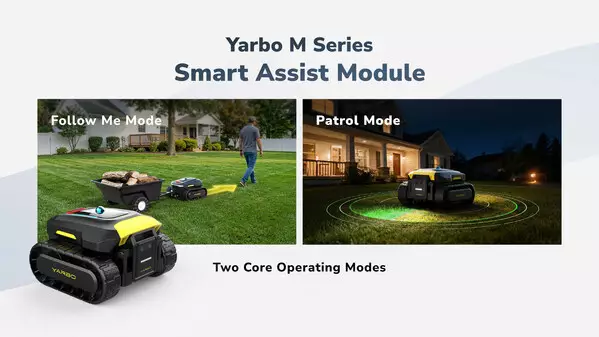
The module introduces two primary features designed to expand how users interact with their yard robot in everyday use:
- Follow Me Mode — enabling Yarbo to move alongside the user while carrying tools or materials, reducing the need for manual transport during yard work.
- Patrol Mode — allowing Yarbo to move along customizable routes around the property, with features such as remote live view, app-based alerts, and optional audio notifications via its built-in speaker, providing an added layer of awareness and convenience for users managing outdoor spaces.
The Smart Assist Module is positioned as part of Yarbo's broader effort to extend the practical use cases of its modular system.
Looking Ahead
The Yarbo Open Platform is planned for release in early 2027 and is being developed to support both the Y Series and M Series. By introducing a framework that combines software integration, developer tools, and hardware extensibility, Yarbo aims to enable a broader range of applications while allowing users to define how the system evolves over time.
Further details will be shared as development progresses.
About Yarbo
Yarbo is defining a new category of outdoor robotics with its Modular Yard Robot. Known for its automated snow blower robots, Yarbo introduced a modular system designed for year-round use. Powered by a single intelligent core unit, the system supports interchangeable modules for mowing, leaf blowing, snow clearing, and more—creating a more efficient approach to outdoor maintenance for homeowners.
Announced alongside M Series Smart Assist Module launch on Kickstarter
NEW YORK, April 4, 2026 /PRNewswire/ -- Yarbo, a company focused on intelligent yard robotics, today announced the Yarbo Open Platform, a long-term initiative currently under development and planned for release in early 2027. Designed to expand Yarbo's modular yard robot system across both software and hardware, the platform is intended to support deeper customization, broader smart home connectivity, and new forms of user and developer-driven functionality over time. The announcement coincides with the launch of the Smart Assist Module (SAM) for the M Series on Kickstarter.
The Open Platform is not available today. Instead, it reflects Yarbo's roadmap for how its ecosystem may evolve over time, including a three-layer software architecture built around an Open API, SDK, and no-code Automation Editor, as well as a hardware expansion framework designed to support future user-built and developer-built modules.
A Structured Approach to Software Integration and Automation
The Yarbo Open Platform is structured to accommodate different levels of technical expertise, from everyday users to experienced developers. It is designed to provide multiple entry points into the Yarbo ecosystem, enabling both software-driven automation and hardware-level expansion.
On the software side, the platform consists of three layers:
- Yarbo Open API — intended to enable connectivity between Yarbo devices and external platforms, allowing them to participate in broader home automation scenarios.
- Yarbo SDK — a set of development tools, including code libraries and documentation, designed for developers building custom features or integrations.
- Yarbo Automation Editor — a visual, drag-and-drop interface within the Yarbo app that allows users to create automation workflows without writing code.
Together, these components are intended to make automation accessible to a wide range of users, while also supporting more advanced development use cases.
The platform is also designed to support compatibility with widely used smart home ecosystems, including Home Assistant, Google Home, and Amazon Alexa, enabling users to incorporate Yarbo into existing connected home setups.
Extending Capability Through Hardware
In addition to software capabilities, the Open Platform introduces a hardware expansion approach designed to extend Yarbo's functionality beyond its existing modules.
At the center of this is CoreBridge, a standardized hardware interface currently in development that is intended to provide access to Yarbo's mechanical mounting points, power system, and data connections. It is designed to support third-party development and user-built extensions, allowing new types of functionality beyond pre-defined modules.
One example of this extensibility is an electromagnet-based module, which can be attached via CoreBridge to enable Yarbo to latch onto and move objects such as garbage bins. In a potential use scenario, this could enable automated movement of a bin to the curb on collection day and its return afterward.
This combination of software and hardware openness reflects an effort to expand the role of outdoor robotics beyond fixed-function devices.
Smart Assist Module Launch on Kickstarter
Alongside the Open Platform announcement, Yarbo is launching the Smart Assist Module (SAM) for the M Series on Kickstarter.
The module introduces two primary features designed to expand how users interact with their yard robot in everyday use:
- Follow Me Mode — enabling Yarbo to move alongside the user while carrying tools or materials, reducing the need for manual transport during yard work.
- Patrol Mode — allowing Yarbo to move along customizable routes around the property, with features such as remote live view, app-based alerts, and optional audio notifications via its built-in speaker, providing an added layer of awareness and convenience for users managing outdoor spaces.
The Smart Assist Module is positioned as part of Yarbo's broader effort to extend the practical use cases of its modular system.
Looking Ahead
The Yarbo Open Platform is planned for release in early 2027 and is being developed to support both the Y Series and M Series. By introducing a framework that combines software integration, developer tools, and hardware extensibility, Yarbo aims to enable a broader range of applications while allowing users to define how the system evolves over time.
Further details will be shared as development progresses.
About Yarbo
Yarbo is defining a new category of outdoor robotics with its Modular Yard Robot. Known for its automated snow blower robots, Yarbo introduced a modular system designed for year-round use. Powered by a single intelligent core unit, the system supports interchangeable modules for mowing, leaf blowing, snow clearing, and more—creating a more efficient approach to outdoor maintenance for homeowners.
** This press release is distributed by PR Newswire through automated distribution system, for which the client assumes full responsibility. **
Yarbo Introduces Open Platform Strategy, Opening Its Robotics System to Developers and Smart Home Ecosystems
Yarbo Introduces Open Platform Strategy, Opening Its Robotics System to Developers and Smart Home Ecosystems