European Central Bank President Christine Lagarde on Wednesday stressed that only international cooperation can balance artificial intelligence (AI)'s potential to boost productivity against its mounting risks.
In an exclusive interview with China Global Television Network (CGTN) at the World Economic Forum (WEF) in Davos, Lagarde affirmed AI's transformative power and urged coordinated strategies to harness it responsibly.
"AI is most likely going to be very transformative. What exact impact it will have on productivity and at which levels of our economy is still to be demonstrated. What is certain is that it needs data, it needs capital, it needs energy and that is obviously a factor of the scale and the access. My point from all that is that cooperation is key in order to deliver value, and I would hope that cooperation happens," she said.
She is in Davos for the 2026 WEF meeting, which opened on Monday in Davos and will run through Friday under the theme "A Spirit of Dialogue. About 3,000 leaders and experts from around the world are gathering to discuss five pressing global challenges, including enhancing cooperation, unlocking new sources of growth and deploying innovation at scale and responsibly.

Lagarde urges cooperation to manage AI productivity gains, offset risks
Efforts are underway in Gaza to restore what remains of the historic Abu Salim Mosque and preserve that it represents, after the religious site was hit by an Israeli airstrike on August 24.
Located in Deir al-Balah in central Gaza, the Abu Salim Mosque is widely regarded as one of Gaza's oldest and most historically significant religious landmarks.
However, more than half of the mosque currently lies in ruins, with parts of its historic walls collapsing following the Israeli strike.
The municipality and volunteers are trying to salvage whatever they can from the rubble, even the mosque's damaged stones, valued by Palestinians for their historical and cultural significance.
"We are searching for heritage books and stones. When conditions allow reconstruction in the future, the municipality will work with heritage organizations to restore this mosque," said Salem Abu Hasnin, a member of the Deir al-Balah Municipal Council.
The search through the rubble is made harder by a severe lack of equipment and resources.
"This mosque is both a heritage and archaeological site. It was built in 1951 in the Ottoman style. Our team launched a preventive preservation campaign, collecting historic marble pieces and scattered limestone for safekeeping," said Shaimaa Al-Natour, a member of the Heritage Guardians Team.
The mosque's library was also damaged. Among the debris, the team is trying to rescue surviving books and preserve them with whatever materials are available.
"Documenting, archiving and collecting historic books require special preservation boxes. We are working with very limited resources, keeping the books in cardboard or wooden boxes that are not designed for this purpose," said Muhannad Abu Lahya, a cultural heritage guide.
The Palestinian Ministry of Religious Endowments says almost all of Gaza's 1,275 mosques have been targeted since the war began, including well over 1,000 that were completely destroyed.
Despite the widespread destruction, Palestinians remain determined to preserve their heritage, hoping what they save from the rubble can one day be rebuilt into what was lost.
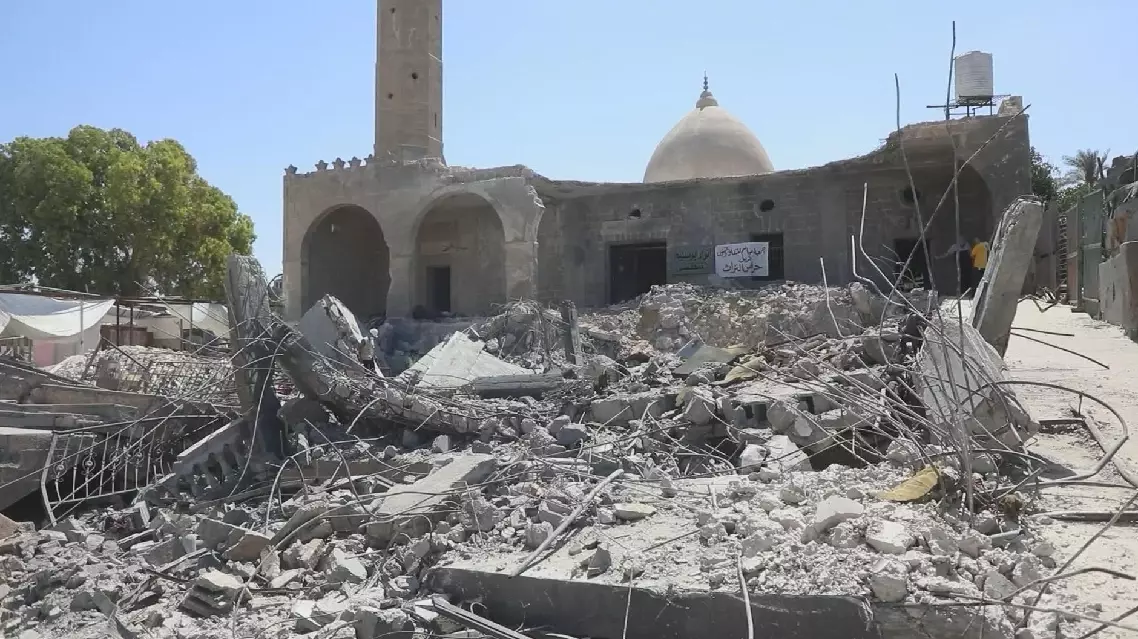
Efforts underway to preserve historic Abu Salim Mosque after Israeli strike