Skip to Content Facebook Feature Image

Zero Aedes albopictus detected in January 2026 across most surveyed areas, emphasizing continued mosquito control efforts.

HK

Zero Aedes albopictus detected in January 2026 across most surveyed areas, emphasizing continued mosquito control efforts.
HK

HK

Zero Aedes albopictus detected in January 2026 across most surveyed areas, emphasizing continued mosquito control efforts.

2026-01-22 17:35 Last Updated At:17:48

FEHD releases third batch of gravidtrap indexes for Aedes albopictus in January

The Food and Environmental Hygiene Department (FEHD) today (January 22) released the third batch of gravidtrap indexes and density indexes for Aedes albopictus in January, covering 22 survey areas, as follows:
More Images

Source: AI-found images

Source: AI-found images

District

Survey Area

January 2026

First Phase Gravidtrap Index

First Phase Density Index

Central and Western

Kennedy Town and Shek Tong Tsui

0.0%

N/A

Southern

Aberdeen and Ap Lei Chau

0.0%

N/A

Deep Water Bay and Repulse Bay

0.0%

N/A

Pok Fu Lam

0.0%

N/A

Wong Tai Sin

Ngau Chi Wan and San Po Kong

0.0%

N/A

Sai Kung

Sai Kung Town

0.0%

N/A

Sha Tin

Ma On Shan

0.0%

N/A

Sha Tin East

0.0%

N/A

Tai Wai

0.0%

N/A

Tai Po

Tai Po East

0.0%

N/A

Kwai Tsing

Kwai Chung East

0.0%

N/A

Tsuen Wan

Ma Wan and Sham Tseng

1.9%

1.0

Tsuen Wan West

0.0%

N/A

Yuen Long

Yuen Long Town

0.0%

N/A

District

Survey Area

January 2026

Area Gravidtrap Index

Area Density Index

Eastern

Shau Kei Wan and Sai Wan Ho

0.9%

1.0

Islands

Tung Chung

0.0%

N/A

Sham Shui Po

Lai Chi Kok

0.0%

N/A

Sai Kung

Tseung Kwan O East

0.0%

N/A

Tseung Kwan O North

0.0%

N/A

Tseung Kwan O West

0.0%

N/A

Sha Tin

Sha Tin Town Centre and Fo Tan

0.0%

N/A

Tuen Mun

Tuen Mun South

0.0%

N/A

Among the third batch of First Phase Gravidtrap Indexes covering 14 survey areas and Area Gravidtrap Indexes covering eight survey areas in January, all were below 10 per cent.

The FEHD has so far released three batches of gravidtrap indexes for Aedes albopictus in January 2026, covering 38 survey areas; most of the areas recorded 0 per cent, indicating that the distribution of Aedes albopictus mosquitoes was not extensive.

The eggs of Aedes albopictus can withstand long periods of desiccation and will hatch when the temperature becomes suitable and water is present. Members of the public should continue to take mosquito control measures during winter to eliminate mosquito eggs.

Public participation is crucial to the effective control of mosquito problems. The FEHD appeals to members of the public to continue to work together in strengthening personal mosquito control measures, including:

  • tidy up their premises and check for any accumulation of water inside their premises;
  • remove all unnecessary water collections and eliminate the sources;
  • check household items (those placed in outdoor and open areas in particular), such as refuse containers, vases, air conditioner drip trays, and laundry racks to prevent stagnant water;
  • change the water in flower vases and clear the water in saucers of potted plants at least once every seven days;
  • properly cover all containers that hold water to prevent mosquitoes from accessing the water;
  • properly dispose of articles that can contain water, such as empty lunch boxes and cans; and
  • scrub drains and surface sewers with alkaline detergent at least once a week to remove any mosquito eggs.
  • Starting in August 2025, following the completion of the surveillance of individual survey areas, and once the latest gravidtrap index and the density index are available, the FEHD has been disseminating relevant information through press releases, its website and social media. It aims to allow members of the public to quickly grasp the mosquito infestation situation and strengthen mosquito control efforts, thereby reducing the risk of chikungunya fever (CF) transmission.

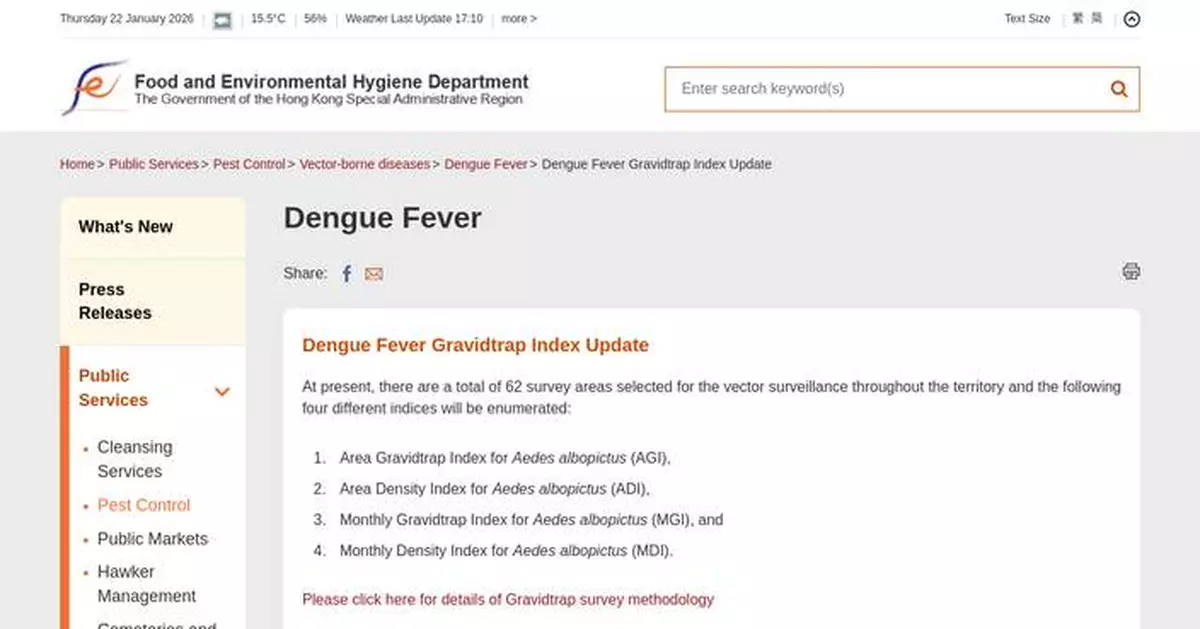
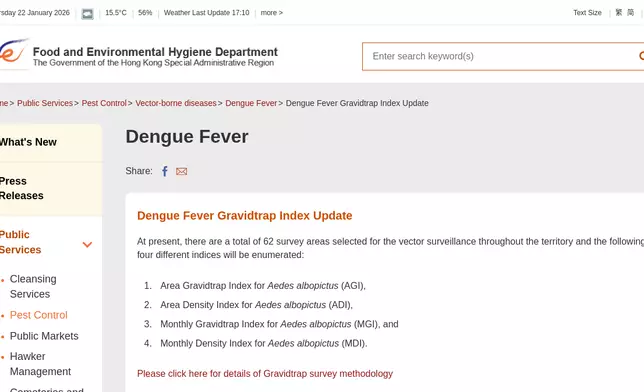
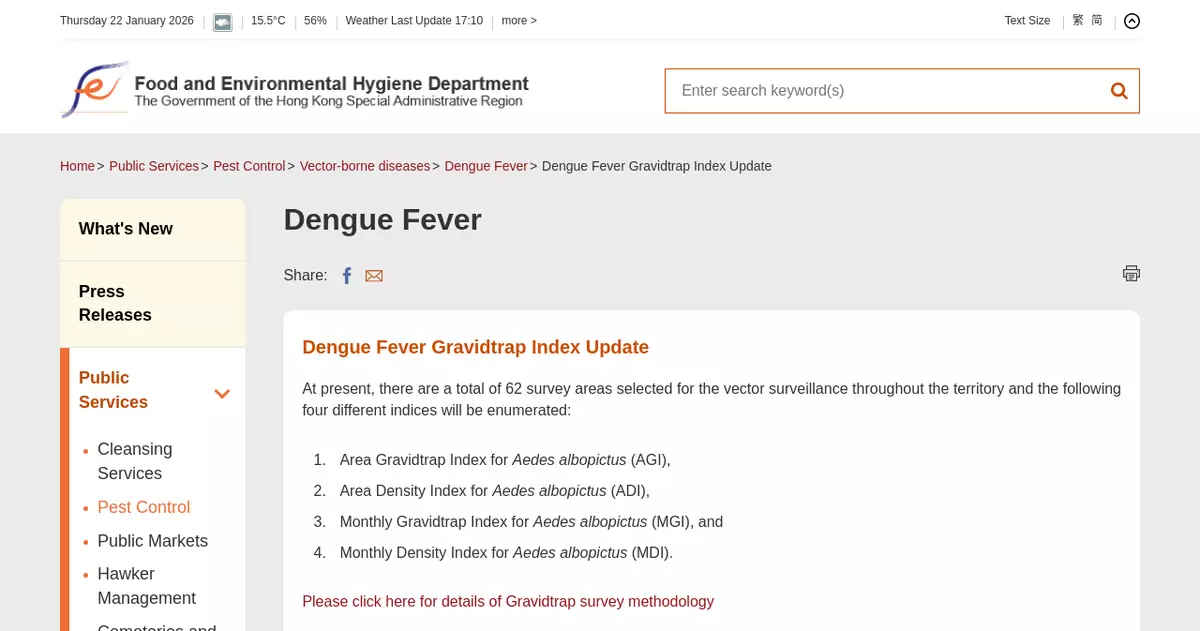
    Following recommendations from the World Health Organization and taking into account the local situation in Hong Kong, the FEHD sets up gravidtraps in districts where mosquito-borne diseases have been recorded in the past, as well as in densely populated places such as housing estates, hospitals and schools to monitor the breeding and distribution of Aedes albopictus mosquitoes, which can transmit CF and dengue fever (DF). After reviewing the present DF and CF vector surveillance programme, the FEHD has expanded the coverage for monitoring Aedes albopictus mosquitoes starting from 2026. The number of survey areas set up in the community has been revised to 62, with some survey areas renamed. Additional gravidtraps will also be set up at different locations across the territory to strengthen the monitoring of the breeding of mosquitoes. Under the present surveillance mechanism, the FEHD has set up gravidtraps in survey areas of the community, with a surveillance period of two weeks. During the surveillance period, the FEHD will collect the gravidtraps once a week. After the first week of surveillance, the FEHD will immediately examine the glue boards inside the retrieved gravidtraps for the presence of adult Aedine mosquitoes to compile the Gravidtrap Index (First Phase) and Density Index (First Phase). At the end of the second week of surveillance, the FEHD will instantly check the glue boards for the presence of adult Aedine mosquitoes. Data from the two weeks of surveillance will be combined to obtain the Area Gravidtrap Index and the Area Density Index. The gravidtrap and density indexes for Aedes albopictus in different survey areas, as well as information on mosquito prevention and control measures, are available on the department's webpage (www.fehd.gov.hk/english/pestcontrol/dengue_fever/Dengue_Fever_Gravidtrap_Index_Update.html#).

    Source: AI-found images

    Source: AI-found images

    HAD opens temporary cold shelters

    In view of the cold weather, the Home Affairs Department has opened 18 temporary cold shelters in various districts today (January 22) for people in need of the service. The temporary shelters will remain open when the Cold Weather Warning is in force.

    Clean mattresses and blankets/quilts, hot meals and hot water will be provided to shelter users free of charge during the opening of the temporary shelters.

    To ensure that cold shelter users can rest in a quiet and undisturbed environment, members of the public or agencies wishing to make donations to shelter users are requested to register with the staff of the shelter first. Donors will then be directed to place the donated items at a specified indoor location. The staff will help notify the shelter users to collect the items on their own.

    Anyone seeking temporary refuge, or those with any questions about the donation arrangements at the cold shelters, may call the department's hotline 2572 8427 for more information.

    The 18 temporary cold shelters are located at:

    Hong Kong Island:

    --------------------

    Central and Western:

    Sai Ying Pun Community Complex Community Hall

    3/F, Sai Ying Pun Community Complex,

    2 High Street, Sai Ying Pun

    Eastern:

    Causeway Bay Community Centre

    3/F, 7 Fook Yum Road, Causeway Bay

    Southern:

    Lei Tung Community Hall

    Lei Tung Estate, Ap Lei Chau

    Wan Chai:

    Wan Chai Activities Centre

    LG/F, Wan Chai Market, 258 Queen's Road East, Wan Chai

    Kowloon:

    ------------------

    Kowloon City:

    Hung Hom Community Hall

    1/F, Kowloon City Government Offices,

    42 Bailey Street, Hung Hom

    Kwun Tong:

    Lam Tin (West) Estate Community Centre

    71 Kai Tin Road, Lam Tin

    Sham Shui Po:

    Nam Cheong District Community Centre

    1 Cheong San Lane, Sham Shui Po

    Wong Tai Sin:

    Tsz Wan Shan (South) Estate Community Centre

    45 Wan Wah Street, Tsz Wan Shan

    Yau Tsim Mong:

    Henry G Leong Yaumatei Community Centre

    60 Public Square Street, Yau Ma Tei

    New Territories:

    ----------------

    Islands:

    Tung Chung Community Hall

    G/F, Tung Chung Municipal Services Building, 39 Man Tung Road, Tung Chung

    Kwai Tsing:

    Tai Wo Hau Estate Community Centre

    15 Tai Wo Hau Road, Kwai Chung

    North:

    Cheung Wah Community Hall

    Cheung Wah Estate, Fanling

    Sai Kung:

    Hang Hau Community Hall

    G/F, Sai Kung Tseung Kwan O Government Complex,

    38 Pui Shing Road, Hang Hau, Tseung Kwan O

    Sha Tin:

    Lung Hang Estate Community Centre

    Lung Hang Estate, Sha Tin

    Tai Po:

    Tai Po Community Centre

    2 Heung Sze Wui Street, Tai Po

    Tsuen Wan:

    Lei Muk Shue Community Hall

    G/F, Hong Shue House, Lei Muk Shue Estate, Tsuen Wan

    Tuen Mun:

    Butterfly Bay Community Centre

    Butterfly Estate (near Tip Sum House), Tuen Mun

    Yuen Long:

    Long Ping Community Hall

    Long Ping Estate, Yuen Long

    Source: AI-found images

    Source: AI-found images

    Recommended Articles