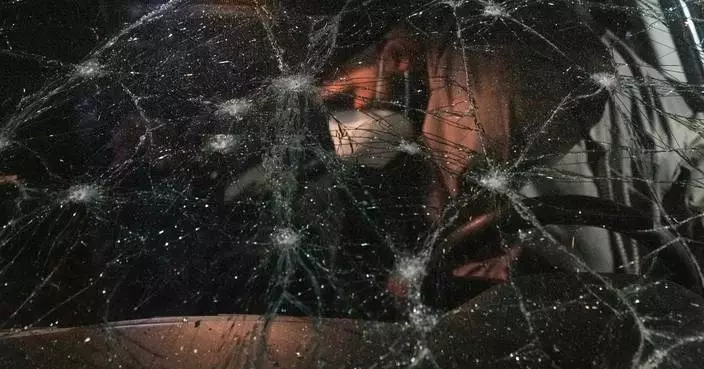
JACKSON, Miss. (AP) — A group of animal advocates were preparing on Friday to weather a massive winter storm with 80 dogs inside a warehouse after the animals were rescued from a rural Mississippi property.
After the Lee County Sheriff's Office called them for help, members of Paws of War, a New York-based nonprofit that rescues animals and places them with veterans and first responders, raced across the country to rescue the more than 200 dogs from the home in Tupelo, about 190 miles (300 kilometers) north of Jackson, on Wednesday.
Robert Misseri, the organization's co-founder, said his team worked through the night Thursday, calling shelters and asking them to pick up as many dogs as possible. With 80 dogs still left, Misseri said his team is now preparing to bed down in a warehouse and wait out the severe weather.
The weather and the property's rural location have posed major challenges to the rescue operation, Misseri said, calling it “a perfect storm.”
Shelters that would normally offer to take some of the dogs are refusing due to travel safety concerns, he said. Nearby stores are running out of essential supplies his team needs as people stock up ahead of the storm. Misseri said it has also been difficult to plan and coordinate because there is little cell service in the area.
Misseri described the property where the dogs were living as a “house of horrors," with the skeletal remains of dogs decomposing in the yard and feces everywhere. The dogs, he said, were living both inside and outside of the home.
“It's rewarding seeing them come off the property for the first time, knowing that they will ultimately wind up on someone's couch. But to think that they suffered up there for all these years in silence," Misseri said before trailing off.
Thirteen of the dogs are now at the Northshore Humane Society in Covington, Louisiana. The nonprofit’s team traversed more than 300 miles (480 kilometers) to the Tupelo area on Wednesday for what they dubbed “Operation: Tupelo Tails.”
“A lot of these dogs have scars on their faces, which is evidence that they were probably sparring with the other dogs for food,” said Scott Bernier, Northshore Humane Society’s CEO. “So it’s a bad condition. Not something we ever like to see.”
Scout Cannizzaro, a veterinary technician at the Northshore Humane Society, said some of the dogs had upper respiratory infections and skin conditions, and he suspects some have heartworm.
Northshore Humane Society is now trying to get as many dogs as possible into foster homes because their building is old and doesn't retain heat well. Bernier assured that any animals left at the shelter when the storm hits will be warm and safe.
At the warehouse, Misseri said the dogs will be kept warm with several heaters. Members of the Paws of War team will stay at the warehouse with the animals during the storm and play classical music to soothe them at night.

Two neglected dogs covered in scars await a foster home at Northshore Humane Society in Covington, La., Thursday, Jan. 22, 2026, after being rescued near Tupelo, Mississippi. (AP Photo/Stephen Smith)
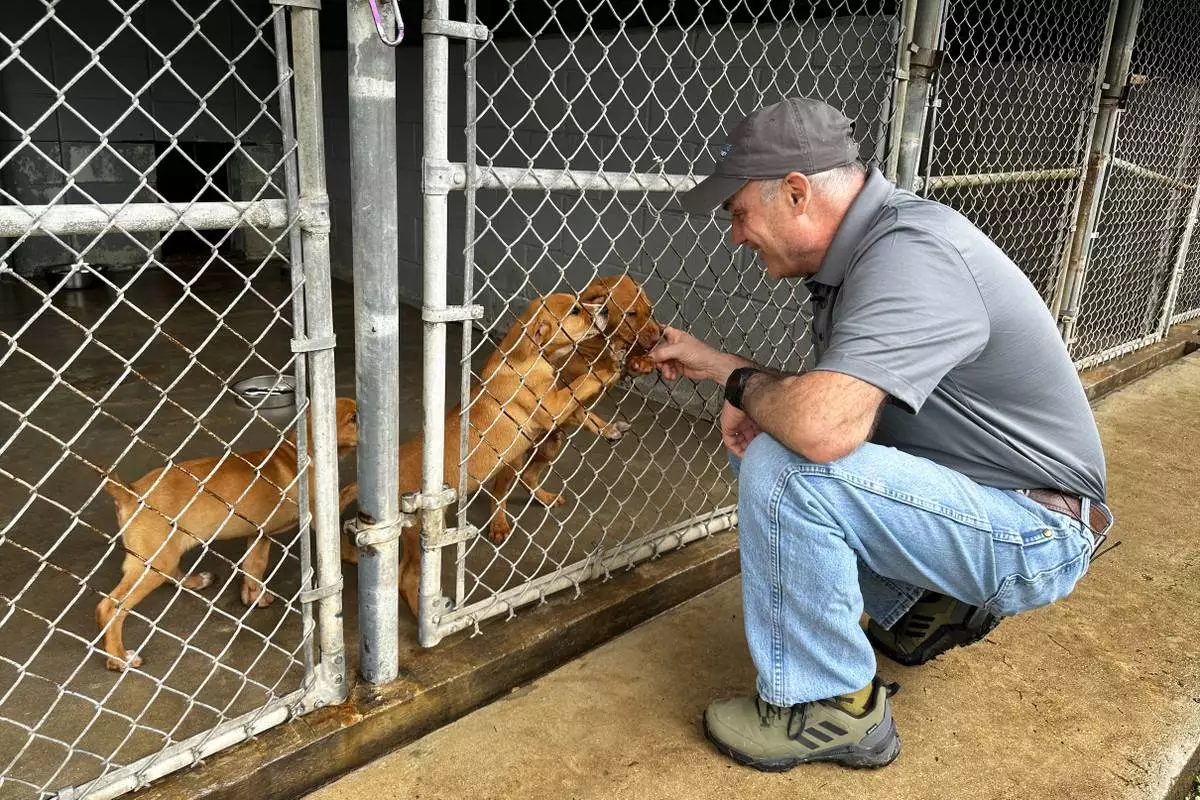
Scott Bernier, CEO of Northshore Humane Society comforts recently rescued puppies who were neglected along with more than 200 other dogs near Tupelo, Mississippi in Covington, La., Thursday, Jan. 22, 2026. (AP Photo/Stephen Smith)

A neglected dog sits with scars on her face at Northshore Humane Society after being rescued near Tupelo, Mississippi, in Covington, La., Thursday, Jan. 22, 2026. (AP Photo/Stephen Smith)
WASHINGTON (AP) — A Smithsonian museum exhibit about the maritime journey that millions of Africans were forced to take across the Atlantic to slavery in the Americas will change later this month, when a remnant from one of the first sunken slave ships ever recovered is taken off display in Washington.
The National Museum of African American History and Culture says a timber piece of the slave ship, the São José-Paquete de Africa, on display in its “Slavery and Freedom” exhibit, will soon be prepared for a trip back to its home museum in South Africa.
The 33-pound (15-kilogram) timber piece has been prominently displayed — seemingly suspended over a dark void, a ballast at its side — as part of a loan agreement to the museum since it opened in 2016. The agreement, examined by The Associated Press, was initially five years and then was extended another five in 2021, ending July 1.
The ship remnant will be among several items sent back to the Iziko Museums of South Africa later this year. Because of its delicate nature, a special crate has to be built for its transport.
Other items from the ship, including the ballasts that served as counterweights for the human cargo, are remaining on display and will be returned to South Africa in two years. A manifesto of the cargo on the ship will replace the timber piece.
The last day for museum visitors to see the timber piece on display is March 22.
The São José, a Portuguese vessel bound for Brazil with more than 400 captives from Mozambique, struck a rock and sank in December 1794 off the coast of Cape Town, South Africa. Half of the people aboard perished. Survivors were resold into slavery in the Western Cape, according to the Smithsonian.
Recovered in 2015, the ship was identified and studied through the Slave Wrecks Project, an international network of institutions that confirmed it was associated with the trans-Atlantic slave trade. The ship is among the first known wreckage of such a ship that was recovered, in which enslaved Africans died.
The São José piece is in the lowest public level of the museum and is part of the larger “Slavery and Freedom” exhibit, which focuses on the slave trade, including the ships and conditions of transport, as well as artifacts, such as shackles.
The exhibit addresses the Middle Passage, an especially fraught part of the Atlantic Ocean crossing where many of the captives died. While there is no exact count, the number of people who perished during the journey is in the millions, according to Paul Gardullo, the assistant director of history at the National Museum of African American History and Culture.
The alteration of the slavery exhibit comes at a time when any changes related to history and the American story at federal parks, museums or other public spaces are being scrutinized. President Donald Trump's administration has focused on putting the U.S. in a good light as the country prepares to celebrate the 250th anniversary of the signing of the Declaration of Independence.
The displays, exhibits and programming of several Smithsonian museums are under review as part of an executive order signed in March 2025 by the Republican president, titled “Restoring Truth and Sanity to American History.” The National Museum of African American History and Culture is one of the institutions named in the order.
Michelle Commander, the museum's deputy director, told the AP the exhibit change is entirely related to the loan agreement but understood the timing might raise questions.
“That’s why we’re being transparent in this moment, because we are aware that there are those kinds of questions,” Commander said. “But, as we’ve said, this is really about the conservation needs of that item.”
As part of the loan, Gardullo said, the South African government has a robust cultural patrimony law that dictates how its artifacts and historical materials are treated and how long they can be loaned out.
“The wooden materials are more fragile, and they need a little more close care,” he said.
Recent visitors to the National Museum of African American History and Culture spoke of the power of the display with the slave ship timber, unaware that it would be altered shortly.
Lines wait to enter the darkened gallery, entitled the Middle Passage, where there is a solemnity as people study the dark space where the timber sits next to a ship's ballast. The tangible nature of the exhibit takes it out of textbooks and into reality, said Krystina Hernandez, who was there chaperoning her 7-year-old son’s schoolmates.
Anehtra Reynolds, from northern Virginia, was emotional as she exited the area. She said the presentation, including the artifacts and the darkness of the gallery, gave her a “piece of what they felt in terms of their misery.”
“I think there was a sign in there that mentioned there were some slaves who starved themselves to death in hopes that they would, when they died, they would be returned to their land,” Reynolds said.
Jim Carnes, who was in Washington visiting family from Birmingham, Alabama, said he was familiar with much of the information because he has worked in civil rights education in Birmingham and Montgomery, two places central to the nation's civil rights history.
“The artifacts are extraordinarily powerful,” he said, adding that he's left feeling sadness and anger, not just at the conditions of the enslaved people but at the current push by the federal government to “deny this ever happened.”
Jorge Carvajal, who is originally from Colombia but lives with his wife in south Florida, said seeing the exhibit silenced the stereotypes, especially that Black people are unreasonably angry.
“Empathy is what I’m trying to say. This will help people empathize a lot more. I mean, at least you would hope,” he said.
Commander said the staff at the museum will work to make sure that the exhibit continues to have the same impact with the remaining artifacts and displays.
“The story does not leave the museum because this timber is going to be returned to its owners,” she said.
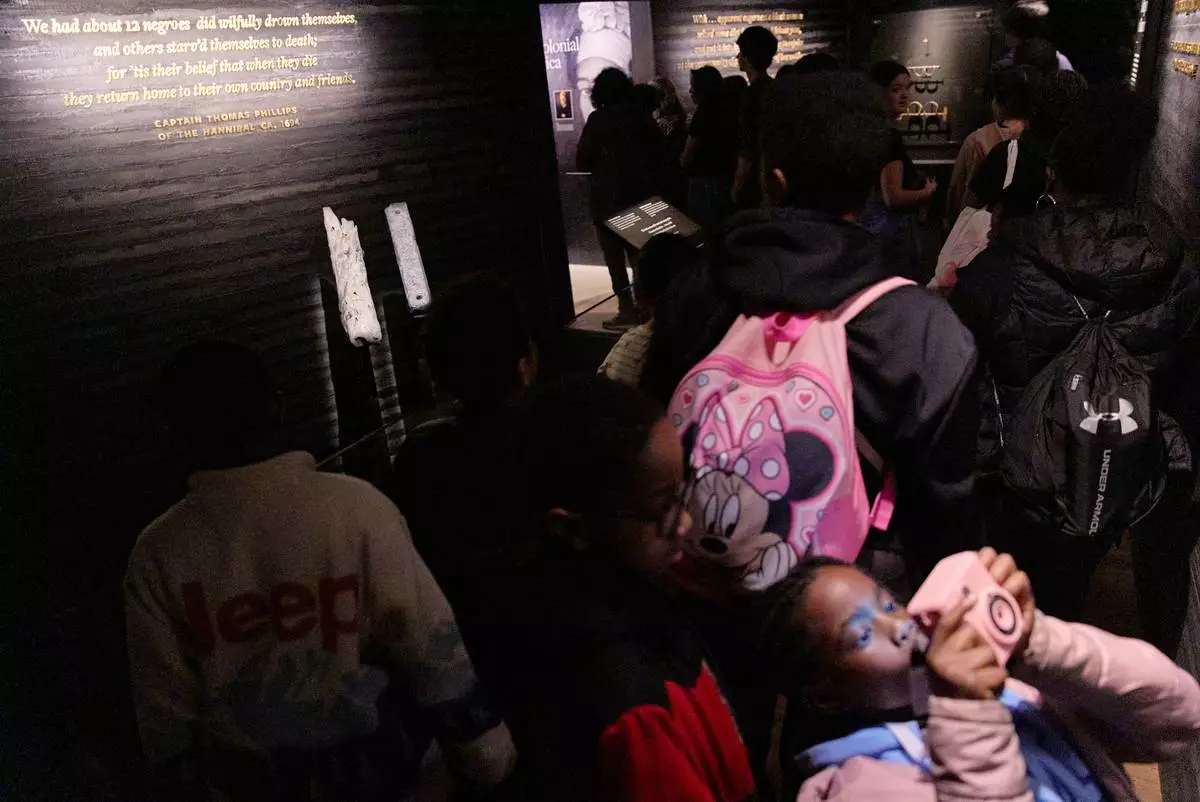
School children visit the National Museum of African American History and Culture's Middle Passage exhibit, including a wooden timber, the artifact at back left, from the slave ship, the São José-Paquete de Africa, Friday, March 6, 2026, in Washington. (AP Photo/Jacquelyn Martin)

Jim Cairnes of Birmingham, Ala., speaks to a reporter while visiting the National Museum of African American History and Culture, Friday, March 6, 2026, in Washington. (AP Photo/Jacquelyn Martin)

Anehtra Richmond of Woodbridge, Va., speaks to a reporter while visiting the National Museum of African American History and Culture, Friday, March 6, 2026, in Washington. (AP Photo/Jacquelyn Martin)
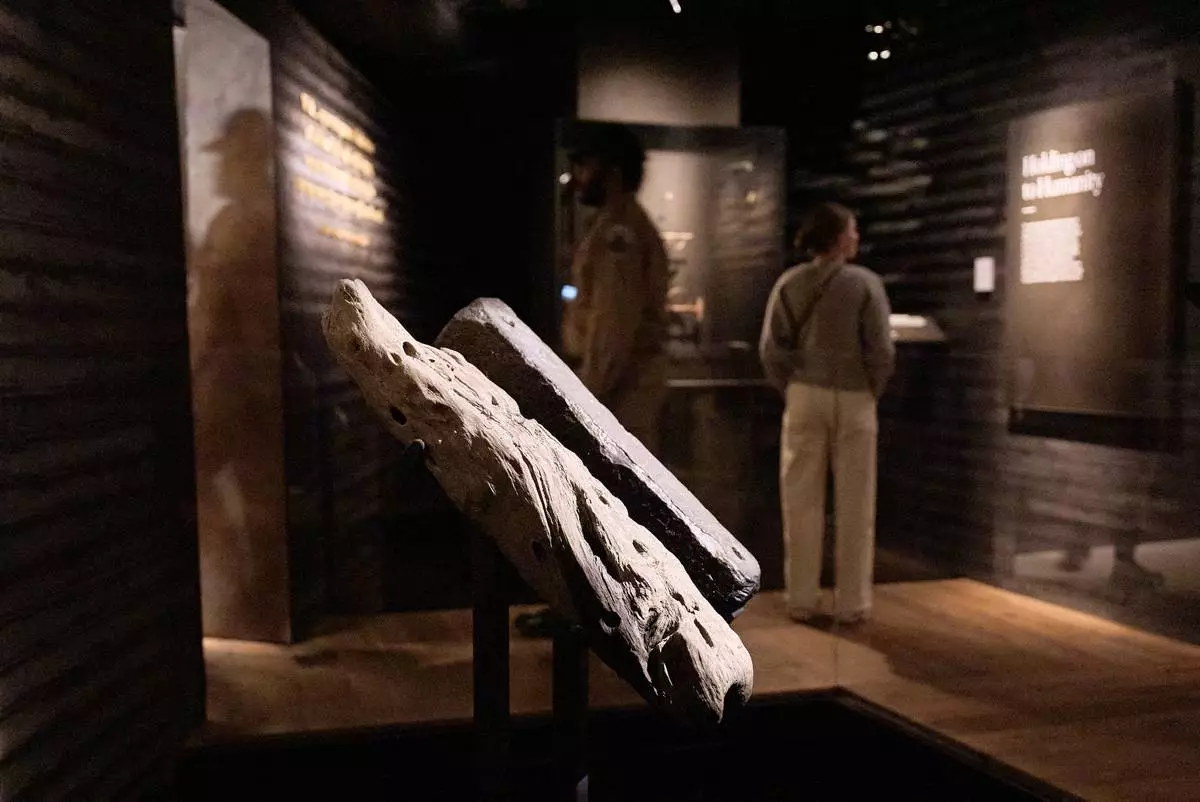
People visit the National Museum of African American History and Culture's Middle Passage exhibit, including a wooden timber, the artifact at left, from the slave ship, the São José-Paquete de Africa, Friday, March 6, 2026, in Washington. (AP Photo/Jacquelyn Martin)
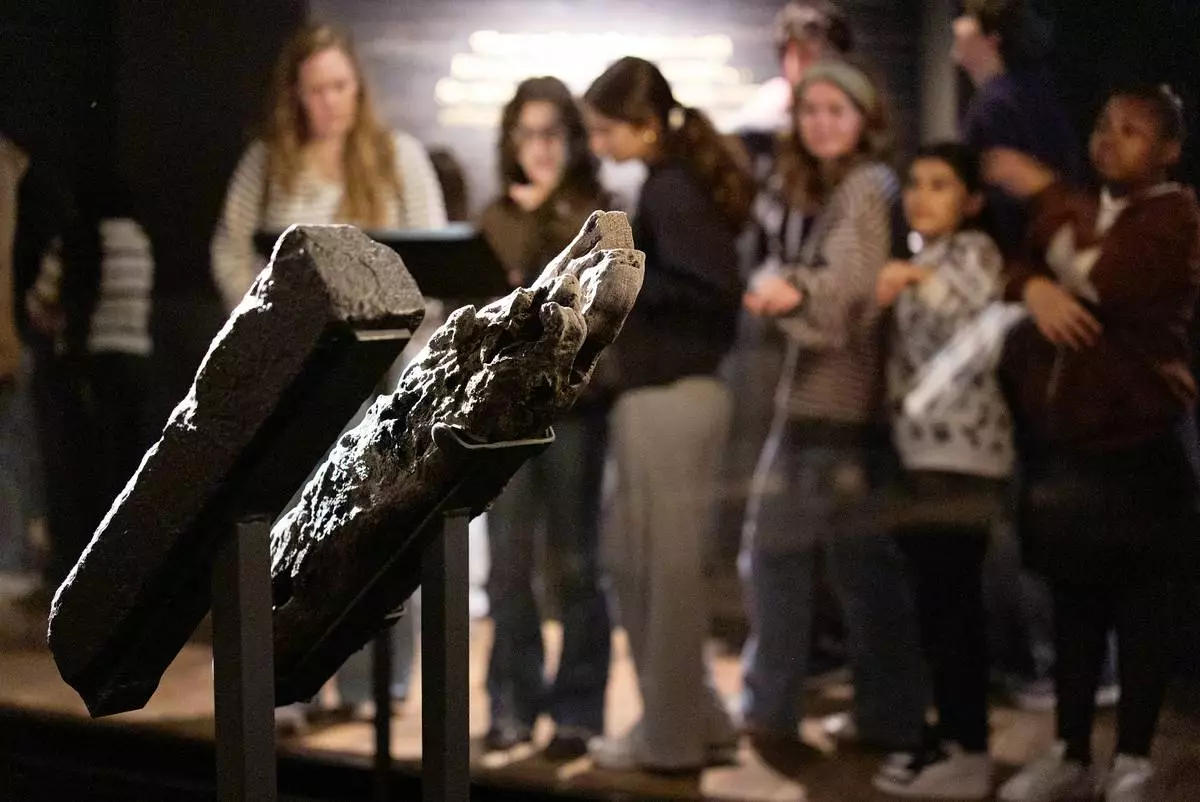
School children visit the National Museum of African American History and Culture's Middle Passage exhibit, behind a wooden timber, the artifact at right, from the slave ship, the São José-Paquete de Africa, Friday, March 6, 2026, in Washington. (AP Photo/Jacquelyn Martin)