DAVOS, Switzerland--(BUSINESS WIRE)--Jan 23, 2026--
His Excellency Majid A. Alkassabi, Saudi Arabia’s Minister of Commerce, today at the World Economic Forum Annual Meeting in Davos said the Kingdom stands to benefit from ongoing shifts in global supply chains.
This press release features multimedia. View the full release here: https://www.businesswire.com/news/home/20260123425621/en/
Speaking in a session titled ‘Many Shapes of Trade’, HE commented: “Trade today is definitely shifting from fair trade to a managed and rule-driven trade model. For us in Saudi Arabia, we have a strategic location, we have a lot of resources, we could become a bridge economy. We could become a connector economy where we can connect with Africa, with Europe, with Asia, becoming a logistic hub.”
His Excellency Ahmed A. Alkhateeb, Minister of Tourism, in a session called ‘The New Geography of Travel: Elevating Destinations, Expanding Opportunity’, said: “UN Tourism is projecting the number of tourists to grow to 2 billion by 2030, which means adding 500 million. This is a lot, and this is very encouraging for Saudi Arabia – for its hotel operators, investors, technology providers. This is an industry of amazing potential.”
His Excellency Mohammed A. Aljadaan, Minister of Finance said: “Our role as policymakers is to ensure that a predictable environment is provided for businesses, and we are doing so by strengthening the resilience of our economy and giving the private sector the confidence it needs.”
His Excellency Abdullah A. Alswaha, Minister of Communications and Information Technology, in ‘Converging Technologies to Win’, said: “In AI, the Kingdom is tackling the energy wall and the memory wall. We’re issuing a call to our partners, that in the Intelligence Age, you need a partner that can accelerate AI, but more critically adopt AI; and the Kingdom stands as your partner of choice.”
His Excellency Bandar I. Alkhorayef, Minister of Industry and Mineral Resources, in ‘A Collective Voice on the Future of Minerals: Aligning Policy, Investment and Supply’, said: “The Kingdom adopts a multilateral approach to international cooperation, creating platforms that enable dialogue and partnership. The Future Minerals Forum stands at the forefront, now a global convening platform uniting governments, industry, finance, academia, and technology leaders.”
Speaking in ‘Redefining Economic Partnerships: From Dialogue to Delivery’, His Excellency Faisal F. Alibrahim, Minister of Economy and Planning, said: “I believe there is a world where every country can unlock its economic potential and still keep dialogue open.” He added: “There has never been a more blank canvas or a wider opportunity for us to design the future.”
On Thursday, the Global Innovation Platform, a strategic partnership between Saudi HoldCo and GoldenPoint Global, launched the Saudi–U.S. Innovation Partnership. It is a nationally anchored platform designed to accelerate bilateral collaboration in life sciences, artificial intelligence, and advanced manufacturing. Anchored by the cities of Riyadh and Austin, the partnership aligns two of the world’s most dynamic innovation ecosystems.
Additionally, Amplifai Health was announced as a winner of the second cohort of WEF’s MINDS - AI Global Alliance initiative.
*Source:AETOSWire

Amid shifting global trade dynamics, Saudi Arabia underscores its role as a stable connector economy linking markets across regions (Photo: AETOSWire)
Winter has its fans, but even those who enjoy playing in the snow probably dislike the chore of clearing up after a big storm that dumps several inches or even feet of snow and ice.
It's easy to dash to the closest hardware store to grab a bag of salt, but experts say there are a lot of environmental and other factors to consider when tackling all that ice and snow.
Here's what to know.
Rock salt, also known as sodium chloride, is the cheapest and most commonly used product. But it's not great for the environment and it's not the most effective option out there.
“There's a chart we reference that’s chemical effectiveness at certain temperatures. And really, when you get to about 15 degrees or colder, you can keep applying more and more rock salt and it’s not going to do any more than it already does,” said Martin Tirado, CEO of the Snow and Ice Management Association, a trade group for industry professionals.
In those conditions, other products — calcium chloride, magnesium chloride — release heat that helps the salt work better, Tirado said.
The different formulations vary in other ways, too, including how quickly they work, their corrosiveness and how they interact with moisture. Calcium chloride and magnesium chloride can cost at least twice as much as rock salt.
But all contain chlorides that can pollute fresh water, damage shrubs, trees and grass and crumble concrete sidewalks, stoops and driveways.
Blends and coatings can reduce the corrosive nature and environmental hazards of these salts, experts say.
Calcium manganese acetate is one of the tamest de-icing products out there, developed specifically to replace rock salt and be more environmentally friendly. It is biodegradable, a corrosion inhibitor, and typically used as a liquid. But it is much more expensive and can still create issues with dissolved oxygen on bodies of water.
Pamela Bennett, a horticulture professor at Ohio State, said rock salt is the worst for plants. It gets them in two ways: through the roots and through the air.
Salt percolates through the soil. When plants start to draw in salty water in the spring, that dries roots, leading to dry leaves. Brown tips on leaves indicate the soil might have gotten too salty.
Salt can also reach plant foliage — in the winter, that's evergreens — directly when it's carried by mist and spray. That's an issue that's worse on major roads as a lot of traffic moves quickly.
“When you have a lot of road salt on the highways, cars are splashing and wind blows it. That salt turns into what looks like a burn,” Bennett says.
Most people walking their dog in snowy places have seen what happens when they walk across a heavy salt treatment — stopping suddenly and lifting a paw as if in pain.
“Their paw pads get dry or they get little cuts because those crystals are sharp, and then they’re chewing them because that’s the only way they know to make it feel better,” said Alison Manchester, an assistant clinical sciences professor at Cornell University. If they swallow enough salt, it can lead to vomiting, too.
For some people, animal safety is a strong reason to look to a nonsalt option against ice and snow.
Abrasives such as gravel and sand can help with grip, so pedestrians and tires are less likely to slip. But they also come with their own problems.
Sand that runs off into freshwater bodies — lakes, streams and rivers — can kill natural growth, Tirado said.
Sand can also accumulate in your soil, eventually becoming a problem for plant growth. It can even make a type of concrete when it mixes in clay-heavy soils, experts say.
Unconventional solutions are out there. You can buy a deicer that wraps its chlorides in beet juice or beet extract that coats the granules for a variety of benefits, including melting ice faster, working in colder temperatures and staying where it's put. And a Korean company, Star's Tech, is working with material taken from invasive starfish to produce a deicer that it says more slowly releases chloride material and thus avoids some of the corrosion and environmental problems of salt.
Experts say preparation and strategy can make clearing ice easier. That starts with watching forecasts to see how much snow is expected.
“People wait until after the storm to start shoveling,” Tirado said. “That’s fine if you’re having 1 to 2 inches. If you start getting 3, 4 or more inches than that, you can’t wait ... you need to go out multiple times. That way it keeps the paved surface more clear in a productive and proactive manner.”
Ground temperature matters. If it’s warmer, you may be able to use less than you think you need. Colder ground temperatures might require more.
Proper application of whatever you put on your sidewalk or driveway is important, too.
“The key here is to not use too much and scatter it too much,” said David Orr, director of the Local Roads Program at Cornell. “We also do probably need to get into the habit that it may not be perfectly bare and that can be OK.”
The Associated Press’ climate and environmental coverage receives financial support from multiple private foundations. AP is solely responsible for all content. Find AP’s standards for working with philanthropies, a list of supporters and funded coverage areas at AP.org.
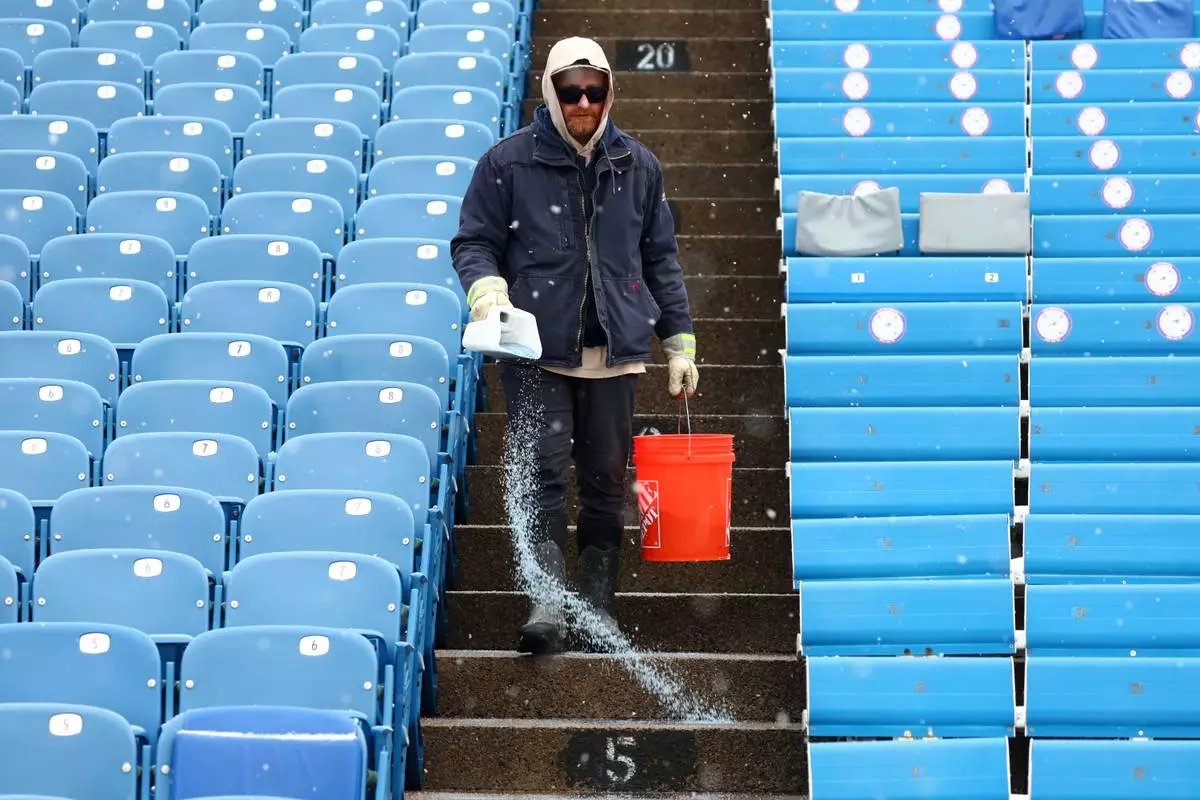
FILE - Salt is applied to the steps as snow falls at Buffalo Bills Highmark Stadium before an NFL football game between the Buffalo Bills and the Cincinnati Bengals, Dec. 7, 2025, in Orchard Park, N.Y. (AP Photo/Jeffrey T. Barnes, File)
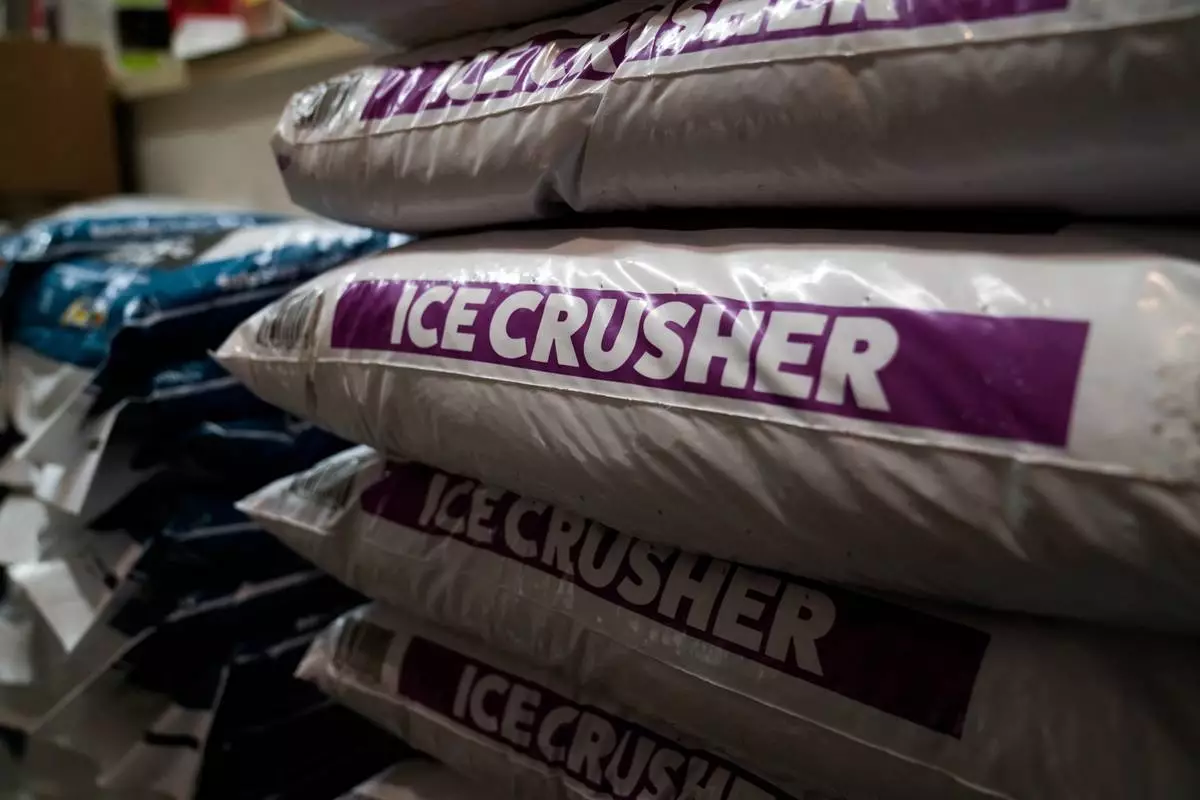
FILE - Ice Crusher, a calcium chloride blend road salt, is displayed for sale at Ankeny Hardware, Jan. 11, 2024, in Portland, Ore. (AP Photo/Jenny Kane, File)
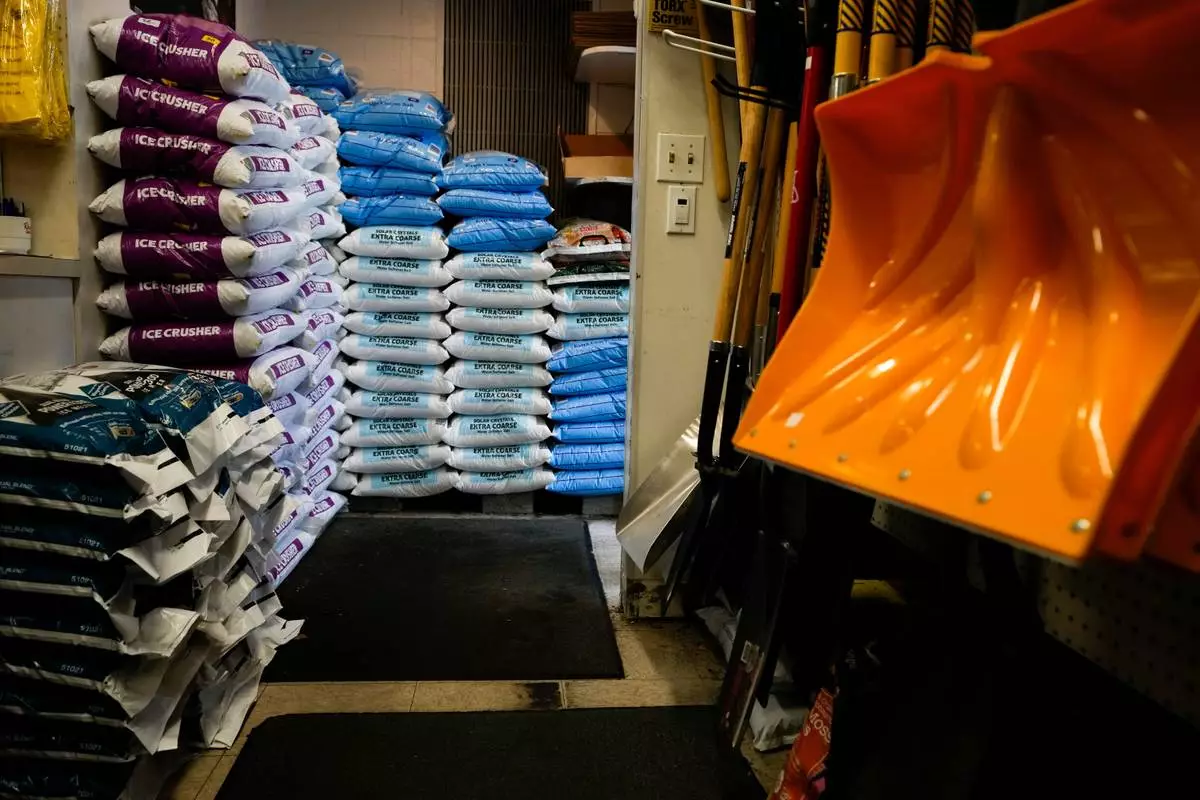
FILE - Salt and shovels are displayed for sale at Ankeny Hardware, Jan. 11, 2024, in Portland, Ore. (AP Photo/Jenny Kane, File)
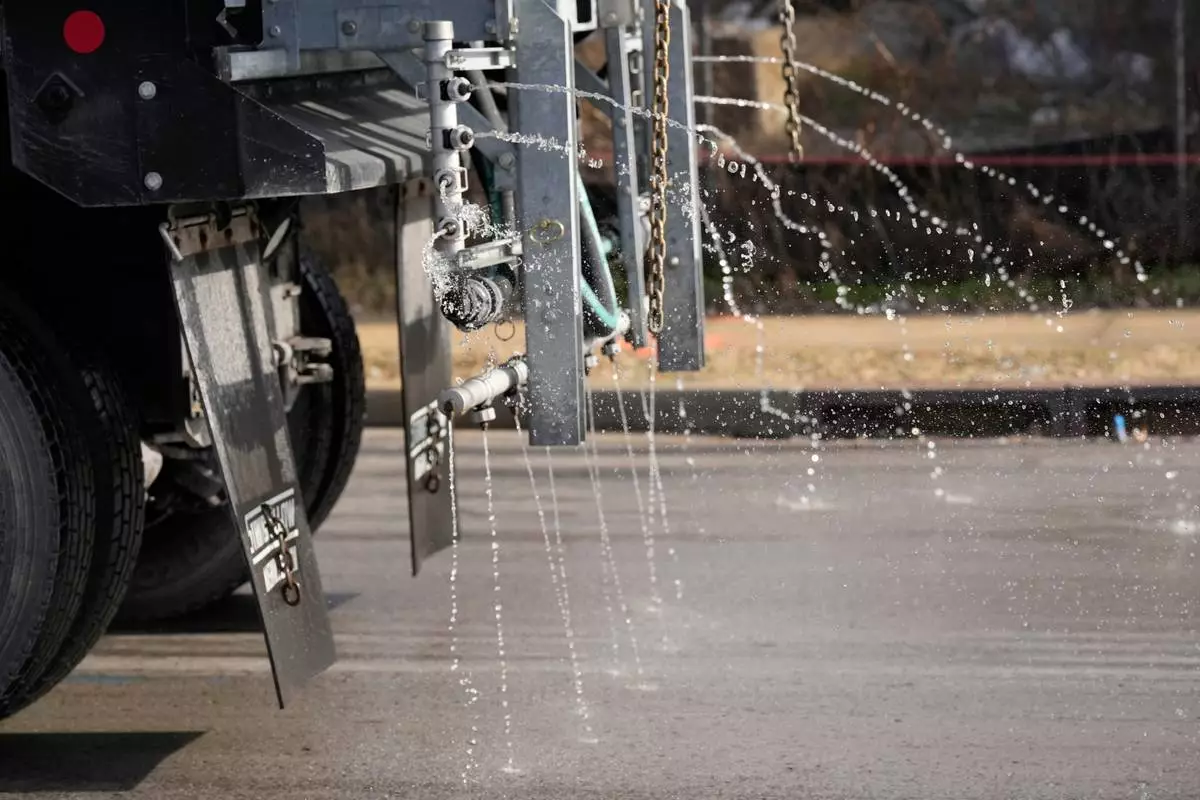
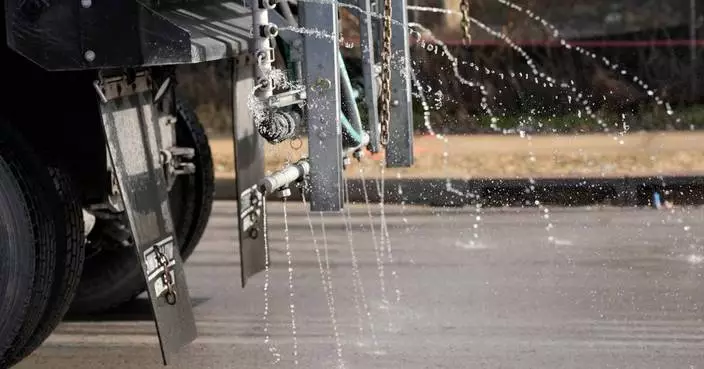
A Nashville Department of Transportation truck applies salt brine to a roadway Thursday, Jan. 22, 2026, in Nashville, Tenn., ahead of a winter storm expected to hit the state over the weekend. (AP Photo/George Walker IV)

FILE - Salt is spread on a street in Gelsenkirchen, Germany, Jan. 7, 2026. (AP Photo/Martin Meissner, File)