Skip to Content Facebook Feature Image

To clear ice and snow, there are rock salt alternatives that are safer for your pets and yard

TECH

To clear ice and snow, there are rock salt alternatives that are safer for your pets and yard
TECH

TECH

To clear ice and snow, there are rock salt alternatives that are safer for your pets and yard

2026-01-23 21:54 Last Updated At:01-24 12:55

Winter has its fans, but even those who enjoy playing in the snow probably dislike the chore of clearing up after a big storm that dumps several inches or even feet of snow and ice.

It's easy to dash to the closest hardware store to grab a bag of salt, but experts say there are a lot of environmental and other factors to consider when tackling all that ice and snow.

More Images
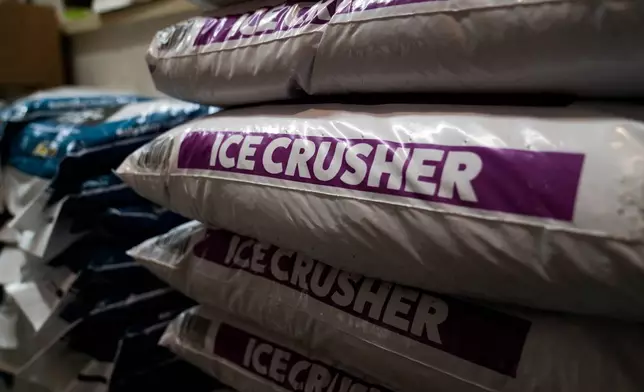
FILE - Salt is applied to the steps as snow falls at Buffalo Bills Highmark Stadium before an NFL football game between the Buffalo Bills and the Cincinnati Bengals, Dec. 7, 2025, in Orchard Park, N.Y. (AP Photo/Jeffrey T. Barnes, File)
FILE - Salt is applied to the steps as snow falls at Buffalo Bills Highmark Stadium before an NFL football game between the Buffalo Bills and the Cincinnati Bengals, Dec. 7, 2025, in Orchard Park, N.Y. (AP Photo/Jeffrey T. Barnes, File)

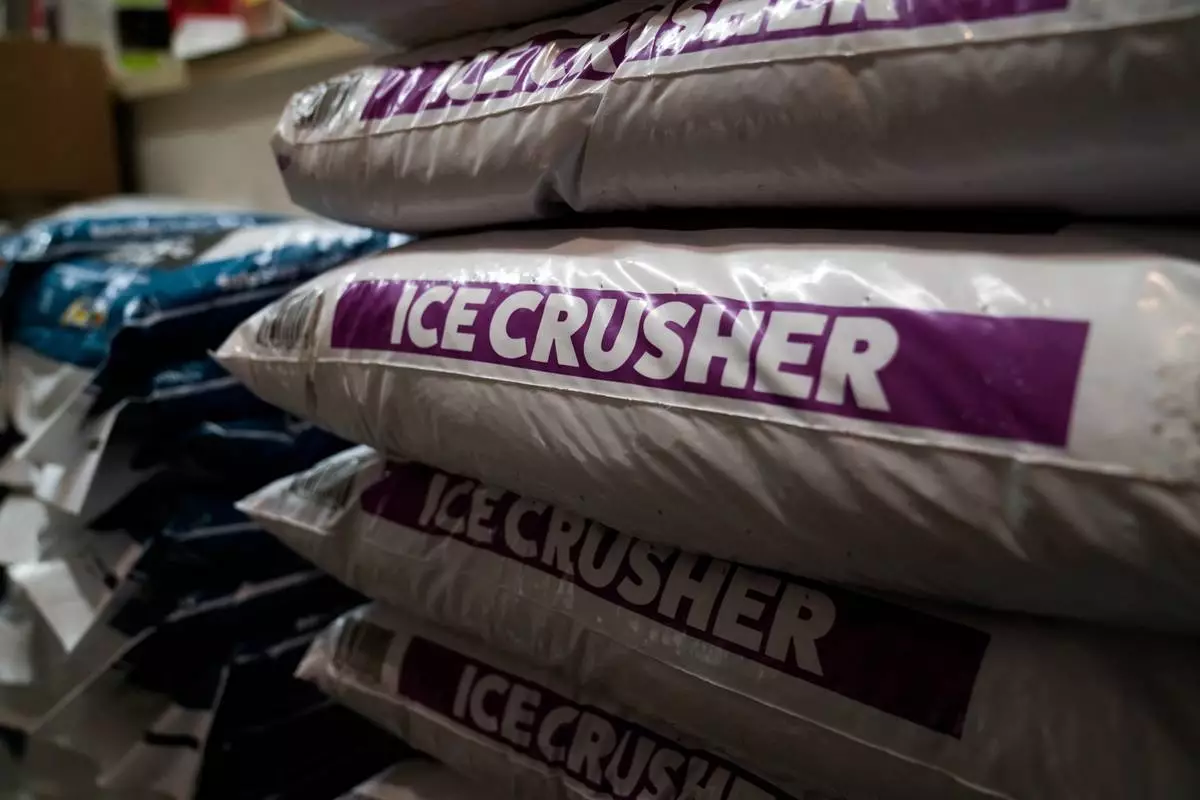
FILE - Ice Crusher, a calcium chloride blend road salt, is displayed for sale at Ankeny Hardware, Jan. 11, 2024, in Portland, Ore. (AP Photo/Jenny Kane, File)
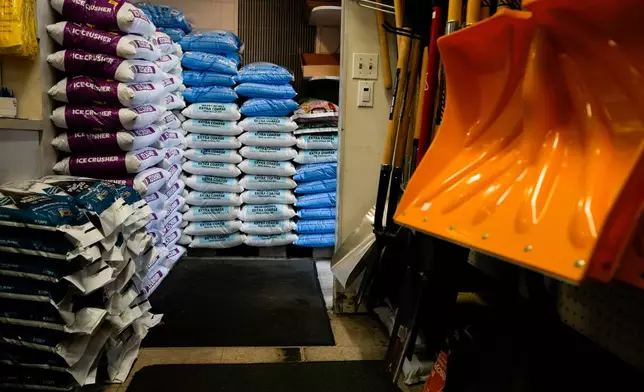
FILE - Ice Crusher, a calcium chloride blend road salt, is displayed for sale at Ankeny Hardware, Jan. 11, 2024, in Portland, Ore. (AP Photo/Jenny Kane, File)
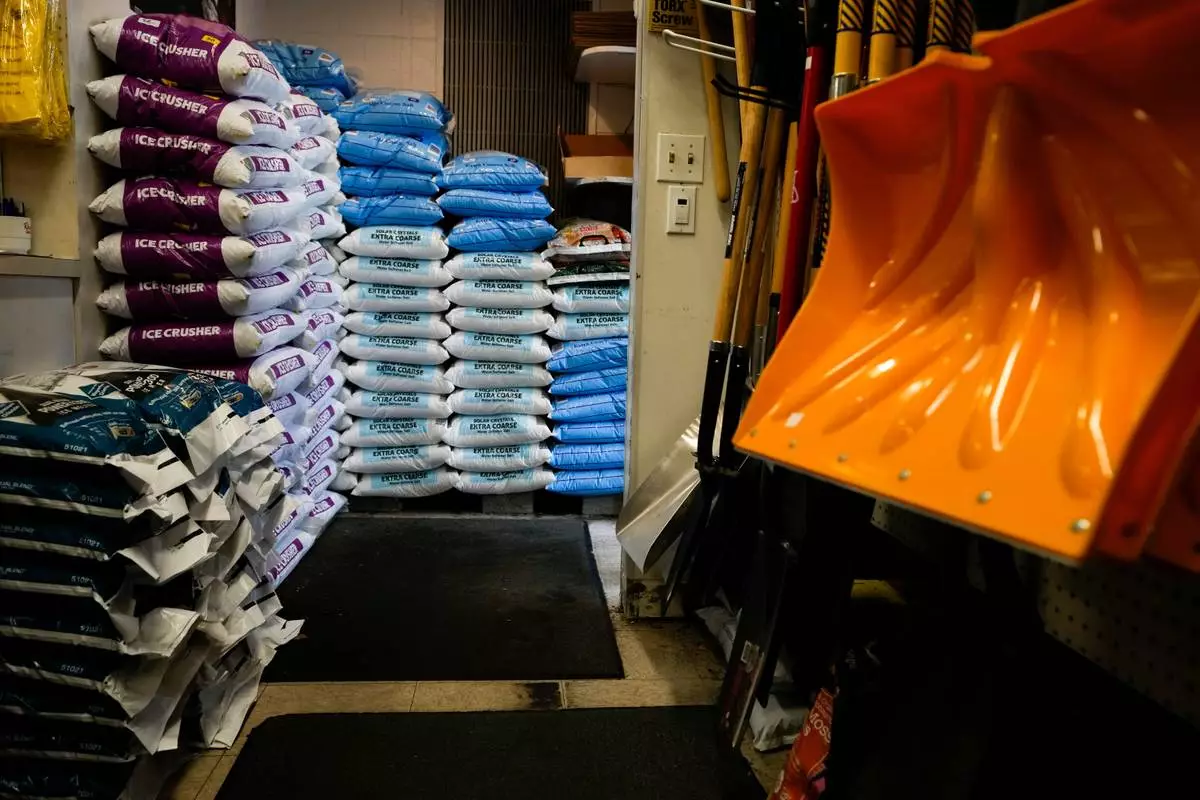
FILE - Salt and shovels are displayed for sale at Ankeny Hardware, Jan. 11, 2024, in Portland, Ore. (AP Photo/Jenny Kane, File)

FILE - Salt and shovels are displayed for sale at Ankeny Hardware, Jan. 11, 2024, in Portland, Ore. (AP Photo/Jenny Kane, File)

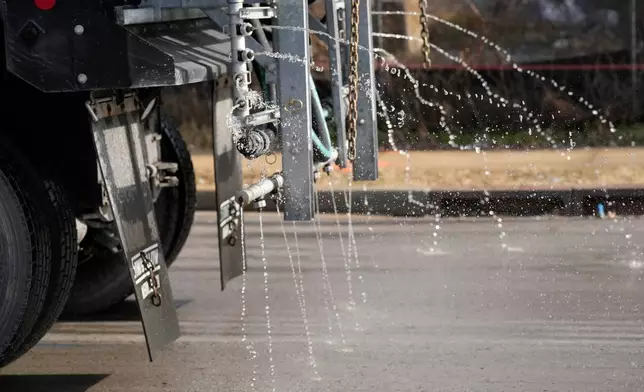
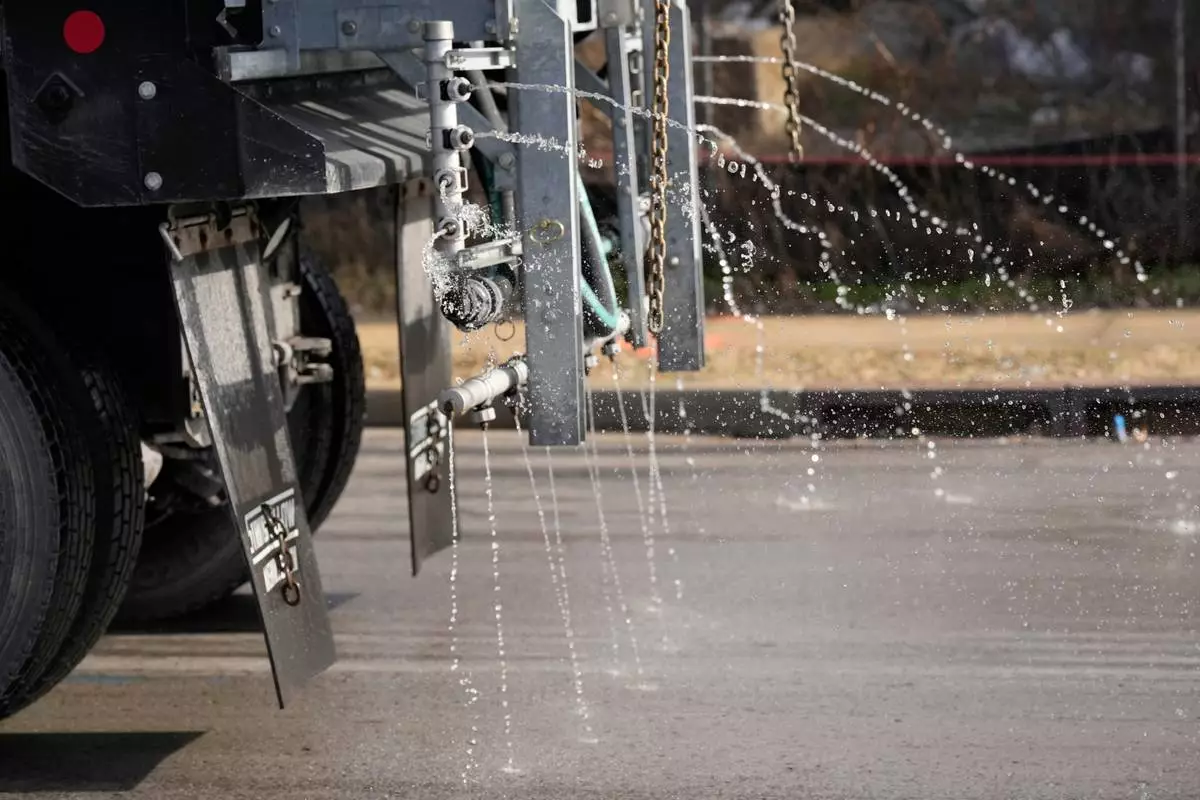
A Nashville Department of Transportation truck applies salt brine to a roadway Thursday, Jan. 22, 2026, in Nashville, Tenn., ahead of a winter storm expected to hit the state over the weekend. (AP Photo/George Walker IV)
A Nashville Department of Transportation truck applies salt brine to a roadway Thursday, Jan. 22, 2026, in Nashville, Tenn., ahead of a winter storm expected to hit the state over the weekend. (AP Photo/George Walker IV)

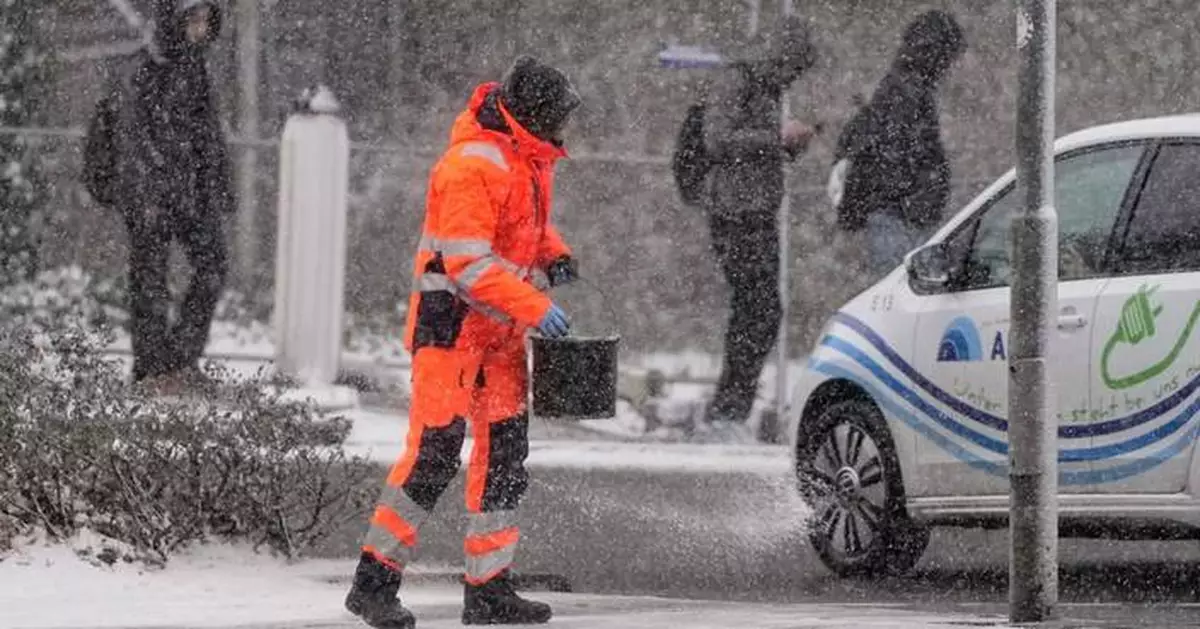
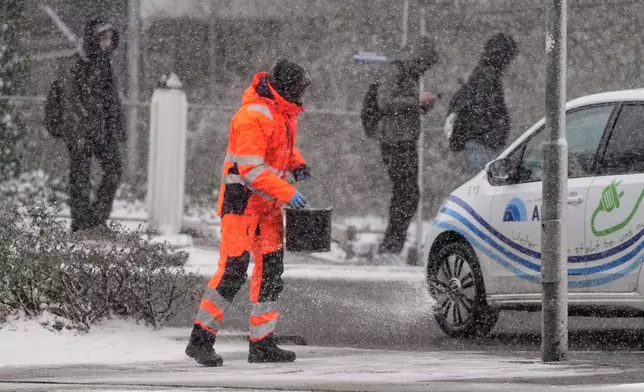
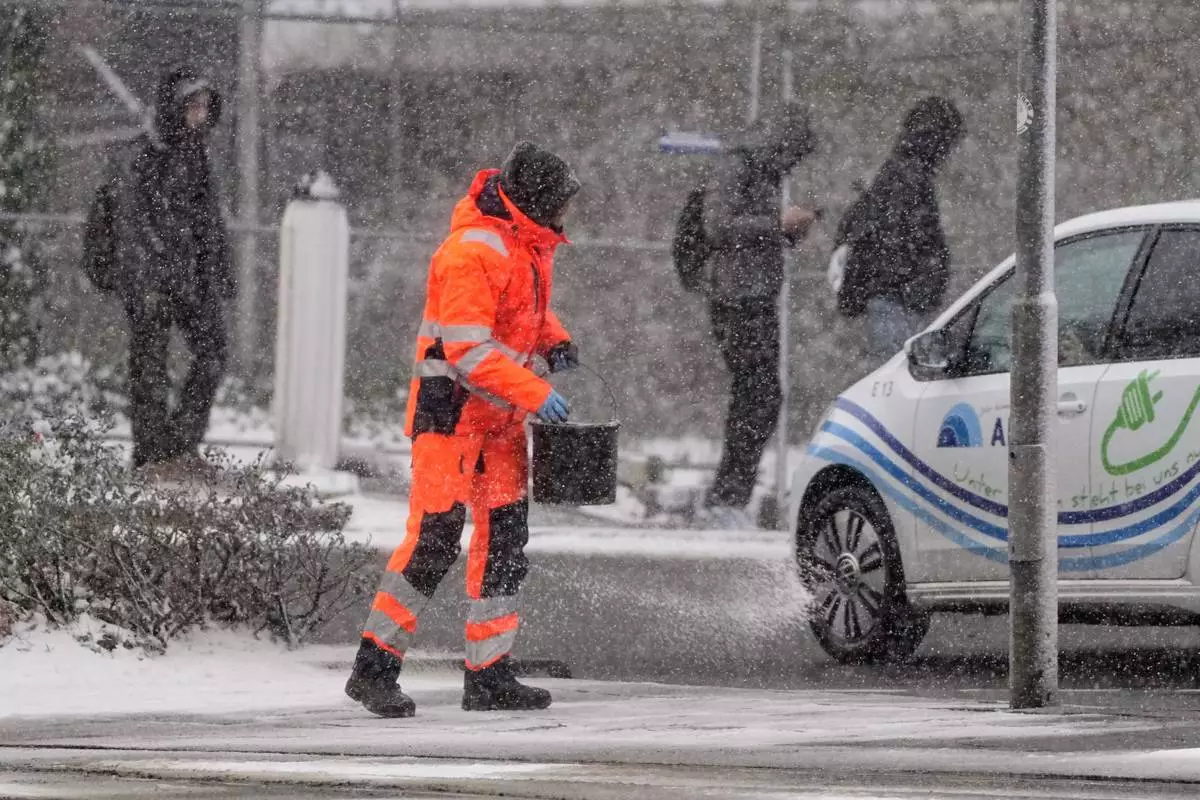
FILE - Salt is spread on a street in Gelsenkirchen, Germany, Jan. 7, 2026. (AP Photo/Martin Meissner, File)

FILE - Salt is spread on a street in Gelsenkirchen, Germany, Jan. 7, 2026. (AP Photo/Martin Meissner, File)

Here's what to know.

Rock salt, also known as sodium chloride, is the cheapest and most commonly used product. But it's not great for the environment and it's not the most effective option out there.

“There's a chart we reference that’s chemical effectiveness at certain temperatures. And really, when you get to about 15 degrees or colder, you can keep applying more and more rock salt and it’s not going to do any more than it already does,” said Martin Tirado, CEO of the Snow and Ice Management Association, a trade group for industry professionals.

In those conditions, other products — calcium chloride, magnesium chloride — release heat that helps the salt work better, Tirado said.

The different formulations vary in other ways, too, including how quickly they work, their corrosiveness and how they interact with moisture. Calcium chloride and magnesium chloride can cost at least twice as much as rock salt.

But all contain chlorides that can pollute fresh water, damage shrubs, trees and grass and crumble concrete sidewalks, stoops and driveways.

Blends and coatings can reduce the corrosive nature and environmental hazards of these salts, experts say.

Calcium manganese acetate is one of the tamest de-icing products out there, developed specifically to replace rock salt and be more environmentally friendly. It is biodegradable, a corrosion inhibitor, and typically used as a liquid. But it is much more expensive and can still create issues with dissolved oxygen on bodies of water.

Pamela Bennett, a horticulture professor at Ohio State, said rock salt is the worst for plants. It gets them in two ways: through the roots and through the air.

Salt percolates through the soil. When plants start to draw in salty water in the spring, that dries roots, leading to dry leaves. Brown tips on leaves indicate the soil might have gotten too salty.

Salt can also reach plant foliage — in the winter, that's evergreens — directly when it's carried by mist and spray. That's an issue that's worse on major roads as a lot of traffic moves quickly.

“When you have a lot of road salt on the highways, cars are splashing and wind blows it. That salt turns into what looks like a burn,” Bennett says.

Most people walking their dog in snowy places have seen what happens when they walk across a heavy salt treatment — stopping suddenly and lifting a paw as if in pain.

“Their paw pads get dry or they get little cuts because those crystals are sharp, and then they’re chewing them because that’s the only way they know to make it feel better,” said Alison Manchester, an assistant clinical sciences professor at Cornell University. If they swallow enough salt, it can lead to vomiting, too.

For some people, animal safety is a strong reason to look to a nonsalt option against ice and snow.

Abrasives such as gravel and sand can help with grip, so pedestrians and tires are less likely to slip. But they also come with their own problems.

Sand that runs off into freshwater bodies — lakes, streams and rivers — can kill natural growth, Tirado said.

Sand can also accumulate in your soil, eventually becoming a problem for plant growth. It can even make a type of concrete when it mixes in clay-heavy soils, experts say.

Unconventional solutions are out there. You can buy a deicer that wraps its chlorides in beet juice or beet extract that coats the granules for a variety of benefits, including melting ice faster, working in colder temperatures and staying where it's put. And a Korean company, Star's Tech, is working with material taken from invasive starfish to produce a deicer that it says more slowly releases chloride material and thus avoids some of the corrosion and environmental problems of salt.

Experts say preparation and strategy can make clearing ice easier. That starts with watching forecasts to see how much snow is expected.

“People wait until after the storm to start shoveling,” Tirado said. “That’s fine if you’re having 1 to 2 inches. If you start getting 3, 4 or more inches than that, you can’t wait ... you need to go out multiple times. That way it keeps the paved surface more clear in a productive and proactive manner.”

Ground temperature matters. If it’s warmer, you may be able to use less than you think you need. Colder ground temperatures might require more.

Proper application of whatever you put on your sidewalk or driveway is important, too.

“The key here is to not use too much and scatter it too much,” said David Orr, director of the Local Roads Program at Cornell. “We also do probably need to get into the habit that it may not be perfectly bare and that can be OK.”

The Associated Press’ climate and environmental coverage receives financial support from multiple private foundations. AP is solely responsible for all content. Find AP’s standards for working with philanthropies, a list of supporters and funded coverage areas at AP.org.
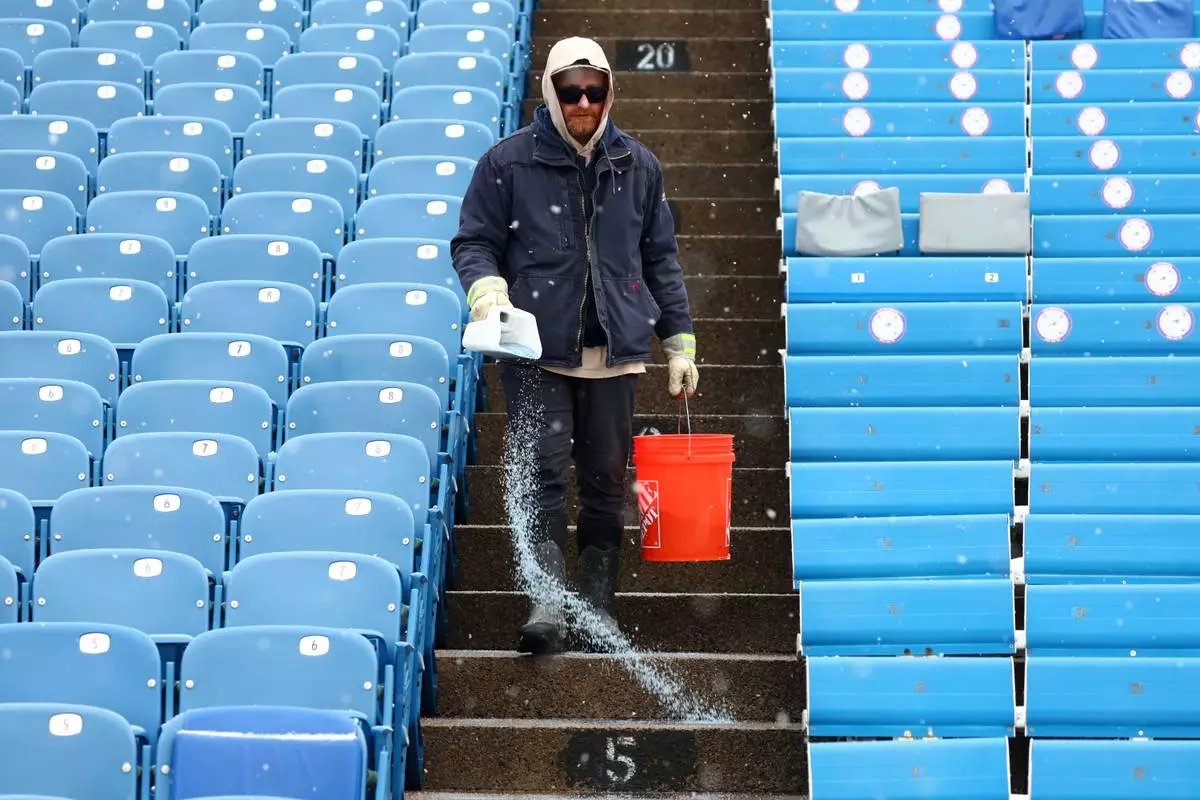
FILE - Salt is applied to the steps as snow falls at Buffalo Bills Highmark Stadium before an NFL football game between the Buffalo Bills and the Cincinnati Bengals, Dec. 7, 2025, in Orchard Park, N.Y. (AP Photo/Jeffrey T. Barnes, File)
FILE - Salt is applied to the steps as snow falls at Buffalo Bills Highmark Stadium before an NFL football game between the Buffalo Bills and the Cincinnati Bengals, Dec. 7, 2025, in Orchard Park, N.Y. (AP Photo/Jeffrey T. Barnes, File)

FILE - Ice Crusher, a calcium chloride blend road salt, is displayed for sale at Ankeny Hardware, Jan. 11, 2024, in Portland, Ore. (AP Photo/Jenny Kane, File)
FILE - Ice Crusher, a calcium chloride blend road salt, is displayed for sale at Ankeny Hardware, Jan. 11, 2024, in Portland, Ore. (AP Photo/Jenny Kane, File)
FILE - Salt and shovels are displayed for sale at Ankeny Hardware, Jan. 11, 2024, in Portland, Ore. (AP Photo/Jenny Kane, File)

FILE - Salt and shovels are displayed for sale at Ankeny Hardware, Jan. 11, 2024, in Portland, Ore. (AP Photo/Jenny Kane, File)

A Nashville Department of Transportation truck applies salt brine to a roadway Thursday, Jan. 22, 2026, in Nashville, Tenn., ahead of a winter storm expected to hit the state over the weekend. (AP Photo/George Walker IV)
A Nashville Department of Transportation truck applies salt brine to a roadway Thursday, Jan. 22, 2026, in Nashville, Tenn., ahead of a winter storm expected to hit the state over the weekend. (AP Photo/George Walker IV)

FILE - Salt is spread on a street in Gelsenkirchen, Germany, Jan. 7, 2026. (AP Photo/Martin Meissner, File)


FILE - Salt is spread on a street in Gelsenkirchen, Germany, Jan. 7, 2026. (AP Photo/Martin Meissner, File)
TUCSON, Ariz. (AP) — Law enforcement agents have been gathering more potential evidence as the search for “Today” show host Savannah Guthrie 's mother heads into its third week.

Nancy Guthrie, 84, was last seen at her Arizona home on Jan. 31 and was reported missing the following day. Authorities say her blood was found on the front porch. Purported ransom notes were sent to news outlets, but two deadlines for paying have passed.

Authorities have expressed concern about Nancy Guthrie’s health because she needs vital daily medicine. She is said to have a pacemaker and have dealt with high blood pressure and heart issues, according to sheriff’s dispatcher audio on broadcastify.com.

Here's what to know about her disappearance and the intense search to find her:

The Federal Bureau of Investigation released surveillance videos of a masked person wearing a handgun holster outside Guthrie’s front door in Tucson the night she vanished. A porch camera recorded video of a person with a backpack who was wearing a ski mask, long pants, jacket and gloves.

On Thursday, the FBI called the person a suspect. It described him as a man about 5 feet, 9 inches tall with a medium build. The agency said he was carrying a 25-liter “Ozark Trail Hiker Pack” backpack.

Investigators initially said there was no surveillance video available since Guthrie didn’t have an active subscription to the doorbell camera company. But digital forensics experts kept working to find images in back-end software that might have been lost, corrupted or inaccessible.

Investigators collected DNA from Guthrie’s property which doesn’t belong to Guthrie or those in close contact with her, the Pima County Sheriff's Department said. Investigators are working to identify who it belongs to.

Evidence requiring forensic analysis is being sent to the same out-of-state lab that has been used since the beginning of the case, the department said.

Investigators found several gloves, the nearest about 2 miles (3.2 kilometers) from Guthrie’s home, and submitted them for lab analysis, the sheriff’s department said. It did not specify what type of gloves.

The sheriff stressed his department is working closely with the FBI.

The Pima County sheriff and the FBI announced phone numbers and a website to offer tips. Several hundred detectives and agents have been assigned to the case, the sheriff’s department said.

The FBI said it has collected more than 13,000 tips since Feb. 1, the day Guthrie was reported missing. The sheriff’s department, meanwhile, said it has taken at least 18,000 calls.

The sheriff’s department has not said whether any tips have advanced the investigation.

Late Friday night, law enforcement sealed off a road about 2 miles (3.2 kilometers) from Guthrie’s home as part of their investigation. A parade of sheriff’s and FBI vehicles, including forensics vehicles, passed through the roadblock.

The sheriff’s department said the activity was part of the Guthrie investigation but declined to detail specifics.

On Tuesday, sheriff deputies detained a person for questioning during a traffic stop south of Tucson. Authorities didn’t say what led them to stop the man but confirmed he was released.

The same day, deputies and FBI agents conducted a court-authorized search in Rio Rico, about an hour's drive south of the city.

Savannah Guthrie, her sister and her brother have shared on social media multiple video messages to their mother’s purported captor.

The family’s Instagram videos have shifted in tone from impassioned pleas to whoever may have their mom, saying they want to talk and are even willing to pay a ransom, to bleaker and more desperate requests for the public’s help.

The latest video on Thursday was simply a home video of their mother and a promise to “never give up on her.”

Nancy Guthrie lived alone in the upscale Catalina Foothills neighborhood, where houses are spaced far apart and set back from the street by long driveways, gates and dense desert vegetation.

Savannah Guthrie grew up in Tucson, graduated from the University of Arizona and once worked at a television station in the city, where her parents settled in the 1970s. She joined “Today” in 2011.

In a video, she described her mother as a “loving woman of goodness and light.”

People hang yellow ribbons in their neighborhood around Nancy Guthrie’s home in Tucson, Ariz., on Friday, Feb. 13, 2026. (AP Photo/Ty ONeil)

People hang yellow ribbons in their neighborhood around Nancy Guthrie’s home in Tucson, Ariz., on Friday, Feb. 13, 2026. (AP Photo/Ty ONeil)

A banner reading "Bring her home" on a fence outside of the KVOA news station in Tucson, Ariz., on Friday, Feb. 13, 2026. (AP Photo/Ty ONeil)

A banner reading "Bring her home" on a fence outside of the KVOA news station in Tucson, Ariz., on Friday, Feb. 13, 2026. (AP Photo/Ty ONeil)

A person places flowers in front of Nancy Guthrie’s home in Tucson, Ariz., on Friday, Feb. 13, 2026. (AP Photo/Ty ONeil)

A person places flowers in front of Nancy Guthrie’s home in Tucson, Ariz., on Friday, Feb. 13, 2026. (AP Photo/Ty ONeil)

Recommended Articles