WASHINGTON (AP) — President Donald Trump gives. And he takes away.
Offended by Canadian Prime Minister Mark Carney's increasingly assertive posture toward the U.S., Trump revoked an invitation to join his Board of Peace. Many Western allies are suspicious of the organization, which is chaired by Trump and was initially formed to focus on maintaining the ceasefire in Israel's war with Hamas but has grown into something skeptics fear could rival the United Nations.
Appearing at the World Economic Forum, Trump spoke of imposing tariffs on Switzerland — which he ultimately lowered — because the country's leader “rubbed me the wrong way” during a phone call. Before shelving sweeping tariffs on multiple European countries, Trump pressed Denmark to “say yes” to the U.S. push to control Greenland “and we will be very appreciative. Or you can say no and we will remember,” he said, imperiling the NATO alliance.
Over his decades in public life, Trump has never been one for niceties. But even by his standards, the tumult of the past week stood out because it crystallized his determination to erase the rules-based order that has governed U.S. foreign policy — and by extension most of the Western world — since World War II.
The president and his supporters have dismissed that approach as inefficient, overly focused on compromise and unresponsive to the needs of people contending with rapid economic change. But in its place, Trump is advancing a system that is poorly understood and could prove far less stable, driven by the whims of a single, often mercurial, leader who regularly demonstrates that personal flattery or animus can shape his decisions.
Returning to the U.S. from Davos, home to the World Economic Forum, Republican Sen. Lisa Murkowski of Alaska said the phrase she heard “over and over” was that “we are entering this new world order” as she described a sense of confusion among allies.
“It may be you just had a bad telephone call with the president and now you're going to have tariffs directed at you,” she told reporters. “This lack of stability and reliability, I think, is causing what were traditionally reliable trade partners to be saying to other countries, ‘Hey, maybe you and I should talk because I’m not sure about what’s going on with the United States.’”
The Trump-centric approach to governing is hardly surprising for someone who accepted his first Republican presidential nomination in 2016 by declaring that “I alone can fix” the nation's problems. As he settles into his second term with a far more confident demeanor than his first, he has delighted supporters with his to-the-victor -goes-the-spoils style.
Steve Bannon, Trump's former adviser, recently told the Atlantic that Trump is pursuing a “maximalist strategy” and that he must keep going “until you meet resistance.”
“And we haven’t met any resistance,” Bannon said.
That's certainly true in Washington, where the Republican-controlled Congress has done little to check Trump's impulses. But leaders of other countries, who have spent much of Trump's administration trying to find ways to work with him, are increasingly vocal.
Carney is quickly emerging as a leader of a movement for countries to find ways to link up and counter the U.S. Speaking in Davos ahead of Trump, Carney said, “Middle powers must act together because if you are not at the table, you are on the menu.”
“In a world of great power rivalry, the countries in between have a choice: to compete with each other for favor or to combine to create a third path with impact,” he continued. “We should not allow the rise of hard powers to blind us to the fact that the power of legitimacy, integrity, and rules will remain strong — if we choose to wield it together.”
Trump did not take kindly to those remarks, responding with threats in Davos before yanking the Board of Peace invitation.
“Canada lives because of the United States,” Trump said. “Remember that, Mark, the next time you make your statements.”
Carney, however, was unbowed, speaking of Canada as “an example to a world at sea” as he crafted a potential template for other world leaders navigating a new era.
“We can show that another way is possible, that the arc of history isn’t destined to be warped toward authoritarianism and exclusion,” he said in a speech before a cabinet retreat in Quebec City.
In the UK, Prime Minister Keir Starmer blasted Trump on Friday for “insulting and frankly appalling” comments in which he expressed doubt that NATO would support the U.S. if requested. The president seemingly ignored that the only time Article 5 of NATO’s founding treaty, which requires all member countries to help another member under threat, was invoked was after the 9/11 attacks on the U.S.
Referring to non-US troops, Trump told Fox Business Network, “You know, they’ll say they sent some troops to Afghanistan, or this or that, and they did, they stayed a little back, a little off the front lines.”
Starmer, noting the 457 British personnel who died and those with life-long injuries, said he will “never forget their courage, their bravery and the sacrifice they made for their country.” Denmark, which Trump has belittled as “ungrateful” for U.S. protection during World War II, had the highest per capita death toll among coalition forces in Afghanistan.
His tactics have raised fears that Trump is imposing long-term damage on the U.S. standing in the world and encouraging countries to rethink their alliances and deepen their ties with China. Carney already traveled there earlier this month to meet with President Xi Jinping.
“China’s leadership watched an American president fight with allies, insult world leaders, and engage in bizarre antics, and thought to themselves — this is nothing but good for us,” Jake Sullivan, former President Joe Biden's national security adviser, said in an email.
The administration is showing no sign of backing down. The Pentagon released a defense strategy late Friday telling allies to handle their own security. And Trump on Saturday threatened to impose a 100% tariff on goods imported from Canada if the country went ahead with its China trade deal.
Sen. Chris Coons of Delaware, a Democrat on the Foreign Relations Committee, was in Davos and participated in a bipartisan delegation to Denmark with Murkowski that was intended to show unity amid Trump's bid for Greenland. Recalling his conversations with other leaders, he told reporters on Friday that Trump has shown he only backs down when countries like China “showed toughness and a resiliency.”
“Those who were accommodating and who negotiated in good faith, like the EU, which did not impose retaliatory tariffs, seemed to have not won any of his respect,” Coons said. “They can reach their own conclusions, but it would seem to me that trying to find a way to accommodate him when the foundation of his demands about Greenland is unhinged … seem to me to suggest a course of action.”
Associated Press writers Becky Bohrer in Juneau, Alaska, Rob Gillies in Toronto and Pan Pylas in London contributed to this report.
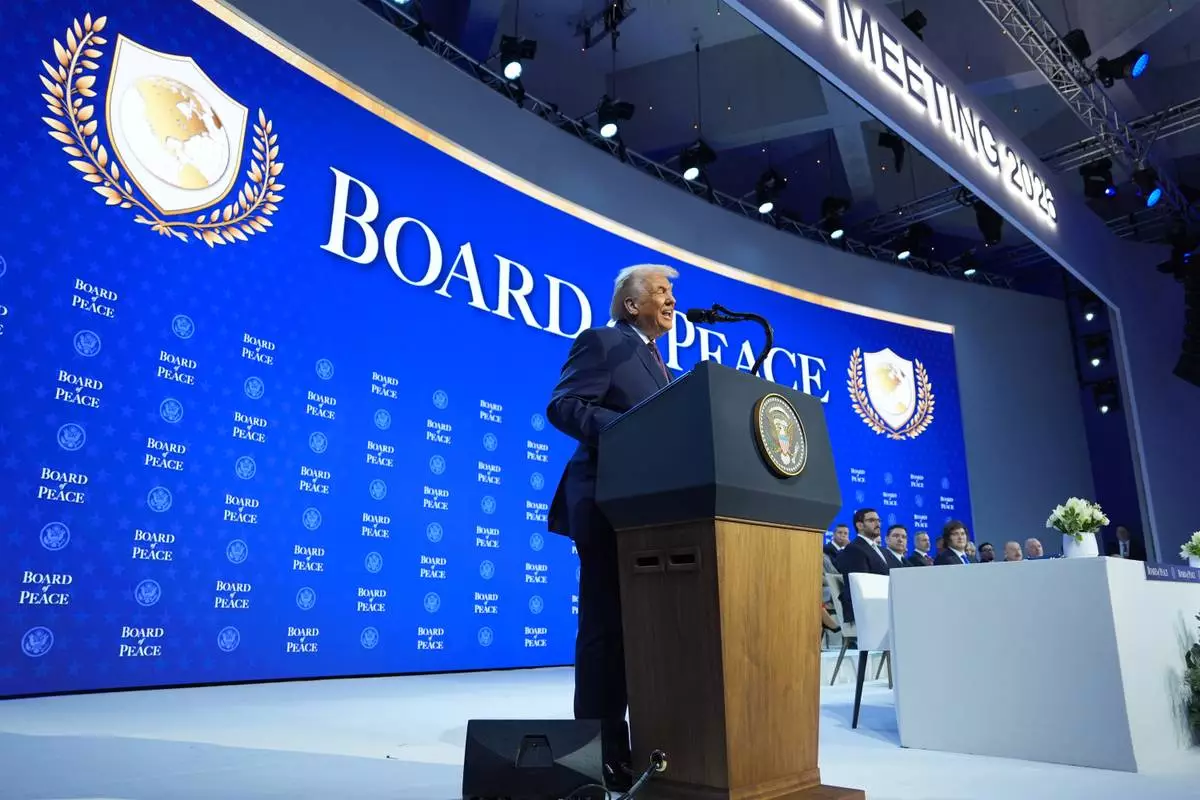
President Donald Trump speaks during a Board of Peace charter announcement during the Annual Meeting of the World Economic Forum in Davos, Switzerland, Thursday, Jan. 22, 2026. (AP Photo/Evan Vucci)
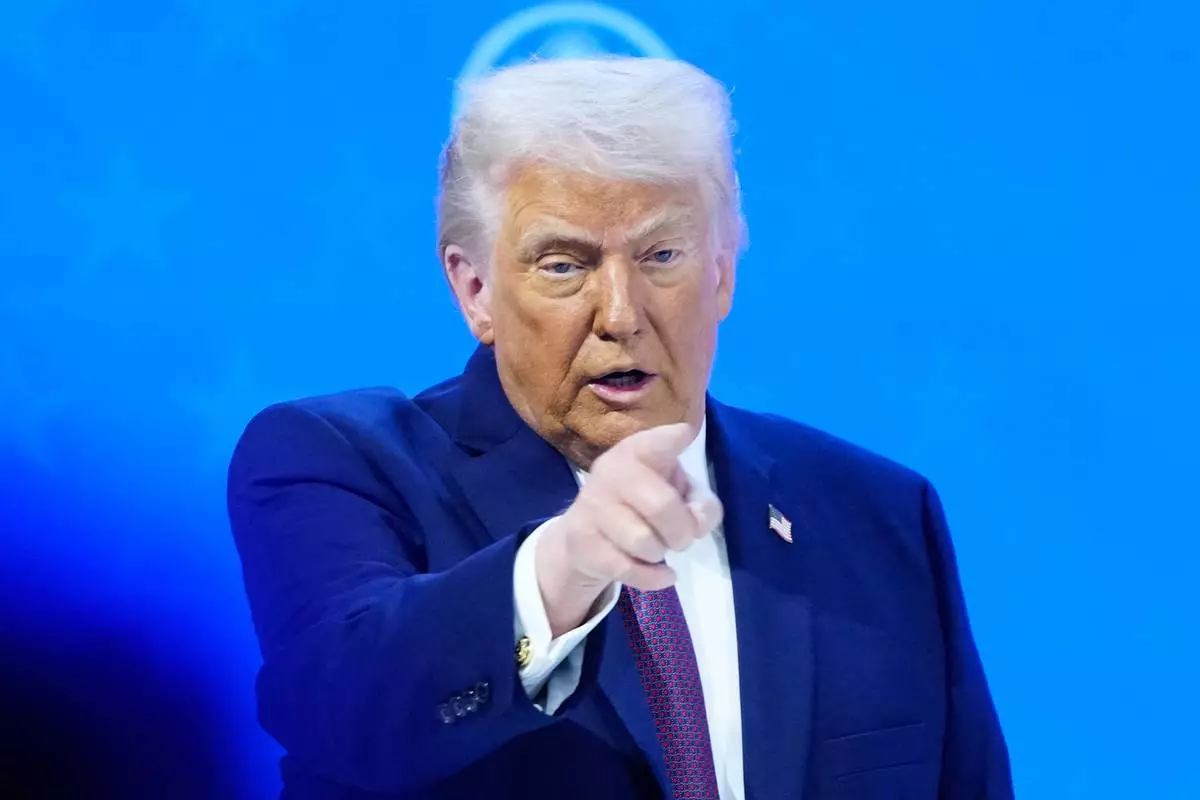
President Donald Trump reacts during a signing ceremony on his Board of Peace initiative at the Annual Meeting of the World Economic Forum in Davos, Switzerland, Thursday, Jan. 22, 2026. (AP Photo/Markus Schreiber)
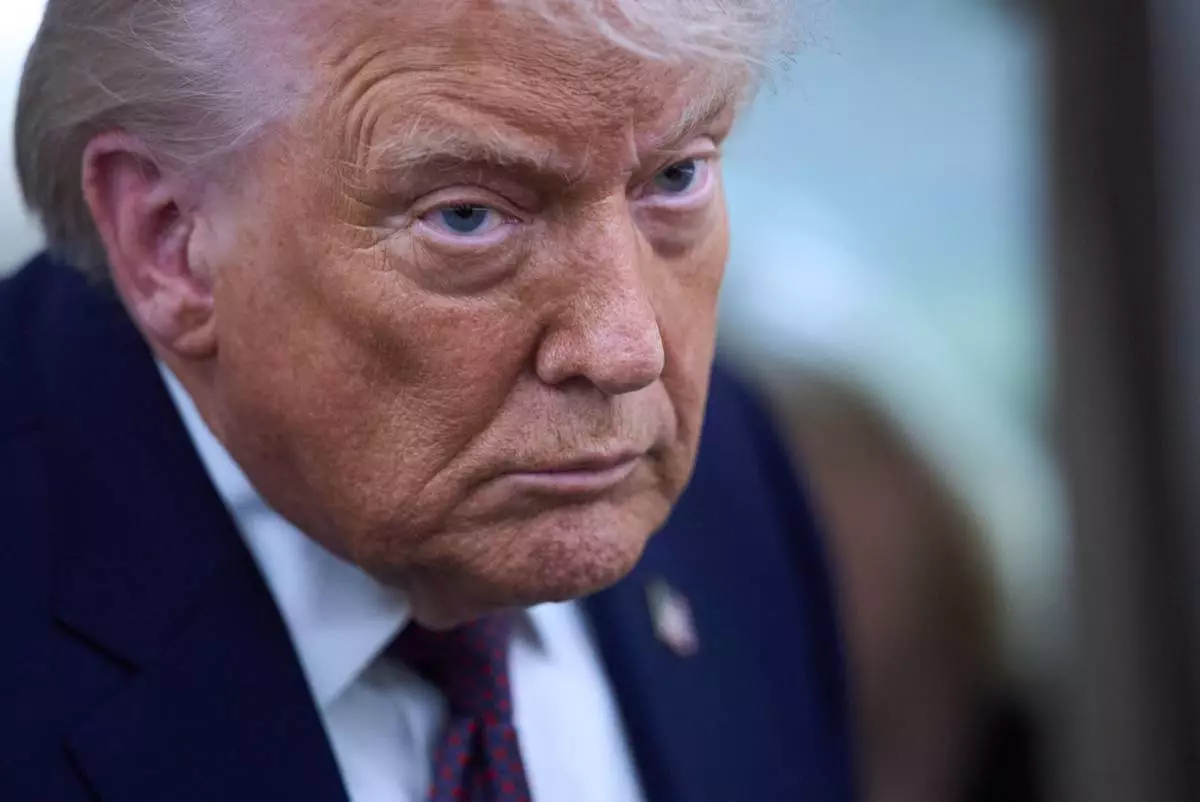
President Donald Trump speaks with reporters aboard Air Force One after leaving the World Economic Forum in Davos for Washington, Thursday, Jan. 22, 2026. (AP Photo/Evan Vucci)
U.S. Defense Secretary Pete Hegseth said Tuesday would be the most intense day yet of U.S. strikes inside Iran. The Islamic Republic, its firepower diminished, vowed to fight on. Israeli Prime Minister Benjamin Netanyahu said the war’s aim is a popular overthrow of Iran’s government, and “we are breaking their bones.” White House press secretary Karoline Leavitt said U.S. President Donald Trump “is not making anything up” as he offers varying justifications for launching the war.
The U.S. stock market and oil prices were holding relatively steady Tuesday after Trump's signals about how long the war could last caused wild swings in financial and fuel markets. The Pentagon, meanwhile, offered its first tally of American wounded, saying about 140 U.S. troops have been injured, eight severely.
Iranian Parliament Speaker Mohammad Bagher Qalibaf dismissed any suggestion of seeking a ceasefire, while another top Iranian security official, Ali Larijani, warned Trump himself, writing on X that “Iran doesn’t fear your empty threats. Even those bigger than you couldn’t eliminate Iran. Be careful not to get eliminated yourself.”
Here is the latest:
The Ministry of Defense said early Wednesday that it intercepted and destroyed six ballistic missiles launched toward Prince Sultan Air Base, a major U.S.- and Saudi-operated facility in eastern Saudi Arabia.
The ministry also said it intercepted and destroyed two drones over Hafar al-Batin, a major eastern city.
Since the conflict resumed between Hezbollah and Israel after Hezbollah fired rockets into Israel early last week, at least five Lebanese soldiers have been killed.
The man succumbed to his wounds early Wednesday, two days after the strike on his team while they were rescuing people following an earlier attack, the Lebanese Health Ministry said.
It is the first time a Red Cross worker has been killed since the conflict between Hezbollah and Israel erupted March 2.
The Health Ministry and the Lebanese Red Cross have condemned repeated strikes on medical and rescue teams. Another, separate strike Monday wounded one member of a team.
Pyongyang also criticized the United States and Israel for what it called “illegal” attacks on Iran and interference in its internal affairs.
In comments attributed to an unidentified Foreign Ministry spokesperson, North Korea said it respects Iranians’ right to choose their leader.
The spokesperson denounced the United States and Israel, saying their military actions against Iran and efforts to “interfere in its internal affairs and openly advocate the attempt to overthrow its social system deserve worldwide criticism.”
Separately, state media reported that leader Kim Jong Un supervised tests of nuclear-capable cruise missiles from a prized new warship for the second time in two weeks.
Some analysts say the display of naval power is meant to showcase Kim’s military capabilities after the killing of Iran’s previous supreme leader, Ayatollah Ali Khamenei, and the U.S. sinking of Iranian naval assets — signaling that, unlike Iran, his ships could carry nuclear warheads.
An Israeli strike killed five people and wounded five others in the town of Qana in the Nabatieh district, the Health Ministry said early Wednesday.
Another strike in the Tyre district killed one and wounded eight, while a separate strike in the Bint Jbeil district killed one and injured two, the ministry added.
The attacks happened late Tuesday, two security officials said on condition of anonymity because they were not authorized to speak to journalists.
Some drones fell near Iraqi security positions, while others landed near logistical support sites used by U.S.-led coalition forces, one official said. The military installations include Victoria Base, a U.S.-operated compound.
No injuries or damage were reported, and it was not immediately clear who carried out the attack. Pro-Iranian Iraqi militias, including Saraya Awliya al-Dam, have previously targeted the base.
The Iraqi Ministry of Defense condemned the repeated drone and rocket attacks, emphasizing that the air bases are sovereign Iraqi facilities hosting Iraqi Air Force squadrons and army personnel responsible for safeguarding the country’s security.
— Qassem Abdul-Zahra
The Israeli military struck multiple areas early Wednesday after it said it was launching a series of strikes on Hezbollah infrastructure. No injuries were immediately reported.
Tens of thousands had already fled the area following Israel’s evacuation notice for all the southern suburbs.
The minelayers near the Strait of Hormuz were among multiple Iranian vessels taken out by U.S. forces on Tuesday, according to U.S. Central Command.
The military published the figure and unclassified footage of some of the vessels after Trump warned Iran against laying mines in the critical waterway.
They were granted asylum before their teammates departed the country, Home Affairs Minister Tony Burke told reporters in Canberra on Wednesday.
The two were reunited with five players who were granted humanitarian visas a day earlier, Burke said. One was a player and the other a team staffer.
The rest of the team’s departure from Sydney late Tuesday happened amid outraged protests at the team’s hotel and at the airport. Iranian Australians sought to prevent the women from leaving the country, citing fears for their safety in Iran.
Two Israeli airstrikes killed three people in the town of Hanaouayh, in the Tyre district in southern Lebanon, the Lebanese Health Ministry said Tuesday. In a separate strike, a person was killed in Ouzai, a coastal area south of Beirut near the capital’s southern suburbs.
The ministry said the first strike wounded two people. When a paramedic arrived to treat them, a second one hit, killing the paramedic and the two wounded individuals.
In a statement, the ministry condemned what it called the repeated targeting of paramedics carrying out humanitarian work and called on the international community to intervene.
The paramedic worked for the Hezbollah-affiliated Islamic Health Authority, which also condemned the attack.
Meanwhile the Lebanese Red Cross condemned the wounding of two of its paramedics by Israeli strikes while responding to casualties in southern Lebanon on Monday.
Lebanon’s Health Ministry has said Israeli strikes since March 2 have killed 486 and wounded 1,313 after Hezbollah fired rockets into northern Israel, triggering the latest round of fighting.
The North Dakota Republican told reporters that an investigation into whether the U.S. military struck a school in Iran needs to “get to the bottom of it,” and then “admit if you know whose fault it is.”
If it the U.S. was behind it, Cramer said, the military must “do everything you can to eliminate those mistakes going forward.”
“But you also can’t undo it.”
The South Carolina Republican told reporters that he does not support an independent investigation into whether the U.S. military struck a school in Iran.
“I’m not worried about that right now,” said Graham, a staunch supporter of the war. “I’m sorry anybody died. I’m not taking the Iranian bait and listening to them.”
Graham added that if the U.S. were responsible for the deadly strike, it would be “a mistake.”
“These things happen in war.”
Leaders of the Group of Seven most advanced economies will hold the meeting via videoconference Wednesday, French President Emmanuel Macron’s office said in a statement.
The talks will focus on “the economic consequences of the war in the Middle East, in particular the energy situation and measures to mitigate its impact,” it said.
France currently holds the rotating presidency of the G7.
Earlier Tuesday a meeting of G7 energy ministers discussed a potential use of strategic oil reserves to bring down prices.
A spokesperson said the video clip posted by Energy Secretary Chris Wright was deleted from his official X account after it was determined that it was incorrectly captioned by department staff. The post, which claimed that the U.S. Navy had helped an oil tanker through the Strait of Hormuz, was quickly taken down.
Spokesperson Ben Dietderich said the secretary and other officials are “closely monitoring the situation” in the strait, a key access point for oil and natural gas shipments in the Middle East. The military is considering additional options to keep it open “including the potential for our Navy to escort tankers,” Dietderich said.
The prospect of military escorts could help reduce price pressures created by the war.
Trump says the U.S. military “completely destroyed” 10 inactive Iranian mine-laying vessels after reports of Iranian action in the Strait of Hormuz.
And in his social media post he added that there would be “more to follow.” The announcement came soon after two other social media postings by the U.S. president in which he said he has no reports of Iran putting explosive mines in the strategic waterway, but also warned Tehran that if it did, he wants them immediately removed.
The Iranian ambassador to the United Nations once again criticized the U.N. and its most powerful body — the Security Council — for what he characterized as continued silence while the U.S.-Israeli war against Iran stretches into its 11th day.
“The Council is turning a blind eye to these grave violations, despite its primary responsibility under the U.N. Charter to maintain international peace and security,” Amir Saeid Iravani told reporters Tuesday.
“Today it is Iran,” he said, “tomorrow it could be any other sovereign state.”
The S&P 500 fell 0.2% Tuesday after giving up an early gain. The Dow Jones Industrial Average slipped 0.1%, and the Nasdaq composite was essentially flat.
Oil prices pulled back from where they were in the final moments of the U.S. stock market’s trading late Monday. That was after they plunged from nearly $120 per barrel toward $90 on hopes for a quick end to the war.
Stocks rose in Asia and Europe in their first chance to trade after that fall for oil prices.
The U.S. president said he has no reports of Iran putting explosive mines in the strategic waterway. But if Tehran did, “we want them removed, IMMEDIATELY!” he posted on social media.
“If for any reason mines were placed, and they are not removed forthwith, the Military consequences to Iran will be at a level never seen before,” Trump wrote.
The concern is that mines could make it impossible for tankers to pass through the strait, which could cause oil and natural gas prices to rise. Trump has been sensitive to higher energy prices as a domestic political issue, as his economic argument to voters is based on keeping gasoline costs low.
A fifth of the world’s oil passes through the strait, which is only about 33 kilometers (21 miles) wide at its narrowest point.
▶ Read more
The draft resolution, obtained by The Associated Press, condemns Iran’s attacks on Bahrain, Kuwait, Oman, Qatar, Saudi Arabia, the United Arab Emirates and Jordan. The measure calls for an immediate end to all strikes and threats against neighboring states, including through proxies.
A vote has been scheduled for Wednesday afternoon, three diplomats said, speaking on condition of anonymity ahead of an official announcement.
The draft, sponsored by Gulf Cooperation Council members, would be the first Security Council resolution considered since Israel and the United States launched airstrikes on Iran and Tehran responded with attacks against Israel and across the region.
— Edith M. Lederer
Military escorts could reopen the Strait of Hormuz for oil and natural gas shipments and reduce a global supply shortage created by the Iran war. And Trump has said the U.S. Navy would escort oil tankers through the strait if necessary. But those escorts haven’t happened yet, the White House said Tuesday.
For now, the Trump administration is providing ship reinsurance — $20 billion on a rolling basis, the U.S. International Development Finance Corp. said — so that shipping companies operating in the Gulf region can be insured against financial losses caused by unstable political conditions, government actions or violence.
There are currently about 400 oil and product tankers idle in the Gulf, and one oil tanker passed through the Strait of Hormuz without incident on Monday, according to data from MarineTraffic, a project that tracks the movement of vessels around the globe using publicly available data.
▶ Read more
The Qatari Defense Ministry says it intercepted another missile attack from Iran. Earlier in the day, Qatar said it intercepted five Iranian ballistic missiles launched, with no casualties or damage reported.
The defense ministry of Bahrain, home to the U.S. Navy’s 5th Fleet headquarters, said it has intercepted 105 ballistic missiles and 176 drones since the war began. One hit a residential building in Bahrain’s capital, Manama, killing a 29-year-old woman and wounding eight others, the Interior Ministry said.
Israel’s military said it launched new airstrikes targeting Iran’s capital, Tehran, where witnesses reported some of the heaviest bombing yet. Hegseth said Tuesday's U.S. bombardments would be the most intense so far in the war.
The United Arab Emirates’ Defense Ministry said nine drones hit the country on Tuesday, while it intercepted eight missiles and 26 drones, and that the attacks have killed six people and injured 122 others.
A ship likely came under attack in the Persian Gulf off the coast of Abu Dhabi, the United Kingdom Maritime Trade Operations center reported. If confirmed, that would expand the radius of ongoing assaults against shipping by Iran.
“If they were ready for a diplomatic solution, it is achievable,” Johann Wadephul said during a visit to Jerusalem. “But for now, this is what we hear from Tehran, they are not ready for a diplomatic solution. And as long as this is not the case, we still have to wait.”
Wadephul met with his Israeli counterpart, Gideon Saar. It is the first visit by a European official to Israel since the beginning of the war with Iran.
Press secretary Karoline Leavitt didn’t answer why Trump falsely asserted on Monday that Iran has access to the U.S.-made Tomahawk cruise missile, the weapon likely used to strike a girls school in Iran, killing 165 people.
She responded in part that “the president has a right to share his opinions with the American public” while noting “he has said he’ll accept the conclusion of that investigation.”
Raytheon, the U.S. manufacturer of the Tomahawk, sells the weapon to some allies, but there is no evidence to suggest that Iran has gotten its hands on the cruise missile.
Israel says Iran has been firing cluster munitions throughout this war, adding a complicated and deadly challenge to Israel’s already-stretched air defenses.
The warheads burst open at high altitudes, scattering dozens of smaller bomblets across a wide area. The smaller bombs, which at night can resemble orange fireballs, are difficult to intercept and have proved lethal.
Normally restrictive about releasing information on Iranian hits and damage, Israeli authorities in recent days have sought to educate the public about their dangers, which can persist as unexploded bombs on the ground even after civilians leave shelters. At least three people have been killed, including two at a construction site in central Israel on Tuesday.
Over 120 countries have signed an international convention banning the use of cluster munitions. Israel, the United States and Iran are among the nations that have not joined the treaty. Israel used the weapon when it fought the Iran-allied Lebanese militant group Hezbollah in 2006.
▶ Read more
The Pentagon says about 140 U.S. service members have been wounded in conflict with Iran.
“The vast majority of these injuries have been minor, and 108 service members have already returned to duty,” Pentagon spokesman Sean Parnell said in an emailed statement. Eight are currently “severely injured,” Parnell added.
These numbers are the first insight into the broader toll of injuries sustained by U.S. troops after a barrage of retaliatory rocket and drone strikes from Iran that also killed seven soldiers in Kuwait and Saudi Arabia.
They say extensive strikes led to electricity cuts in many western neighborhoods. One resident who lives in the western part of the capital said his neighborhood was shaking for half an hour because of strikes around midnight.
Another resident said he didn’t think he would survive the night.
A 27-year-old mother of a toddler said she witnessed a residential building get hit. She and others reached by The Associated Press spoke on condition of anonymity to prevent reprisals.
Iranian media said civilians were the main casualties in the overnight strikes. AP could not independently confirm the claims.
On Tuesday, Tehran’s streets were less crowded and many private businesses closed their offices earlier, fearing more strikes.
U.S. Defense Secretary Pete Hegseth said Tuesday would be the most intense day yet of U.S. strikes inside Iran.
— Jon Gambrell
Humanitarian chief Tom Fletcher will brief the Security Council at an emergency meeting Wednesday morning, U.N. spokesman Stephane Dujarric said.
France called for the meeting with support from the council’s other European members: the United Kingdom, Denmark, Greece and Latvia. Paris expressed deep concern about escalating violence in Lebanon, where Israel has resumed deadly airstrikes, and condemned Hezbollah’s attacks on Israel since March 1.
France’s Foreign Ministry urged Hezbollah “to end its operations and hand over its weapons” and on Israel “to refrain from any land-based or long-term interventions in Lebanon.”
Russian President Vladimir Putin noted the need for a political settlement to the war during his phone call Tuesday with Iran’s Masoud Pezeshkian.
Putin also reaffirmed his “principled position in favor of a quick de-escalation of the conflict,” the Kremlin said in a readout, adding that Pezeshkian thanked Putin for Russia’s support, including humanitarian assistance.
The two men last spoke by phone on Friday, and their second official call of the war comes a day after the Russian leader discussed the conflict with Trump.
Several people also were wounded when Israeli forces fired at a house in central Gaza’s Zawaida area on Tuesday, according to Al-Aqsa Hospital. The Israeli military did not immediately comment.
Gaza has seen near-daily Israeli strikes during the current war with Iran, killing at least 18 Palestinians, Gaza’s Health Ministry says. Nearly 650 people in Gaza have been killed since Israel and Hamas agreed to a fragile ceasefire deal in October, according to the ministry.
Gaza’s militants have so far stayed on the sidelines during the current U.S.-Israeli war with Iran.
Toronto Police Deputy Chief Frank Barredo said two individuals emerged from a white Honda CRV SUV at around 4:30 a.m. and fired multiple shots at the building before fleeing. Nobody was injured.
Royal Canadian Mounted Police Chief Superintendent Chris Leather called it a national security incident and said the American and Israeli consulates as well as embassies in Ottawa will see more security.
Two Toronto-area synagogues were struck by gunfire last weekend. Toronto has a large Iranian community and there have been demonstrations outside the U.S. consulate both in support and in protest of the war.
▶ Read more
Three fully equipped teams will arrive this week in Qatar, the United Arab Emirates and Saudi Arabia, Ukrainian President Volodymyr Zelenskyy told journalists Tuesday.
Answering a follow-up question, Zelenskyy’s communications adviser said an expert team was also being sent to a U.S. base in Jordan. An official in the president’s office confirmed that these are military personnel.
Last week, he said the U.S. and its allies in the Middle East were seeking Ukraine’s expertise in countering Iran’s Shahed drones.
Russia has fired tens of thousands of Shaheds at Ukraine since it invaded its neighbor just over four years ago.
IEA chief Fatih Birol convened the agency’s 30 member states for talks Tuesday to assess security of oil supplies and "inform a subsequent decision on whether to make emergency stocks of IEA countries available" now that the situation in the Middle East “is creating significant and growing risks” for the oil market.
IEA member countries, including the U.S., currently hold over 1.2 billion barrels of public emergency oil stocks. The IEA hosted a meeting at its Paris headquarters earlier in the day with G7 energy ministers.

A boy runs inside cement pipe turned into a bomb shelter as air raid sirens warn of incoming Iranian missile strike in Michmoret, Israel, Tuesday, March 10, 2026. (AP Photo/Ariel Schalit)
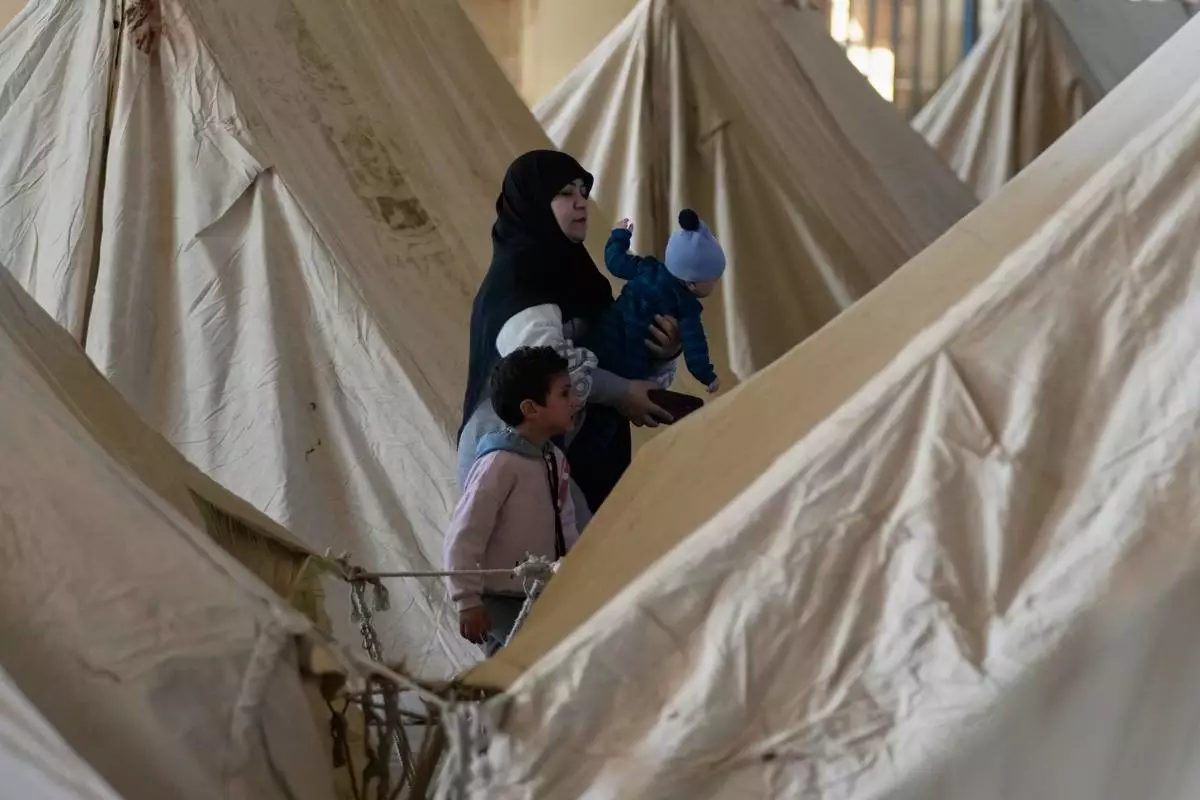
A displaced woman holds a child as another stands beside her between rows of tents at the Camille Chamoun Sports City Stadium, which has been turned into a shelter for people displaced by Israeli airstrikes in southern Lebanon and Dahiyeh, Beirut's southern suburbs, in Beirut, Lebanon, Tuesday, March 10, 2026. (AP Photo/Hassan Ammar)
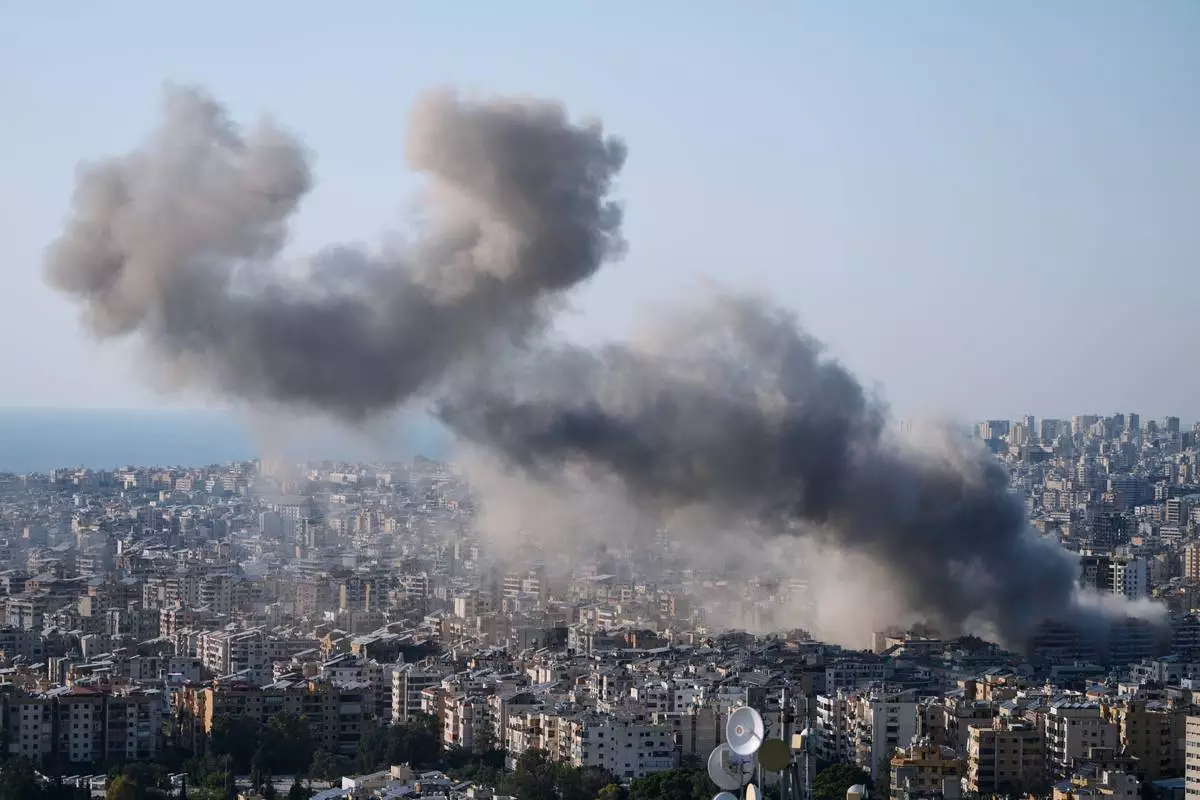
Smoke rise from an Israeli airstrike in Dahiyeh, Beirut's southern suburbs, Lebanon, Tuesday, March 10, 2026. (AP Photo/Bilal Hussein)
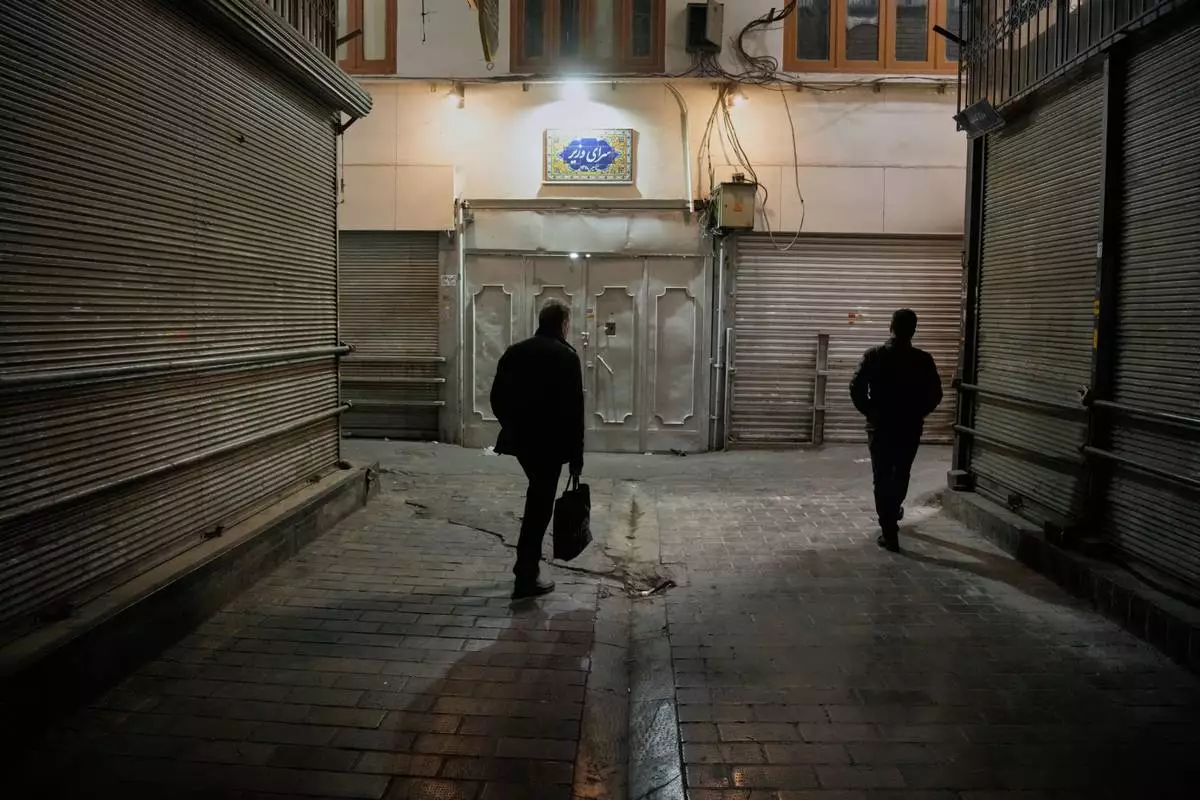
People walk past closed shops at the nearly empty traditional main bazaar in Tehran, Iran, Tuesday, March 10, 2026. (AP Photo/Vahid Salemi)
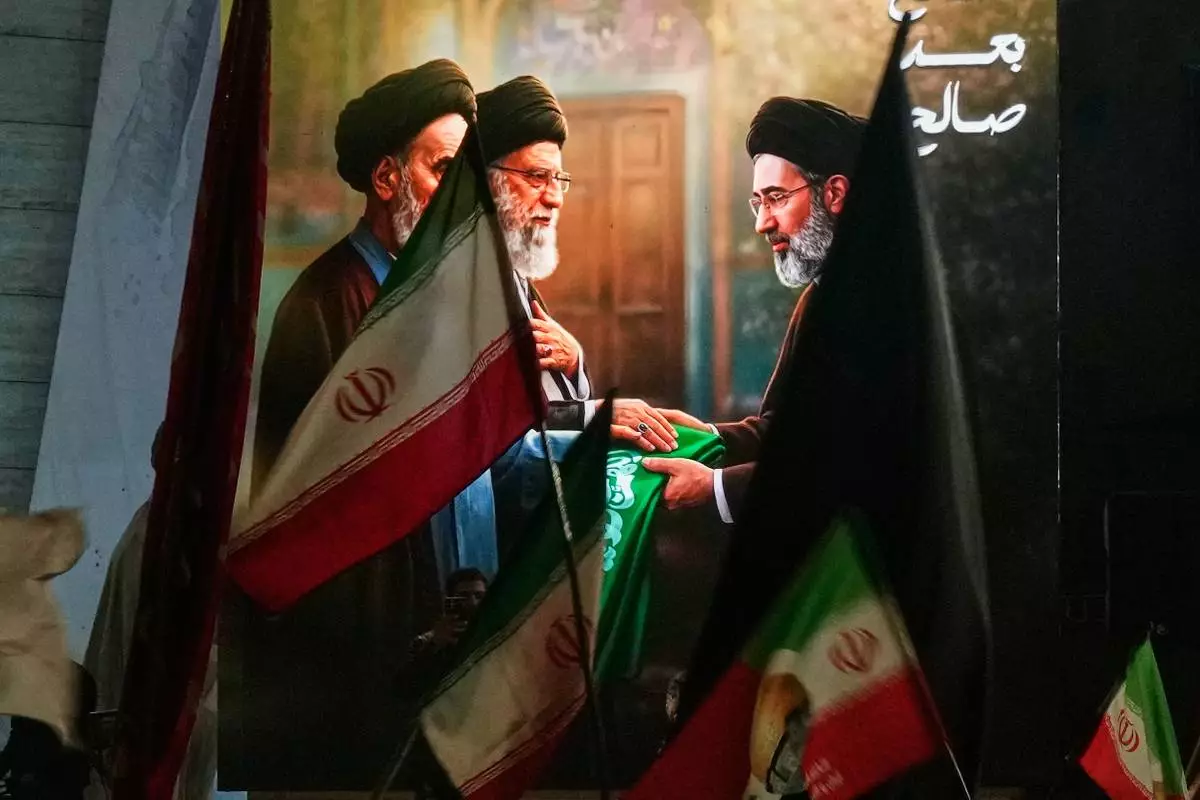
Protesters wave Iranian flags and hold a portrait of the late Iran's Supreme Leader Ayatollah Ali Khamenei and his son Ayatollah Mojtaba Khamenei to support his selection as the new Iran's Supreme Leader in Baghdad, Monday, March 9, 2026. (AP Photo/Hadi Mizban)
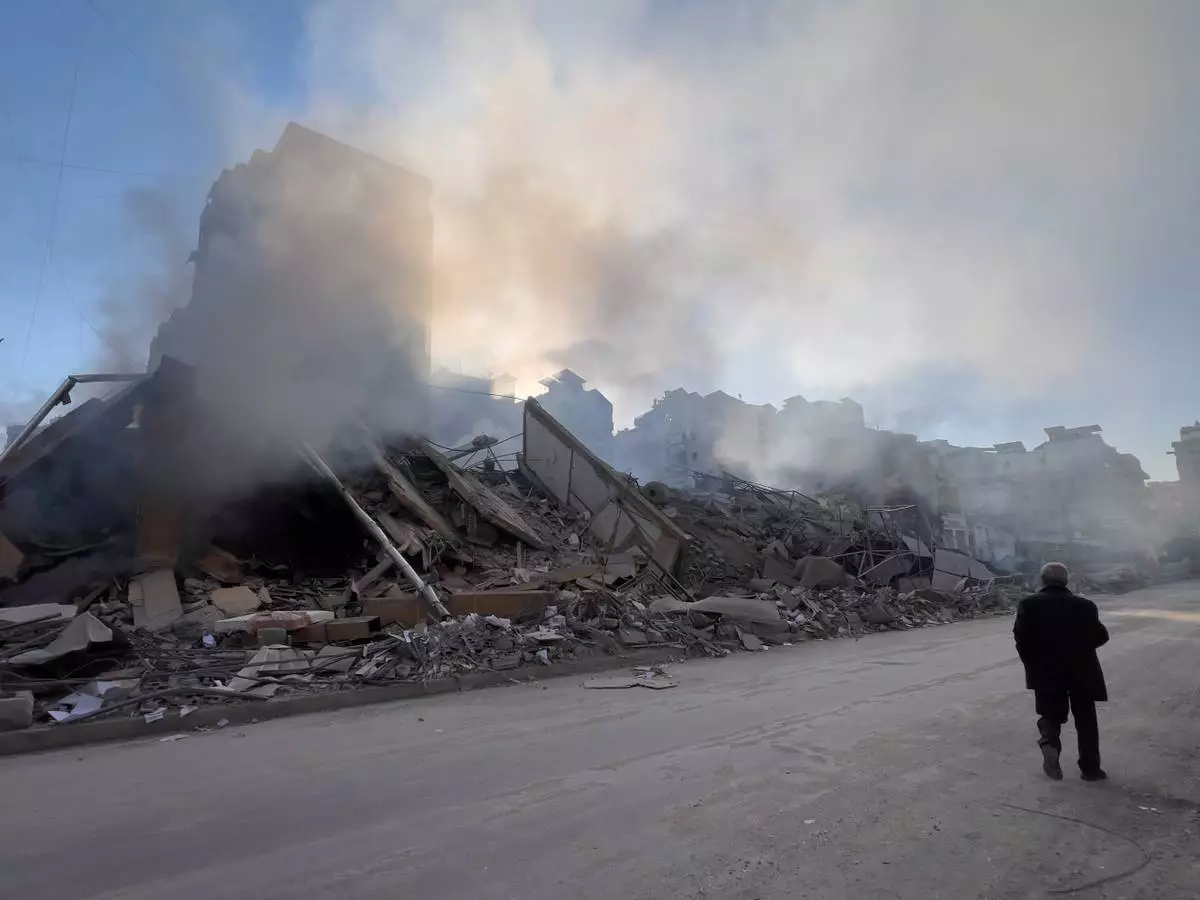
A man passes in front of a destroyed building that housed a branch of Al-Qard Al-Hassan, a non-bank financial institution run by Hezbollah, which was hit by an Israeli airstrike in Dahiyeh, Beirut's southern suburbs, Lebanon, Tuesday, March 10, 2026. (AP Photo/Hussein Malla)
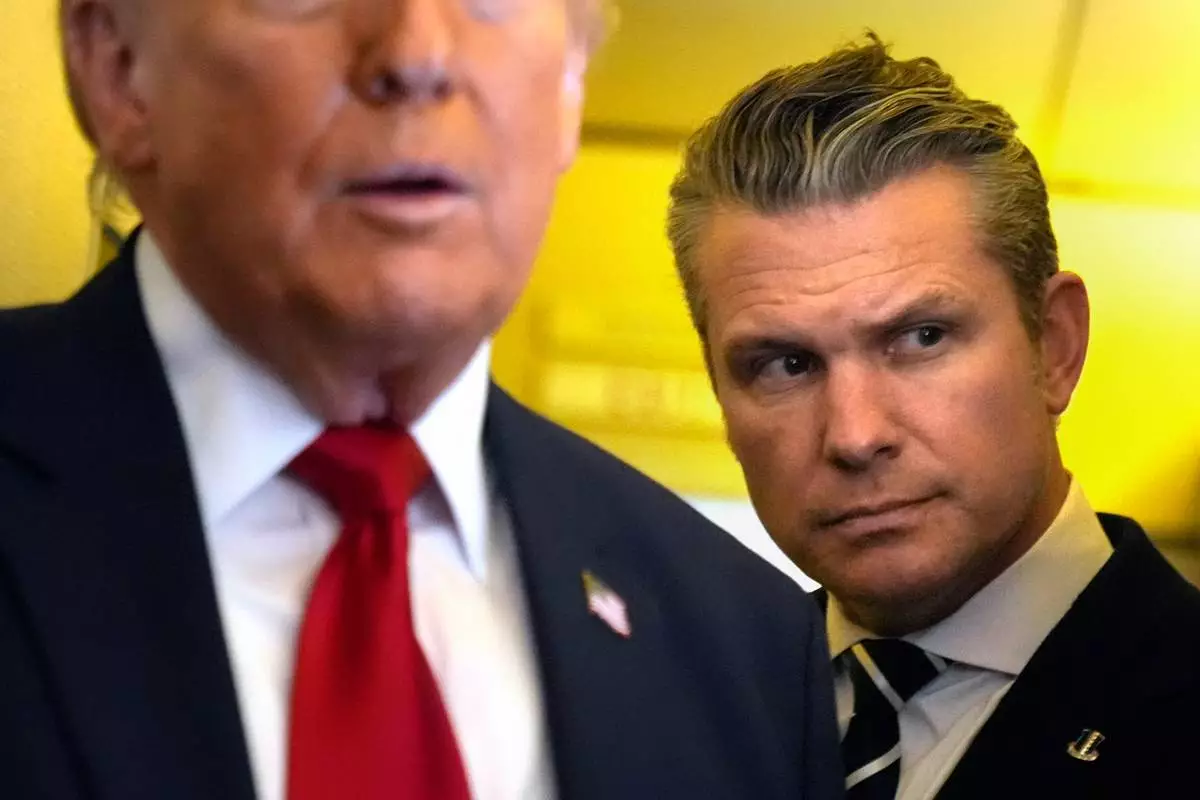
Defense Secretary Pete Hegseth listens as President Donald Trump speaks to reporters while traveling aboard Air Force One en route from Dover Air Force Base, Del., to Miami, Saturday, March 7, 2026. (AP Photo/Mark Schiefelbein)
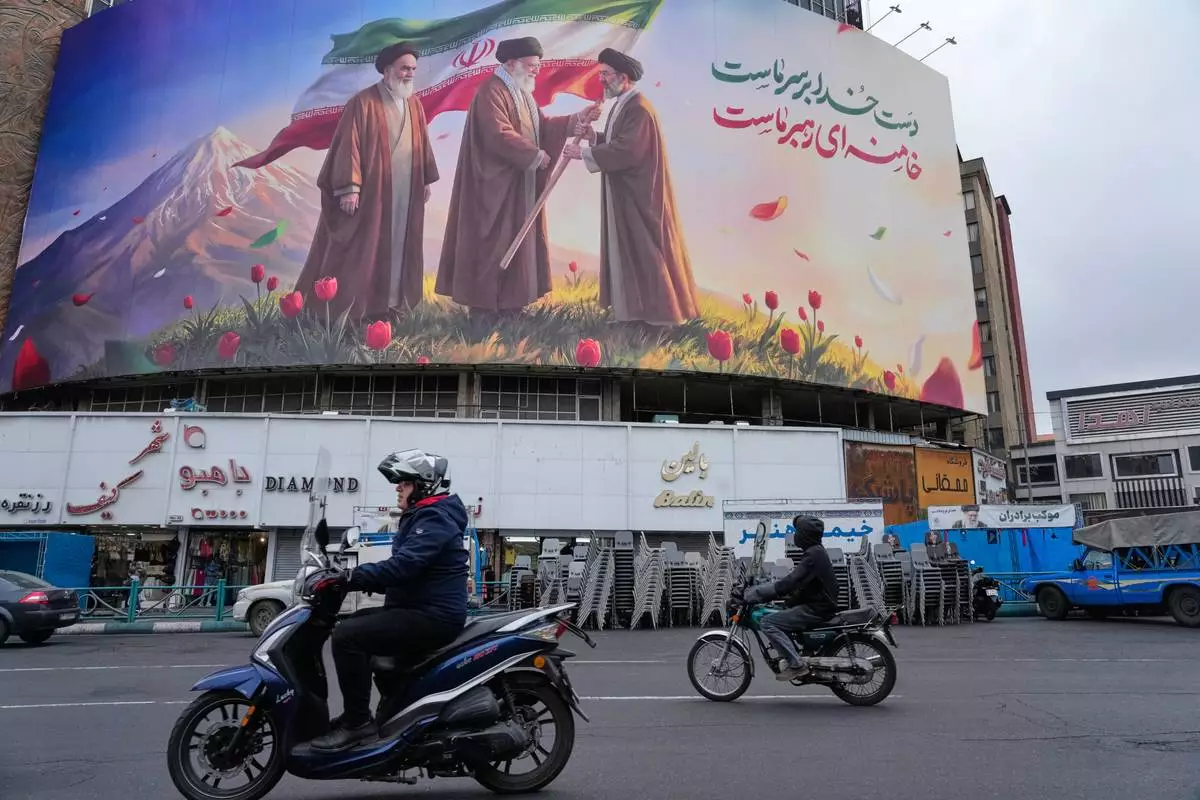
Motorbikes drive past a billboard depicting Iran’s late Supreme Leader Ayatollah Ali Khamenei, center, handing the country’s flag to his son and successor Ayatollah Mojtaba Khamenei, right, as the late revolutionary founder Ayatollah Ruhollah Khomeini stands at left, in a square in downtown Tehran, Iran, Tuesday, March 10, 2026. (AP Photo/Vahid Salemi)
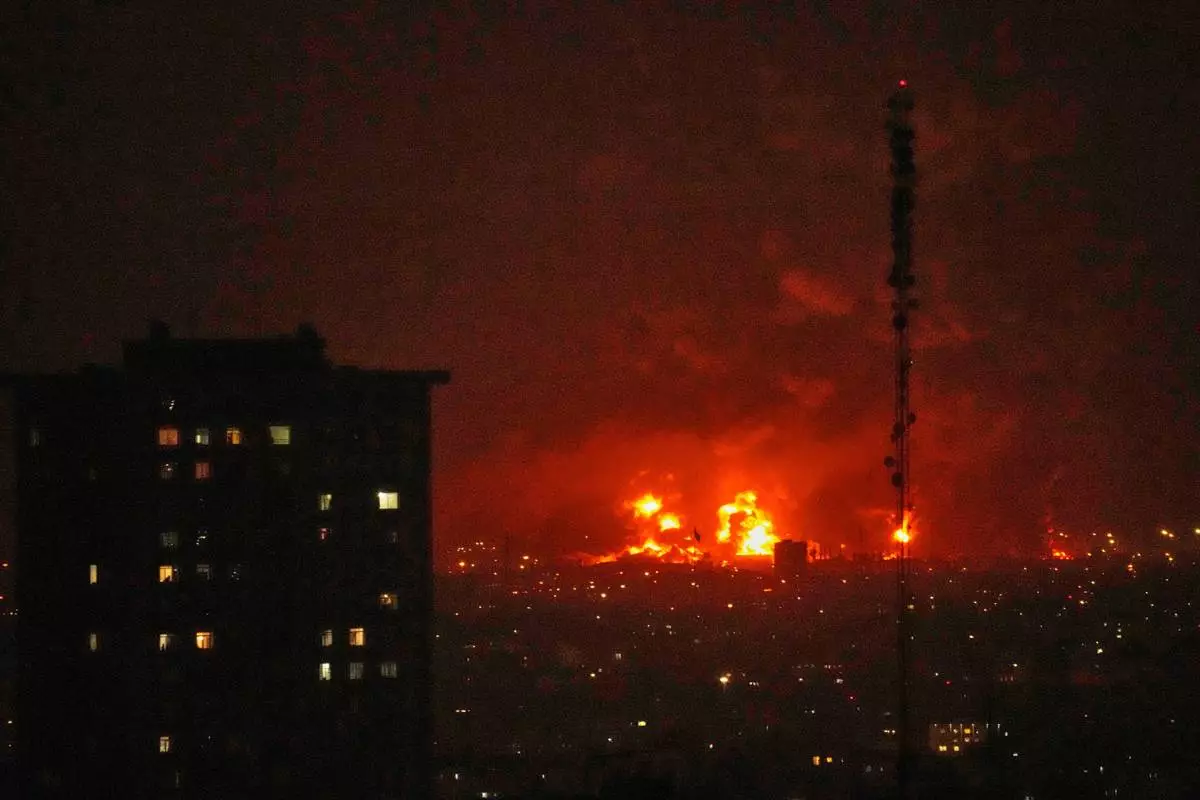
Flames rise from an oil storage facility south of the capital Tehran as strikes hit the city during the U.S.–Israel military campaign, Iran, Saturday, March 7, 2026. (AP Photo/Vahid Salemi)
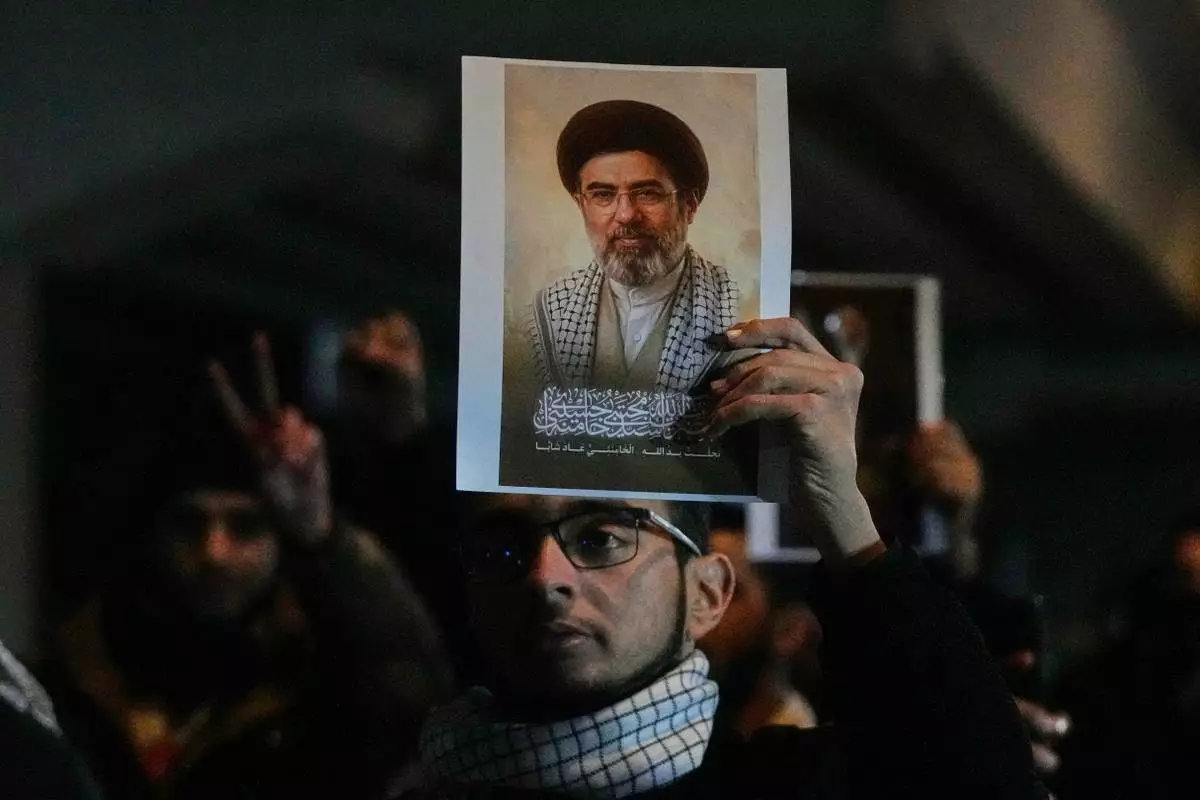
Iraqis hold a portrait of the new successor to Supreme Leader, Ayatollah Mojtaba Khamenei at a bridge leading to the fortified Green Zone where the U.S. embassy is located in Baghdad, Iraq, Monday, March 9, 2026. (AP Photo/Hadi Mizban)
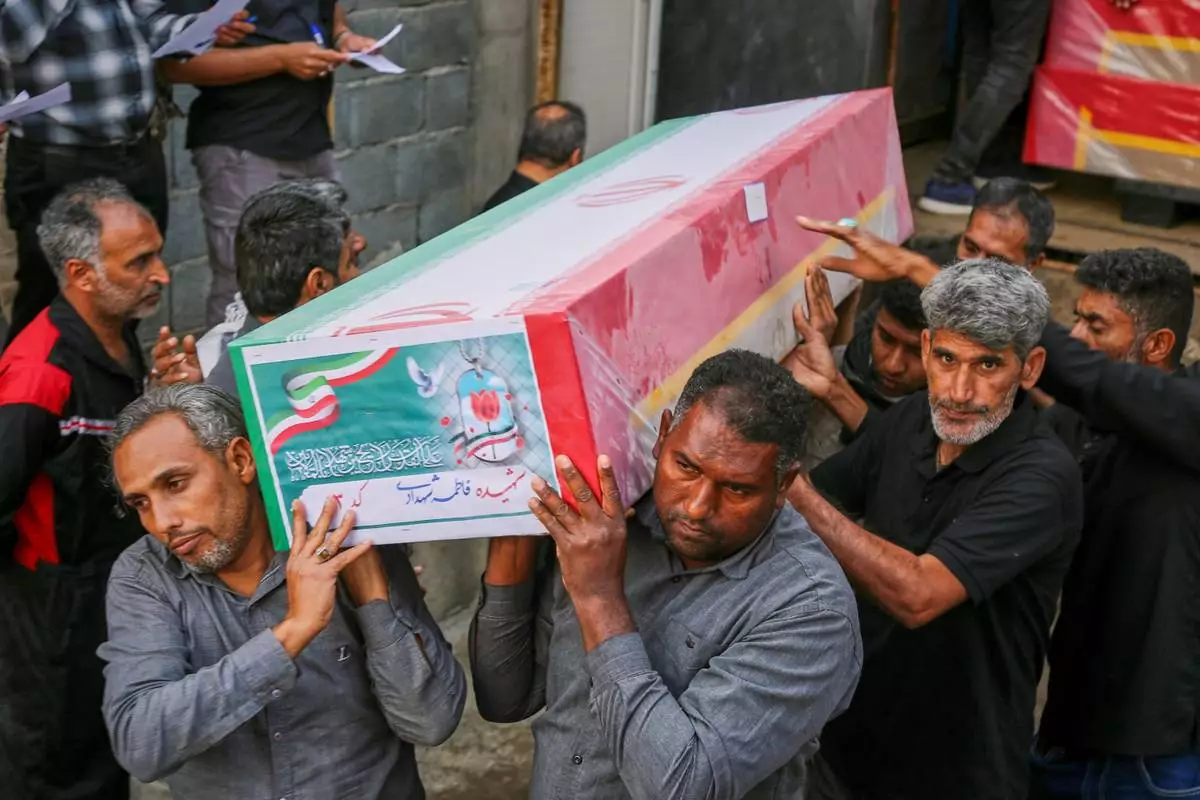
A coffin is carried during the funeral of mostly children killed in a strike Feb. 28 at a girls' elementary school in Minab, Iran, Tuesday, March 3, 2026. (Abbas Zakeri/Mehr News Agency via AP)
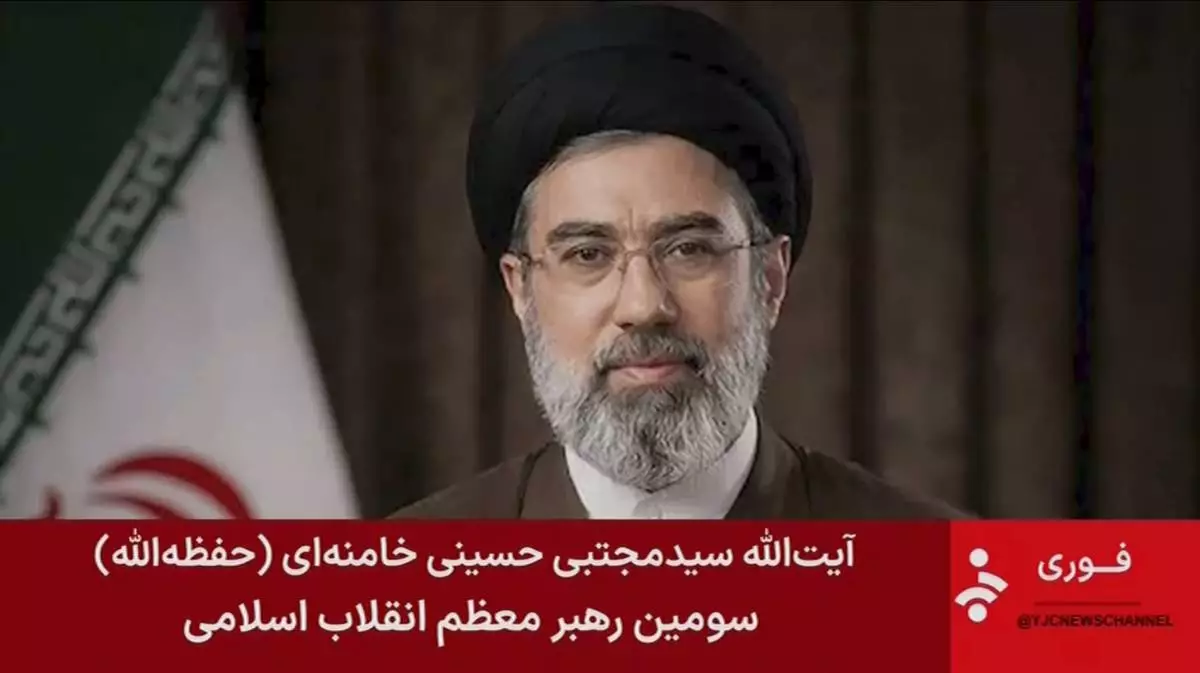
This image taken from video provided by Iran state TV shows Mojtaba Khamenei, a son of Iran's slain supreme leader, who has been named as the Islamic Republic's next ruler, authorities announced Monday, March 9, 2026. (Iran state TV via AP)