KYIV, Ukraine (AP) — Olena Janchuk spends another day of freezing isolation in her high-rise apartment.
The former kindergarten teacher has severe rheumatoid arthritis, and has been trapped for weeks on the 19th floor of her Kyiv tower block, 650 steps from the ground.
Click to Gallery
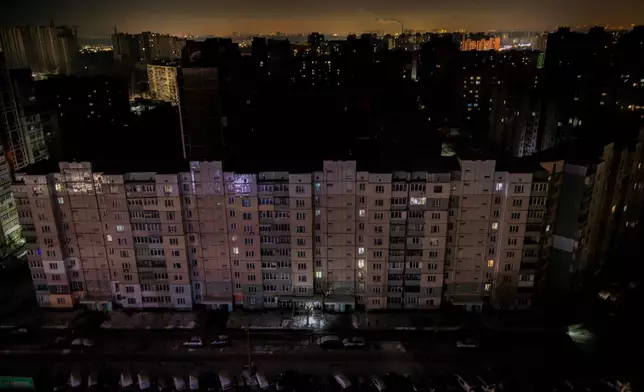
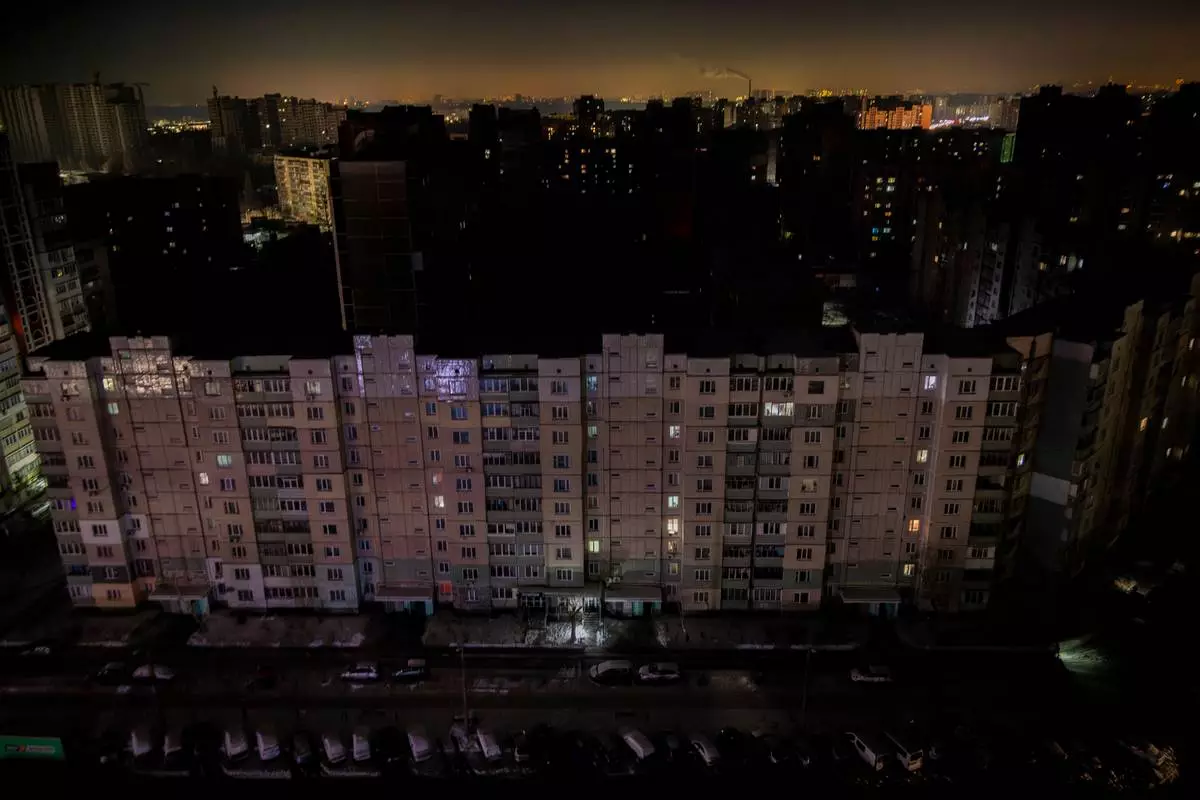
Residential multistory buildings are seen in the dark during large-scale power outages following Russian strikes on Ukraine's power grid in Kyiv, Ukraine, Tuesday, Jan. 20, 2026. (AP Photo/Dan Bashakov)
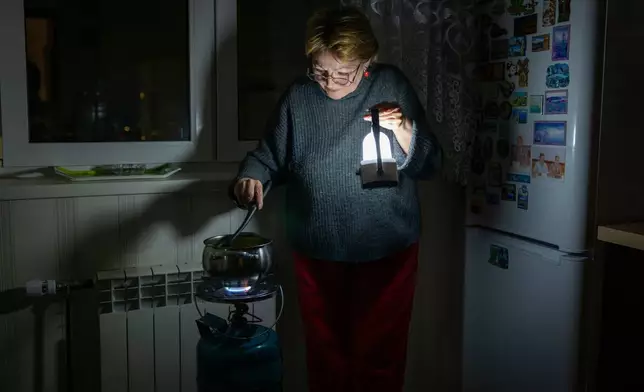
Olena Janchuk's mother cooks food on a gas burner by lantern light during a blackout in Kyiv following Russian attacks on energy infrastructure in Kyiv, Ukraine, Tuesday, Jan. 20, 2026. (AP Photo/Dan Bashakov)

Olena Janchuk, 53, chats online on her phone charged from a power bank during prolonged power outages following Russian attacks on energy objects in Kyiv, Ukraine, Tuesday, Jan. 20, 2026. (AP Photo/Dan Bashakov)

Kyiv resident Olena Janchuk, 53, who can no longer walk due to illness, endures a blackout in her apartment with her mother, keeping warm with candles and heated bricks after Russian attacks on Ukraine's energy infrastructure in Kyiv, Ukraine, Tuesday, Jan. 20, 2026. (AP Photo/Dan Bashakov)

Long daily blackouts caused by Russia’s bombardment of power plants and transmission lines have made working elevators a luxury.
With January temperatures plummeting to minus 10 degrees Celsius (14 degrees Fahrenheit), there’s a permanent line of frost on the inside of Janchuk’s windows, white patterns creeping across the glass by morning.
The 53-year-old huddles over a makeshift fireplace of candles arranged beneath stacked bricks, designed to absorb and slowly release heat. USB charging cables snake across the floor from overloaded power strips, while her electric blanket is hooked up to a power bank rationed for the coldest hours.
“When there’s no light and heat for seventeen and a half hours, you have to come up with something,” she said. “The bricks work best in a small room, so we stay in there.”
By day, the family shifts into rooms that catch the winter sun, the function of each space changing with the blackout schedule. At night, heavy clothes stay on indoors as the apartment cools rapidly without central heating.
Kyiv, a city of about 3 million people, is dominated by tower blocks, many from the Soviet era, now left without power for most of the day.
In this fourth winter of war, electricity is a rationed commodity.
Residents plan their lives around electricity schedules: when to cook, shower, charge phones and run washing machines. Food is chosen for shelf life, water filtered into bottles and stored in buckets. Small camping gas burners are used to heat soup or tea when the power is out.
Sleep is fractured by air raid sirens and the need to use electricity during off-peak hours.
Outside, across snow-covered Kyiv, diesel generators rumble on commercial streets. Shoppers navigate aisles using phone flashlights, and bars glow by candlelight.
Apps notify users of narrowing electricity windows — usually just a few hours — enough for a household reboot.
Janchuk’s 22-story building is located near a power station and residents can see the missile and drone attacks firsthand, flashes lighting up the horizon at night.
During blackouts, they climb the stairs in darkness, phone lights bouncing off concrete steps, often accompanied by the echo of children and barking dogs. People sometimes leave plastic bags with cookies or water inside elevators for those who get stuck when the power cuts midride.
Janchuk’s husband, out working most of the day, brings the groceries in the evening while her mother, 72-year-old Lyudmila Bachurina, is in charge of chores.
“It’s cold, but we manage,” the mother says, holding a square USB-charged flashlight she recently mounted on the wall. “When the lights come on, I start turning on the washing machine, fill up water bottles, cook food, charge power banks, run around the kitchen and run around the house.”
In upscale neighborhoods, residents pool funds for generators to keep elevators running. But most blocks — home to pensioners, families and people with disabilities — cannot afford them.
Disability advocates, including groups representing wounded war veterans, say staircases have become an invisible social barrier, cutting people off inside their own homes.
They are urging city officials to fund generators for residential buildings.
Until then, life bends around the electricity timetable. USB lamps, power banks and inverter batteries have become household staples. Telegram chats help neighbors check on the elderly and swap blackout updates.
From upper floors, Kyivans look out over a skyline of high rises and the city’s historic golden-domed churches. At night, flashes of explosions are visible as Russia continues its campaign against Ukraine’s energy system.
Too many power stations and transmission lines have been hit to meet demand, even with electricity imports from Europe. To prevent a grid collapse, operators impose rolling blackouts, keeping hospitals and critical services alive while homes go dark.
At one coal-fired power plant struck repeatedly, shift supervisor Yuriy walks through wreckage of charred machinery, collapsed roofs and control panels melted into useless lumps. Repairs are carried out by torchlight, giant sandbags shielding what still works. Photographs of colleagues killed on the job hang near the entrance.
“After missile and drone attacks, the consequences are terrible — large-scale,” he said.
Officials asked that the plant’s location and Yuriy’s full name not be disclosed for security reasons.
“Our energy equipment has been destroyed. It is expensive,” Yuriy said. “Right now, we’re restoring what we can.”
Ukraine’s energy sector has suffered more than $20 billion in direct war damage, according to a joint estimate by the World Bank, the European Commission and the United Nations.
Kyiv has repeatedly updated its austere winter power-saving schedule, dimming or cutting streetlights in low-traffic areas and investing in less centralized power generation.
In the tower blocks, restoration feels far off.
“I’m tired, really tired, to be honest. When you can’t go outside, when you don’t see the sun, when there’s no light and you can’t even go to the store on your own. … It wears you down,” Bachurina said.
“But the important thing, as all Ukrainians say now, is that we will endure anything until the war ends.”
Associated Press writers Susie Blann and Dan Bashakov contributed to this report.
Follow AP’s coverage of the war in Ukraine at https://apnews.com/hub/russia-ukraine
Residential multistory buildings are seen in the dark during large-scale power outages following Russian strikes on Ukraine's power grid in Kyiv, Ukraine, Tuesday, Jan. 20, 2026. (AP Photo/Dan Bashakov)
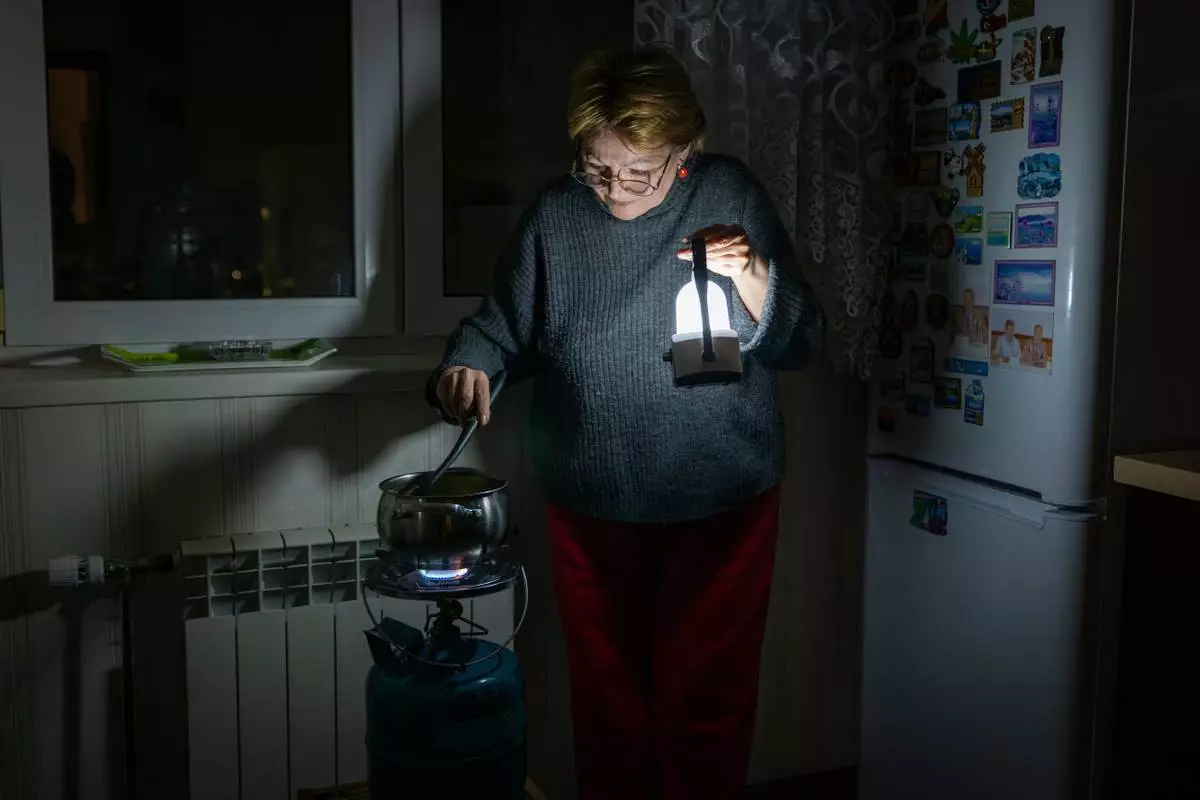
Olena Janchuk's mother cooks food on a gas burner by lantern light during a blackout in Kyiv following Russian attacks on energy infrastructure in Kyiv, Ukraine, Tuesday, Jan. 20, 2026. (AP Photo/Dan Bashakov)

Olena Janchuk, 53, chats online on her phone charged from a power bank during prolonged power outages following Russian attacks on energy objects in Kyiv, Ukraine, Tuesday, Jan. 20, 2026. (AP Photo/Dan Bashakov)

Kyiv resident Olena Janchuk, 53, who can no longer walk due to illness, endures a blackout in her apartment with her mother, keeping warm with candles and heated bricks after Russian attacks on Ukraine's energy infrastructure in Kyiv, Ukraine, Tuesday, Jan. 20, 2026. (AP Photo/Dan Bashakov)


DUBAI, United Arab Emirates (AP) — Israel and Iran exchanged fire early Wednesday as Tehran kept up pressure on the region's oil industry and targeted infrastructure as global energy concerns mounted and the war in the Middle East showed no signs of abating.
Iran has effectively stopped cargo traffic in the narrow strait through which about a fifth of all oil is shipped from the Persian Gulf toward the Indian Ocean. It has also targeted oil fields and refineries in Gulf Arab nations as part of a strategy apparently aimed at generating enough global economic pain to pressure the United States and Israel to end their strikes.
Early Wednesday, a projectile hit a container ship off the coast of Oman in the Strait of Hormuz, setting it ablaze and forcing the crew to abandon the vessel. Kuwait said its defenses downed eight Iranian drones and Saudi Arabia said it intercepted five drones heading toward the kingdom's Shaybah oil field.
The U.N. Security Council was to vote later in the day on a resolution sponsored by the Gulf Cooperation Council demanding Iran stop attacking its Arab neighbors.
Israel, which launched the war with the United States on Feb. 28, said it had renewed attacks on Tehran, following multiple strikes the day before that residents described as some of the heaviest during the war. Explosions were also heard in Beirut and in southern Lebanon after Israel said it had started a new assault on targets related to the Iran-linked militia Hezbollah.
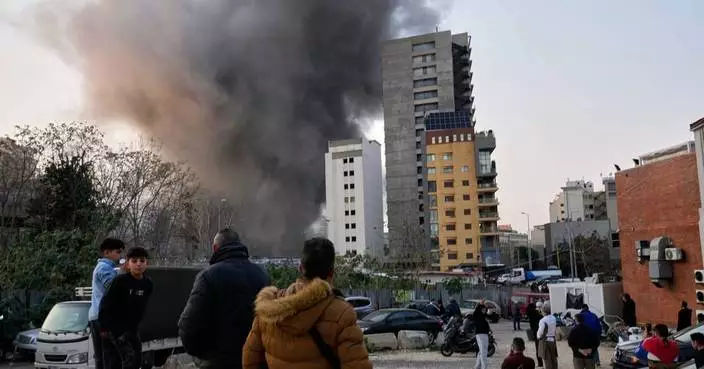
The attacks set a building ablaze in central Beirut in the densely populated Aicha Bakkar area, engulfing the top two floors of the multistory structure. There were no immediate reports of casualties from the strike, which came without warning.
An earlier Israeli strike killed five people in the Nabatieh district in southern Lebanon, while two more were killed in strikes in the Tyre and Bint Jbeil districts, Lebanon's Health Ministry said. A Red Cross worker also died Wednesday of wounds sustained Monday, when his team was hit by an Israeli strike while they were rescuing people from an earlier attack.
Nearly 500 people have been killed so far in Lebanon since Hezbollah triggered the latest round of fighting with Israel when it fired rockets into the country’s north after the American and Israeli attacks on Iran started.
Israel warned of three Iranian attacks early Wednesday, with sirens heard in Tel Aviv and elsewhere but no immediate reports of casualties.
In addition to Iranian attacks targeting Saudi Arabia's oil fields, the kingdom's defense ministry said it had destroyed six ballistic missiles launched toward Prince Sultan Air Base, a major U.S.- and Saudi-operated air facility in eastern Saudi Arabia. The ministry also said it intercepted and destroyed two drones over the eastern city of Hafar al-Batin.
In the Strait of Hormuz north of Oman, a cargo ship was hit with a projectile and set on fire, according to the United Kingdom Maritime Trade Operations center, run by the British military.
Iran did not immediately claim the attack though it has been targeting ships in and around the strait.
The UKMTO earlier reported on another attack targeting a container ship off Ras al-Khaimah in the United Arab Emirates. In that case, it said the “extent of the damage is currently unknown but under investigation by the crew.”
The United Arab Emirates said early Wednesday that its air defenses were working to intercept incoming Iranian fire. The wealthy nation — home to the business and travel hub of Dubai — said Iranian attacks have killed six people and wounded 122 others there.
Bahrain sounded sirens early Wednesday, warning of an incoming Iranian attack. The warnings came a day after an Iranian attack hit a residential building in the capital, Manama, and killed a 29-year-old woman and wounding eight people.
At the United Nations, the Security Council was to vote Wednesday afternoon on the Gulf Cooperation Council resolution, according to three diplomats speaking on condition of anonymity ahead of an official announcement.
The council, a six-nation regional bloc, said its own facilities were targeted in an Iranian attack last week on Bahrain.
The draft resolution, obtained by The Associated Press, condemns Iran’s attacks on Bahrain, Kuwait, Oman, Qatar, Saudi Arabia, the United Arab Emirates and Jordan. The measure calls for an immediate end to all strikes and threats against neighboring states, including through proxies.
It would be the first Security Council resolution considered since the start of the war.
Oil prices remained well below the peaks Monday but the price of Brent crude, the international standard, was still up some 20% Wednesday from when the war began, and consumers around the world are already feeling the pain at the pump.
The spike in oil prices has been rocking financial markets worldwide because of worries that the war could block the global flow of oil and natural gas for a long time.
The U.S. military said Tuesday it had destroyed 16 Iranian minelayers near the Strait of Hormuz, though U.S. President Donald Trump said in social media posts that there were no reports yet of Iran mining the passage, a prospect that experts warned of preceding the war.
If the strait is mined, it could take at least weeks to clean it up once the conflict is over.
Some tankers, believed linked to Iran, are continuing to get through the strait making so-called “dark” transits -- meaning they aren’t turning on their Automatic Identification System tracks, which show where vessels are. Vessels carrying sanctioned Iranian crude often turn off their AIS trackers.
The security firm Neptune P2P Group said Wednesday there had been seven ships pass through the strait since March 8. Of them, five were linked to Iranian-associated shipping, it said. In ordinary times the strait typically sees 100 ships or more transit daily from the Persian Gulf into the Gulf of Oman.
Meanwhile, the commodity-tracking firm Kpler said Iran has restarted crude exports through its Jask oil terminal on the Gulf of Oman. A tanker loaded roughly 2 million barrels at Jask on March 7, it said.
Meanwhile, concerns grew over the health of Iran’s new Supreme Leader Ayatollah Mojtaba Khamenei after comments about him “being injured.”
The 56-year-old Khamenei — the son of the late Supreme Leader Ayatollah Ali Khamenei — has not been seen since since becoming supreme leader on Monday. His father and wife both were killed in an Israeli airstrike Feb. 28 that started the war.
In addition to the nearly 500 people killed in Lebanon, Iran has said more than 1,300 people have been killed there and Israel has reported 12 people dead.
The U.S. has lost seven soldiers while another eight have suffered severe injuries.
Many foreign nationals have been getting out of the Persian Gulf region since the war began, including over 45,000 U.K. citizens, the British Foreign Office said. Some 40,000 people returned to the United States, according to the State Department.
Magdy reported from Cairo, and Rising from Bangkok. Associated Press writers Sally Abou AIJoud in Beirut, Giovanna Dell’Orto in Miami, Julie Watson in San Diego, and Edith M. Lederer at the United Nations contributed to this story.
People take shelter in an underground metro station as air raid sirens warn of incoming Iranian missile strike, in Ramat Gan, Israel, Tuesday, March 10, 2026. (AP Photo/Oded Balilty)
A man passes in front of a destroyed building that housed a branch of Al-Qard Al-Hassan, a non-bank financial institution run by Hezbollah, which was hit by an Israeli airstrike in Dahiyeh, Beirut's southern suburbs, Lebanon, Tuesday, March 10, 2026. (AP Photo/Hussein Malla)
People walk past closed shops at the nearly empty traditional main bazaar in Tehran, Iran, Tuesday, March 10, 2026. (AP Photo/Vahid Salemi)
Motorbikes drive past a billboard depicting Iran’s late Supreme Leader Ayatollah Ali Khamenei, center, handing the country’s flag to his son and successor Ayatollah Mojtaba Khamenei, right, as the late revolutionary founder Ayatollah Ruhollah Khomeini stands at left, in a square in downtown Tehran, Iran, Tuesday, March 10, 2026. (AP Photo/Vahid Salemi)
Smoke rises from an Israeli airstrike in Dahiyeh, Beirut's southern suburbs, Lebanon, Tuesday, March 10, 2026. (AP Photo/Bilal Hussein)