As the Chinese New Year, or the Spring Festival, is around the corner, craftsmen across China are busy making traditional lanterns which serve as an important cultural symbol during the grandest traditional annual holiday.
At the Beijing Fine Arts Red Lantern Factory, master craftsmen are racing against time to fulfill orders for lantern making for the Spring Festival. Beijing palace lanterns are made with a wooden frame, inlaid with silk or glass and painting. Adorned with tassels, Chinese knots, and other decorations, they are a typical representative of traditional Chinese art. The entire lantern-making process relies on mortise and tenon joints, assembled without a single nail.
"Making this palace lantern requires the supply of more than 100 pieces of wood and involves hundreds of work processes. Therefore, our lantern making is inseparable from ancient architecture," said Zhai Yuliang, a representative inheritor to Beijing palace lanterns.
As a representative of lantern craftsmanship from areas south of the Yangtze River, the "needle-piercing" technique of the Haining Xiashi lantern making from east China's Zhejiang Province is particularly exquisite, with thousands of needle holes outlining beautiful patterns on Xuan paper as thin as cicada wings.
"Through needles, we integrate traditional Chinese painting, calligraphy and seal carving into our work, along with other arts. Under the illumination of nighttime lights, it creates a truly magical effect, almost close to the Wanyanluo lantern (a splendid lantern for imperial use)," said Shou Binjie, a representative inheritor to the craftsmanship.
In south China's Guangdong Province, the traditional Chaozhou lanterns are mainly classified into two categories: painted vertical screen lanterns and hanging lanterns. They integrate in them various patterns of intangible cultural heritage elements such as the Chaozhou opera and Chaozhou embroidery, making a truly comprehensive art form.
"The most distinctive feature of Chaozhou lanterns is their capability of story telling. Through precise depiction of characters' costumes, expressions and movements, as well as recreation of the scenery, the stories from books and operas are vividly presented to the audience, allowing the spiritual and cultural connotations behind these stories to be passed down through lanterns," said Ding Chujie, director of the Cultural Center of Xiangqiao District, Chaozhou City.
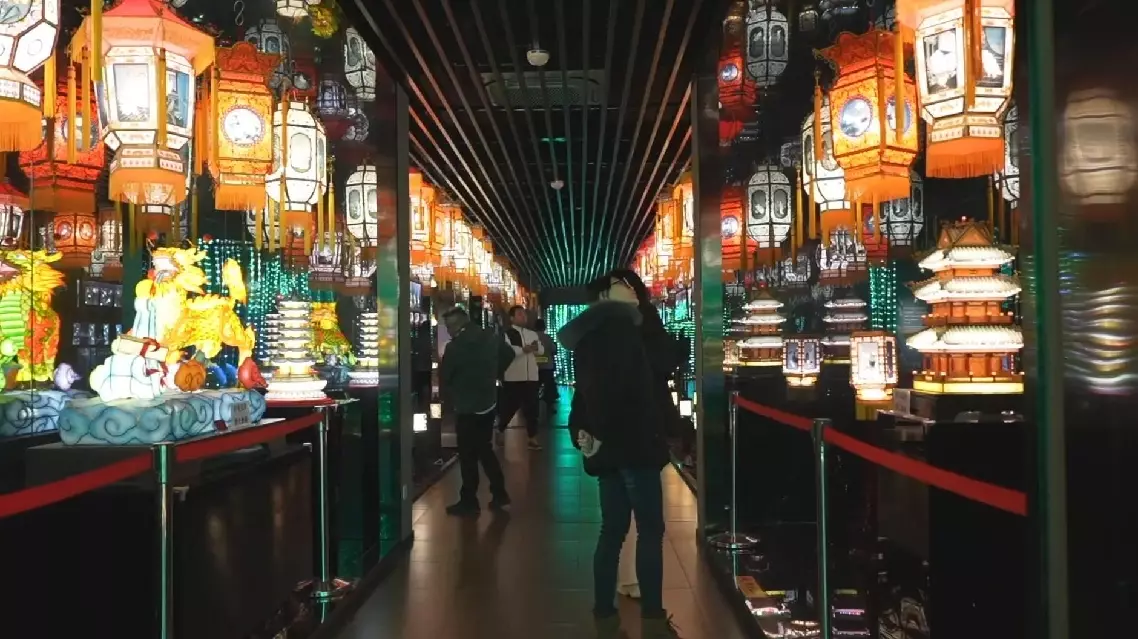
Chinese craftsmen busy making traditional lanterns ahead of Spring Festival