BANGKOK (AP) — Myanmar 's military is making increasing use of commercial paramotors and gyrocopters, low-tech flying machines that expand their capabilities to attack civilians and anti-government forces from the sky as the country's civil war rages, according to a report released Monday.
The military's use of paramotors, basically a paraglider combined with a backpack motor with a propeller, was first reported in 2024, while the first incident involving a gyrocopter, an ultralight one- or two-person aircraft with helicopter-like rotating blades, was last March, the human rights organization Fortify Rights said in its report.
The organization tracked an increasing number of such attacks over the course of last year where pilots would drop mortar shells by hand, and in the case of the paramotors, sometimes cutting their engines and gliding silently in their final approach to the target.
“The Myanmar military has found new ways to kill civilians from the sky using paramotors and gyrocopters equipped with manually-dropped, unguided explosives,” said Fortify Rights’ Chit Seng in a statement.
In the deadliest such attack recorded, a paramotor in October dropped two shells on anti-election protesters attending a candlelight vigil in the Sagaing region, killing at least 24. In another attack in Sagaing, a gyrocopter attacked a hospital, killing the chief physician and two other hospital staff. The reports were both backed up by interviews with eyewitnesses, Fortify Rights said.
Myanmar's military, known as the Tatmadaw, did not respond to a request for comment on the findings, but regularly insists it does not target civilians.
The military ousted the elected civilian government of Aung San Suu Kyi in February 2021, triggering widespread opposition that has spiraled into a civil war. Since then, more than 7,700 civilians have been killed, according to the Assistance Association for Political Prisoners, a watchdog group that tracks political arrests, attacks and casualties.
The attacks by the two types of aircraft documented by Fortify Rights came across Myanmar’s central lowlands in Sagaing, Magway, Mandalay, Ayeyarwady and Bago regions where largely flat terrain makes their low-altitude flight practical. It said the attacks came primarily in opposition-held areas where militia activity is limited or lacking in aerial defense capabilities, as the slow-moving aircraft are particularly vulnerable.
Still, they add to the Tatmadaw's aerial arsenal, which also includes modern jets, helicopters and drones.
They are cheap and easy to operate, can be launched from open fields, and can stay in the air roughly three hours while carrying 30 to 40 mortar shells that are dropped by hand or crude release mechanisms on ground targets.
“Paramotors are deployed in areas where armed actors are less sophisticated or lack firepower,” said Morgan Michaels, an analyst with the International Institute of Strategic Studies who runs its Myanmar Conflict Map project and has tracked a similar increase in their usage.
“We can infer, then, that they also help reduce strain on the air force, allowing the Tatmadaw to redirect more advanced air assets to borderland peripheries where (anti-government militias) operate,” Michaels, who was not involved in the Fortify Rights study, told The Associated Press.
The Fortify Rights data, based on open source reports of attacks and first-hand interviews, suggests increases in attacks starting in July, just ahead of the military government's announcement it would hold elections, and surged in December as the first round of voting began. With Suu Kyi's party banned and opposition largely stifled, critics have said the elections, whose third and final round concluded Sunday, were simply contrived to add a sheen of legitimacy to the military's power.
“The pattern of attacks has intensified in parallel with the junta’s efforts to consolidate control over central Myanmar, intimidate civilians, and assert authority ahead of its multi-phase sham elections," Fortify Rights said.
Overall, the organization counted 304 paramotor and gyrocopter attacks on civilians between December 2024 and Jan. 11, 2026.
Including attacks on the military, there were about 350 total incidents involving such aerial vehicles over roughly that period of time, according to the online Armed Conflict Location and Event Data database, though it lists only about a third as specifically on civilians, Michaels said.
“We know that the Tatmadaw attacks civilians, and collective punishment has featured as a key component of its counterinsurgency strategy for decades. This is not in dispute,” he said.
“However, open source conflict data is not reliable enough to determine what percentage of aerial attacks constitute the deliberate targeting of civilians versus what percentage are aerial attacks that target combatants but inflict undue harm onto civilians," he added.
Even though the militias drawn from Myanmar's ethnic minority groups and pro-democracy “People's Defense Forces” have taken large swaths of territory from the military, the fact that paramotors and gyrocopters can be employed effectively underlines how poorly equipped many of the opposition forces continue to be, Michaels said.
“It shows that the Tatmadaw can still dominate the battlespace across central Myanmar and opposition groups cannot protect civilians against deliberate or disproportional aerial attacks,” he said.
While some countries — notably China and Russia — continue to supply Myanmar with military equipment, many others have sanctions prohibiting such trade.
Despite the sanctions, however, Amnesty International reported in a separate analysis on Monday that aviation fuel has continued to enter the country on so-called “ghost ships,” which turn off their location tracking systems to avoid detection.
Myanmar's military government also did not respond to questions about the Amnesty report.
Fortify Rights urged governments to reassess sanctions to ensure that components for paramotors and gyrocopters were not getting through.
“U.N. member states must strictly enforce existing sanctions against the Myanmar military junta and issue new sanctions that effectively prohibit the sale or transfer of arms, jet fuel, and dual-use equipment or technologies,” Fortify Rights said.
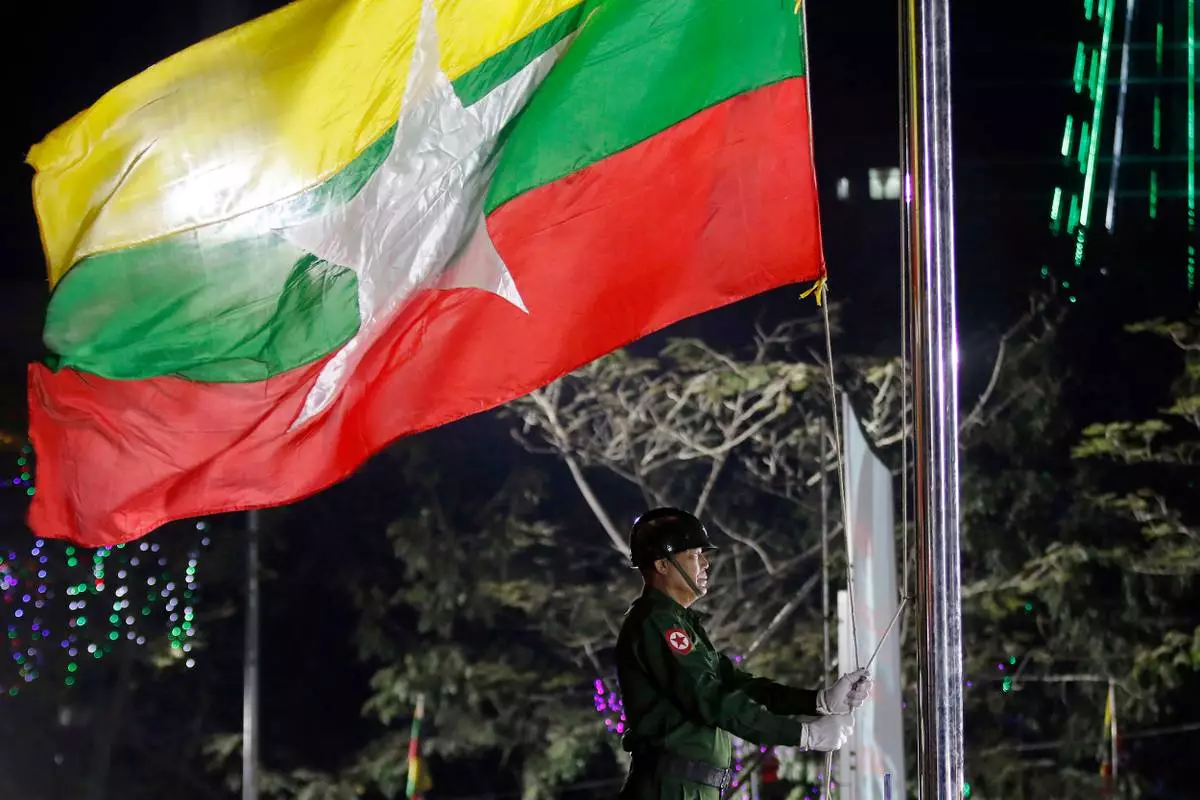
FILE - A Myanmar military soldier hoists a national flag during a ceremony to mark the 69th anniversary of Independence Day in Yangon, Myanmar on Jan. 4, 2017. (AP Photo, File)