CONCORD, Mass.--(BUSINESS WIRE)--Jan 26, 2026--
Aviva Bio, a new biotechnology company focused on rewriting the narrative around hormone-based medicine, announced today it has received formal feedback from the FDA in a Type B meeting regarding the requirements for the development of a testosterone (T) therapy for women. AVA-291 (d3-T) is a next-generation testosterone designed to retain T’s androgen activity while resisting aromatization. The aromatization of T locally in breast tissue is linked to an increased risk of breast cancer. 1,2,3 Today’s announcement marks an important milestone in advancing testosterone therapy for women, a patient population with significant unmet need that has been long constrained by safety concerns and the absence of an FDA-approved, female-specific therapy.
This press release features multimedia. View the full release here: https://www.businesswire.com/news/home/20260126103179/en/
In its feedback, the FDA acknowledged the potential breast cancerriskassociated with T use in women —a central safety issue that has historically limited the development of a T therapy for women. Aviva Bio reflects a shared commitment to addressing this risk through molecular design and evidence-based development strategies.
To further support the differentiated profile of AVA-291 (d3-T), Aviva Bio announced that new data have been accepted for presentation at the American Association for Cancer Research (AACR) Annual Meeting in April 2026. The data demonstrate that AVA-291 (d3-T) has approximately 1,000-foldless potential to stimulate breast cancer cell proliferation compared to ordinary T, supporting its differentiated safety profile.
“For decades, testosterone therapy for women has depended on repurposed male formulations, rather than drugs designed with women’s biology and safety considerations in mind,” said Judith A. Boice, PhD, CEO of Aviva Bio. “Our FDA feedback reinforces the need for a new standard—one anchored in safety, enabled by molecular precision, and developed with regulatory clarity from the start.”
Aviva Bio is advancing AVA-291 (d3-T) as a differentiated testosterone in a broad development program addressing multiple indications in both women’s and men's health where androgen signalling plays a clinically meaningful role but is limited by aromatization.
“The data we are presenting at AACR provides mechanistic evidence that AVA-291 (d3-T) has a reduced risk of exacerbating breast cancer compared with ordinary T,” said Bradford C. Sippy, CTO of Aviva Bio. “This builds on our prior work showing that AVA-291 is resistant to aromatization and highlights the potential clinically differentiated profile.”
As scientific and public attention around testosterone therapy for women continues to grow, Aviva Bio is focused on translating regulatory guidance and differentiated data into a disciplined development program for AVA-291 (d3-T). The company continues to advance its pipeline across multiple indications with high unmet need and evaluate strategic collaborations to support the next phase of clinical, regulatory, and commercial progress.
About Aviva Bio
Aviva Bio is a clinical-stage biotechnology company unlocking the full potential of hormone-based medicine. Through novel drug design and a focus on unmet needs, Aviva Bio is developing next-generation therapeutics to improve lives.
About AVA-291 (d3-Testosterone)
AVA-291 or d3-Testosterone (d3-T) is a novel, deuterium-substituted isotopologue of testosterone designed to resist aromatization. The aromatization of testosterone is linked with potential safety (breast cancer) and tolerability (gynecomastia) concerns associated with T therapy. In vitro studies of AVA-291 (d3-T) have demonstrated a similar metabolic profile and similar androgen receptor affinity as testosterone, but, unlike testosterone, AVA-291 is highly resistant to aromatization. In human clinical studies, d3-T was shown to be a direct substitute for ordinary testosterone.
AVA-291 (d3-T) may be a useful alternative to testosterone in clinical situations where the aromatization of testosterone limits its therapeutic potential, such as hormone replacement therapy in menopausal women, men on testosterone therapy who develop gynecomastia, addressing muscle loss and/or low-libido in patients on GLP-1 therapy, and in the treatment of ER+ breast cancer.
As a structurally identical form of testosterone, AVA-291 shares similar physical properties as T, and can be substituted in any current T formulation. AVA-291 is covered by multiple issued US patents that extend to at least 2041.
References

Image of d3-Testosterone
PORTLAND, Maine (AP) — Six people died when a business jet crashed during takeoff as a snowstorm moved in and visibility diminished in Maine Sunday night.
The Bombardier Challenger 600 flipped over and burned on takeoff at Bangor International Airport around 7:45 p.m. Sunday night as the nation’s massive winter storm was beginning to reach the area.
An audio recording of air traffic controllers posted by www.LiveATC.net includes someone saying “Aircraft upside down. We have a passenger aircraft upside down,” about 45 seconds after a plane was cleared for takeoff. First responders arrived less than a minute later, airport director Jose Saavedra said.
Experts say the weather and questions about whether ice accumulating on the wings kept the plane from getting airborne — as has happened at least twice before on that plane model — will likely be an initial focus by the National Transportation Safety Board. However, the agency will consider all possible factors.
“You can count on the fact that NTSB is going to look very closely at this,” said John Cox, who is CEO of Safety Operating Systems.
The airport said Monday afternoon there were six people aboard, according to the flight manifest, and all died. Earlier in the day, the Federal Aviation Administration had said seven died and one was injured but warned the numbers were subject to change, and the agency defers to local authorities.
Snowfall was heavy elsewhere at the time of the crash, but accumulation had just started in Bangor. Other planes had been taking off safely. But about half an hour before the crash, the pilot of a Florida-bound Allegiant plane radioed the tower to abort his takeoff.
“One, our deice fluid has failed and two, I don’t think the visibility is good enough for us to go, so we’re going to have to taxi back to the gate here,” the Allegiant pilot radioed. The controller responded by saying he was just getting ready to warn the pilot that visibility had dropped to about three-quarters of a mile.
At about the same time, the pilot of the Bombardier had taxied over to the deicing pad and was radioing in a request to get his plane's wings and tail treated, according to audio posted by www.LiveATC.net. The plane remained at the deicing pad for about 20 minutes before taxiing to the runway.
The Bombardier Challenger 600 model “has a history of problems with icing on takeoff” that caused previous deadly crashes in Birmingham, England; and Montrose, Colorado, more than 20 years ago, aviation safety consultant Jeff Guzzetti said. Even a little bit of ice on the wings can cause serious problems, so careful inspections and de-icing are a crucial step before takeoff, the former federal crash investigator said. And there is a time limit on how long de-icing remains effective. It could last only about 20 minutes.
The National Weather Service in Caribou, Maine, said the airport eventually received nearly 10 inches of snow, but it was just beginning to fall at the time of the crash. Wind speeds were about 10 mph, which is not out of the ordinary. Temperatures dropped below 3 degrees (minus 16 Celsius) while the jet was in Bangor.
Cox said those conditions wouldn't keep planes from flying.
The plane that crashed had just landed at Bangor from Houston at 6:09 p.m., according to FlightRadar24.com, so it would have likely been sitting outside in the snow for more than an hour before it tried to takeoff again. And it wouldn’t have taken long for ice to start building up on the wings — particularly if the plane was refueled with cold jet fuel that’s stored in wing tanks, a factor the NTSB has cited in previous crashes.
“Given the weather conditions at the time, and the history of wind contamination with this particular aircraft, I’m sure that’s something the NTSB is going to look into immediately,” Guzzetti said. “If there was any kind of precipitation at all, freezing precipitation, they would have needed to clean off those wings before they took off.”
The Bombardier Challenger 600 is a wide-bodied business jet configured for nine to 11 passengers. It was launched in 1980 as the first private jet with a “walk-about cabin” and remains a popular charter option, according to aircharterservice.com.
Crash investigators in England recommended improved procedures for ice detection after a 2002 crash, but significant changes weren't made until after the NTSB finished its investigation in 2006 of the Colorado crash that killed the son of NBC television executive Richard Ebersol.
The FAA published new rules afterward to make clear to pilots and airports that even a small amount of frost on the wings can be a problem. The agency also clarified the standards for de-icing to make certain that all frozen particles are removed from the wings, and it required a combination of tactile and visual inspections.
The identities of those onboard won’t be released publicly until they can be confirmed, officials said.
The jet was registered to a corporation that shares the same address in Houston as the personal injury law firm Arnold and Itkin Trial Lawyers, and one of the law firm’s founding partners is listed as the registered agent for the company that owns the plane.
The international airport in Bangor, about 200 miles (320 kilometers) north of Boston, is one of the closest in the U.S. to Europe and is often used to refuel private jets flying overseas. The Bombardier was headed for France when it crashed.
The airport shut down after the crash and will remain closed at least until Wednesday so the FAA and National Transportation Safety Board investigators can examine and remove the wreckage.
A preliminary report outlining the facts of the crash should be released in about a month, but the final version likely won't be published for more than a year.
Ramer contributed to this report from Concord, New Hampshire; and Funk contributed from Omaha, Nebraska.
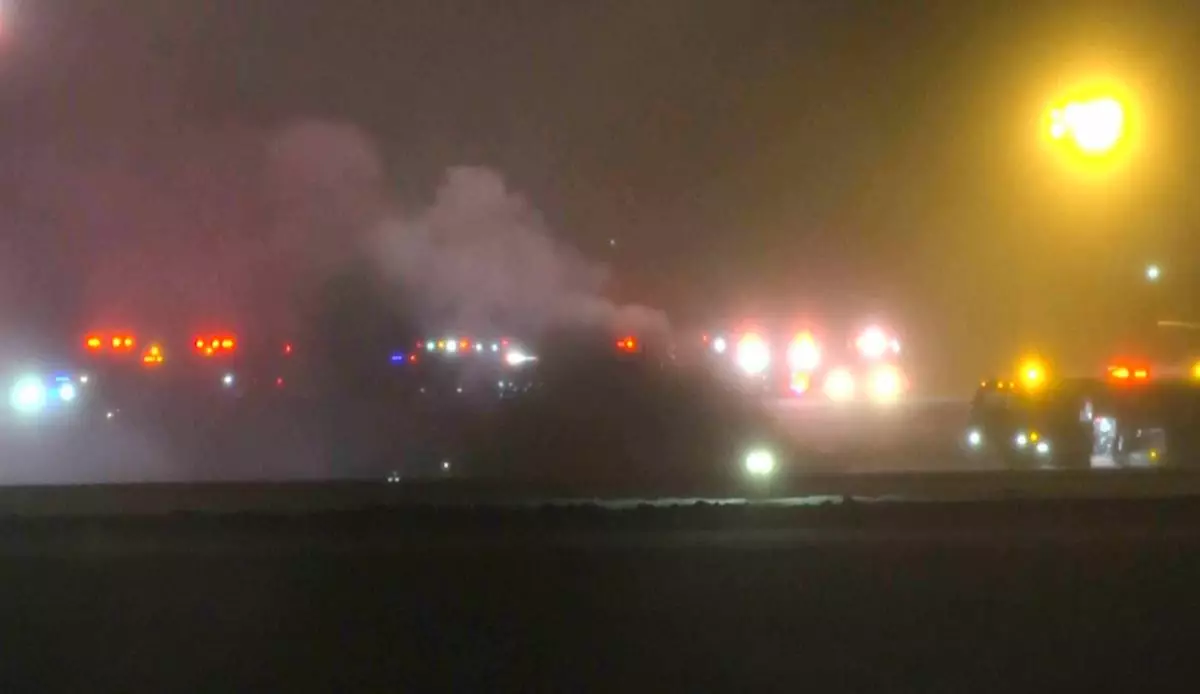
This image taken from video provided by WABI television, emergency services work on a scene of the Bombardier Challenger 600 crash at the Bangor Airport in Maine, late Sunday, Jan. 25, 2026. (WABI via AP)