Residents of Helsinki, the Finnish capital, have told China Global Television Network (CGTN) that they welcome China's contributions to environmental protection and technological development, and highlighted China's important role on the global political stage.
Their comments came during Finnish Prime Minister Petteri Orpo's four-day visit to China, which began on Sunday.
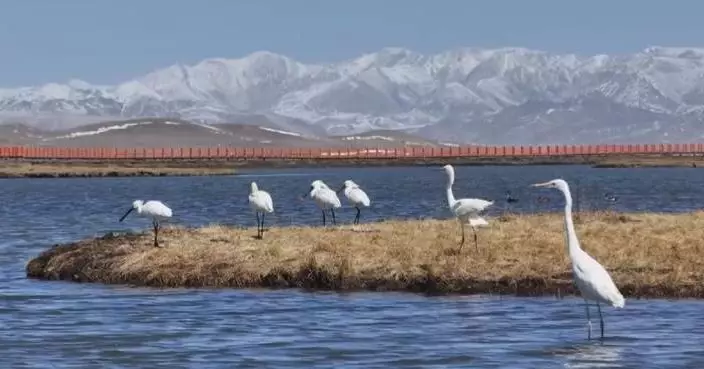
"I like the fact that China has made big changes towards environmentally-friendly solutions. It has made a really big impact. For example, we can see how the desert is being made green again. This is truly impressive. And then there is technology, especially electric vehicles, high-tech industries and artificial intelligence. These things bring a kind of stability to the international markets. It's a good direction," said Artur Kuu, a Helsinki-based entrepreneur.
"My perception of China is that it is a country that has gone through major changes in recent times. It has developed rapidly and become even more important in global politics and development. It is also very different compared to Europe. So, perhaps it is important that Europe and China have a good connection," said Mark Pokidko, a student in Helsinki.
Chinese and Finnish firms signed more than 10 cooperation agreements in Beijing on Monday, advancing joint work in innovation, green development and digitalization during the sixth meeting of the China-Finland Committee for Innovative Business Cooperation.
After a meeting between Chinese Premier Li Qiang and Orpo in Beijing on Tuesday, the two leaders witnessed the signing of several cooperation documents covering science and technology, housing and urban-rural development, customs, culture and tourism, economy and trade, and energy.
In Helsinki, Finnish journalist Evgenii Vologin emphasized the deep historical roots of bilateral ties between the two nations.
"That's been long, for many, many years. Actually, Finland was one of the first Western countries to recognize the People's Republic of China back in times, and one of the first countries to make a bilateral trade agreement with that. There are a lot of Chinese people in Finland, and we have some Asian grocery stores, Chinese investments, Finnish companies working in China. Then we do cooperation in information technologies. The founder of Linux was a Finnish guy who then went to China. So it's always been there. There are a lot of things happening," he said.
Tourism, trade, and technological innovation were also identified by the interviewees as defining pillars of the bilateral relationship.
"So, tourism has traditionally been very important in Finland, especially in terms of Chinese tourists. They are a highly anticipated group of travelers to Finland, especially in Lapland. I know from my own experience that the Chinese people really enjoy traveling. And of course, China too is a really interesting country from a tourism perspective. A lot of people from Finland visit China. And regarding this trip by Prime Minister Petteri Orpo, I know that they will be discussing tourism, trade and innovation. These are important matters for both sides," said Kuu, the entrepreneur.
"My impression is that the relationship between China and Finland is quite proper. It's focused on handling real problems. It isn't just theoretical and symbolic. It's genuinely practical and tries to take into account matters that actually require attention. For example, I know that many Finnish universities have connections with Chinese universities and a great deal of research work happens together with China. I also know that technology is quite important. There are a lot of innovative technologies in Finland, while China has the capacity to implement all of these because it has a good foundation for manufacturing all kinds of products," said Pokidko.

Finns welcome pragmatic approach to win-win cooperation with China