Chinese Premier Li Qiang on Tuesday stressed the importance of improving the conduct of officials, building integrity and combating corruption in government work, which will provide a strong guarantee to achieve the goals and tasks of the 15th Five-Year Plan period (2026-2030).
Li, who is also a member of the Standing Committee of the Political Bureau of the Communist Party of China (CPC) Central Committee, made the remarks at a State Council meeting on clean governance.
Addressing the meeting, Li called for higher standards and more practical measures in exercising full and rigorous Party self-governance, with the aim of ensuring relevant efforts are implemented across all aspects and processes of government work.
He also called for a more resolute, vigorous approach to implementing the CPC Central Committee's decisions and arrangements, as well as efforts to ensure officials have the correct understanding of what it means to perform well.
Moreover, Li called for further work to combat pointless formality and reduce the burden on primary-level officials, and to strengthen audit-based and accounting oversight to ensure the secure, efficient use of public funds and assets.
He also emphasized the need to deal with corruption issues in key areas seriously, as well as those that occur at people's doorsteps.
Ding Xuexiang, a member of the Standing Committee of the Political Bureau of the CPC Central Committee and Chinese vice premier, presided over the meeting.
Li Xi, a member of the Standing Committee of the Political Bureau of the CPC Central Committee and secretary of the CPC Central Commission for Discipline Inspection, attended the meeting.
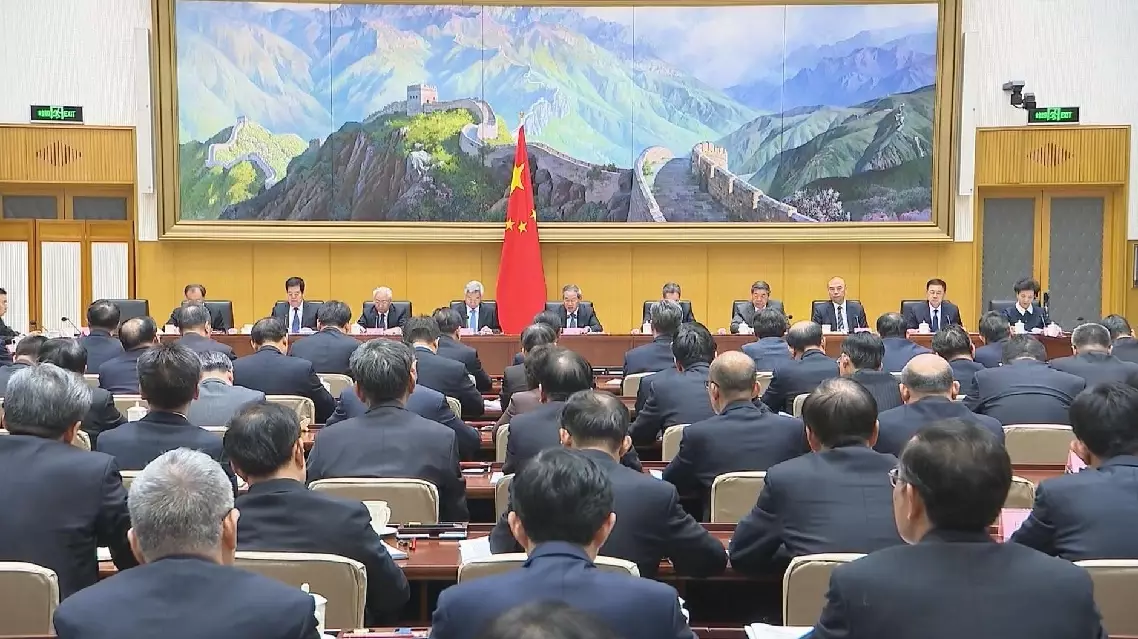
Chinese premier urges integrity, anti-corruption efforts in government work
The Nigerian government's efforts to drive up non-oil exports appear to be yielding positive results as fresh data shows that the country's non-oil exports rose to a historic high of 6.1 billion U.S. dollars in 2025, representing an 11.5 percent increase year on year.
For decades, oil exports have been the main driver of the Nigerian economy. The government has invested heavily to diversify the economy and prop up the country's non-oil exports.
The country's export promotion authority, the Nigerian Export Promotion Council ( NEPC), says the record 6.1-billion-dollar non-oil exports in 2025 is a clear indication that the government's diversification drive is working.
"In volume terms, total non-oil exports stood at 8.02 million metric tons, reflecting a 10 percent increase compared to 7.2 million metric tons recorded the previous year. This growth in both value and volume demonstrates improved export activities across multiple value chains and market destinations," said Nonye Ayeni, the executive director of the NEPC.
According to the NEPC, Nigeria exported a total of 281 non-oil products across 120 countries in 2025. The products cut across agriculture, manufacturing and solid minerals.
Leading the pack are products like Cocoa, Urea, Cashew nuts, Sesame seeds, aluminum ingots, copper and rubber, among others and much more. Many have welcomed the development.
"I think this growth was activated largely by the addition of agricultural commodities to our export regime. Products such as cocoa, sesame seeds, soybeans, and then improved processing of these commodities also added to the value chain," said Julius Ogar, an Agro-entrepreneur.
"We have to understand that this is a great significant push for Nigeria, saying that we are also moving away significantly from oil exports which has remained for a long time the most significant of our revenue source. So I would say that from a macroeconomic point of view, this is good news," said Femi Oladele, a policy analyst.
"It's worth celebrating but it also calls for, it calls significantly for deep thinking to see how we are going to make greater progress. Is this the best that we can do?" he added.
With Nigeria's foreign exchange (FX) market under strain for much of the past year, non-oil exports are increasingly being framed as part of the solution. The logic is simple: more exports, more dollar inflows ease pressure on the country's currency naira.
"If you see over the last few months, the rate has been quite stable. And so I believe that, yes, the export of our goods and services have contributed to balancing our FX situation in Nigeria. And I believe that we can do more. I believe because I understand that even when we look at the services that we have been rendering, especially many people here in Nigeria rendering services abroad, I would say that we have not even scratched the surface. And so I believe that there is a lot that we can do to still contribute more to our FX position. But yes, this figure is good and it contributes significantly to easing of the pressure on our FX demand," said Oladele.
But while goods volumes are rising, Nigeria still exports mostly raw or lightly processed goods, limiting its earnings and competitiveness. It's something many say has to change.
Authorities are hoping to consolidate on the figure and significantly drive-up non-oil export even further. The Nigerian Export Promotion Council has stated that it is collaborating with other government agencies to formalize and integrate informal trade into official channels. A significant volume of exports currently occurs through informal channels and remains unrecorded in official statistics.

Nigeria's non-oil exports surge to record high of 6.1 bln dollars in 2025