Speech by FS at Asia Private Equity Forum 2026 (with video)
Following is the speech by the Financial Secretary, Mr Paul Chan, at the Asia Private Equity Forum 2026 today (January 28):
Stephanie (Chairwoman of Hong Kong Venture Capital and Private Equity Association (HKVCA), Ms Stephanie Hui), Rebecca (Past Chairwoman of HKVCA, Ms Rebecca Xu), Kent (Vice Chairman of HKVCA, Mr Kent Chen), distinguished guests, ladies and gentlemen,
Good morning. It gives me great pleasure to join you again at the Asia Private Equity Forum for the ninth time, alongside leaders from the venture capital and private equity community in Hong Kong and across the region.
Over the years, this Forum has become an important platform for dialogue - helping us take stock of market developments, exchange perspectives, and explore emerging investment opportunities. I thank the Hong Kong Venture Capital and Private Equity Association for convening this timely gathering.
The global environment
Globally, private markets are showing encouraging signs of recovery. Anticipated interest-rate cuts, improving valuation expectations, and growing investor demand for private assets are contributing to a more conducive environment for deal-making and capital deployment. In Asia-Pacific, the private equity ecosystem has shown positive momentum in recent months, supported by sustained investment activity and deepening market sophistication across major hubs.
At the same time, the private markets industry itself is evolving. Artificial intelligence is increasingly being applied to sourcing, due diligence, and portfolio value creation and monitoring. Participation in private markets is also broadening. Retail and high-net-worth investors are increasingly seeking exposure to private equity, attracted by the potential for improved risk-adjusted returns and diversification.
Hong Kong: outlook and opportunities
So how about Hong Kong? I remain confident and optimistic - for a few reasons.
First, capital inflows. You must be aware of the strong performance of our public markets. Last year, the Hang Seng Index rose by 28 per cent, following an 18per cent increase in 2024. Trading activity reached new highs, with average daily turnover close to HK$250 billion, up 90per cent year on year. In 2025, Hong Kong recorded 119 initial public offerings (IPOs), raising more than HK$285 billion, registering an increase of over two times year on year, and ranking first globally.
A vibrant stock market and robust IPO performance are certainly good news for the private equity ecosystem. They provide portfolio companies with clearer and more credible exit pathways, support better price discovery, and can improve valuations when conditions allow. Improved liquidity has also strengthened investor confidence and renewed interest in high-potential companies.
Beyond public markets, our deep liquidity is underpinned by a thriving asset and wealth management sector. At last count, in 2024, Hong Kong's asset and wealth management industry managed over HK$35 trillion in assets under management, representing a 13 per centincrease from the year before. Fund flows have remained strong as well. In the first 11 months of 2025, Hong Kong-domiciled funds recorded net inflows of HK$386 billion.
This momentum is supported by a growing family office ecosystem. There are more than 2 700 family offices in Hong Kong, over half of which are managing assets of more than US$50 million.
Looking ahead, the global environment in 2026 will remain complex. Geopolitical tensions, impact of technological advancement, climate-related risks and other variables will continue to affect sentiment and volatility.
However, Asia's medium- to long-term fundamentals remain strong. China, for example, is expected to grow at around 4.5 per centto 5per cent this year. While it steadily contributes to 30per cent of global GDP growth, the Global South as a whole contributes to some 60 per cent. In particular, ASEAN (Association of Southeast Asian Nations) is home to young populations, massive infrastructure development, a growing middle class, and expanding industrial production. These dynamics are becoming powerful engines of both capital formation and demand.
The second reason for optimism is increasingly attractive investment opportunities.
Technology will, no doubt, shape the future. The recalibration of Asia's private equity landscape is being driven by a decisive pivot towards hard technology - the engines of future growth, particularly artificial intelligence, biotech and new energy. The outlook for private equity in these sectors is compelling.
China is embarking on the 15th Five-Year Plan, advancing high-quality development. In essence, it is pursuing high-level, two-way opening-up and accelerating technological and industrial innovation. Notably, it places strong emphasis on technological self-reliance, and we can expect game-changing breakthroughs.
In Hong Kong, we have been developing innovation and technology as one of our three principal engines of growth, alongside finance and trade. From supporting R&D and building infrastructure, to nurturing start-ups and attracting talent, we are strengthening Hong Kong's tech ecosystem from upstream to downstream.
Two points are particularly worth noting. First, the Government is determined to attract the world's leading frontier-technology enterprises to Hong Kong. Over the past three years, the Office for Attracting Strategic Enterprises has attracted more than 100 strategic enterprises, which are expected to invest over HK$60 billion and create more than 22 000 jobs. Importantly, these companies will bring partners across their value chains, further strengthening and broadening Hong Kong's innovation ecosystem.
Second, the HKSAR Government has established the Hong Kong Investment Corporation Limited, or HKIC. It provides patient capital and makes strategic investments in high-potential ventures, particularly in hard technology. HKIC also co-invests in projects where justified. Its portfolio includes frontier AI platforms reshaping productivity across the Greater Bay Area - from smart logistics to advanced manufacturing - as well as biotech ventures advancing precision medicine and next-generation therapeutics, and AI-driven healthcare solutions integrating machine learning with clinical diagnostics. HKIC plays an important role in channelling private capital into strategic projects. For every dollar it invests, it attracts around six dollars in private investment. HKIC is ready to further collaborate with the private equity community to support high-potential ventures.
Developments for the PE sector
Looking ahead, we are keen to support the PE and VC sector's continued growth. Hong Kong has a strong private equity ecosystem. We are home to over 650 PE firms, and assets under management stand at around US$230 billion. This keeps us firmly in second place in Asia, behind only the Chinese Mainland.
We continue to see encouraging responses to the recent reforms to fund structures. By end-2025, close to 680 open-ended fund companies had been set up, a 43 per centyear-on-year increase. About 1 450 limited partnership funds were registered, up 37per cent from the previous year.
The Government is committed to creating fresh momentum for the industry. We will continue to support the growth of our asset and wealth management business, including facilitating more family offices in setting up or expanding here. We are committed to facilitating at least 220 family offices in establishing or expanding operations in Hong Kong from 2026 to 2028.
Maintaining the competitiveness of our tax regime is also essential. To attract more funds to establish a presence and be managed in Hong Kong, we will introduce a bill into the Legislative Council in the first half of this year to enhance the preferential tax regimes for funds, single family offices, and carried interest.
Key enhancements will include: first, expanding the scope of "fund" under the tax exemption regime to cover pension funds and endowment funds; second, increasing the types of qualifying investments to include emission derivatives and carbon credits, insurance-linked securities, loans and private credit investments, and digital assets; and third, enhancing the tax concession arrangement on the distribution of carried interest by removing the certification requirement for funds and the reference to a hurdle rate.
On exit options, we have in recent years modernised our listing regime by establishing listing avenues for companies from the new economy and emerging sectors, including pre-revenue biotechnology companies and specialist technology companies, thereby broadening fundraising channels for these enterprises and, in turn, providing PE investors with the avenues to realise their investments through the public markets.
We also welcome alternative asset funds to list in Hong Kong. In February 2025, the SFC clarified the regulatory requirements for authorising closed-ended funds that invest mainly in private and less liquid assets. This is intended to encourage eligible and sizeable alternative asset funds - such as those investing in private equity, private credit, or infrastructure debt, and preferably with regular income streams - to list in Hong Kong. And subject to the approval of the Mandatory Provident Fund Schemes Authority, an MPF fund can gain limited exposure to such funds. We look forward to welcoming the first such listing.
Closing
Ladies and gentlemen, 2026 will not be without challenges. Yet with the country's unwavering support, Hong Kong's enduring institutional strengths, and the wide-ranging initiatives we are putting in place - from deepening market liquidity and strengthening our innovation ecosystem to enhancing tax competitiveness and broadening exit channels - we are well positioned to turn uncertainty into opportunity, and opportunity into lasting value.
In just a couple of weeks, we will welcome the Year of the Horse - symbolising agility, stamina, and transformation. These qualities also describe the private equity and venture capital community. With your insight, discipline, and long-term commitment, I am confident Hong Kong will continue to thrive as a leading international financial centre and a premier hub for private capital in Asia.
I wish you a rewarding Forum, and the very best in business, investment, and health in the year ahead. Thank you.
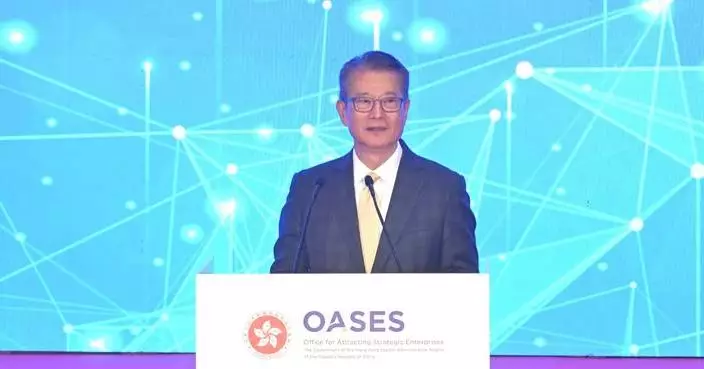
The Financial Secretary, Mr Paul Chan, Photo source; FB of Mr Paul Chan