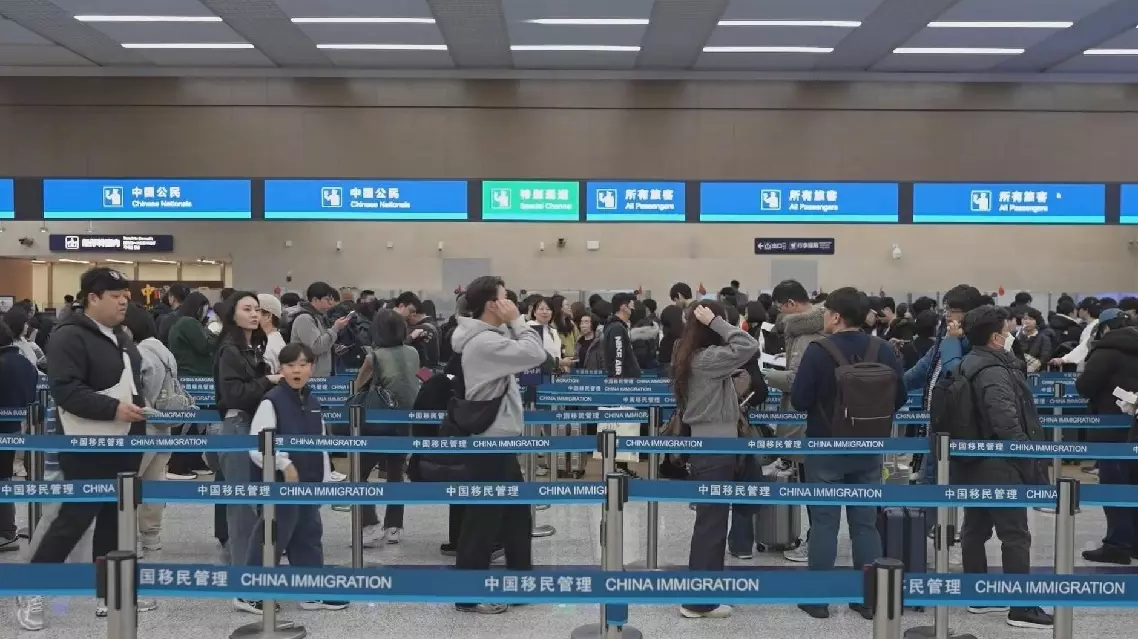
China recorded 82.035 million border entries and exits by foreign nationals in 2025, a year-on-year increase of 26.4 percent, shown by latest data released by the National Immigration Administration of China.
"Of these entries, 30.08 million were made under visa‑free arrangements, accounting for 73.1 percent of all inbound foreign‑national crossings and marking a 49.5 percent rise compared to the previous year," said Lyu Ning, a spokeswoman of the National Immigration Administration of China.
Driven by multiple visa‑facilitation policies, China has strengthened its position as a favored global destination, attracting travelers from popular cities to emerging border regions for both sightseeing and in‑depth cultural experiences.
The upgraded 240-hour transit visa‑free policy, launched in late 2024, served as a major catalyst.
In 2025, its coverage was expanded to include Indonesia and five additional ports in south China's Guangdong Province, bringing the total number of eligible ports nationwide to 65, greatly boosting cross‑border travel.
Meanwhile, China's visa‑free "circle of friends" continued to grow. With 11 new countries added, including Brazil, Russia, and Sweden, the total number of unilateral visa‑free countries reached 48, while mutual visa‑exemption agreements expanded to 29.
Notably, the Hainan Free Trade Port now offers visa‑free entry to citizens of 86 countries, with visa‑free travelers making up 88.9 percent of all arrivals there.
The policy effect has further penetrated into border areas. At Heihe Port in northeast China's Heilongjiang Province, visa‑free entry for Russian tourists drove Russian arrivals to 46,000 in September and October 2025 alone, a 28.4 percent year-on-year increase.
Large tour groups, such as one with 174 travelers, were able to complete border procedures in as little as 20 minutes thanks to streamlined clearance services.
In southwest China's Yunnan Province, a visa‑free policy for ASEAN tourist groups entering via Xishuangbanna, covering ten countries including Malaysia, Thailand, and Laos, took effect in February 2025.
In southwest China's Yunnan Province, a visa‑free policy for ASEAN tourist groups entering via Xishuangbanna was implemented starting February 10, 2025, covering ten member states including Malaysia, Thailand, and Laos.
This "ready‑to‑go" arrangement has provided greater travel convenience for ASEAN visitors.
As a core hub under this policy, Mohan Port processed over 160 inbound and outbound tourist groups from the ten ASEAN countries in 2025.
"We are international travelers from Singapore. We've been to China many times. But this is our first time taking the China-Laos Railway. The trip is really wonderful," said a passenger from Singapore.
China's inbound travel surges as visa‑free policies attract global visitors