Starbucks reported strong fiscal first quarter as holiday drinks and a viral bear cup helped drive sales.
Same-store sales – or sales at locations open at least a year – rose 4% for the October-December period. That was higher than the 2.3% that Wall Street was expecting, according to analysts polled by FactSet.
Same-store sales in the U.S. were also up 4%, with a 3% increase in transactions and a 1% increase in spending per visit. That was the best U.S. performance for the company in two years.
Shares of the Seattle coffee giant jumped more than 6% before the opening bell Wednesday.
Starbucks Chairman and CEO Brian Niccol said the results were evidence that the company's turnaround plan is taking hold. Over the last year, Starbucks has been adding staff and equipment to stores to ensure faster and friendlier service and better sequence its mobile orders.
Starbucks is also adding seating and updating stores to make them cozier and more welcoming. Niccol said around 200 stores have been redecorated so far and more than 1,000 will get that treatment by this fall.
“We have a plan, we are working the plan, and the plan is working," Niccol said Wednesday during a conference call with investors. “The shine is back on our brand, both in the U.S. and around the world.”
Niccol warned that the turnaround may not be linear. But the company does expect to turn around lagging sales this year. Starbucks said it expects global same-store sales and revenue to grow 3% or more in its 2026 fiscal year. Starbucks' global same-store sales fell 1% in its previous fiscal year.
Niccol said Starbucks delivered record revenue during its holiday launch week. One “Lucky Strike extra,” Niccol said, was the $29.95 glass Bearista cups, which sold out almost immediately after they were introduced. On Wednesday, an authentic Bearista cup was selling for $119.99 on eBay.
U.S. traffic was up despite a strike by more than 1,000 unionized Starbucks workers, who hoped to disrupt Starbucks’ Red Cup Day, which is typically one of the company’s busiest days of the year. Since 2018, Starbucks has given out free, reusable cups on that day to customers who buy a holiday drink. The strike closed some stores, but only briefly.
Some U.S. stores also gained customers after Starbucks closed nearly 600 stores in North America in September. The company said it was closing the stores to focus its resources on better performers.
Starbucks also had a strong quarter in China, where same-store sales were up 7%.
In November, Starbucks announced it was forming a joint venture with Chinese investment firm Boyu Capital to operate Starbucks stores in China. Under the agreement, Boyu will acquire a 60% interest in Starbucks’ retail operations in China, which is valued at $4 billion. Starbucks will retain a 40% interest in the joint venture and will own and license the Starbucks brand.
Revenue rose 6% to $9.9 billion for the quarter, also beating Wall Street expectations for $9.65 billion.
Starbucks said its margins have been pressured by investments in labor as well as tariffs on coffee. But some of those costs should abate as this year progresses, Chief Financial Officer Cathy Smith said. In November, President Donald Trump announced he was scrapping U.S. tariffs on beef, coffee, tropical fruits and a broad swath of other commodities.
Adjusted for one-time items, Starbucks earned 56 cents per share in the quarter. That was lower than the 59-cent profit Wall Street was expecting.
FILE - The "Siren" logo hangs outside a Starbucks Coffee shop, Wednesday, July 14, 2021, in Boston. (AP Photo/Charles Krupa, File)
ROME (AP) — Italian Premier Giorgia Meloni visited a southern town in Sicily on Wednesday that has been left teetering on the edge of a cliff after days of heavy rains from a cyclone triggered a huge landslide that brought down properties and forced the evacuation of over 1,500 people.
The landslide in Niscemi, a town in the southwest of the island, spanned 4 kilometers (2.5 miles). Images showed cars and structures that had fallen 20 meters (yards) off the newly formed cliff, while many other homes remain perched perilously on the cliff edge.
Civil protection crews have created a 150-meter wide “no go zone” in the town, which is just inland from the coastal city of Gela.
“The entire hill is collapsing onto the plain of Gela,” civil protection chief Fabio Ciciliano said. “To be honest, there are houses located on the edge of the landslide that obviously can no longer be inhabited, so we need to work with the mayor to find a permanent relocation for these families.”
Authorities have warned that residents with homes in the area will have to find long-term alternatives to moving back since the water-soaked ground was still shifting and too unstable to live.
The federal government included Niscemi in a state of emergency declaration on Monday for three southern regions hard hit by Cyclone Harry and set aside an initial 100 million euros ($120 million) to be divided among them. Sicilian regional officials estimated on Wednesday the overall damage to Sicily stood at 2 billion euros.
Meloni took a helicopter tour of the landslide area and met with local, regional and civil protection officials at the town hall. She vowed that the initial emergency funding was just the first step in addressing the immediate financial needs of displaced residents and that more was coming.
In a statement, her office said the government was committed to helping residents find alternative housing and to restoring road access, utilities and school activities in town.
“The situation is complicated by the fact that, as long as the landslide remains active, it is impossible to identify the exact area to be treated and therefore to establish the methods of intervention,” it said.
Niscemi was built on a hill on layers of sand and clay that become particularly permeable in heavy rain and have shifted before, most recently in a major 1997 landslide that forced the evacuation of 400 people, geologists say.
“Today, the situation is repeating itself with even more significant characteristics: the landslide front extends for about 4 kilometers and directly affects the houses facing the slope,” warned Giovanna Pappalardo, professor of applied geology at the island's University of Catania.
The latest landslide, which began on Sunday with Cyclone Harry thrashing southern Italy, has revived political mud-slinging about why construction was allowed on land which, because of its geological makeup, had a known high risk of landslides.
Renato Schifani, the center-right regional president of Sicily, acknowledged such questions were legitimate. But he noted he had only been in office for a few years and said the main issue was an institutional response to help residents immediately affected.
Elly Schlein, the opposition center-left Democratic Party leader, called on the government to reallocate 1 billion euros approved for its controversial bridge from Sicily to the Italian mainland and direct it toward storm-hit regions, since the bridge project is currently tied up in court challenges.
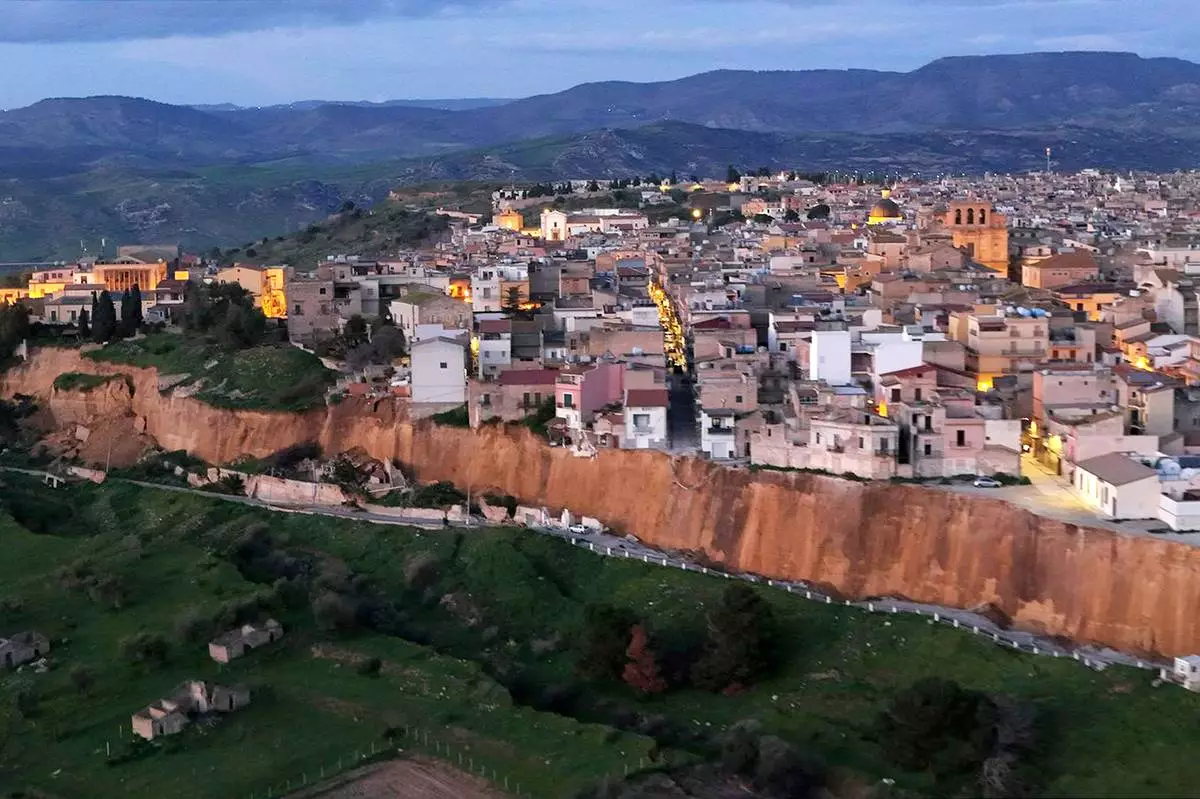
Aerial view of the village of Niscemi near the Sicilian town of Caltanissetta, southern Italy, Tuesday, Jan. 27, 2026, where severe storms provoked a landslide, and some 1,500 people had to be evacuated from their homes. (Alberto Lo Bianco/LaPresse via AP)
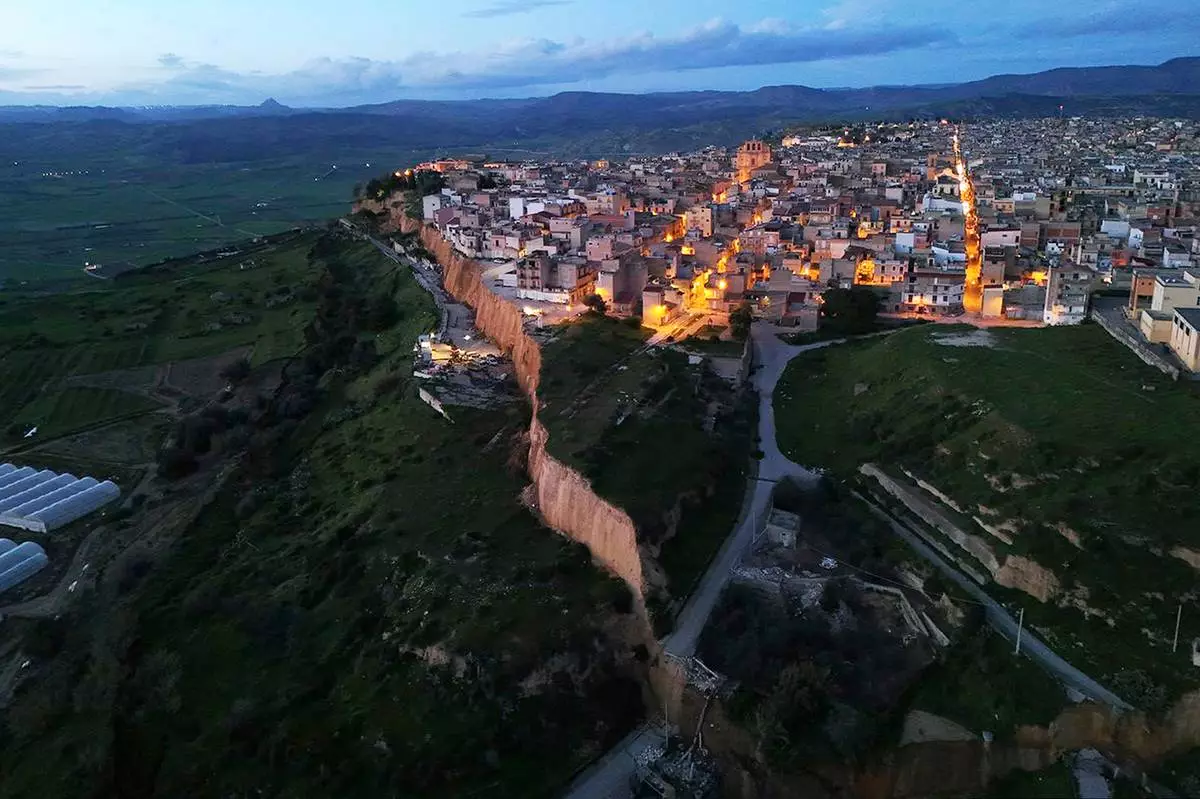
Aerial view of the village of Niscemi near the Sicilian town of Caltanissetta, southern Italy, Tuesday, Jan. 27, 2026, where severe storms provoked a landslide, and some 1,500 people had to be evacuated from their homes. (Alberto Lo Bianco/LaPresse via AP)
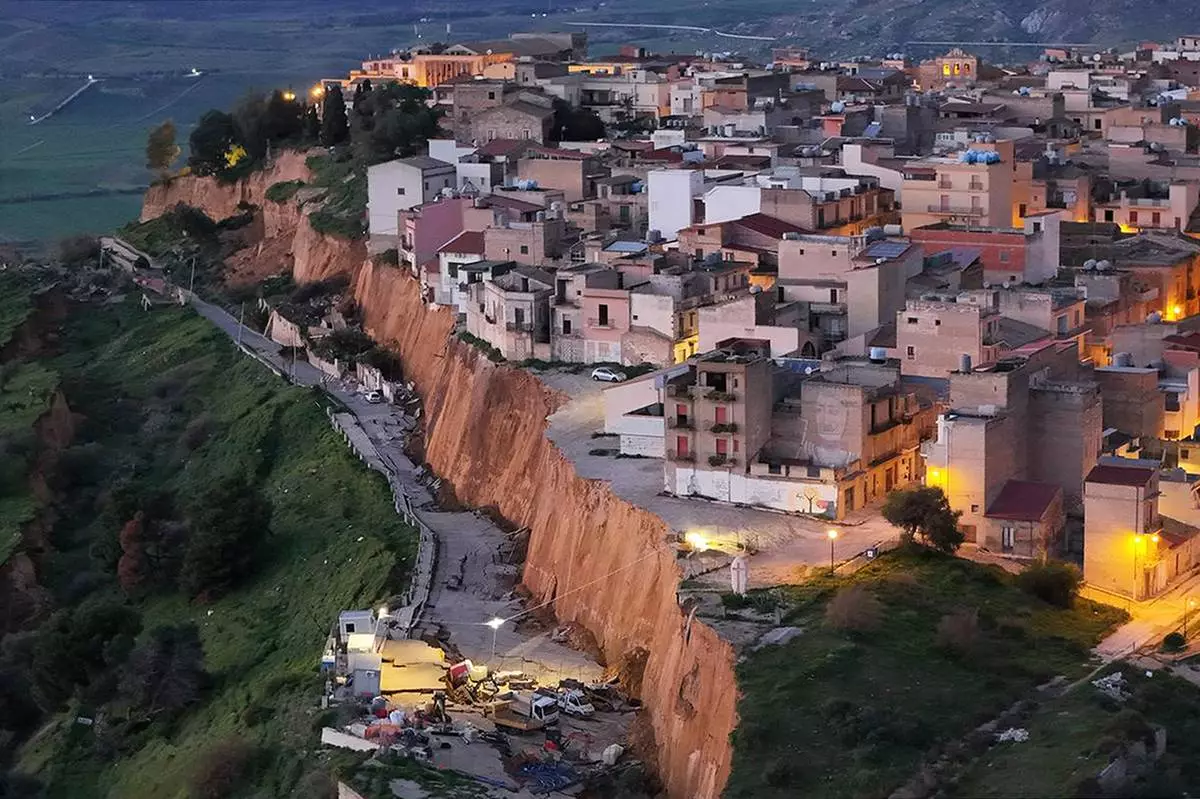
Aerial view of the village of Niscemi near the Sicilian town of Caltanissetta, southern Italy, Tuesday, Jan. 27, 2026, where severe storms provoked a landslide, and some 1,500 people had to be evacuated from their homes. (Alberto Lo Bianco/LaPresse via AP)