China's 40-day Spring Festival travel rush is expected to see a significant increase in demand for inter-regional passenger trips this year, said Li Chunlin, deputy head of the National Development and Reform Commission (NDRC), at a press conference in Beijing on Thursday.
The Spring Festival travel season, also known as Chunyun, is the world's largest annual migration.
This year's Spring Festival travel rush will run from Feb. 2 to March 13, lasting 40 days.
"This year's Spring Festival is particularly special, as it coincides with a weekend before the holiday, resulting in a total of nine consecutive days off. This year's Spring Festival marks a significant occasion, and it is expected that the demand for people returning home for family reunions and traveling will be even stronger. Based on comprehensive analysis, inter-regional passenger trips across China are expected to reach a record high of 9.5 billion, setting a new record high. Self-driving trips will continue to dominate, accounting for about 80 percent of total travel. Railway and civil aviation passenger volumes are projected to reach 540 million and 95 million, respectively, with both the overall scale and peak daily traffic expected to surpass historical levels," Li said.
Each year during the Spring Festival travel rush, millions of people working, studying or living away from their hometowns return home for the Spring Festival, China's most important traditional holiday, forming the world's largest annual human migration.

China expects soaring demand for passenger trips during 2026 Spring Festival travel rush
Smart wearable devices are increasingly embedded in daily life in China, where booming sales of watches and smart glasses are reshaping the consumer electronics market. In Beijing's Chaoyang District, smart watches have become a popular choice for shoppers seeking tools to monitor sleep, heart rate and stress.
"I often use my smart watch to monitor my sleep, heart rate, and stress. I hope it could also incorporate AI functions, allowing me to chat with it in-depth or help me complete some simple tasks," said a customer.
Beyond watches, smart glasses powered by large‑model technology are entering China's consumer market, reshaping the landscape of wearable electronics.
"It is more convenient to use smart glasses as earphones at work. This is my third pair of smart glasses, and the functions of the new one is much better than the previous ones," said a customer.
"Smart wearable devices have evolved significantly, shifting from simply displaying data to facilitating effective user interaction. As these product categories update at an accelerating pace and user demands grow increasingly diverse, manufacturers are compelled to accelerate their own cycles of innovation in both functional design and hardware configuration. Take smartwatches as an example: sales in this category have increased by more than 40 percent (compared to the same period in 2024)," said Zhang Jie, manager of Beijing Shuangjing Branch of JD Mall.
According to the latest worldwide quarterly wearable device tracker, in the first three quarters of 2025, global wrist-worn device shipments reached 150 million units, a year-on-year increase of 10 percent.
Among them, China's cumulative shipments totaled 58.43 million units, representing a year-on-year growth of 27.6 percent. In the first half of 2025, the global smart glasses shipments reached 4.065 million units, a year-on-year increase of 64.2 percent, and China's cumulative shipments exceeded 1 million units.
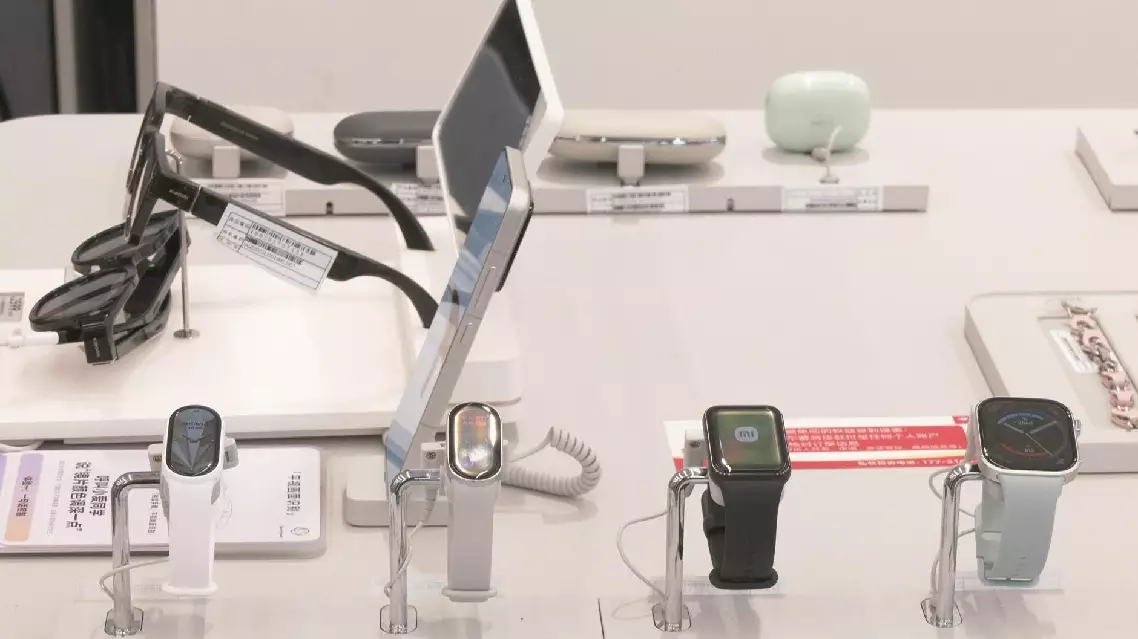
China smart wearables growth fuels consumer electronics boom