MINNEAPOLIS--(BUSINESS WIRE)--Jan 29, 2026--
Veterans pursuing civilian careers in automotive retail now have a new pathway at Walser Automotive Group, where the company’s on-the-job sales training program is officially eligible for GI Bill ® benefits.
This press release features multimedia. View the full release here: https://www.businesswire.com/news/home/20260129742927/en/
The designation allows eligible veterans to receive financial support while training for a full-time sales career, bridging the gap between military service and civilian employment.
It’s a benefit that Customer Specialist Dominic Tolkinen is embracing.
Tolkinen, a U.S. Marine Corps veteran who served as a Lance Corporal and CBRN Defense Specialist, joined Walser in June 2025.
"Making GI Bill benefits available is a statement of who Walser really is and what they stand for,” Tolkinen said. “And just like in service to our country, at Walser we are driven by a commitment to protect, support, and serve with integrity.”
The GI Bill approval builds on Walser’s veteran employment efforts, including its Beyond the Yellow Ribbon company designation in 2025 and a goal to hire 50 veterans annually.
While the GI Bill is commonly used to cover college tuition costs, the benefit can also support veterans during on-the-job training. Walser worked alongside its employee resource group, Veterans at Walser, and the Minnesota’s Department of Veterans Affairs to certify its 12-month, 2,000-hour training program as eligible for both the federal and Minnesota GI Bill.
The program combines classroom instruction, self-guided learning, workshops, and hands-on dealership experience. The structured approach prepares sales consultants for high-performance sales roles and long-term leadership opportunities.
“Walser making their sales training benefit-eligible creates a bridge from service to purpose,” said Tolkinen. “Walser does more than thank their veterans for their service: they invest in their lives, their families, and their next chapter.”
As a result, veterans like Tolkinen and other eligible beneficiaries enrolled in Walser’s sales training program can now receive GI Bill benefits in addition to military-focused benefits such as military training pay and differential pay for active deployments. Together, these benefits provide financial stability and help ease military transition.
“The word ‘thank you’ often feels insufficient for our veterans’ sacrifice, and making our sales training program benefit-eligible is an actionable way to show gratitude and support to our veterans,” said Kristen Baker, Walser’s Director of Training.
Baker said the program was redesigned in 2024 to center on the learner experience and support multiple learning styles.
“Many dealerships drop new hires off on the show floor with no support or guidance. This is a structured, compassionate training program that not only builds skills, but careers as well,” Baker said.
In 2026, Veterans at Walser plans to implement a veteran mentorship program designed to connect new veteran hires with experienced veteran mentors who can provide guidance and support during a critical transition period.
GI Bill ® is a registered trademark of the U.S. Department of Veterans Affairs (VA). More information about education benefits offered by VA is available at the official U.S. government website at https://benefits.va.gov/gibill/.

Dominic Tolkinen, U.S. Marine Corps veteran and Customer Specialist at Walser Automotive Group, is the first employee to benefit from Walser’s newly GI Bill®-eligible sales training program.
BRUSSELS (AP) — The European Union appeared poised Thursday to sanction Iran’s paramilitary Revolutionary Guard and list it as a terrorist group over Tehran’s deadly crackdown on nationwide protests, further squeezing the Islamic Republic as it faced U.S. threats to potentially launch a military strike against it.
U.S. forces have moved the USS Abraham Lincoln and several guided-missile destroyers into the Mideast that can be used to launch attacks from the sea. President Donald Trump has threatened military action in response to the killing of peaceful demonstrators and over possible mass executions, though it remains unclear whether he will decide to use force. At least 6,373 people have been killed in Iran's protests, activists said.
For its part, Iran has said it could launch a pre-emptive strike or broadly target the Mideast, including American military bases in the region and Israel.
The EU’s top diplomat, Kaja Kallas, told journalists Thursday it was “likely” fresh sanctions would be put in place on the Revolutionary Guard, which has played a key role in suppressing the demonstrations.
“This will put them on the same footing with al-Qaida, Hamas, Daesh,” Kallas said, using an Arabic acronym for the Islamic State group. “If you act as a terrorist, you should also be treated as a terrorist.”
If approved, the sanctions by the EU, which the bloc's member states have long discussed, could put fresh pressure on Iran as its economy already struggles under the weight of multiple international sanctions from countries including the U.S. and Britain. The Guard holds vast business interest across Iran, and sanctions could see any of its assets in Europe seized.
Iran's rial currency fell to a record low of 1.6 million to $1 on Thursday. Economic woes had sparked the protests that broadened into challenging the theocracy before the crackdown.
Iran had no immediate comment, but it has been criticizing Europe in recent days as it considered the move, which follows the U.S. sanctioning the Guard in 2019.
By EU law, sanctions require unanimity across the bloc’s 27 nations. That's at times hindered Brussels’ ability to take quick action, such as responding to Russia's full-scale invasion of Ukraine in 2022.
France had objected to listing the Revolutionary Guard as a terrorist organization over fears it would endanger French citizens detained in Iran, as well as diplomatic missions, which provide some of the few communication channels between the Islamic Republic and Europe and its allies. However, the office of President Emmanuel Macron on Wednesday signaled Paris backed the decision.
French Foreign Minister Jean-Noël Barrot said Thursday before the Foreign Affairs Council in Brussels that France supports more sanctions in Iran and the listing “because there can be no impunity for the crimes committed.”
“In Iran, the unbearable repression that has engulfed the peaceful revolt of the Iranian people cannot go unanswered,” he said.
Kristina Kausch, a deputy director at the German Marshall Fund, said the listing would be “a symbolic act” showing that for the EU “the dialogue path hasn’t led anywhere and now it’s about isolation and containment as a priority.”
“The designation of a state military arm, of an official pillar of the Iranian state as a terrorist organization is one step short of cutting diplomatic ties," she said. "But they haven’t cut diplomatic times and they won’t.”
The Guard was born from Iran’s 1979 Islamic Revolution as a force meant to protect its Shiite cleric-overseen government and later enshrined in its constitution. It operated in parallel to the country’s regular armed forces, growing in prominence and power during a long and ruinous war with Iraq in the 1980s. Though it faced possible disbandment after the war, Supreme Leader Ayatollah Ali Khamenei granted it powers to expand into private enterprise, allowing it to thrive.
The Guard's Basij force likely was key in putting down the demonstrations, starting in earnest from Jan. 8, when authorities cut off the internet and international telephone calls for the nation of 85 million people. Videos that have emerged from Iran via Starlink satellite dishes and other means show men likely belonging to its forces shooting and beating protesters.
Sanctioning the Guard, however, would be complicated. Iranian men once reaching the age of 18 are required to do up to two years of military service, and many find themselves conscripted into the Guard despite their own politics.
Meanwhile, the hard-line Keyhan newspaper again raised the specter of Tehran attempting to militarily close the Strait of Hormuz, the narrow mouth of the Persian Gulf through which 20% of the world's oil passes. Such a move likely would see U.S. military intervention.
“Today, Iran and its allies have their finger on a trigger that, at the first enemy mistake, will sever the world’s energy artery in the Strait of Hormuz and bury the hollow prestige of billion-dollar Yankee warships in the depths of the Persian Gulf,” the newspaper said.
On Wednesday, the U.S.-based Human Rights Activists News Agency said the violence in Iran has killed at least 6,373 people in recent weeks, with many more feared dead. Its count included at least 5,993 protesters, 214 government-affiliated forces, 113 children and 53 civilians who weren’t demonstrating. More than 42,450 have been arrested, it added.
The group verifies each death and arrest with a network of activists on the ground, and has been accurate in multiple rounds of previous unrest in Iran. The communication cutoff imposed by Iranian authorities have slowed the full scale of the crackdown from being revealed, and The Associated Press has been unable to independently assess the death toll.
Iran’s government as of Jan. 21 put the death toll at a far lower 3,117, saying 2,427 were civilians and security forces and labeled the rest “terrorists.” In the past, Iran’s theocracy has undercounted or not reported fatalities from unrest.
That death toll exceeds that of any other round of protest or unrest in Iran in decades, and recalls the chaos surrounding the 1979 Islamic Revolution.
Gambrell reported from Dubai, United Arab Emirates.
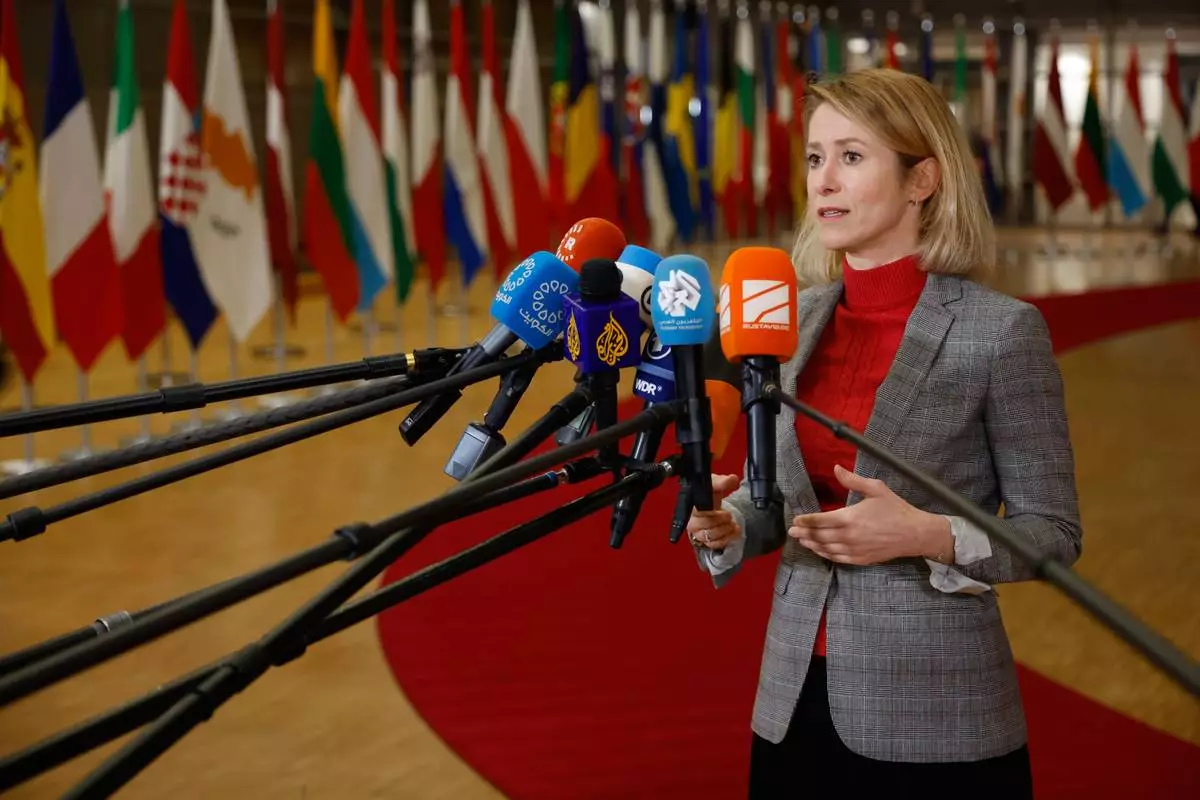
European Union foreign policy chief Kaja Kallas speaks with the media as she arrives for a meeting of EU foreign ministers at the European Council building in Brussels, Thursday, Jan. 29, 2026. (AP Photo/Geert Vanden Wijngaert)
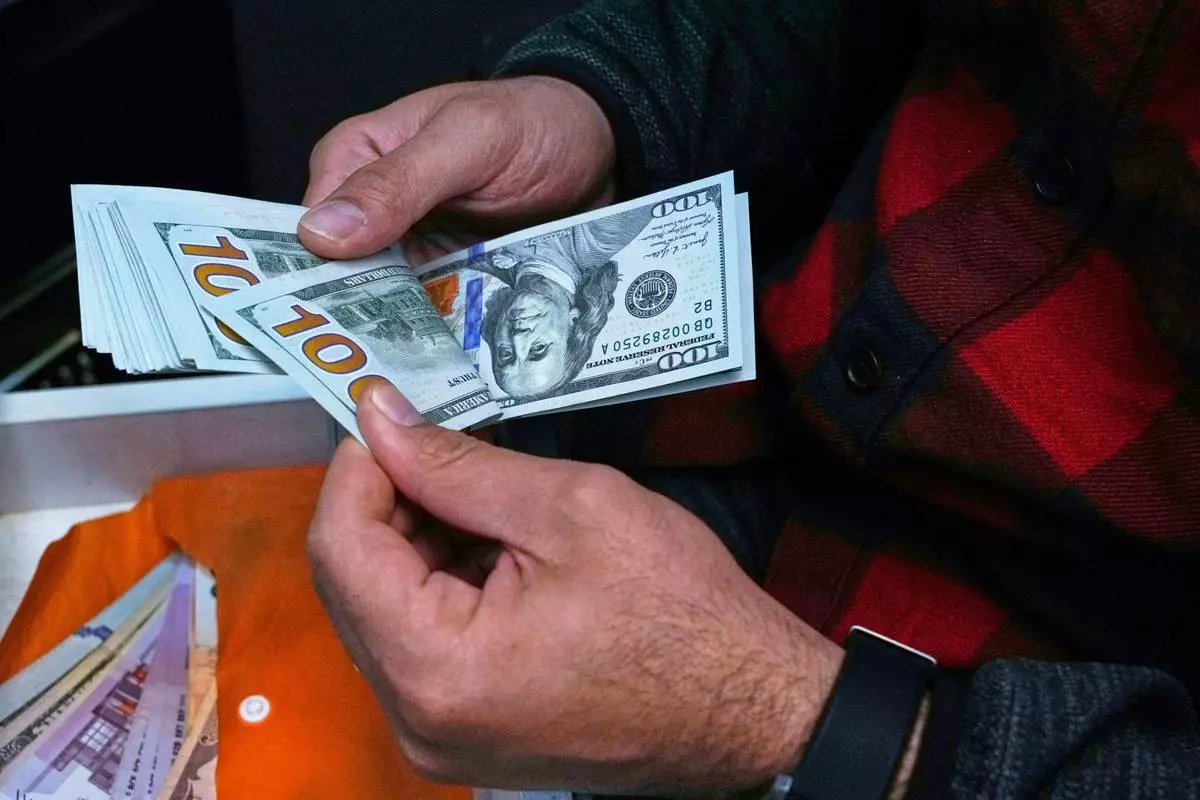
FILE- A currency exchange bureau worker counts U.S. dollars at Ferdowsi square, Tehran's go-to venue for foreign currency exchange, in downtown Tehran, Iran, April 5, 2025. (AP Photo/Vahid Salemi, File)
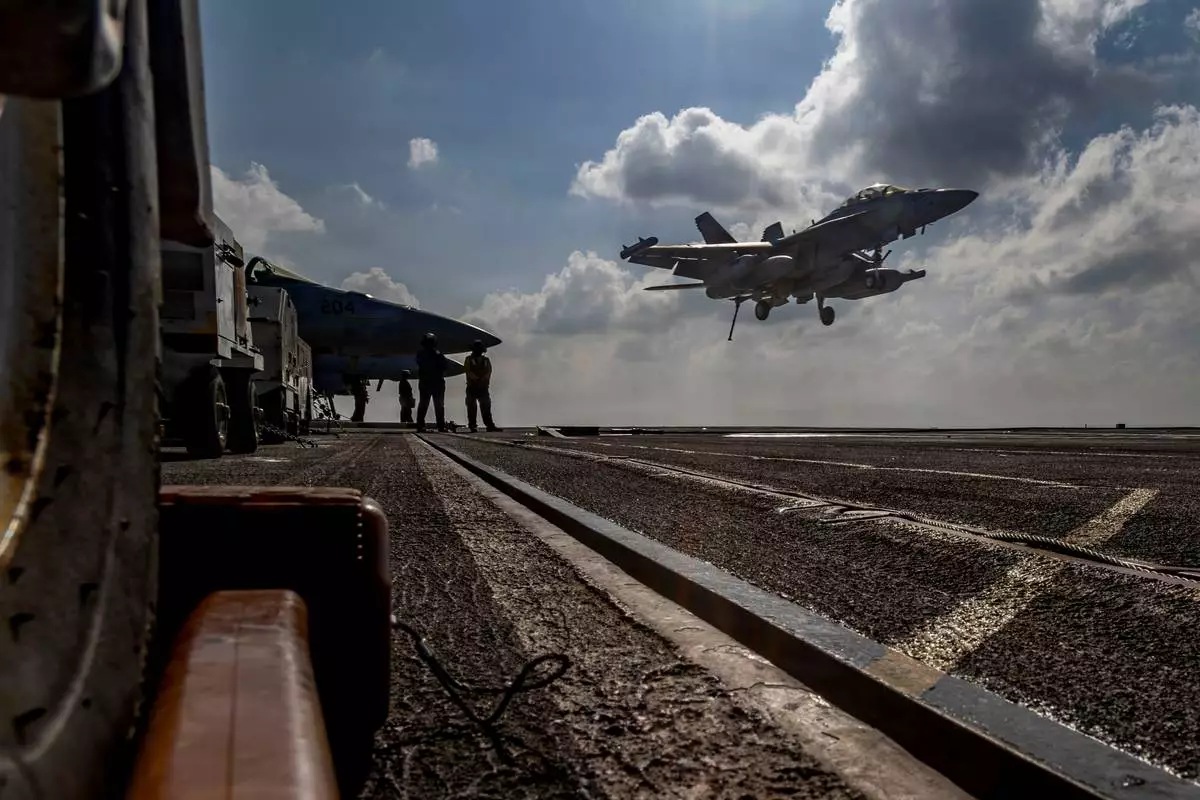
This handout image from the U.S. Navy shows an EA-18G Growler landing on the flight deck of the Nimitz-class aircraft carrier USS Abraham Lincoln in the Indian Ocean on Jan. 23, 2026. (Mass Communication Specialist Seaman Daniel Kimmelman/U.S. Navy via AP)
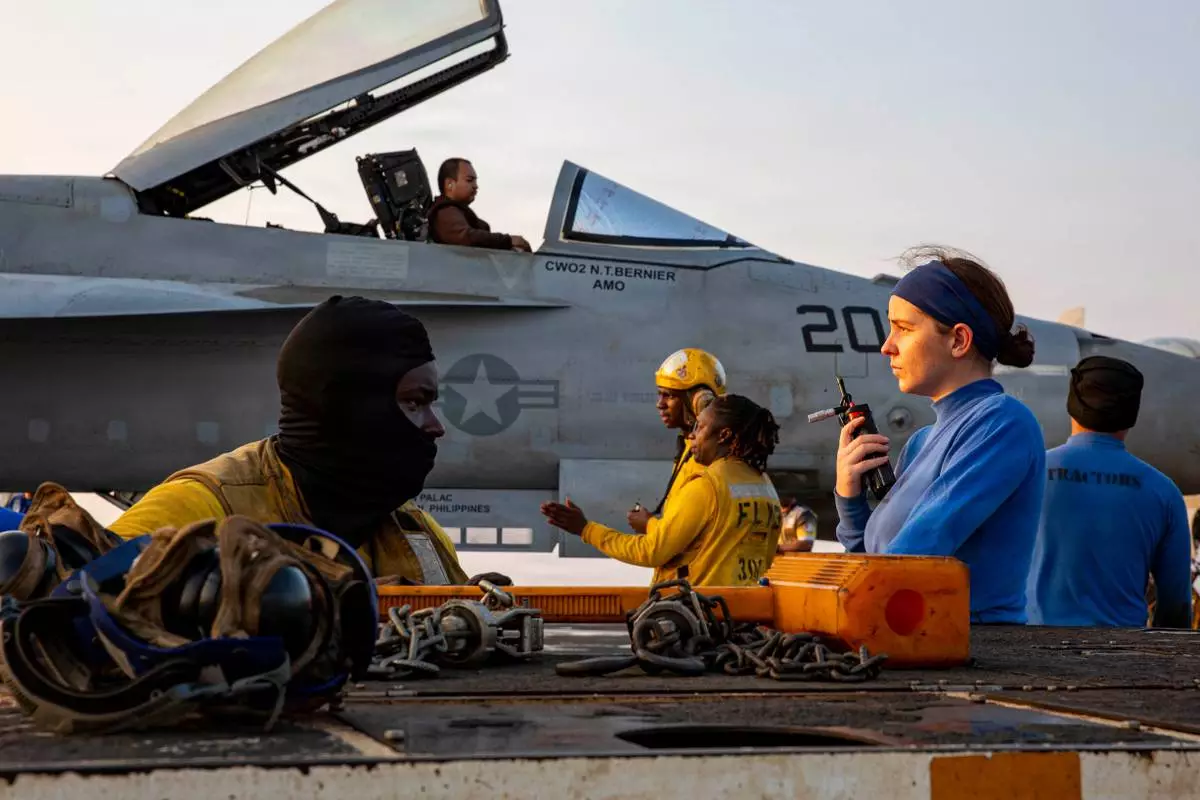
This handout photograph from the U.S. Navy shows sailors taxiing an F/A-18E Super Hornet on the flight deck of the Nimitz-class aircraft carrier USS Abraham Lincoln in the Indian Ocean on Jan. 25, 2026. (Mass Communication Specialist 3rd Class Shepard Fosdyke-Jackson/U.S. Navy via AP)
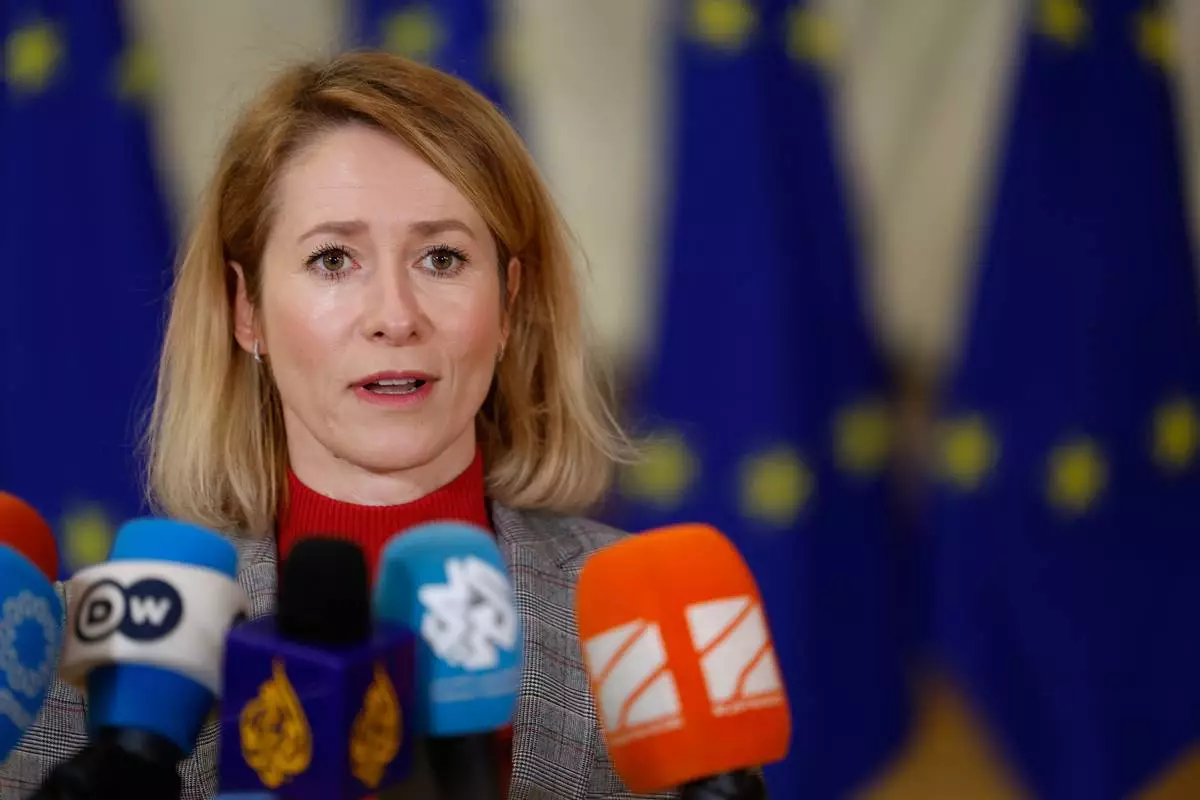
European Union foreign policy chief Kaja Kallas speaks with the media as she arrives for a meeting of EU foreign ministers at the European Council building in Brussels, Thursday, Jan. 29, 2026. (AP Photo/Geert Vanden Wijngaert)