Qingdao Port, a major foreign trade gateway in east China's Shandong Province, is entering 2026 with steady growth momentum, driven by automation, digitalized customs clearance and an expanding global shipping network.
The port handled more than 700 million tonnes of cargo last year and operates over 230 shipping routes linking more than 700 ports in over 180 countries, according to port officials.
Its automated container terminal, which relies on driverless vehicles and centralized digital control, has set world records for automated container-handling efficiency 13 times. The port said higher throughput has been achieved through automation and system integration rather than increased labor input.
From a central control room, operators monitor vessel schedules, container movements and equipment operations in real time, with tasks coordinated through integrated digital systems.
"Our A-TOS system serves as the port's intelligent management and control platform, responsible for overall planning, operational scheduling and resource optimization. The A-ECS system, on the other hand, is an intelligent equipment control system. It directly manages the real-time operation of key automated equipment, including automated quay cranes, high-speed rail-mounted gantry cranes and AGVs (Automated Guided Vehicles)," said Ge Xiubo, R&D engineer at Qingdao New Qianwan Container Terminal.
Customs procedures have also been streamlined by integrating inspections directly into terminal operations, reducing clearance time and logistics costs.
"In the past, cargo had to be transported to a designated inspection area for X-ray checks. Now, this inspection step is integrated directly into the unloading process. As containers are unloaded, X-ray images are transmitted in real time to our centralized image review center, where customs officers assess them. If no issues are found, the container can be released directly from the terminal front," said Qiu Mingming, image inspector at Huangdao Customs under Qingdao Customs.
Customs estimates show the model shortens inspection time for imported containers by three to seven hours, saving about 600 yuan (over 86 U.S. dollars) per container. Export inspections are reduced by about one and a half hours, cutting average costs by around 100 yuan (over 14 U.S. dollars) per container.
Qingdao Port said new shipping routes will begin operations in the first month of 2026, strengthening its global network and supporting trade flows from China's industrial hinterland.
"We operate more than 230 shipping routes, covering over 180 countries and more than 700 ports worldwide. Over there is our sea-rail inter-modal transport center. Rail lines run directly to the terminal, within less than 100 meters of the quay. Through land-sea coordination and direct sea-rail transport, each container can save about 57 U.S. dollars and reduce waiting time by 24 hours," said Zhang Yong, deputy general manager at Qingdao Qianwan Container Terminal.
The port is also expanding the use of artificial intelligence in customer-facing services through its Ark TaaS (Trade as a Service) platform, aimed at improving information access for shipping companies, agents and cargo owners.
"The Ark TaaS model is like a smart assistant that understands port operations. By learning port-related procedures through AI, it can answer users' questions in natural language. For example, it can tell you when a vessel will berth, or where a container is located," said Zhao Yufei, Ark TaaS model developer at Shandong Port Group.
The system can also generate cost estimates and route options for cargo shipments, helping users compare logistics choices more efficiently.
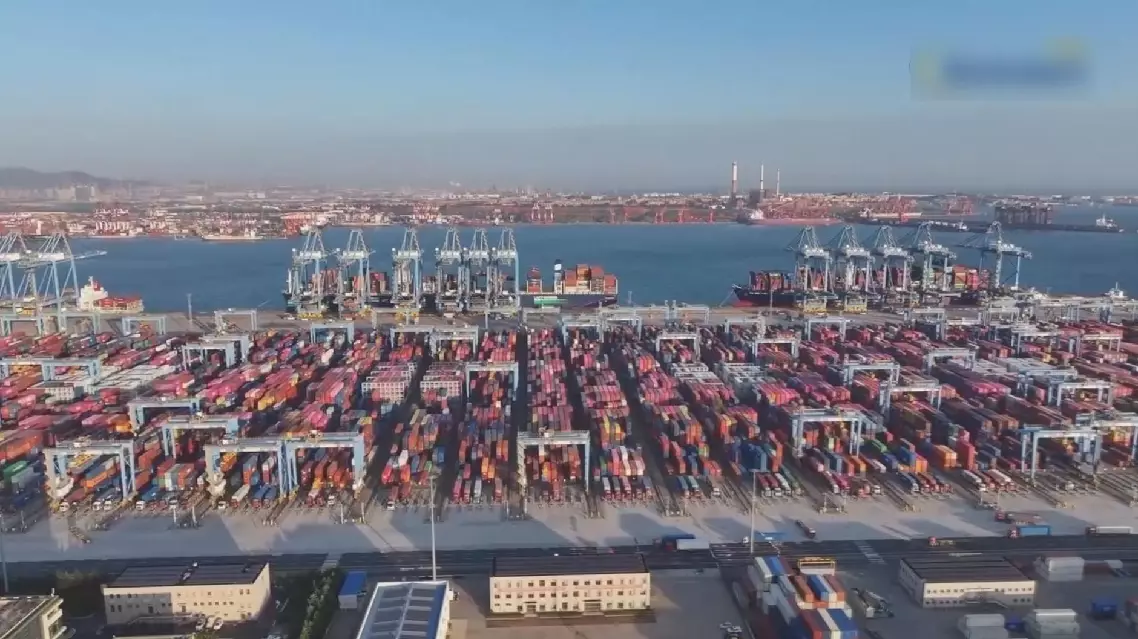
Qingdao Port enters 2026 with automation-driven growth