TORONTO--(BUSINESS WIRE)--Jan 29, 2026--
Cyclic Materials, the advanced recycling company creating a resilient and secure circular supply chain for rare earth elements (REEs) and other critical materials, today announced it is investing more than USD $82M to establish a rare earth recycling campus in McBee, South Carolina. The new site will host Cyclic Materials’ second U.S. Spoke facility, and the company’s largest Hub facility to date, capable of processing 2,000 tonnes of magnet material, with a planned expansion to 6,000 tonnes per year.
This press release features multimedia. View the full release here: https://www.businesswire.com/news/home/20260129743973/en/
The combined Spoke and Hub facility will utilize Cyclic Materials’ proprietary MagCycle℠ and REEPure℠ processes to separate and recover Mixed Rare Earth Oxides (MREO) from end-of-life products that are typically not recycled today, enabling a resilient, North American anchored source of REEs. These materials are critical to the production of vehicles, advanced electronics, AI infrastructure, and high-performance permanent magnets used in defense, wind turbines, and advanced manufacturing systems.
The site will initially have the capacity to produce 600 tonnes of MREO a year, with a planned expansion to produce 1,800 tonnes to meet growing demand. Deploying such a facility will enable Cyclic Materials to onshore the production of these critical materials in short order, particularly the much-needed heavy rare earths. The expected 1,800 tonnes of MREO produced by this campus annually would supply REEs equivalent to the material needed in producing 6 million hybrid transmissions per year.
The announcement follows Cyclic Materials’ late-2025 agreement with VACUUMSCHMELZE (VAC), a global leader in magnetic materials and solutions. Under a 10-year exclusive agreement, Cyclic Materials will recycle 100 percent of magnet production byproducts (swarf) generated at VAC’s new manufacturing facility in nearby Sumter, South Carolina, which began operations at the end of 2025. Together, the two companies’ facilities position South Carolina as a strategic hub for rare earth magnet recycling and production in the U.S.
“Announcing the opening of our second U.S. recycling site in South Carolina is a major milestone and a clear signal of our long-term commitment to building resilient, domestic critical minerals infrastructure in the U.S.,” said Ahmad Ghahreman, CEO and founder of Cyclic Materials. “This facility will enable Cyclic to reliably serve partners such as VAC, while scaling our advanced recycling technologies that support manufacturing, creates a secure supply chain for the most critical rare earth elements, reduce reliance on overseas supply chains, recirculate rare earths back to our domestic partners, ultimately delivering valuable economic benefit and environmental value.”
By scaling regional sourcing and processing of rare earth elements, Cyclic Materials is accelerating domestic deployment of rare earth elements supply infrastructure years faster than traditional mining projects, in addition to being much less resource intensive. The South Carolina project will also be supported by a range of federal and state incentives. Operations for the South Carolina campus are expected to begin in 2028, creating over 90 new highly skilled jobs for the state.
“Cyclic Materials’ new facility in Chesterfield County reflects the confidence companies have in South Carolina’s workforce and our ability to support advanced manufacturing. This over $82 million investment will bring jobs to the community and strengthen the local economy,” said South Carolina Gov. Henry McMaster.
Established in 2021, Cyclic Materials’ proprietary technologies are capable of economically and sustainably recovering critical raw materials from end-of-life magnet-containing products such as drones, robots, electric vehicle motors, wind turbines, MRI machines, and data center electronics. Cyclic Materials recently announced a Series C investment round of $75 Million USD led by T. Rowe Price, in addition to backing by global leaders including Microsoft, Amazon, Canada Growth Fund, Hitachi Ventures, BMW i Ventures, Jaguar Land Rover's lnMotion fund, Energy Impact Partners, ArcTern Ventures, Fifth Wall and more. The company has forged strategic commercial partnerships with key industry leaders such as Solvay, Vattenfall, Lime, and VACUUMSCHMELZE to recycle magnets containing REEs and bring a circular and resilient rare earth supply chain to scale.
About Cyclic Materials
Cyclic Materials, founded in 2021, is a cleantech company building a resilient supply chain for rare earth elements (REEs) and other critical materials through recycling of magnet-containing EOL. Its innovative technology transforms end-of-life products into valuable raw materials used in AI, robotics, defense and advanced manufacturing critical to the future of Western industry. With the success of its commercial demonstration, and first successful shipments of very high quality recycled Mixed Rare Earth Oxides (rMREO) to customers, the company is scaling its cutting-edge technology to recover REEs from permanent magnets, leveraging its proprietary MagCycle℠ and REEPure℠ processes to feed strategic industries with secure supply of recycled rMREO. Cyclic Materials is scaling its footprint across North America, Europe and Asia. With Mesa, Arizona hosting its first commercial scale Spoke facility, and Kingston, Ontario serving as a Centre of Excellence with R&D facility and Hub hydrometallurgical site, the company is expanding its REE recycling infrastructure in the US to supply the surging demand for permanent magnets that power our modern world. In recognition of its pioneering work, the company was named Top 10 Climate Tech Companies to Watch by MIT Tech Review in 2025. Learn more at cyclicmaterials.earth.
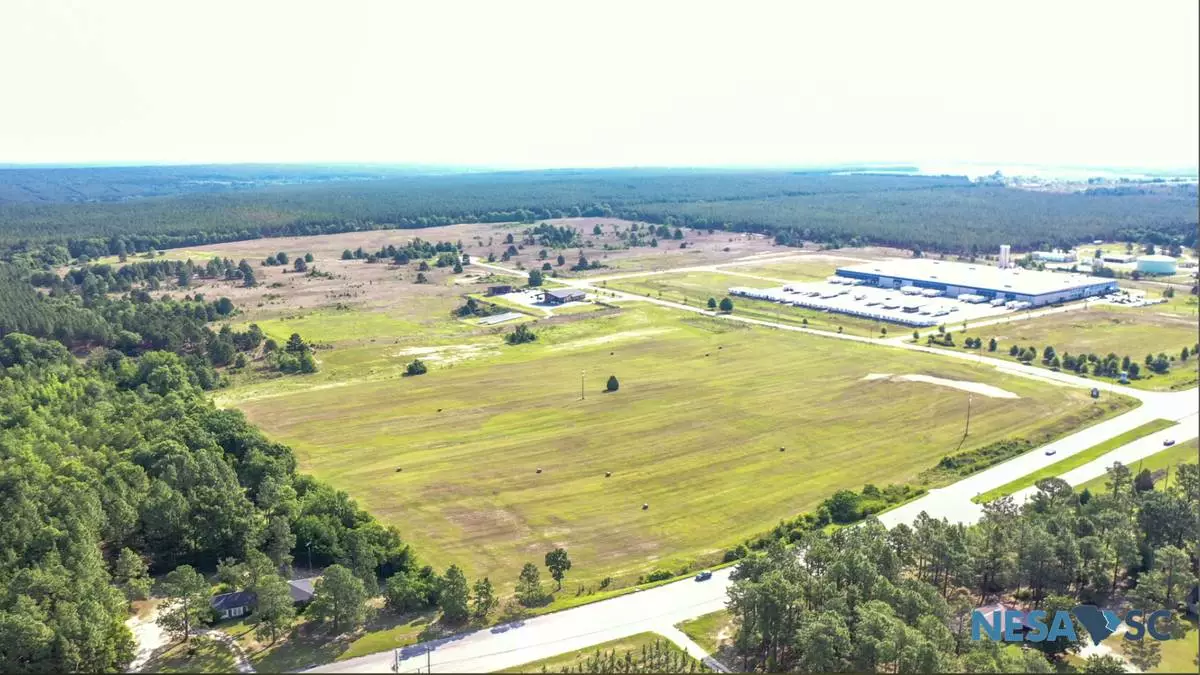
Cyclic Materials' new site in McBee, South Carolina, will host Cyclic Materials’ second U.S. Spoke facility, and the company’s largest Hub facility to date. Photo credit: North Eastern Strategic Alliance
BRUSSELS (AP) — The European Union is expected Thursday to list Iran’s paramilitary Revolutionary Guard as a terrorist group and widen sanctions on the country over Tehran’s deadly crackdown on nationwide protests, further squeezing the Islamic Republic as it faced U.S. threats to potentially launch a military strike against it.
U.S. forces have moved the USS Abraham Lincoln and several guided-missile destroyers into the Mideast that can be used to launch attacks from the sea. It remains unclear whether President Donald Trump will use force against Iran, after he threatened military action in response to the killing of peaceful demonstrators and over possible mass executions. At least 6,373 people have been killed in Iran's protests, activists said.
For its part, Iran has said it could launch a pre-emptive strike or broadly target the Mideast, including American military bases in the region and Israel. Iran issued a warning to ships at sea Thursday that it planned to run a drill next week that would include live firing in the Strait of Hormuz, potentially disrupting traffic through a waterway that sees 20% of all the world's oil pass through it.
The EU’s top diplomat, Kaja Kallas, told journalists Thursday it was “likely” fresh sanctions would be put in place on the Revolutionary Guard, which has played a key role in suppressing the demonstrations.
“This will put them on the same footing with al-Qaida, Hamas, Daesh,” Kallas said, using an Arabic acronym for the Islamic State group. “If you act as a terrorist, you should also be treated as a terrorist.”
France's foreign minister said the sanctions will target “those responsible for this repression," including members of the Revolutionary Guard as well as the government, the judiciary, police and officials responsible for enabling the internet blackout.
“More than 20 individuals and entities will have their assets frozen and will be denied access to European territory,” said French Foreign Affairs Minister Jean-Noel Barrot before the meeting in Brussels.
If approved, the sanctions by the EU, which the bloc's member states have long discussed, would put fresh pressure on Iran as its economy already struggles under the weight of multiple international sanctions from countries including the U.S. and Britain. The Guard holds vast business interest across Iran, and sanctions could see any of its assets in Europe seized.
Iran's rial currency fell to a record low of 1.6 million to $1 on Thursday. Economic woes had sparked the protests that broadened into challenging the theocracy before the crackdown.
Iran had no immediate comment, but it has been criticizing Europe in recent days as it considered the move, which follows the U.S. sanctioning the Guard in 2019.
By EU law, sanctions require unanimity across the bloc’s 27 nations. That's at times hindered Brussels’ ability to take quick action, such as responding to Russia's full-scale invasion of Ukraine in 2022.
France had objected to listing the Revolutionary Guard as a terrorist organization over fears it would endanger French citizens detained in Iran, as well as diplomatic missions, which provide some of the few communication channels between the Islamic Republic and Europe and its allies. However, the office of President Emmanuel Macron on Wednesday signaled Paris backed the decision.
French Foreign Minister Jean-Noël Barrot said Thursday before the Foreign Affairs Council in Brussels that France supports more sanctions in Iran and the listing “because there can be no impunity for the crimes committed.”
“In Iran, the unbearable repression that has engulfed the peaceful revolt of the Iranian people cannot go unanswered,” he said.
Kristina Kausch, a deputy director at the German Marshall Fund, said the listing would be “a symbolic act” showing that for the EU “the dialogue path hasn’t led anywhere and now it’s about isolation and containment as a priority.”
“The designation of a state military arm, of an official pillar of the Iranian state as a terrorist organization is one step short of cutting diplomatic ties," she said. "But they haven’t cut diplomatic times and they won’t.”
The Guard was born from Iran’s 1979 Islamic Revolution as a force meant to protect its Shiite cleric-overseen government and later enshrined in its constitution. It operated in parallel to the country’s regular armed forces, growing in prominence and power during a long and ruinous war with Iraq in the 1980s. Though it faced possible disbandment after the war, Supreme Leader Ayatollah Ali Khamenei granted it powers to expand into private enterprise, allowing it to thrive.
The Guard's Basij force likely was key in putting down the demonstrations, starting in earnest from Jan. 8, when authorities cut off the internet and international telephone calls for the nation of 85 million people. Videos that have emerged from Iran via Starlink satellite dishes and other means show men likely belonging to its forces shooting and beating protesters.
Sanctioning the Guard, however, would be complicated. Iranian men once reaching the age of 18 are required to do up to two years of military service, and many find themselves conscripted into the Guard despite their own politics.
A notice to mariners sent by VHF radio from Iran on Thursday warned that it planned to conduct “naval shooting” in the Strait of Hormuz on Sunday and Monday. The Associated Press saw a copy of the message, which was initially reported by the firm EOS Risk Group. Two Pakistani security officials, speaking on condition of anonymity as they weren't authorized to talk to journalists, also confirmed the warning had been sent.
Iran did not immediately acknowledge the drill. The hard-line Keyhan newspaper earlier Thursday raised the specter of Tehran attempting to militarily close the strait.
“Today, Iran and its allies have their finger on a trigger that, at the first enemy mistake, will sever the world’s energy artery in the Strait of Hormuz and bury the hollow prestige of billion-dollar Yankee warships in the depths of the Persian Gulf,” the newspaper said.
Such a move likely would see U.S. military intervention. American military officials did not immediately respond to a request for comment over the warning.
On Wednesday, the U.S.-based Human Rights Activists News Agency said the violence in Iran has killed at least 6,373 people in recent weeks, with many more feared dead. Its count included at least 5,993 protesters, 214 government-affiliated forces, 113 children and 53 civilians who weren’t demonstrating. More than 42,450 have been arrested, it added.
The group verifies each death and arrest with a network of activists on the ground, and has been accurate in multiple rounds of previous unrest in Iran. The communication cutoff imposed by Iranian authorities have slowed the full scale of the crackdown from being revealed, and The Associated Press has been unable to independently assess the death toll.
Iran’s government as of Jan. 21 put the death toll at a far lower 3,117, saying 2,427 were civilians and security forces and labeled the rest “terrorists.” In the past, Iran’s theocracy has undercounted or not reported fatalities from unrest.
That death toll exceeds that of any other round of protest or unrest in Iran in decades, and recalls the chaos surrounding the 1979 Islamic Revolution.
Gambrell reported from Dubai, United Arab Emirates. Associated Press writer Munir Ahmed in Islamabad contributed to this report.
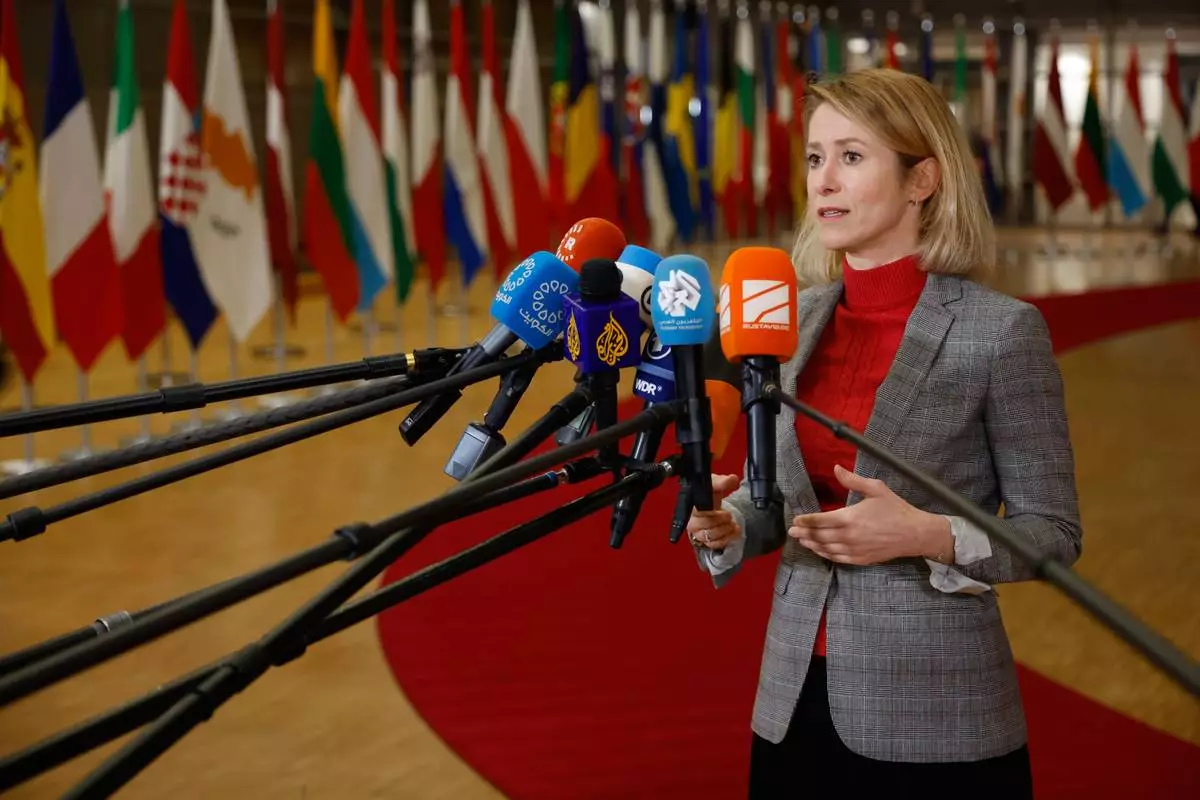
European Union foreign policy chief Kaja Kallas speaks with the media as she arrives for a meeting of EU foreign ministers at the European Council building in Brussels, Thursday, Jan. 29, 2026. (AP Photo/Geert Vanden Wijngaert)

FILE- A currency exchange bureau worker counts U.S. dollars at Ferdowsi square, Tehran's go-to venue for foreign currency exchange, in downtown Tehran, Iran, April 5, 2025. (AP Photo/Vahid Salemi, File)
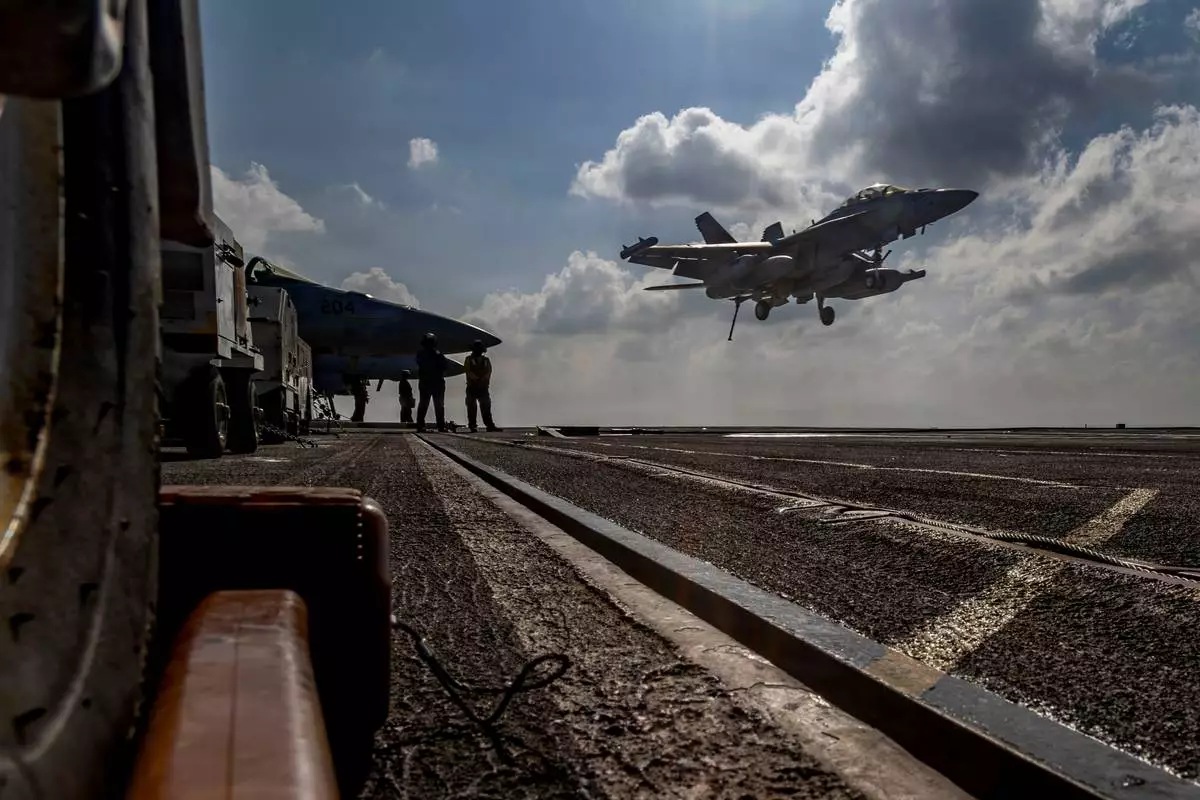
This handout image from the U.S. Navy shows an EA-18G Growler landing on the flight deck of the Nimitz-class aircraft carrier USS Abraham Lincoln in the Indian Ocean on Jan. 23, 2026. (Mass Communication Specialist Seaman Daniel Kimmelman/U.S. Navy via AP)
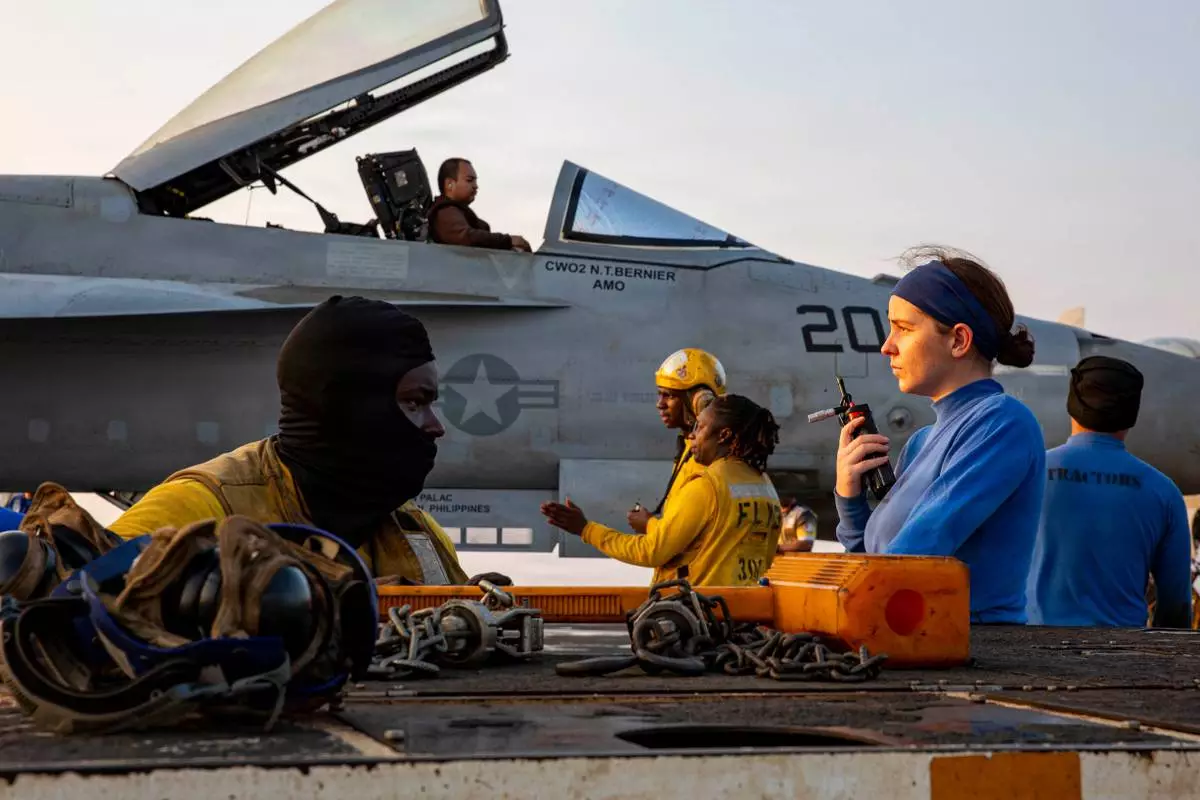
This handout photograph from the U.S. Navy shows sailors taxiing an F/A-18E Super Hornet on the flight deck of the Nimitz-class aircraft carrier USS Abraham Lincoln in the Indian Ocean on Jan. 25, 2026. (Mass Communication Specialist 3rd Class Shepard Fosdyke-Jackson/U.S. Navy via AP)

European Union foreign policy chief Kaja Kallas speaks with the media as she arrives for a meeting of EU foreign ministers at the European Council building in Brussels, Thursday, Jan. 29, 2026. (AP Photo/Geert Vanden Wijngaert)