Apple’s iPhone sales soared to a new quarterly record during the holiday season, despite artificial intelligence blunders that prompted the technology trendsetter to get a helping hand from Google.
The October-December results announced Thursday reflect the allegiance of Apple’s fans, who eagerly snapped up the latest iPhone 17 models even though the company still hasn’t delivered on its 2024 promise to smarten up the device’s Siri assistance with AI.
Apple tried to offset its AI miscues with a new “liquid glass” design for the iPhone 17 and older models installed by way of a free software upgrade released last September. That formula helped produce iPhone sales of $85.3 billion, a 23% increase from the same time in the previous year. It marked Apple's highest iPhone sales for a three-month period since the device’s debut in 2007.
“The demand for iPhone was simply staggering,” Apple CEO Tim Cook crowed during a conference call with analyst while predicting the device will become a cutting-edge platform for AI.
The iPhone’s robust performance propelled Apple to a profit of $42.1 billion, or $2.84 per share for the quarter, a 16% increase from the previous year. Total revenue also rose 16% from the previous year to $143.8 billion. Both the earnings and sales exceeded the analyst projections that steer investors.
Apple’s shares rose by about 1% in extended trading after the numbers came out. But the stock price still remains slightly down so far this year, and isn't that much higher from where it finished at the end of 2024.
Zacks Investment Research analyst Ethan Feller said the worries about Apple's late start in AI appeared to have been overblown and now appears well positioned to roll out more of the technology “as a feature that scales naturally across its ecosystem,” which also includes iPads, Mac computers and smartwatches in addition to iPhones. Apple said more than 2.5 billion active devices worldwide are now running on its various operating systems.
The Cupertino, California, company will try to sustain the momentum by finally releasing a batch of delayed AI features, including an Siri upgrade that is supposed to make the assistant more conversational and versatile.
To pull it off, Apple is tapping into Google’s latest AI model, Gemini 3, in a tacit acknowledgment of its own shortcomings in a technology that’s widely considered to be the industry’s biggest breakthrough since the iPhone’s introduction.
Despite its AI deficiencies, the iPhone ended last year as the worldwide sales leader with a nearly 20% market share that ranked just ahead of Samsung, according to the research firm International Data Corp.
In a show of its confidence, Apple forecast its revenue for the January-March period will climb by at least 13% from last year, above the roughly 10% bump that analysts had been anticipating.
The AI boom is confronting Apple with another challenge: a shortage of memory chips that for smartphones and laptops amid the voracious demand for the same processors in the massive data centers that are being built to power AI features.
Besides threatening to curtail iPhone production, the memory chip crunch is also driving up their prices — a factor that has already been eroding Apple’s profit margins. That financial pressure could eventually push Apple to raise the prices on iPhones and other products to help offset the rising memory chip costs
“We do continue to see market pricing for memory increasing significantly,” Cook told analysts Thursday. “As always, we’ll look at a range of options to, to deal with that.”

FILE - An Apple logo adorns the facade of the downtown Brooklyn Apple store on March 14, 2020, in New York. (AP Photo/Kathy Willens, File)
WASHINGTON (AP) — Democrats and the White House are narrowing in on a spending deal that could avert a partial government shutdown as they negotiate new restrictions for President Donald Trump’s surge of immigration enforcement.
As the country reels from the deaths of two protesters at the hands of federal agents in Minneapolis, the two sides had tentatively agreed to separate homeland security funding from the rest of the legislation and fund it for two weeks while they debate Democratic demands for curbs on the U.S. Immigration and Customs Enforcement agency. The potential deal comes after Democrats voted to block legislation to fund the Department of Homeland Security on Thursday.
“We don’t want a shutdown,” President Donald Trump said as he began a Cabinet meeting Thursday morning.
Speaker Mike Johnson, R-La., told The Associated Press on Thursday that he had been “vehemently opposed” to breaking up the funding package, but “if it is broken up, we will have to move it as quickly as possible. We can’t have the government shut down.”
Democrats have requested a short extension—two weeks or less—and say they are prepared to block the wide-ranging spending bill if their demands aren’t met, denying Republicans the votes they need to pass it and potentially triggering a shutdown.
Republicans were pushing for a longer extension of the Homeland Security funding, but the two sides were “getting closer,” said Senate Majority Leader John Thune, R-S.D.
The rare bipartisan talks between Trump and his frequent adversary, Senate Democratic leader Chuck Schumer, came after the fatal shooting of 37-year-old Alex Pretti in Minnesota over the weekend and calls by senators in both parties for a full investigation. Schumer called it “a moment of truth.”
“The American people support law enforcement. They support border security. They do not support ICE terrorizing our streets and killing American citizens,” Schumer said.
With no final agreement yet and an uncertain path ahead, the standoff threatened to plunge the country into another shutdown, just two months after Democrats blocked a spending bill over expiring federal health care subsidies. That dispute closed the government for 43 days as Republicans refused to negotiate.
The fall shutdown ended when a small group of moderate Democrats broke away to strike a deal with Republicans, but Democrats are more unified this time after the fatal shootings of Pretti and Renee Good by federal agents.
Democrats have laid out several demands, asking the White House to “end roving patrols” in cities and coordinate with local law enforcement on immigration arrests, including requiring tighter rules for warrants.
They also want an enforceable code of conduct so agents are held accountable when they violate rules. Schumer said agents should be required to have “masks off, body cameras on” and carry proper identification, as is common practice in most law enforcement agencies.
The Democratic caucus is united in those “common sense reforms,” and the burden is on Republicans to accept them, Schumer said.
“Boil it all down, what we are talking about is that these lawless ICE agents should be following the same rules that your local police department does,” said Democratic Sen. Tina Smith of Minnesota. “There has to be accountability.”
Earlier on Thursday, Tom Homan, the president’s border czar, stated during a press conference in Minneapolis that federal immigration officials are developing a plan to reduce the number of agents in Minnesota, but this would depend on cooperation from state authorities.
As the two sides narrowed in on a spending deal, the length of a temporary extension for Homeland Security funding emerged as a sticking point. Thune said Thursday that two weeks wasn’t enough time to negotiate a final compromise.
“We’ll see where discussions are going between (Democrats) and the White House on that,” Thune said.
Even if the two sides strike a deal, negotiations down the road on a final agreement on the Homeland Security bill are likely to be difficult.
Democrats want Trump’s aggressive immigration crackdown to end. “If the Trump administration resists reforms, we shut down the agency,” said Connecticut Sen. Richard Blumenthal.
“We need to take a stand,” he said.
But Republicans are unlikely to agree to all of the Democrats' demands.
North Carolina Sen. Thom Tillis said he is opposed to requiring immigration enforcement officers to show their faces, even as he blamed Homeland Security Secretary Kristi Noem for decisions that he said are “tarnishing” the agency’s reputation.
“You know, there’s a lot of vicious people out there, and they’ll take a picture of your face, and the next thing you know, your children or your wife or your husband are being threatened at home,” Tillis said.
South Carolina Sen. Lindsey Graham said some of the Democratic proposals “make sense,” such as better training and body cameras. Still, he said he was putting his Senate colleagues “on notice” that if Democrats try to make changes to the funding bill, he would insist on new language preventing local governments from resisting the Trump administration’s immigration policies.
“I think the best legislative solution for our country would be to adopt some of these reforms to ICE and Border Patrol,” Graham posted on X, but also end so-called “sanctuary city” policies.
Across the Capitol, House Republicans have said they do not want any changes to the bill they passed last week. In a letter to Trump on Tuesday, the conservative House Freedom Caucus wrote that its members stand with the Republican president and ICE.
“The package will not come back through the House without funding for the Department of Homeland Security,” they wrote.
Speaker Johnson appeared open to the changes, albeit reluctantly, and told the AP he would want to approve the bills “as quickly as possible” once the Senate acts.
“The American people will be hanging in the balance over this,” Johnson said. “A shutdown doesn’t help anybody.”
Associated Press writers Lisa Mascaro, Stephen Groves, Joey Cappelletti, and Michelle L. Price contributed to this report.
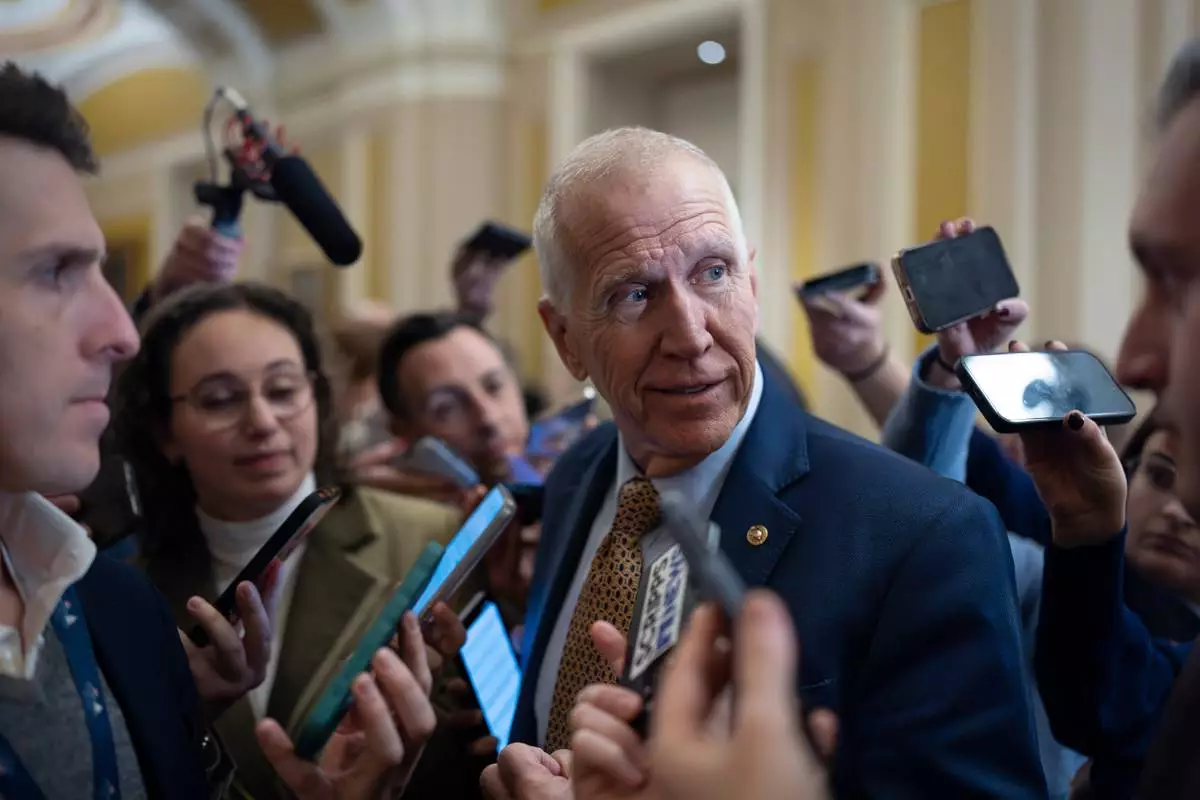
Sen. Thom Tillis, R-N.C., speaks with reporters following a closed-door meeting with fellow Republicans on spending legislation that funds the Department of Homeland Security and a swath of other government agencies, at the Capitol in Washington, Wednesday, Jan. 28, 2026. (AP Photo/J. Scott Applewhite)
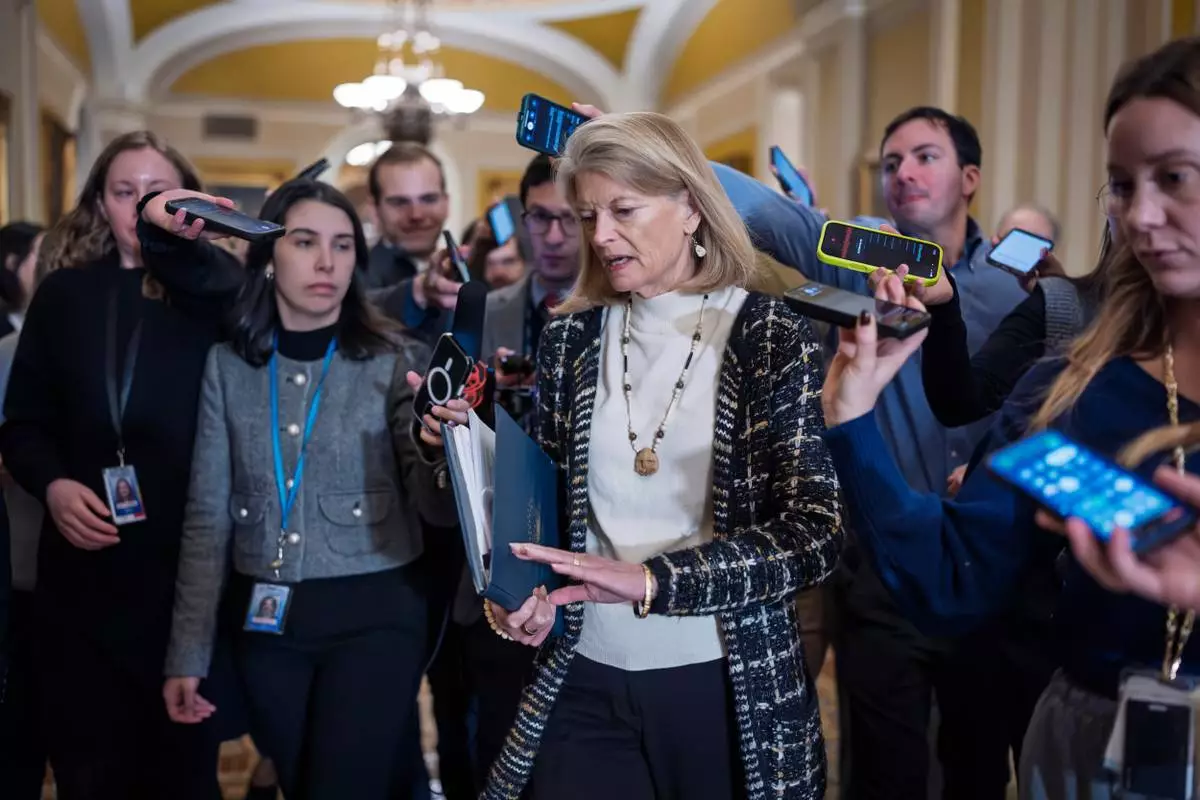
With a partial government shutdown looming by week's end, Sen. Lisa Murkowski, R-Alaska, a member of the Senate Appropriations Committee, is surrounded by reporters following a closed-door Republican meeting on spending legislation that funds the Department of Homeland Security and a swath of other government agencies as the country reels from the deaths of two people at the hands of federal agents in Minneapolis, at the Capitol in Washington, Wednesday, Jan. 28, 2026. (AP Photo/J. Scott Applewhite)
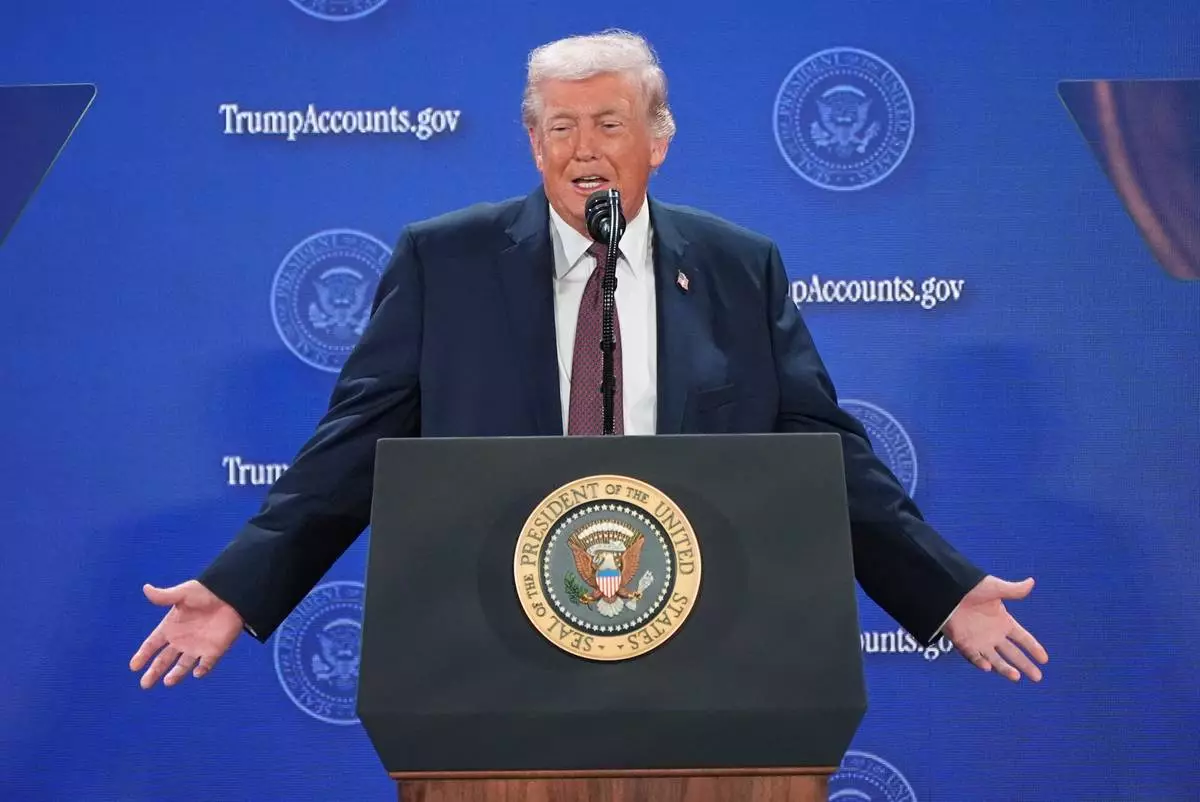
President Donald Trump speaks during the launch of a program known as Trump Accounts at the Andrew W. Mellon Auditorium, Wednesday, Jan. 28, 2026, in Washington. (AP Photo/Jacquelyn Martin)
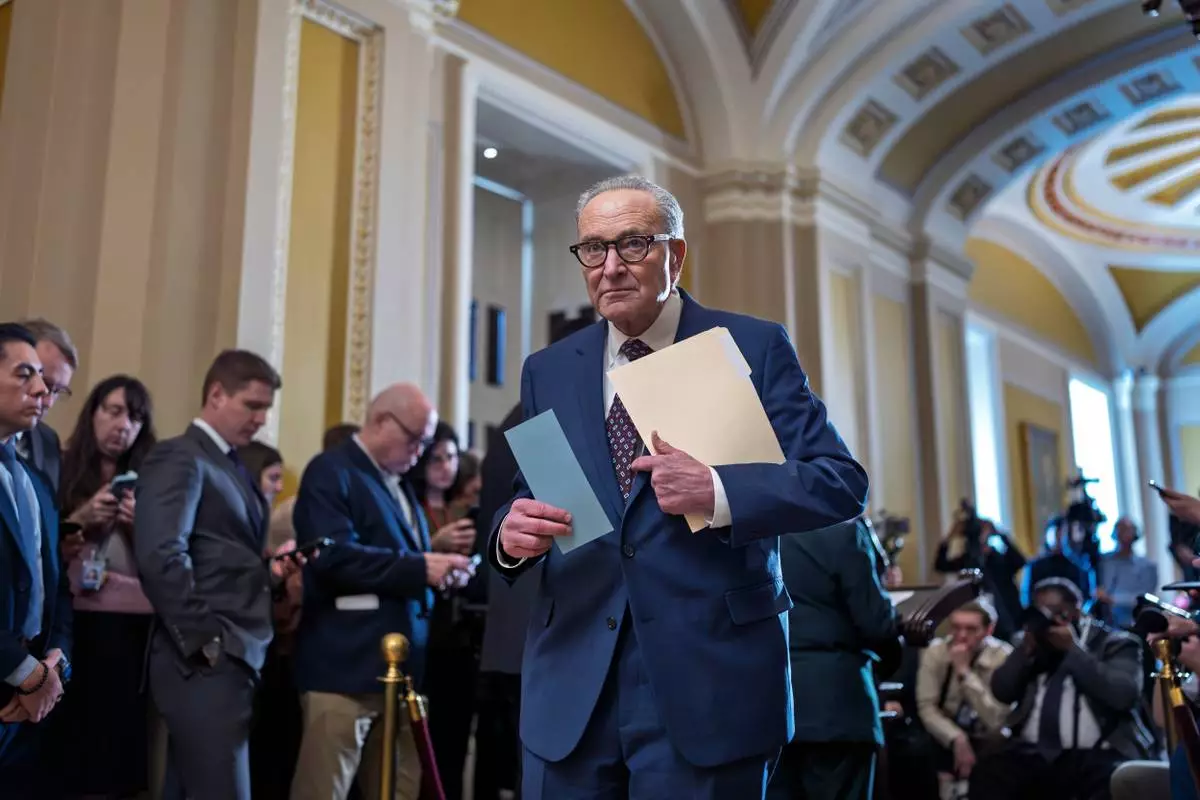
Senate Minority Leader Chuck Schumer, D-N.Y., waits to speak to reporters following a closed-door meeting with fellow Democrats at the Capitol in Washington, Wednesday, Jan. 28, 2026. (AP Photo/J. Scott Applewhite)