Skip to Content Facebook Feature Image

Israel blocks life-saving supplies for Gaza at Rafah border crossing

HotTV

HotTV

HotTV

Israel blocks life-saving supplies for Gaza at Rafah border crossing

2026-01-30 16:00 Last Updated At:02-01 12:26

While Israel has allowed limited pedestrian movement, the flow of humanitarian aid remains severely restricted as aid trucks face continued delays and repeated rejections by Israel.

Palestinians in Gaza are still waiting for the full reopening of the Rafah border crossing under a ceasefire deal signed last October.

At the Rafah border, one cannot help but notice the long queues of aid trucks parked along the desert road, as drivers wait for the green light to enter Gaza.

Some of the drivers expressed their anger that, in many cases, they had to enter the Rafah border crossing to deliver the aid, only to have it rejected, and then return with the same shipment on board.

Truck driver Aly Ibrahim said he had not moved an inch at the border for over two years.

He said that the last time he managed to send aid into the strip was in November 2024.

"I'm carrying medicine, important medicine. My cargo was denied by Israel 21 times! For 15 months, I went to the border and they turned me back. UNRWA is desperate to receive it. This medicine came from other countries by plane. I brought it from Cairo airport, and it's been lying here for nearly two years," said the driver.

He is frustrated. He knows that while people are dying in Gaza, life-saving help is hindered at the crossing.

He says he feels helpless and claims that Israeli authorities are intentionally preventing them from saving lives.

"One time, they rejected the medicine because the truck's wooden pallets were scratched. The other time, they said my truck is 180 centimeters high, and should be five centimeters shorter. Just excuses. They unload the medicine, they break a lot of it while searching, then they load it back and tell me it's rejected," said Ibrahim.

But Aly's colleague, Adel Abu Dos, was luckier.

He just returned from a successful delivery to Gaza - after many weeks of delays.

"I deliver food, tents and blankets. The truck is searched twice at the border, unloaded on the Palestinian side and I return. Some food became spoilt due to the delay but the rest was fine," he said.

Currently, an average of 100 aid trucks enter Gaza daily - a big drop from the 600 trucks entering each day before the war in Gaza.

The reopening of the Rafah border for the first time in two years has been widely welcomed, even if only for pedestrian traffic for now.

"I wish the Rafah border crossing will open indefinitely and we can deliver aid all the time like before the war. I've been here since 2020. I want peace for our brothers in Gaza. They are suffering," said Dos.

For the time being, these drivers have to continue enduring long waits that could stretch up to months.

So, they wait, living in their trucks where they eat and sleep, staying put until the next time they are allowed to make another life-saving trip into the war-destroyed enclave, only a few kilometers away.

Israel blocks life-saving supplies for Gaza at Rafah border crossing

Israel blocks life-saving supplies for Gaza at Rafah border crossing

Israel blocks life-saving supplies for Gaza at Rafah border crossing

Israel blocks life-saving supplies for Gaza at Rafah border crossing

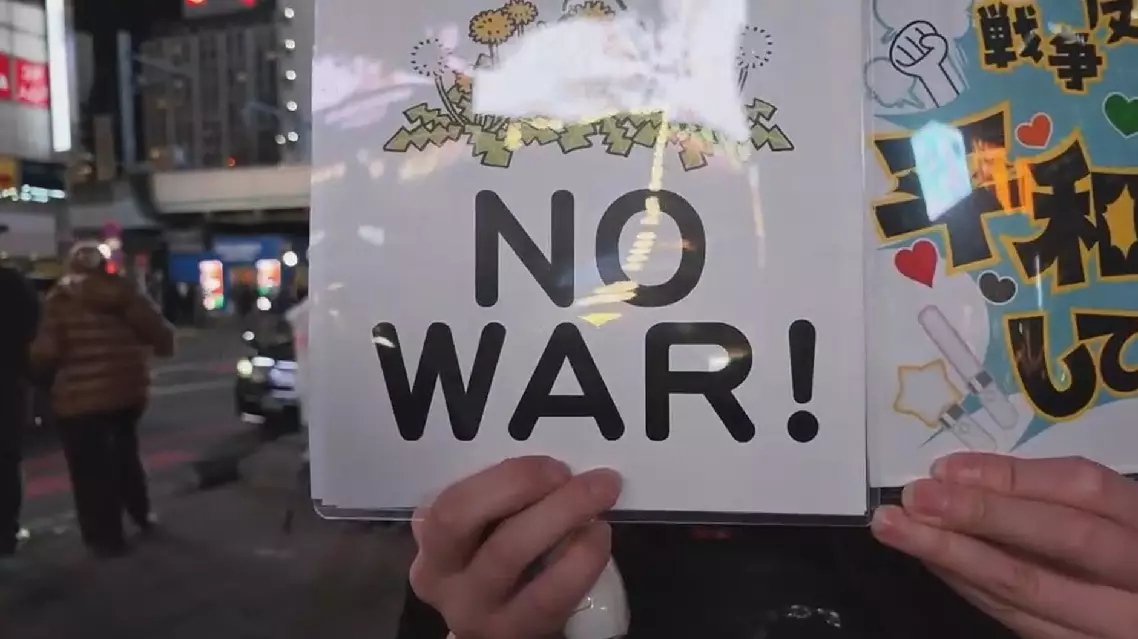
A group of Japanese peace activists rallied in Tokyo on Friday to protest against the government's latest military buildup moves and defense spending hikes, warning that Japan's militarist turn will further constrain the scope of social welfare improvement.

Taking to the streets in Tokyo's bustling Shibuya district, the protesters accused Japan's recent constitutional revision and defense spending hikes of leading to a decline in living standards, urging the government to prioritize public needs with limited fiscal resources.

"In any case, Japan's defense spending is set to rise sharply from now on. To fund this budget, the government will inevitably push for further tax hikes. In addition, the Japanese government is also lifting restrictions on arms exports, allowing the export of lethal weapons. I believe these moves aim to transform Japan into a country capable of waging war," said a protester.

"If the government puts tens of trillions of yen into defense spending, our livelihoods and social welfare will be seriously affected. That is why we firmly oppose the move," said another protester.

"Prices are soaring and people's lives are getting harder. I believe this is not the right time at all to put more money into defense spending," said a protester.

The protesters also urged the government to reflect on its history of aggression during World War II and give up its re-militarization attempt.

"During the wartime, Japan launched its invasion of China and other Asian countries, which started in the 1930s. It is with this history in mind that I oppose war and the administration led by Prime Minister Sanae Takaichi," said a protester.

The Japanese government is considering revising its Three Principles on Transfer of Defense Equipment and Technology, possibly removing an explicit reference to the Three Non-Nuclear Principles from the document's preamble, among other changes, the Asahi Shimbun reported on Nov 24.

The Three Principles on Transfer of Defense Equipment and Technology lay out rules governing Japan's arms exports. In April this year, the government revised the principles and their implementation guidelines through a cabinet resolution, allowing the export of lethal weapons in principle.

The Japanese government is considering a significant increase in defense spending over the next five years, with plans to raise the total defense budget for fiscal 2027 through 2031 to 60 trillion yen (about 376 billion U.S. dollars) when it revises the three key security documents, Kyodo News reported on Nov 15.

Japanese activists rally in Tokyo against government's military buildup

Japanese activists rally in Tokyo against government's military buildup

Recommended Articles