The Professional Women’s Hockey League was but a pipe dream in February 2022 when Kendall Coyne Schofield emphatically declared the urgency needed to address a fractured sport with unrealized potential.
“We need to push for visibility,” Coyne Schofield said then, choking back tears after the United States’ 3-2 gold-medal loss to Canada at the Beijing Winter Games. “We need to continue to fight for women’s hockey because (the status quo) is not good enough. It can’t end after the Olympic Games.”
Four years later, the women’s pro hockey landscape has undergone a seismic shift following the PWHL’s launch in 2023. The league’s presence and expanding success validates Coyne Schofield’s vision as the PWHL prepares for its international coming-out party at the Milan Cortina Games.
“I look at the growth of the women’s game, even from my first Olympics in 2014, and it’s been exponential,” said the 33-year-old captain of the two-time Walter Cup champion Minnesota Frost.
“To be a small part of that growth and just to live through that growth has been one of the greatest things I’ve been able to be a part of,” she added, in having played a key behind-the-scenes role in the league’s formation. “And I’m excited to see what happens after these Games.”
The PWHL is banking on it. The eight-team league, financially backed by Los Angeles Dodgers owner Mark Walter, is placing a major emphasis on marketing the PWHL through advertising spots during the two-week women’s tournament opening on Thursday.
The PWHL is well represented with 61 players among the 10 competing nations' rosters, and most notably filling out a majority of the U.S. and Canadian teams.
The objective is twofold: Introducing PWHL fans to the elite level of Olympic play and luring casual viewers tuning in once every four years to the PWHL.
“Previous years, everybody falls in love with the Olympics. They hear stories about players, we have huge viewership numbers, and then it’s sort of like ‘What now?’” Hockey Hall of Famer and PWHL executive vice president Jayna Hefford said. “It’s a big opportunity to educate, direct back and make sure they know where they can find the players.”
Though much is being made of NHL players competing at the Olympics for the first time since 2014, these Games mark the debut of true professional women’s hockey players.
Their sport has gone through many iterations of so-called pro leagues, many in name only. Canadian Women’s Hockey League players weren’t paid a salary. A majority of the game’s elite eventually balked at competing in the National Women’s Hockey League, which later became the Premier Hockey Federation before being bought out to pave way for the PWHL.
The Olympics serve as the next launching point of growth for a league that began with six franchises and now has eight spanning the continent from Boston to the Pacific Northwest. More expansion is on the horizon, with the PWHL set to add up to four more teams next season.
Attendance is up. After soaring past the 1 million mark in just under two seasons in March, the PWHL has already surpassed 500,000 fans alone nearing the halfway point of its third season.
Challenges remain. Though every game is available on TV in each U.S. team's market, and across America and much of the globe via YouTube, the PWHL lacks a national broadcaster in the U.S.
The PWHL also lags in international talent in its attempt to market itself as the world’s top league. Only 25 of the league's 200-plus players this season come from outside North America. They include New York Sirens forward Krystyna Kaltounkova, who is from the Czech Republic and in June became the first European player to be chosen No. 1 in the draft.
Hefford is confident expansion, coupled with an Olympic tournament featuring PWHL stars, will be a vehicle to attract more international players. League executive Stan Kasten previously said the PWHL is eying playing exhibition games in Europe and one day establishing teams there.
“Europe is a big part of our future,” Kasten told The AP in May.
Boston Fleet forward and veteran Swiss national team player Alina Muller said she believes the PWHL’s growth and stability will gradually lure more international players. Europeans who came to North America to play collegiately before returning home now they have a league to further their careers.
“Now being able to watch our games and think, ‘Yeah, I want to end up playing professionally,’ will change the attitude toward the sport completely,” said Muller, who played college hockey at Northeastern. “Hopefully in Europe people see that it’s worth the investment, and it’s not just a side gig or charity."
AP Hockey Writer Stephen Whyno contributed.
AP women’s hockey: https://apnews.com/hub/womens-hockey
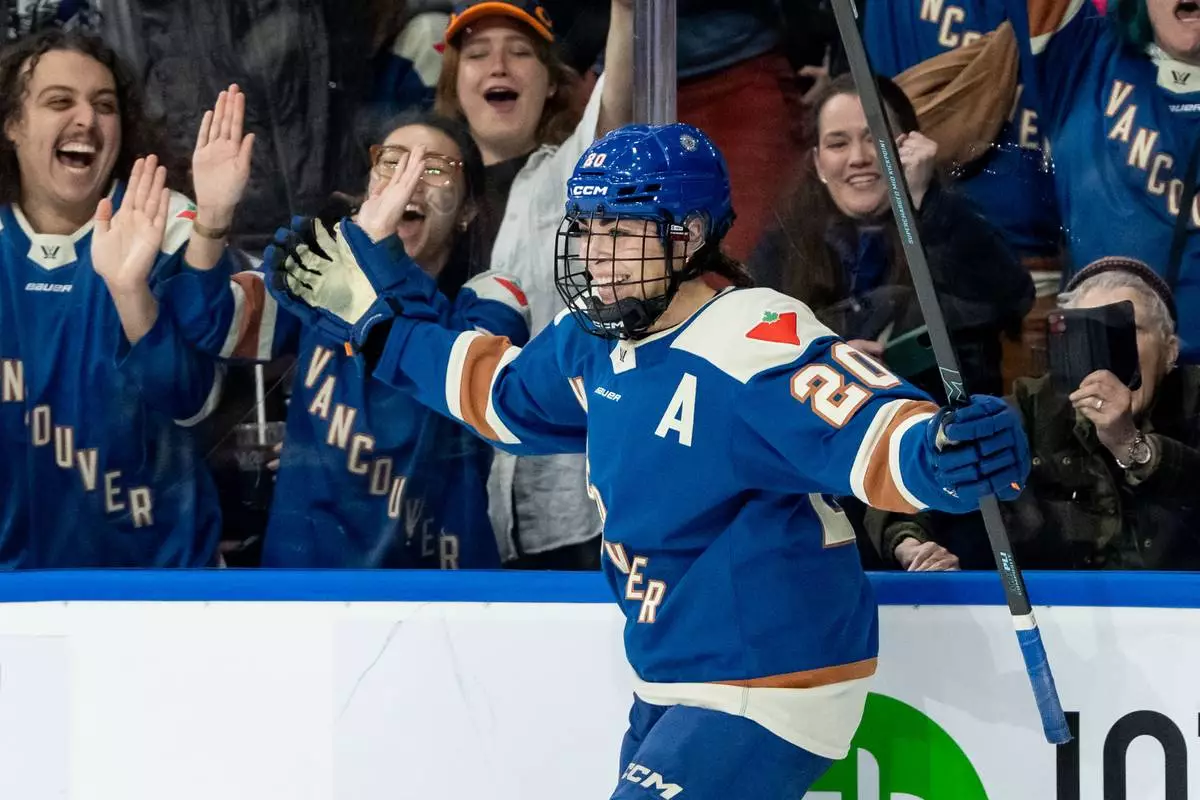
Vancouver Goldeneyes' Sarah Nurse (20) celebrates her goal against the Toronto Sceptres during the third period of a PWHL hockey game in Vancouver, British Columbia, Thursday, Jan. 22, 2026. (Ethan Cairns/The Canadian Press via AP)

Toronto Sceptres' Natalie Spooner, center, enters the ice before a PWHL hockey game against the Vancouver Goldeneyes in Vancouver, British Columbia, Thursday, Jan. 22, 2026. (Ethan Cairns/The Canadian Press via AP)
Cameron Boozer was at the center of everything for Duke this season.
The 6-foot-9, 250-pound forward proved tough enough to score through physical play. Rangy enough to space the floor and shoot from outside. Deft enough as a passer to find teammates, whether against constant double teams coming for him as the top name on every scouting report or while running the entire offense from up top.
“You just want to affect winning in whatever way you can,” Boozer said.
The high-end NBA prospect did that all season for a team that won 35 games, reached No. 1 in the AP Top 25 poll, claimed the top overall seed for March Madness and reached the NCAA Tournament's Elite Eight. Now he's The Associated Press men’s college basketball national player of the year, only the fifth freshman to earn the honor and the second in a row for a Duke program that keeps adding to the longest list of winners in the country.
“It just goes to show more about what our team has done, just because I think that really helps awards like this, having great team success,” Boozer told the AP. “It’s really just not me.”
Boozer, named unanimous first-team AP all-American last month, received 59 of 61 votes from AP Top 25 voters in results released Friday. BYU freshman AJ Dybantsa, another potential top NBA pick, received the other two votes after averaging a national-best 25.5 points per game.
Boozer, son of Duke and longtime NBA player Carlos Boozer, ranked averaged 22.5 points (ninth in Division I) and 10.2 rebounds (12th) while finishing tied for the national lead with 22 double-doubles. He also averaged 4.1 assists while posting efficient shooting numbers at 55.6% overall and 39.1% from 3-point range.
He joins fellow Blue Devils star Cooper Flagg last year, another Duke player in Zion Williamson (2019), Kentucky’s Anthony Davis (2012) and Texas star Kevin Durant (2007) as freshmen to win the AP award. Each went No. 1 or No. 2 in the NBA draft that year.
“I’m very grateful just that I’m even in those (NBA) conversations,” Boozer said. “I think a lot of people dream of being where I am. Sometimes you’ve got to take a step back and just remember that once upon a time, you were a kid dreaming to be here. So I think it’s very special.”
His coaches think the same of him.
“We’ve been fortunate enough the last two years to have two of the best freshmen to ever play in college basketball back to back,” Duke associate head coach and former Blue Devils player Chris Carrawell said. “And Cam is right up there.
Boozer is Duke's ninth AP winner, each coming from a different player. UCLA is the next closest with five winners, though that included Kareem Abdul-Jabbar (1967 and 1969) and Bill Walton (1972 and 1973) as two-time selections.
UCLA, Ohio State and Duke rival North Carolina are the only other programs with as many as three different players to win the award.
Boozer arrived at Duke alongside twin brother Cayden after the two led Miami's Columbus High to four straight state championships. By late February, the Blue Devils were starting a four-week reign atop the AP Top 25 that would carry to March Madness. Boozer — who said he looks at winning as a skill — routinely posted top performances in Duke's biggest games, including during a rugged nonconference slate.
He matched a season high with 35 points in a November win against Arkansas. He followed with 29 points against defending national champion Florida. He also had big performances at Michigan State (18 points, 15 rebounds) and flirted with a triple-double (18 points, 10 rebounds, seven assists) in a February win against Michigan.
Along the way, he pushed through bumps and shoves. He closed Sunday's season-ending loss to UConn with 27 points and his right eye swollen from a first-half blow.
“There’s no agenda other than figuring out a way to win,” Wolverines coach Dusty May said. “I’ve seen him play a number of times this year where there’s six guys in the paint, and it’s not as if he’s jumping 40, 50 inches off the floor. His desire to rebound the ball, to set physical screens, to play to his advantages, is as impressive as any freshman that I can recall.”
The other challenge was managing the scrutiny that comes from expectations for greatness. A missed shot. A turnover. The 3-for-17 shooting while battling rising frustration and Virginia shot-blocker Ugonna Onyenso in the ACC title game.
“He does a great job of flushing it and not letting it dwell on him too much,” Cayden said. “That’s something he’s always been able to do since we were younger. Obviously I talk to him when he needs me to. And I sometimes just understood that, hey, he’s going through something, give him some space for a little bit and he’ll figure it out.”
Cameron said getting away for time alone and putting down the phone helps. He points to prayer and even a recent effort to read more.
The rest of the time, though, he'll throw himself into becoming a better player. There's comfort in that routine, the results yet to fail him.
“I think just being prepared alleviates pressure," Cameron said. "Being ready for a game, watching film, working out, knowing you put your time in, being confident in yourself — I think all that takes away a lot of the pressure that people talk about. At the end of the day, pressure really is what you put on yourself.”
AP March Madness bracket: https://apnews.com/hub/ncaa-mens-bracket and coverage: https://apnews.com/hub/march-madness
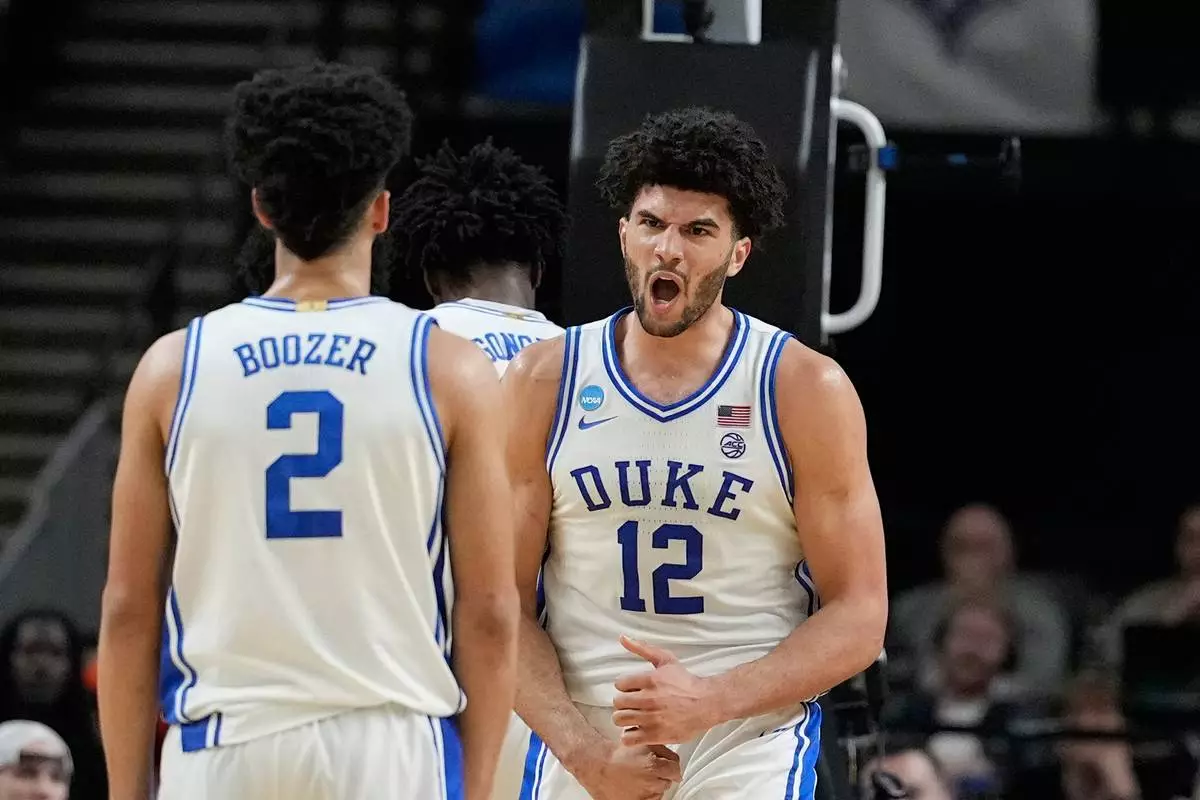
Duke forward Cameron Boozer (12) reacts after scoring during the second half in the second round of the NCAA college basketball tournament against TCU, Saturday, March 21, 2026, in Greenville, S.C. (AP Photo/Brynn Anderson)
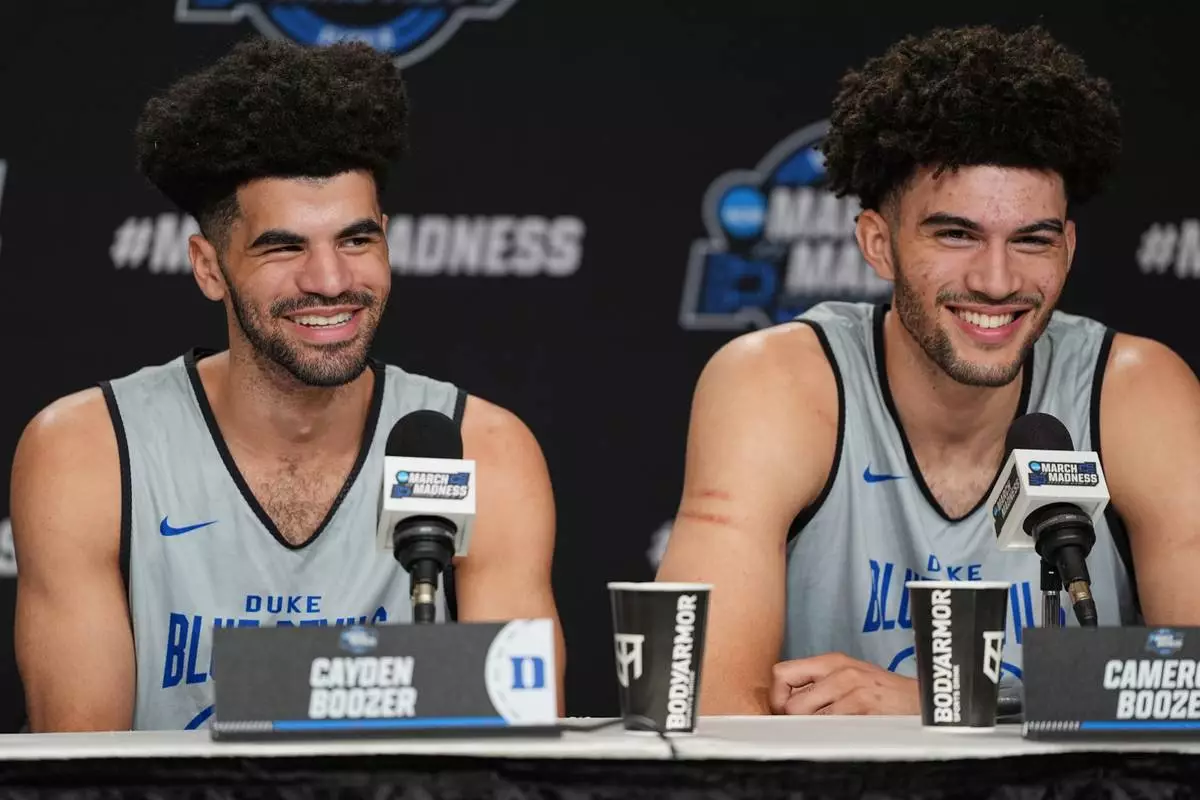
Duke guard Cayden Boozer, left, and Duke forward Cameron Boozer, right, share a laugh during a press conference ahead of a game against UConn in the Elite Eight of the NCAA college basketball tournament Saturday, March 28, 2026, in Washington. (AP Photo/Abbie Parr)
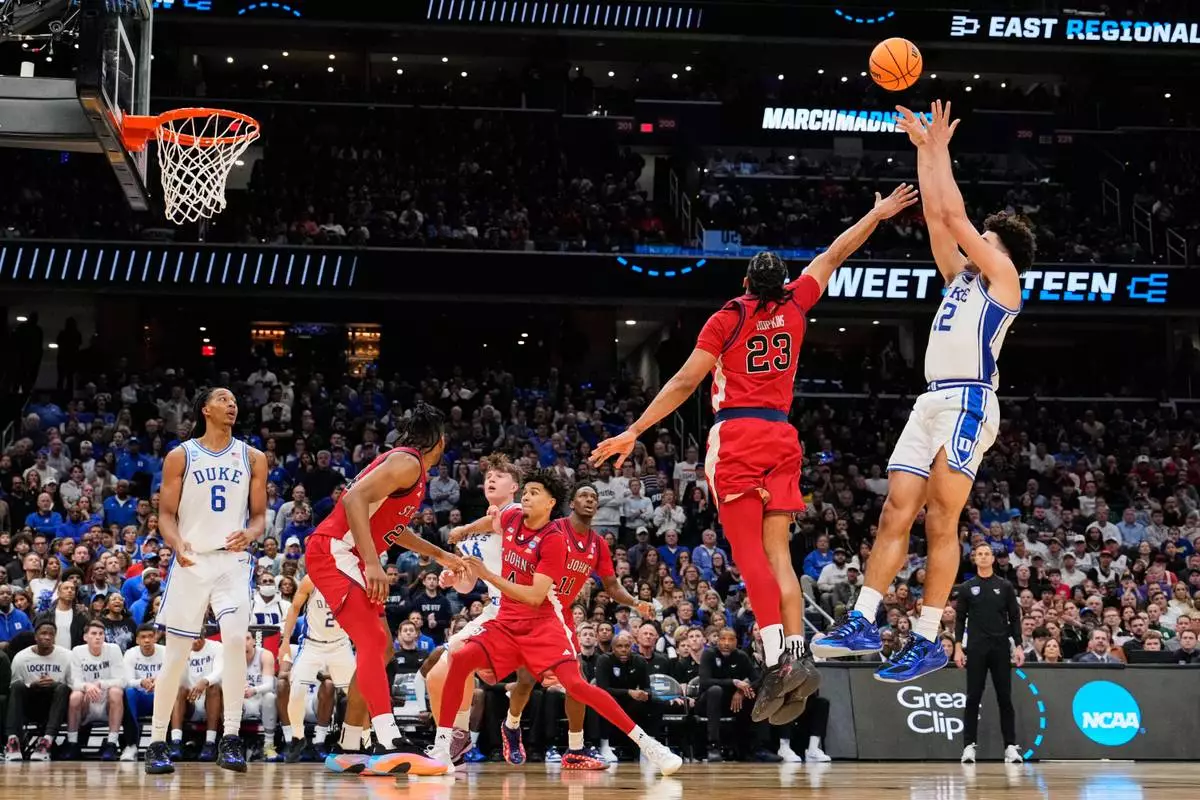
Duke forward Cameron Boozer (12) shoots over St. John's forward Bryce Hopkins (23) during the second half in the Sweet 16 of the NCAA college basketball tournament, Friday, March 27, 2026, in Washington. (AP Photo/Abbie Parr)
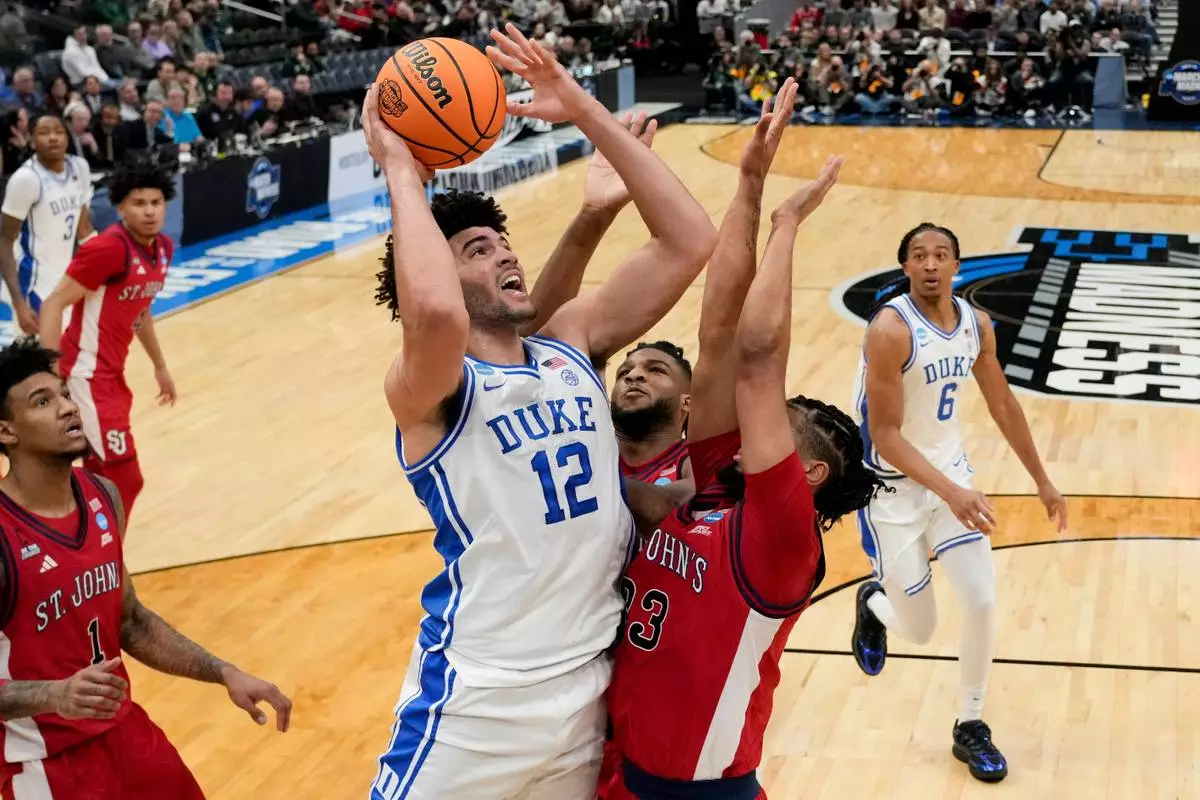
Duke forward Cameron Boozer (12) shoots over St. John's forward Bryce Hopkins (23) during the first half in the Sweet 16 of the NCAA college basketball tournament, Friday, March 27, 2026, in Washington. (AP Photo/Stephanie Scarbrough)