|
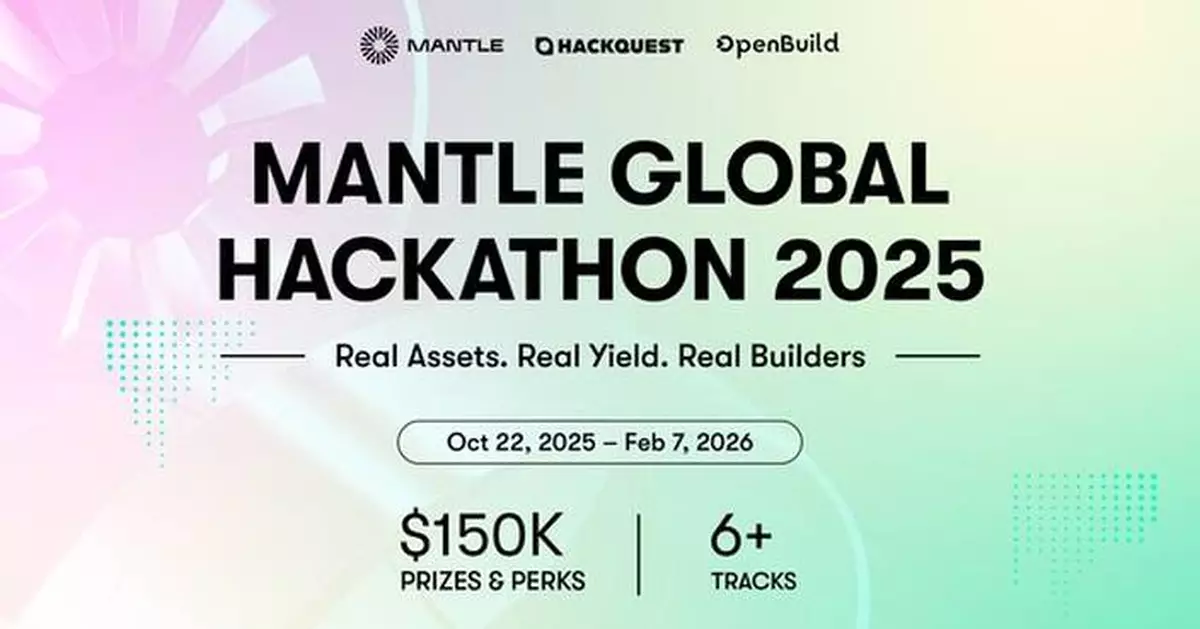
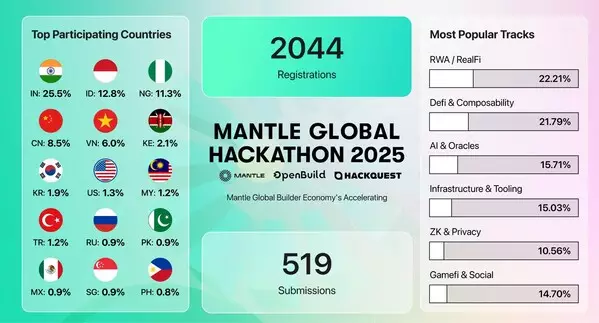
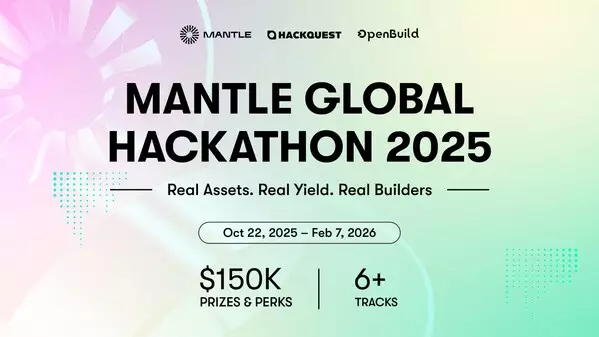
DUBAI, UAE, Feb. 2, 2026 /PRNewswire/ -- Mantle, the high-performance distribution and liquidity layer bridging traditional finance (TradFi), real-world assets (RWAs) and on-chain liquidity, has officially concluded the submission phase of its 2025 Global Hackathon, recording 519 project submissions from over 2,044 registered developers. Launched on October 22, 2025, the four-month initiative achieved a 25.4% conversion rate, significantly outperforming the industry average of 10–15%. This milestone underscores Mantle's growing influence and the high execution capability of its developer community.
Ecosystem Growth and Global Integration
The success of Mantle Global Hackathon 2025 was driven by a solid collaboration between Mantle, OpenBuild, HackQuest, and a worldwide network of ecosystem partners. Strategic initiatives include:
- Targeted Support: High-density online workshops and offline meetups in major tech hubs like Shenzhen and Shanghai.
- Global Reach: Builder interviews and engagement sessions across India, Indonesia, Africa, and South America (Devconnect Argentina) uncovered localized innovation in DeFi, RWA, and consumer payments.
- Technical Enablement: Mantle Mentor Clinic Livestream featured past winners from ETHGlobal and Mantle APAC to elevate project exposure.
Data-Driven Insights: A Diverse Builder Base
Analysis of the 2,000+ participants reveals a sophisticated, multi-chain talent pool:
- Cross-Chain Inflow: While 550 participants were Ethereum-native, significant builder segments joined from Solana (274), Base (229), and Polygon (172).
- Skill Distribution: A versatile developer base utilized JavaScript (62.05%), TypeScript (56.89%), and Solidity (32.34%).
- Sector Innovation: Submissions were led by RWA/RealFi (22.21%) and DeFi (21.79%), followed by AI, Infrastructure, and GameFi.
Strategic Partnerships and Digital Identity
Core partner OpenBuild contributed 124 registrations and 45 high-quality projects, focusing on Mantle's priority verticals like AI and RWA. Furthermore, the DevCard initiative—launched with Web3insight.AI—saw 196 developers activate on-chain identities, resulting in 47 teams receiving direct collaboration invitations.
The Road to Demo Day: $150,000 Prize Pool
From the 519 submissions, 30 finalists will advance to Demo Day on February 3 and 4, 2026. Projects will be evaluated on technical innovation, commercial viability, and ecosystem alignment.
Final winners will be officially revealed on February 10 at Consensus Hong Kong.
The $150,000 prize pool includes a $30,000 Grand Prize and track-specific awards. Beyond the financial rewards, winners will receive fast-track access to Mantle EcoFund grants and long-term incubation support.
About Mantle
Mantle positions itself as the premier distribution layer and gateway for institutions and TradFi to connect with on-chain liquidity and access real-world assets, powering how real-world finance flows.
With over $4B+ in community-owned assets, Mantle combines credibility, liquidity and scalability with institutional-grade infrastructure to support large-scale adoption. The ecosystem is anchored by $MNT within Bybit, and built out through core ecosystem projects like mETH, fBTC, MI4 and more. This is complemented by Mantle Network's partnerships with leading issuers and protocols such as Ethena USDe, Ondo USDY, and OP-Succinct.
For more information about Mantle, please visit: mantle.xyz
For more social updates, please follow: Mantle Official X & Mantle Community Channel
For media enquiries, please contact: contact@mantle.xyz
DUBAI, UAE, Feb. 2, 2026 /PRNewswire/ -- Mantle, the high-performance distribution and liquidity layer bridging traditional finance (TradFi), real-world assets (RWAs) and on-chain liquidity, has officially concluded the submission phase of its 2025 Global Hackathon, recording 519 project submissions from over 2,044 registered developers. Launched on October 22, 2025, the four-month initiative achieved a 25.4% conversion rate, significantly outperforming the industry average of 10–15%. This milestone underscores Mantle's growing influence and the high execution capability of its developer community.
Ecosystem Growth and Global Integration
The success of Mantle Global Hackathon 2025 was driven by a solid collaboration between Mantle, OpenBuild, HackQuest, and a worldwide network of ecosystem partners. Strategic initiatives include:
- Targeted Support: High-density online workshops and offline meetups in major tech hubs like Shenzhen and Shanghai.
- Global Reach: Builder interviews and engagement sessions across India, Indonesia, Africa, and South America (Devconnect Argentina) uncovered localized innovation in DeFi, RWA, and consumer payments.
- Technical Enablement: Mantle Mentor Clinic Livestream featured past winners from ETHGlobal and Mantle APAC to elevate project exposure.
Data-Driven Insights: A Diverse Builder Base
Analysis of the 2,000+ participants reveals a sophisticated, multi-chain talent pool:
- Cross-Chain Inflow: While 550 participants were Ethereum-native, significant builder segments joined from Solana (274), Base (229), and Polygon (172).
- Skill Distribution: A versatile developer base utilized JavaScript (62.05%), TypeScript (56.89%), and Solidity (32.34%).
- Sector Innovation: Submissions were led by RWA/RealFi (22.21%) and DeFi (21.79%), followed by AI, Infrastructure, and GameFi.
Strategic Partnerships and Digital Identity
Core partner OpenBuild contributed 124 registrations and 45 high-quality projects, focusing on Mantle's priority verticals like AI and RWA. Furthermore, the DevCard initiative—launched with Web3insight.AI—saw 196 developers activate on-chain identities, resulting in 47 teams receiving direct collaboration invitations.
The Road to Demo Day: $150,000 Prize Pool
From the 519 submissions, 30 finalists will advance to Demo Day on February 3 and 4, 2026. Projects will be evaluated on technical innovation, commercial viability, and ecosystem alignment.
Final winners will be officially revealed on February 10 at Consensus Hong Kong.
The $150,000 prize pool includes a $30,000 Grand Prize and track-specific awards. Beyond the financial rewards, winners will receive fast-track access to Mantle EcoFund grants and long-term incubation support.
About Mantle
Mantle positions itself as the premier distribution layer and gateway for institutions and TradFi to connect with on-chain liquidity and access real-world assets, powering how real-world finance flows.
With over $4B+ in community-owned assets, Mantle combines credibility, liquidity and scalability with institutional-grade infrastructure to support large-scale adoption. The ecosystem is anchored by $MNT within Bybit, and built out through core ecosystem projects like mETH, fBTC, MI4 and more. This is complemented by Mantle Network's partnerships with leading issuers and protocols such as Ethena USDe, Ondo USDY, and OP-Succinct.
For more information about Mantle, please visit: mantle.xyz
For more social updates, please follow: Mantle Official X & Mantle Community Channel
For media enquiries, please contact: contact@mantle.xyz
** The press release content is from PR Newswire. Bastille Post is not involved in its creation. **
Mantle Global Hackathon 2025: Over 2,000 Web3 Builders Worldwide Innovate in the Next Wave of RWA and AI
Mantle Global Hackathon 2025: Over 2,000 Web3 Builders Worldwide Innovate in the Next Wave of RWA and AI
HANGZHOU, China, April 3, 2026 /PRNewswire/ -- A team led by principal investigators Bobo Dang and Ting Zhou at Westlake University/Westlake Laboratory reported in Science a high-throughput platform for engineering fast-acting covalent protein therapeutics. Their work, titled "A high-throughput selection system for fast-acting covalent protein drugs," opens new avenues for next-generation biologics.
Covalent small-molecule drugs have shown great success in cancer therapy by forming irreversible bonds with their targets. This has inspired efforts to extend covalent strategies to protein therapeutics, especially engineered miniproteins. However, their development is limited by a kinetic mismatch: Miniproteins are rapidly cleared in vivo, whereas covalent bond formation is typically slow. In addition, high-throughput platforms for systematically optimizing covalent protein reactivity have been lacking.
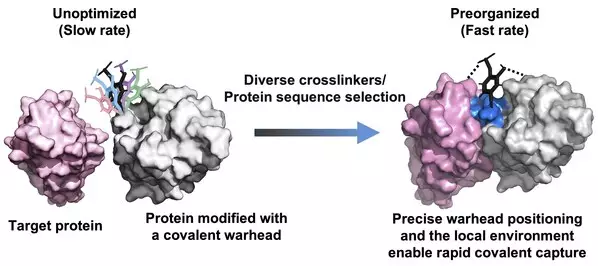
To address this challenge, the researchers proposed that precise spatial positioning of chemical warheads within protein scaffolds could enable molecular preorganization, thereby accelerating covalent bond formation without increasing intrinsic reactivity (Fig. 1).
Based on this concept, the team developed a high-throughput platform that combines yeast surface display with chemoselective protein modification to screen diverse crosslinkers and millions of protein variants. By optimizing warhead placement and the local chemical environment, the platform enables rapid and irreversible target engagement.
Using this platform, the researchers developed a covalent antagonist targeting PD-L1, termed IB101. Structural analysis revealed that IB101 forms a defined binding pocket that precisely positions the warhead in a reactive conformation, greatly accelerating covalent bond formation. Functionally, IB101 effectively blocks the PD-1/PD-L1 immune checkpoint pathway and demonstrates strong antitumor activity in mouse models. Notably, despite its short in vivo half-life, IB101 achieves durable target engagement and tumor suppression, outperforming conventional antibody-based therapies under comparable conditions.
The platform was further applied to cytokine engineering, leading to the development of a covalent IL-18 variant, IB201. This engineered cytokine rapidly forms a covalent interaction with its receptor, enhancing signaling strength and duration. In vivo studies showed that IB201 induces potent antitumor immune responses without detectable systemic toxicity. These results highlight the potential of covalent engineering to improve the efficacy and safety of cytokine-based therapies.
Beyond immunotherapy targets, the platform was also applied to develop a covalent inhibitor targeting the receptor-binding domain (RBD) of SARS-CoV-2. This molecule achieves durable viral neutralization, demonstrating the versatility of the approach across different therapeutic modalities.
This study establishes a general strategy for engineering fast-acting covalent protein therapeutics. By enabling covalent bond formation on timescales compatible with rapid in vivo clearance, the platform overcomes a fundamental limitation in the field.
These findings provide a new framework for designing biologics with both rapid kinetics and sustained target engagement, with broad implications for cancer immunotherapy, antiviral therapy, and beyond.
Media Contact:
Chi Zhang
media@westlake.edu.cn
+86-15659837873
** This press release is distributed by PR Newswire through automated distribution system, for which the client assumes full responsibility. **
Fast-Acting Covalent Protein Drugs From a New High-Throughput Platform