PARIS (AP) — France has adopted its delayed 2026 budget Monday, clearing the way for higher military spending promised by President Emmanuel Macron to confront threats linked to Russia’s war in Ukraine and Mideast conflicts.
The adoption of the budget marks the final step of a monthslong, chaotic process that exposed deep divisions in the fractured Parliament, which proved unable to reach a compromise.
Prime Minister Sébastien Lecornu ultimately opted to use his special constitutional power to pass the bill without a vote, surviving two no-confidence votes on Monday evening.
Macron has vowed to increase defense spending to counter what he describes as a widening range of threats, from Russia and nuclear proliferation to terrorism and cyberattacks.
France in December passed an emergency law to avoid a U.S.-style government shutdown, but only the full 2026 budget provides the military with the needed funding to build up forces.
The Defense Ministry will get this year an additional 6.7 billion euros ($7.9 billion) compared to 2025 — a notable exception as the state seeks to curb spending across most other sectors. This year, the armed forces are set to receive a new nuclear-powered attack submarine, 362 armored vehicles to modernize the army, and new Aster surface-to-air missiles.
France is also launching its new voluntary military service this year aiming at training thousands of volunteers, mostly ages 18 and 19.
The government is targeting a budget deficit of 5% of gross domestic product, down from 5.4% in 2025. Public spending is expected to edge down slightly, from 56.8% to 56.6% of GDP as authorities try to rein in debt in the European Union’s second-largest economy.
France has come under pressure from the EU and credit rating agencies to reduce its debt, prompting the center-right government to seek spending cuts.
However, with no majority in Parliament, Lecornu also granted costly concessions to Socialists to keep them from backing efforts to topple his government. The most symbolic is the suspension of Macron’s unpopular pension changes to raise the retirement age from 62 to 64.
The state deficit is projected at 131.9 billion euros ($156.5 billion), almost stable compared with the previous year.
Businesses will bear several tax increases, including an extra tax on large companies’ profits that's expected to raise 7.3 billion euros ($8.7 billion) in 2026.
Macron, 48, is soon entering the last year of his presidency in spring 2027.
He has largely stepped back from domestic politics since his 2024 decision to call early legislative elections plunged Parliament into turmoil and led to the collapse of successive governments over budget disputes.
Lecornu, the fourth prime minister in two years, has survived eight no-confidence votes initiated by the hard left and the far right. Macron, meanwhile, has focused on foreign policy, European affairs and defense.
In recent weeks, he has pushed for security guarantees for Ukraine in the event of a peace deal with Russia, joined European leaders in a show of solidarity with Greenland, and supported the inclusion of Iran’s Revolutionary Guard on the EU’s list of terrorist organization.
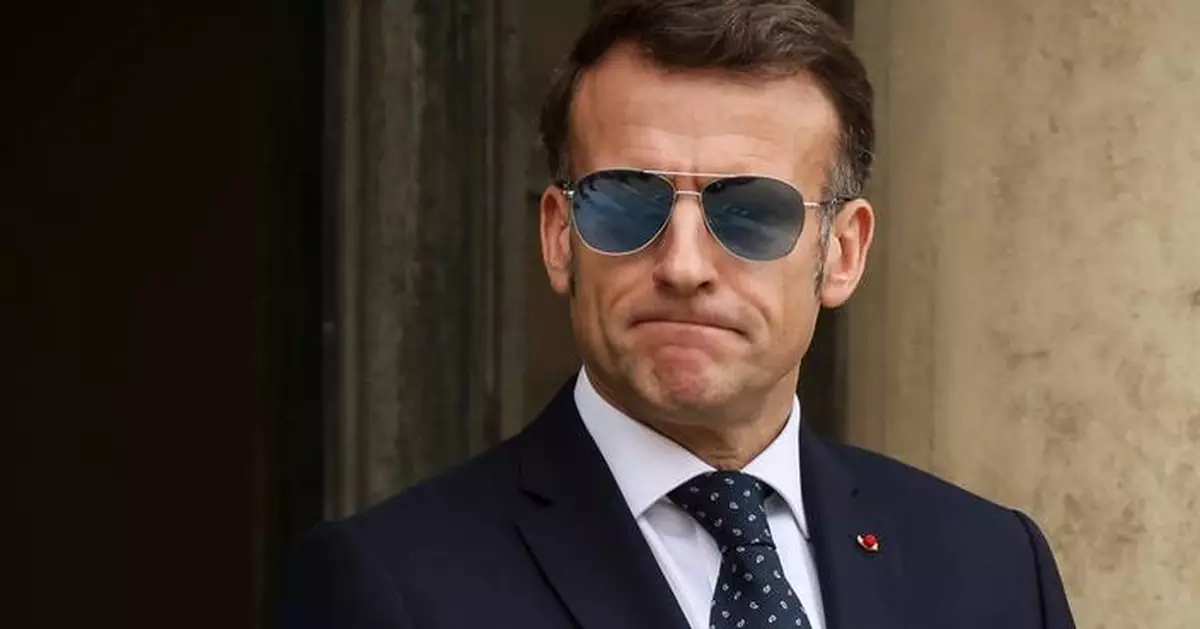
As his sunglasses became a sensation at the Davos gathering of world leaders, Macron's remarks that France prefers “respect to bullies," seen as a rebuke to U.S. President Donald Trump's tariffs threats, drew worldwide attention.
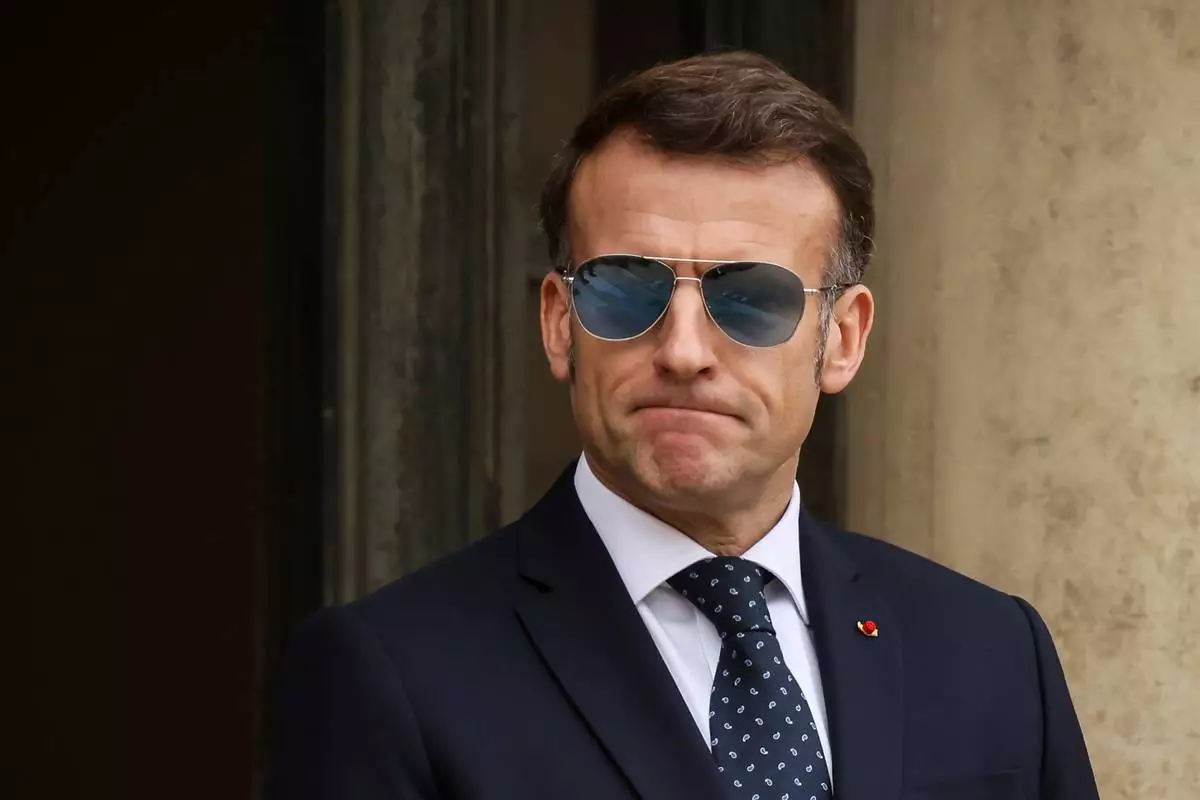
French President Emmanuel Macron waits for the arrival of Denmark's Prime Minister Mette Frederiksen and Greenland Prime Minister Jens-Frederik Nielsen outside the Elysee Palace in Paris, Wednesday Jan. 28. 2026. (AP Photo/Thomas Padilla)
NEW YORK (AP) — Wild swings that swept through financial markets overnight eased as trading headed westward to Wall Street on Monday. U.S. stocks rose following sharp drops in Asia and then gains in Europe, while gold and silver prices rallied back from severe earlier losses.
The S&P 500 added 0.7% and is on track to snap a three-day losing streak. The Dow Jones Industrial Average was up 537 points, or 1.1%, as of 2:08 p.m. Eastern time, and the Nasdaq composite was 1% higher.
Stocks of companies that make computer storage helped lead the market, adding to gains from last week following several profit reports that topped analysts' expectations. Airlines and cruise-ship operators were also strong, benefiting from a sharp easing of oil prices.
The center of the action in financial markets was again precious metals, where momentum has suddenly halted after gold’s price had roughly doubled in just 12 months.
Gold briefly dropped below $4,500 per ounce in the overnight hours, down more than $1,000 from its high point reached just last week. It has since pulled back to $4,672.10, down 1.5%.
Silver’s price has been on an even wilder ride recently, and it swung from a 9% loss overnight to a gain of 0.1%.
Gold and silver prices had been surging as investors looked for safer things to own amid a wide range of worries, including a Federal Reserve that may be set to become less independent, a U.S. stock market that critics say is expensive, threats of tariffs and heavy debt loads for governments worldwide.
Their prices cratered on Friday, including a 31.4% plunge for silver. Some on Wall Street saw it as a result of President Donald Trump’s nomination of Kevin Warsh as the next chair of the Fed. Warsh’s reputation as a former Fed governor may have raised expectations among some investors that he may keep interest rates high to fight against inflation, which would reduce the need to hide out in gold and silver for protection.
But many on Wall Street are also skeptical of that initial reading and say the expectation from Trump is likely that Warsh will cut interest rates, something the president has been demanding. That could give the economy a boost, but also inflation.
The Fed chair has a big influence on the economy and markets worldwide by helping to dictate where the U.S. central bank moves interest rates. That affects prices for all kinds of investments, as the Fed tries to keep the U.S. job market humming without letting inflation get out of control.
The job market has been broadly weakening and is being closely watched by the Fed. The next big monthly update for January was scheduled to be released on Friday, but is now postponed because of the partial federal government shutdown.
The recent swoons for gold and silver are likely more about the washout for some traders who had borrowed money to bet on metals’ prices continuing to soar, rather than about a wholesale change in expectations for demand for metals, according to Darrell Cronk, chief investment officer for Wealth & Investment Management at Wells Fargo
On Wall Street, Sandisk leaped 16.1% to lead the S&P 500. The data-storage company added to its 6.9% gain from Friday, after it reported stronger profit for the latest quarter than analysts expected. It credited demand created by the artificial-intelligence boom, among other things.
That helped offset a 0.6% drop for Nvidia, whose chips are powering much of the world’s move into AI technology. The losses were worse in Asia, where AI winners plunged. South Korea’s Kospi fell 5.3% from its record for its worst day in almost 10 months after chip company SK Hynix lost nearly 9%.
The Walt Disney Co. fell 6.8% even though the entertainment giant reported a stronger profit for the latest quarter than analysts expected. It warned of challenges keeping international visitors away from its U.S. theme parks, among other things.
Oil prices dropped more than 5% after Trump told reporters that Iran is “seriously talking to us.” It’s a potential signal of improving relations between the two countries, which could prevent a possible disruption to the global flow of oil.
That could mean less painful fuel bills for airlines and cruise ships. Carnival steamed 8.2% higher, and United Airlines climbed 5.7%.
In the bond market, Treasury yields edged higher after a report said that U.S. manufacturing grew last month, when economists were expecting a contraction. The yield on the 10-year Treasury erased an earlier dip and rose to 4.27%, up from 4.26% late Friday.
In stock markets abroad, European indexes rose roughly 1% following Asia’s washout. Japan’s Nikkei 225 fell 1.3%, while stocks fell 2.2% in Hong Kong and 2.5% in Shanghai.
AP Business Writers Matt Ott and Elaine Kurtenbach contributed.
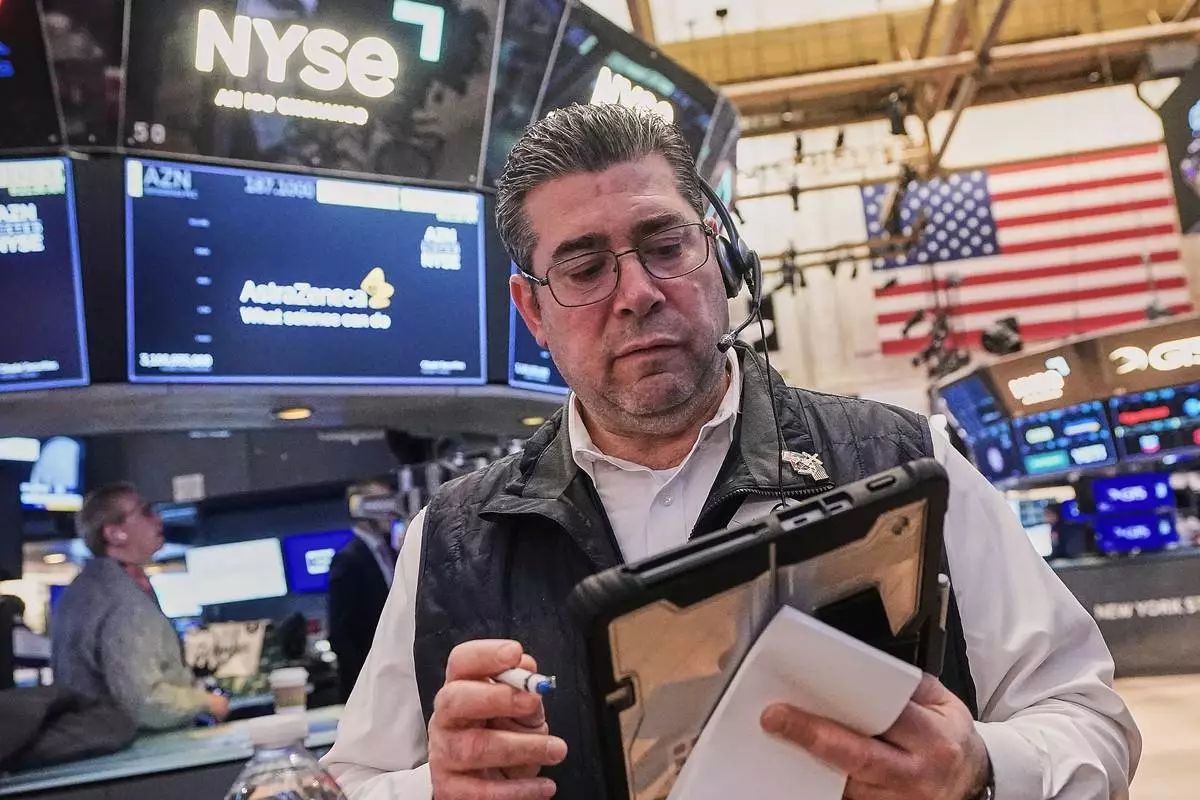
Trader Michael Capolino works on the floor of the New York Stock Exchange, Monday, Feb. 2, 2026. (AP Photo/Richard Drew)
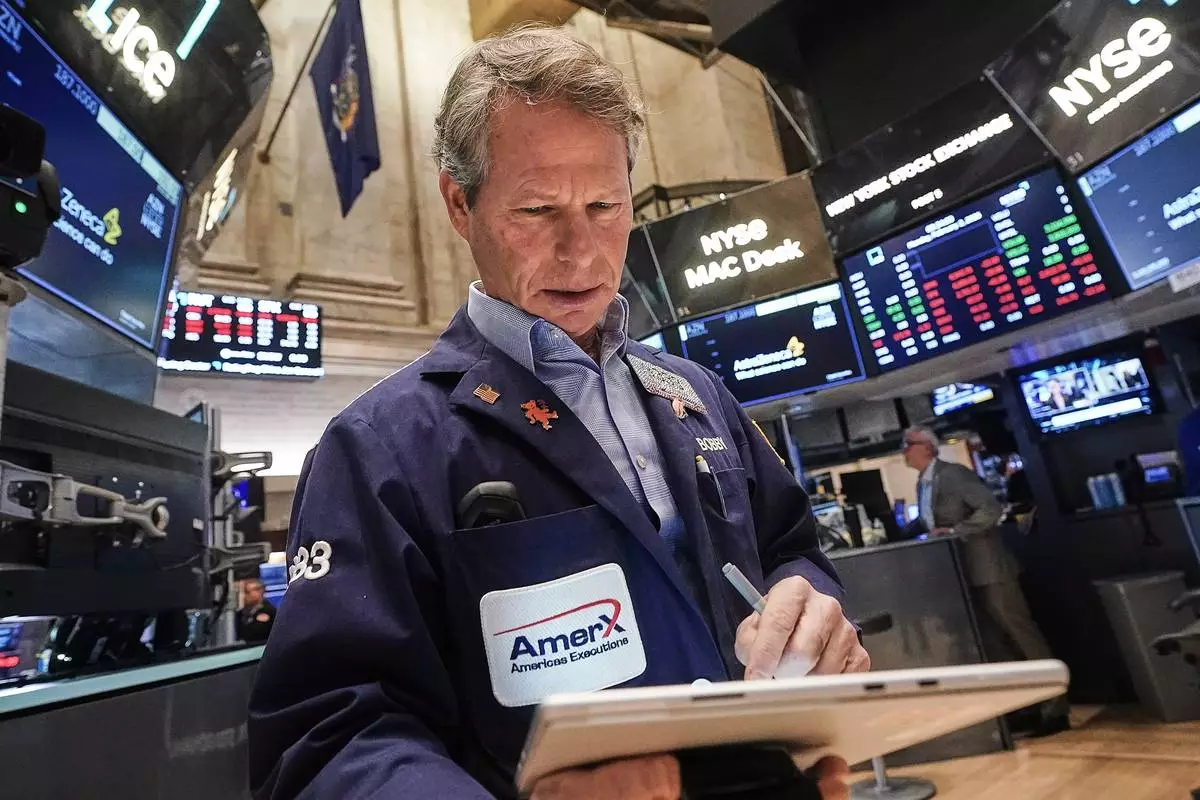
Trader Robert Charmak works on the floor of the New York Stock Exchange, Monday, Feb. 2, 2026. (AP Photo/Richard Drew)
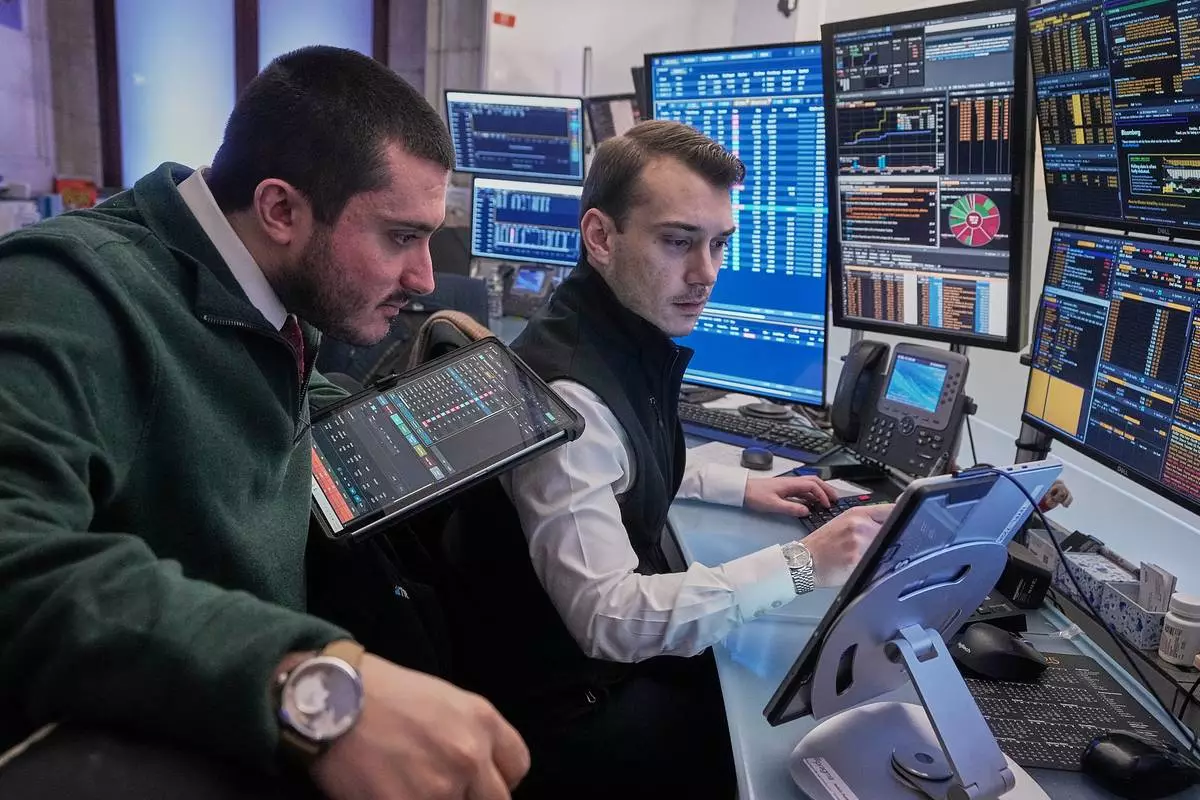
Traders Drew Cohen, left, and Dylan Halvorsan work on the floor of the New York Stock Exchange, Monday, Jan. 26, 2026. (AP Photo/Richard Drew)
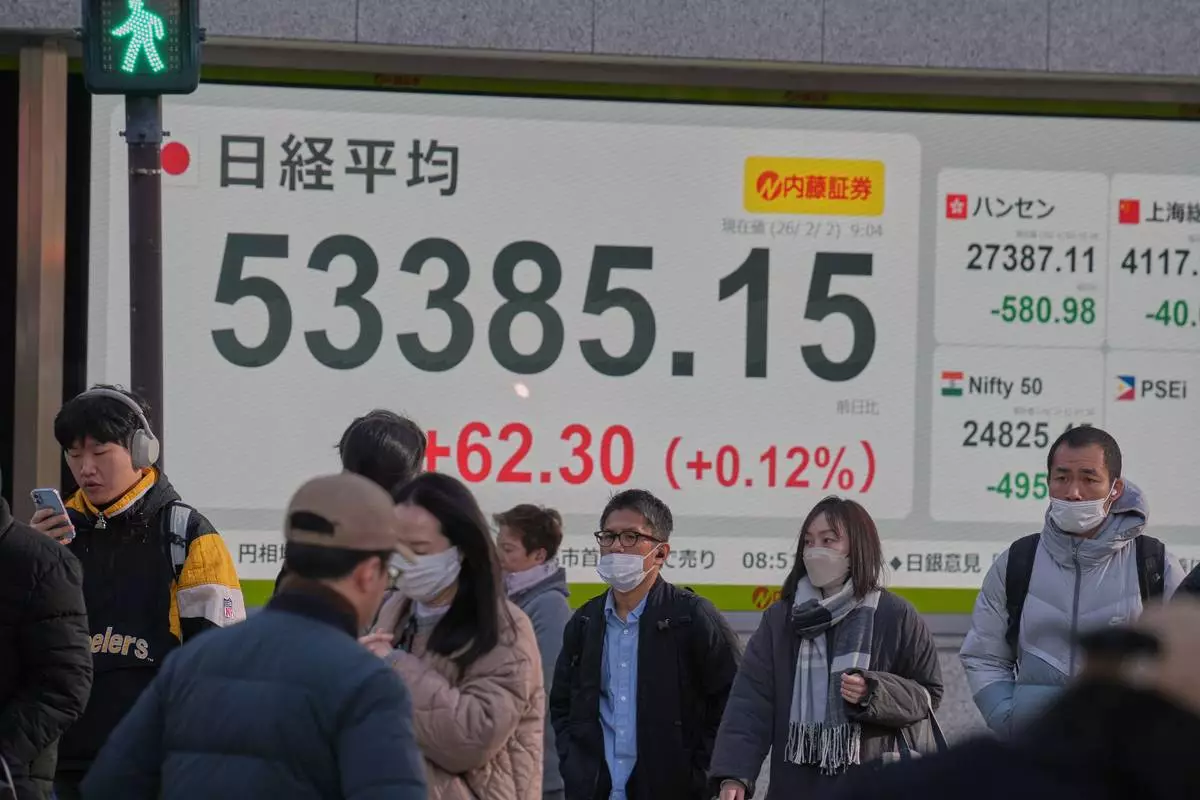
People walk in front of an electronic stock board showing Japan's Nikkei index at a securities firm Monday, Feb. 2, 2026, in Tokyo. (AP Photo/Eugene Hoshiko)
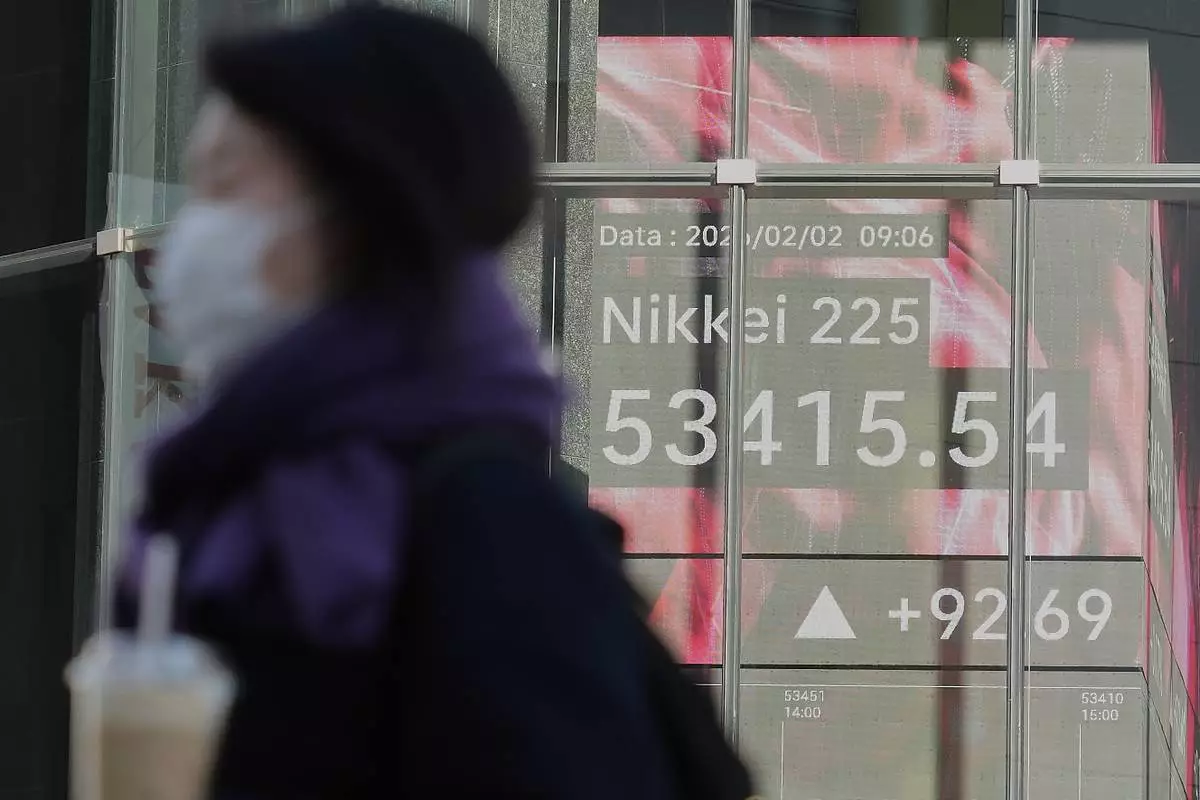
A person walks in front of an electronic stock board showing Japan's Nikkei index at a securities firm Monday, Feb. 2, 2026, in Tokyo. (AP Photo/Eugene Hoshiko)
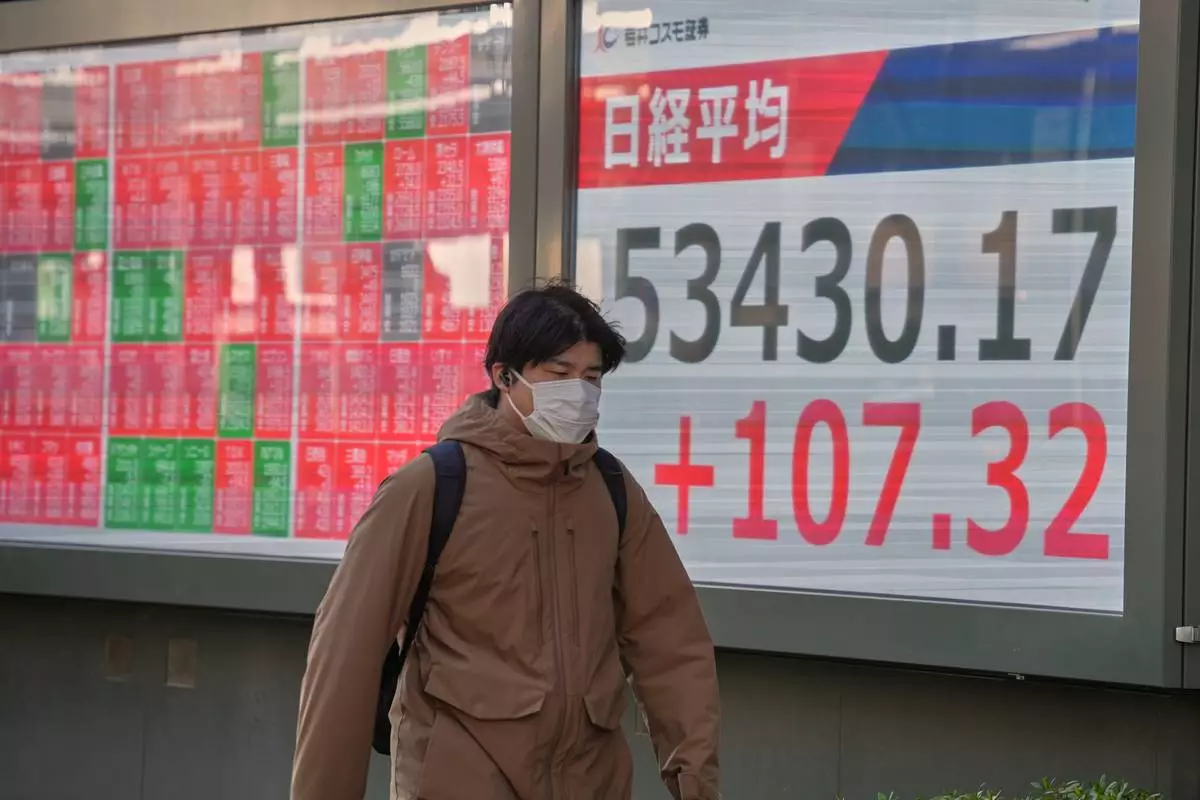
A person walks in front of an electronic stock board showing Japan's Nikkei index at a securities firm Monday, Feb. 2, 2026, in Tokyo. (AP Photo/Eugene Hoshiko)
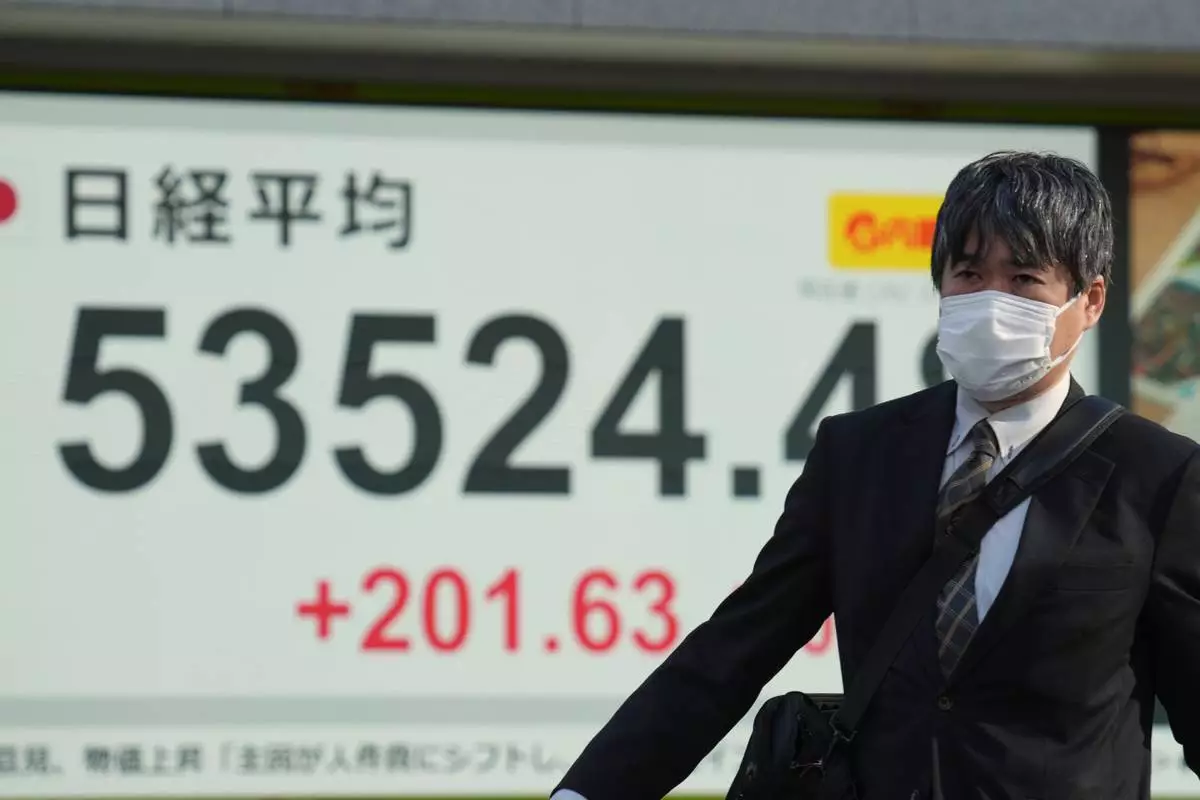
A person walks in front of an electronic stock board showing Japan's Nikkei index at a securities firm Monday, Feb. 2, 2026, in Tokyo. (AP Photo/Eugene Hoshiko)

A currency trader talks on the phone near a screen showing the Korea Composite Stock Price Index (KOSPI), top center, and the foreign exchange rate between U.S. dollar and South Korean won, top center left, at the foreign exchange dealing room of the Hana Bank headquarters in Seoul, South Korea, Friday, Jan. 30, 2026. (AP Photo/Ahn Young-joon)