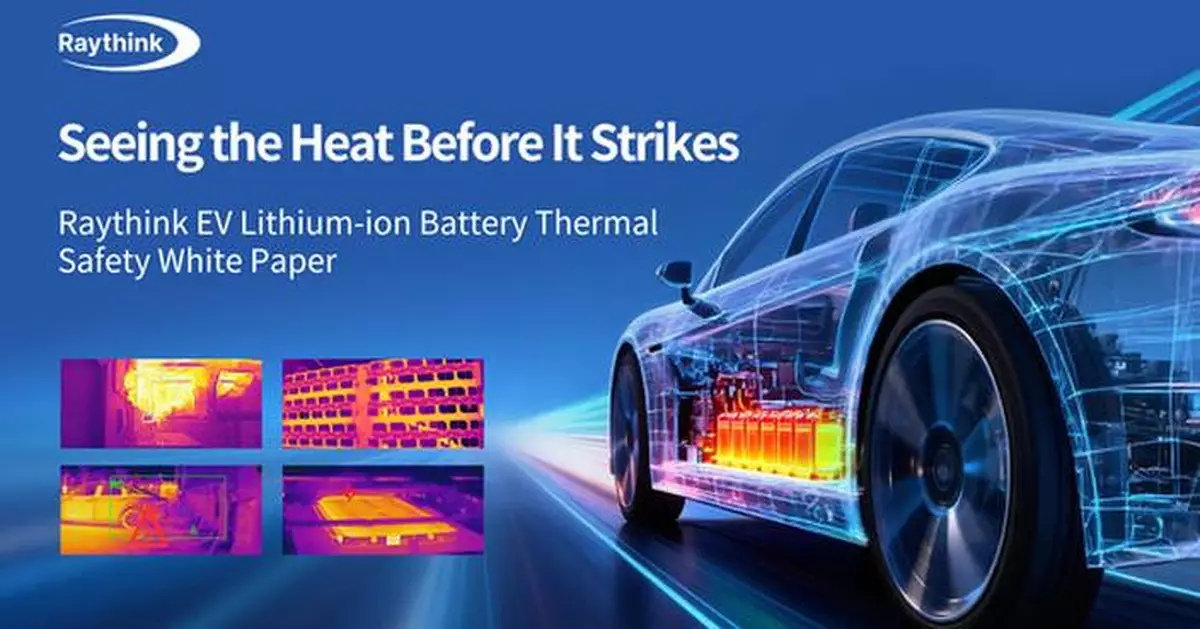
YANTAI, China, Feb. 2, 2026 /PRNewswire/ -- Raythink Technology Co., Ltd. ("Raythink") today announced the global release of its EV Lithium-ion Battery Safety White Paper, introducing a three-layer integrated thermal safety baseline. The system addresses key gaps in traditional lithium-ion battery safety monitoring and enables proactive, full-lifecycle management of EV battery thermal risks.
Three-Layer System for Proactive Safety
Raythink's thermal safety baseline consists of three complementary layers that work alongside existing safety and control systems:
Layer 1: Reliable thermal cameras for harsh environments, placed at production lines, storage facilities, and other critical areas.
Layer 2: The VIS3000 cloud platform centralizes thermal data, enabling safety teams to analyze trends, review incidents, and document compliance.
Layer 3: Thermal Vision integrates with existing safety systems like BMS, fire alarms, and DCS, creating a unified, traceable safety network.
Together, these layers form a scalable, integrated thermal safety baseline that enhances proactive risk detection across the lithium-ion battery lifecycle.
Key Advantages of Raythink's Thermal-Safety Baseline
Built on this foundation, the system provides multiple advantages. Its greatest strength lies in establishing a unified thermal safety baseline that spans the entire EV battery lifecycle.
Most monitoring solutions in practice remain fragmented: different stages rely on independent systems, making it difficult to maintain continuous, traceable safety oversight. In contrast, Raythink's approach can be applied across key environments, including production and assembly lines, testing laboratories, storage facilities, charging and energy storage sites, and hazardous waste handling and recycling.
The unified system consolidates thermal data from all environments onto a single platform, generating valuable data-driven insights and delivering multiple benefits, including quality inspection and process insights beyond lithium-ion battery safety.
Industry Value and ROI
As EV adoption accelerates under policies such as the EU's 2035 zero-emission targets, battery safety compliance is increasingly mandatory. Thermal Vision not only supports compliance with regulations such as the EU Battery Regulation and UNECE GTR No. 20, but also helps optimize production quality, prevent costly incidents, and reduce downtime, offering measurable long-term ROI.
About Raythink
With over 16 years of thermal imaging expertise, Raythink delivers industrial thermal monitoring solutions across diverse applications, serving leading manufacturers in the lithium-ion battery and new energy sectors. Download the white paper to explore how these capabilities support full-lifecycle EV lithium-ion battery safety.
Download the full white paper here.
For more information:
Website: https://www.raythink-tech.com
** The press release content is from PR Newswire. Bastille Post is not involved in its creation. **
Revolutionizing EV Battery Safety: Raythink Releases Groundbreaking White Paper on Full-Lifecycle Thermal Risk Management
HANGZHOU, China, April 3, 2026 /PRNewswire/ -- A team led by principal investigators Bobo Dang and Ting Zhou at Westlake University/Westlake Laboratory reported in Science a high-throughput platform for engineering fast-acting covalent protein therapeutics. Their work, titled "A high-throughput selection system for fast-acting covalent protein drugs," opens new avenues for next-generation biologics.
Covalent small-molecule drugs have shown great success in cancer therapy by forming irreversible bonds with their targets. This has inspired efforts to extend covalent strategies to protein therapeutics, especially engineered miniproteins. However, their development is limited by a kinetic mismatch: Miniproteins are rapidly cleared in vivo, whereas covalent bond formation is typically slow. In addition, high-throughput platforms for systematically optimizing covalent protein reactivity have been lacking.
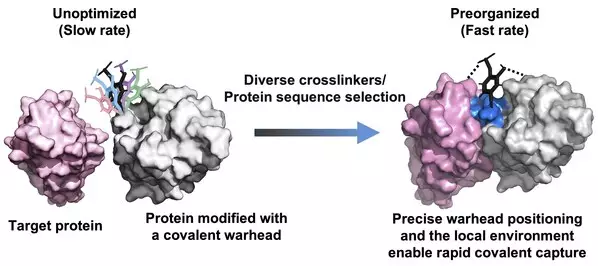
To address this challenge, the researchers proposed that precise spatial positioning of chemical warheads within protein scaffolds could enable molecular preorganization, thereby accelerating covalent bond formation without increasing intrinsic reactivity (Fig. 1).
Based on this concept, the team developed a high-throughput platform that combines yeast surface display with chemoselective protein modification to screen diverse crosslinkers and millions of protein variants. By optimizing warhead placement and the local chemical environment, the platform enables rapid and irreversible target engagement.
Using this platform, the researchers developed a covalent antagonist targeting PD-L1, termed IB101. Structural analysis revealed that IB101 forms a defined binding pocket that precisely positions the warhead in a reactive conformation, greatly accelerating covalent bond formation. Functionally, IB101 effectively blocks the PD-1/PD-L1 immune checkpoint pathway and demonstrates strong antitumor activity in mouse models. Notably, despite its short in vivo half-life, IB101 achieves durable target engagement and tumor suppression, outperforming conventional antibody-based therapies under comparable conditions.
The platform was further applied to cytokine engineering, leading to the development of a covalent IL-18 variant, IB201. This engineered cytokine rapidly forms a covalent interaction with its receptor, enhancing signaling strength and duration. In vivo studies showed that IB201 induces potent antitumor immune responses without detectable systemic toxicity. These results highlight the potential of covalent engineering to improve the efficacy and safety of cytokine-based therapies.
Beyond immunotherapy targets, the platform was also applied to develop a covalent inhibitor targeting the receptor-binding domain (RBD) of SARS-CoV-2. This molecule achieves durable viral neutralization, demonstrating the versatility of the approach across different therapeutic modalities.
This study establishes a general strategy for engineering fast-acting covalent protein therapeutics. By enabling covalent bond formation on timescales compatible with rapid in vivo clearance, the platform overcomes a fundamental limitation in the field.
These findings provide a new framework for designing biologics with both rapid kinetics and sustained target engagement, with broad implications for cancer immunotherapy, antiviral therapy, and beyond.
Media Contact:
Chi Zhang
media@westlake.edu.cn
+86-15659837873
** This press release is distributed by PR Newswire through automated distribution system, for which the client assumes full responsibility. **
Fast-Acting Covalent Protein Drugs From a New High-Throughput Platform