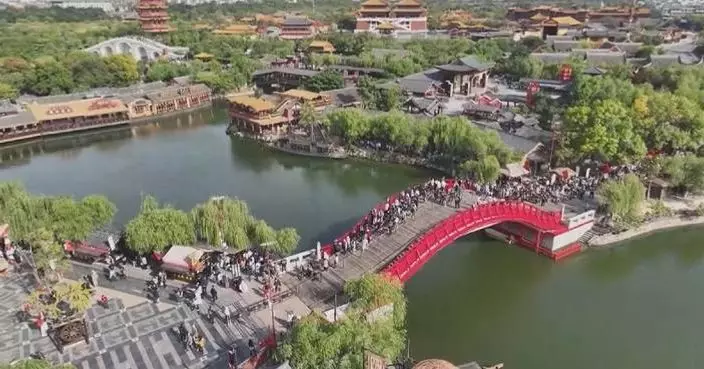
China has consistently made achievements in protecting and restoring its wetlands in recent years with the high importance that President Xi Jinping places on ecological civilization.
By the end of 2025, the total wetland area in China reached 55.6 million hectares, with 903 national wetland parks and 22 international wetland cities, ranking first in the world, the National Forestry and Grassland Administration said on Monday, which is also the World Wetlands Day.
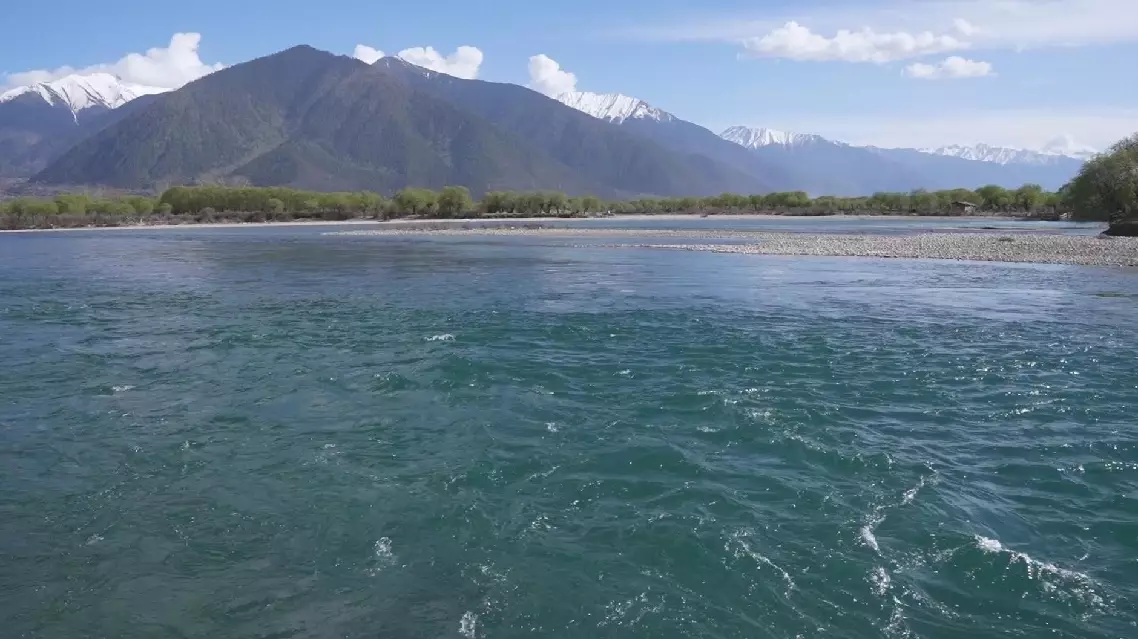
One of the country's conservation highlights is the Yani National Wetland Park, located in the scenic regions where the Nyang River, meaning "Goddess's Tears" in Tibetan, converges with the Yarlung Zangbo River in Nyingchi.
The park covers over 8,700 hectares and embodies China's commitment to preserving ecological zones.
"This is the Nyang River, the mother river for us and all the animals here. So, we protect this river like we protect our eyes," said Sangye Phuntsog, a wetland protector.
Since the 18th National Congress of the Communist Party of China in 2012, President Xi has attached great importance to wetland conservation. He made multiple inspections across major wetland regions in the country, including a mangrove conservation area in the Beihai Golden Bay in south China's Guangxi Zhuang Autonomous Region, an ecological wetland park in the Dianchi Lake in southwest China's Yunnan Province, the Xixi National Wetland Park in east China's Zhejiang Province, and the Ulansuhai Nur (Wuliangsuhai) Wetland in north China's Inner Mongolia Autonomous Region.
In July 2021, Xi visited the Nyang River Bridge in Nyingchi to inspect the ecological preservation in the basin of the Yarlung Zangbo River and its tributary Nyang River.
"The water system of the Yarlung Zangbo River is a rare green ground, a green 'lung'; yet on the other hand, its ecosystem is very fragile, so we need to protect it and use it at the same time, with protection coming first," said Xi. Locals who have witnessed the transformation of this wetland speak highly of its remarkable recovery. Historically, the region endured severe ecological degradation, an environment once characterized by vast sands and relentless winds. Thanks to the ecological restoration efforts, the landscape thrives with greenery.
"The level of human activities is constantly increasing, which has had a certain impact on the water volume and even the water quality of the entire river basin," said Wang Yong, deputy director of the Forestry and Grassland Bureau of Nyingchi City.
Since 2016, greening projects for the basins of the Yarlung Zangbo, Nujiang, Lhasa, Nyangchu, Yalong and Shiquan rivers and for areas near residential houses, roads, farmlands and waters have been executed, with emphasis on eco-environmental restoration and green construction.
Meanwhile, a series of measures to combat desertification and restore degraded wetlands have been implemented, creating historic opportunities for high-altitude ecological restoration.
The establishment of the Yani National Wetland Park Administration in 2016 marked a significant milestone. Combining routine supervision with community patrols, local villagers have become active participants in wetland protection.
"Since the management and protection work began, the wetland has become shady with more trees and birds, including black-necked cranes and ducks in summer. I love working as a wetland protector," said Sangye Phuntsog.
The transformation of the wetland exemplifies China's emphasis on ecological restoration and wetland conservation.
In November 2022, the 14th Meeting of the Conference of the Contracting Parties to the Ramsar Convention on Wetlands (COP14) was held in central China's Wuhan City. Addressing its opening ceremony, Xi put forward a series of specific and detailed development plans.
"China will promote international exchanges and cooperation and will build an international mangrove center in Shenzhen. China supports the convening of a conference of the World Coastal Forum. Let us join hands to write a new chapter in global wetlands conservation," said Xi.
"It is important that we show our respect for nature, minimize disruption and damage caused by human activities, and protect the ecological security of wetlands, in order to leave the beautiful wetlands to our future generations," he said.
Xi's ecological vision guides China's progress in wetland conservation