|
Third edition of VivaTech's Confidence Barometer conducted by OpinionWay among tech executives in Europe (France, Germany, United Kingdom, Spain, Italy, Netherlands) and North America (United States)
PARIS, Feb. 3, 2026 /PRNewswire/ --VivaTech unveils the third edition of its Tech Confidence Barometer, conducted by OpinionWay. Covering sovereignty issues, AI adoption, and investments, executives from seven countries express their strong confidence in new technologies and share their insights.
Technological sovereignty: The emergence of an Atlantic divide
When adopting a new technological tool, 92% of executives would favor a future partner who shares their nationality, and nearly half of them (47%) would make this commonality a decisive factor.
This essential aspect is particularly emphasized by the English-speaking countries surveyed (57% in the United States and the United Kingdom), while the majority of EU members consider it a "plus".
63% of executives say they are concerned about the loss of sovereignty that may accompany technological progress.
The geography of trust: New blocs are Forming
The geographical origin of tech solutions has a significant influence on the level of trust placed in them (86%). Nearly one in two executives (47%) cite their own country as one of the regions they trust the most, but the boundaries of trust extend far beyond that:
- The United States: Confident in their own country (51%), Americans value the North American continent as a whole even more (62%).
- Continental Europe stands united: 43% of European executives favor solutions from their own continent. In France, 63% place the most trust in European solutions.
- The United Kingdom, between two worlds: Particularly confident (56%) in the capabilities of the UK, those surveyed place Europe on an equal footing (53%)
The AI paradox: Maximum confidence, risky practices
89% of executives trust AI to guide their company's decisions.
83% of executives are confident in the sustainable and controlled development of financial investments in artificial intelligence. Only 17% fear a speculative bubble.
92% are confident in their ability to maintain employment levels over the next 12 months.
However, four out of ten executives have already shared information about their company with an AI tool they did not fully trust.
Investments: Record levels driven by AI and cybersecurity
Over the next 12 months, 87% of executives plan to increase their investments in artificial intelligence, and 77% in cybersecurity.
Contact: vivatech@publicisconsultants.com
Third edition of VivaTech's Confidence Barometer conducted by OpinionWay among tech executives in Europe (France, Germany, United Kingdom, Spain, Italy, Netherlands) and North America (United States)
PARIS, Feb. 3, 2026 /PRNewswire/ --VivaTech unveils the third edition of its Tech Confidence Barometer, conducted by OpinionWay. Covering sovereignty issues, AI adoption, and investments, executives from seven countries express their strong confidence in new technologies and share their insights.
Technological sovereignty: The emergence of an Atlantic divide
When adopting a new technological tool, 92% of executives would favor a future partner who shares their nationality, and nearly half of them (47%) would make this commonality a decisive factor.
This essential aspect is particularly emphasized by the English-speaking countries surveyed (57% in the United States and the United Kingdom), while the majority of EU members consider it a "plus".
63% of executives say they are concerned about the loss of sovereignty that may accompany technological progress.
The geography of trust: New blocs are Forming
The geographical origin of tech solutions has a significant influence on the level of trust placed in them (86%). Nearly one in two executives (47%) cite their own country as one of the regions they trust the most, but the boundaries of trust extend far beyond that:
- The United States: Confident in their own country (51%), Americans value the North American continent as a whole even more (62%).
- Continental Europe stands united: 43% of European executives favor solutions from their own continent. In France, 63% place the most trust in European solutions.
- The United Kingdom, between two worlds: Particularly confident (56%) in the capabilities of the UK, those surveyed place Europe on an equal footing (53%)
The AI paradox: Maximum confidence, risky practices
89% of executives trust AI to guide their company's decisions.
83% of executives are confident in the sustainable and controlled development of financial investments in artificial intelligence. Only 17% fear a speculative bubble.
92% are confident in their ability to maintain employment levels over the next 12 months.
However, four out of ten executives have already shared information about their company with an AI tool they did not fully trust.
Investments: Record levels driven by AI and cybersecurity
Over the next 12 months, 87% of executives plan to increase their investments in artificial intelligence, and 77% in cybersecurity.
Contact: vivatech@publicisconsultants.com
** The press release content is from PR Newswire. Bastille Post is not involved in its creation. **
VivaTech 2026 Confidence Barometer: A paradox revealing tensions between technology adoption, sovereignty, and cybersecurity in a fragmented geopolitical context
HANGZHOU, China, April 3, 2026 /PRNewswire/ -- A team led by principal investigators Bobo Dang and Ting Zhou at Westlake University/Westlake Laboratory reported in Science a high-throughput platform for engineering fast-acting covalent protein therapeutics. Their work, titled "A high-throughput selection system for fast-acting covalent protein drugs," opens new avenues for next-generation biologics.
Covalent small-molecule drugs have shown great success in cancer therapy by forming irreversible bonds with their targets. This has inspired efforts to extend covalent strategies to protein therapeutics, especially engineered miniproteins. However, their development is limited by a kinetic mismatch: Miniproteins are rapidly cleared in vivo, whereas covalent bond formation is typically slow. In addition, high-throughput platforms for systematically optimizing covalent protein reactivity have been lacking.
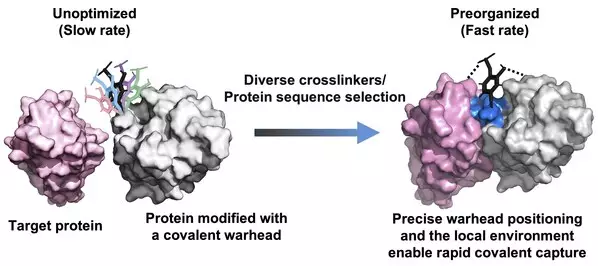
To address this challenge, the researchers proposed that precise spatial positioning of chemical warheads within protein scaffolds could enable molecular preorganization, thereby accelerating covalent bond formation without increasing intrinsic reactivity (Fig. 1).
Based on this concept, the team developed a high-throughput platform that combines yeast surface display with chemoselective protein modification to screen diverse crosslinkers and millions of protein variants. By optimizing warhead placement and the local chemical environment, the platform enables rapid and irreversible target engagement.
Using this platform, the researchers developed a covalent antagonist targeting PD-L1, termed IB101. Structural analysis revealed that IB101 forms a defined binding pocket that precisely positions the warhead in a reactive conformation, greatly accelerating covalent bond formation. Functionally, IB101 effectively blocks the PD-1/PD-L1 immune checkpoint pathway and demonstrates strong antitumor activity in mouse models. Notably, despite its short in vivo half-life, IB101 achieves durable target engagement and tumor suppression, outperforming conventional antibody-based therapies under comparable conditions.
The platform was further applied to cytokine engineering, leading to the development of a covalent IL-18 variant, IB201. This engineered cytokine rapidly forms a covalent interaction with its receptor, enhancing signaling strength and duration. In vivo studies showed that IB201 induces potent antitumor immune responses without detectable systemic toxicity. These results highlight the potential of covalent engineering to improve the efficacy and safety of cytokine-based therapies.
Beyond immunotherapy targets, the platform was also applied to develop a covalent inhibitor targeting the receptor-binding domain (RBD) of SARS-CoV-2. This molecule achieves durable viral neutralization, demonstrating the versatility of the approach across different therapeutic modalities.
This study establishes a general strategy for engineering fast-acting covalent protein therapeutics. By enabling covalent bond formation on timescales compatible with rapid in vivo clearance, the platform overcomes a fundamental limitation in the field.
These findings provide a new framework for designing biologics with both rapid kinetics and sustained target engagement, with broad implications for cancer immunotherapy, antiviral therapy, and beyond.
Media Contact:
Chi Zhang
media@westlake.edu.cn
+86-15659837873
** This press release is distributed by PR Newswire through automated distribution system, for which the client assumes full responsibility. **
Fast-Acting Covalent Protein Drugs From a New High-Throughput Platform