LONDON--(BUSINESS WIRE)--Feb 3, 2026--
Snowflake (NYSE: SNOW), the AI Data Cloud company, today announced new innovations to help enterprises deliver real business impact with AI, which requires more than high-quality models alone. Snowflake is unveiling Semantic View Autopilot (now generally available), an AI-powered service that automates the creation and governance of semantic views, giving AI agents a shared understanding of business metrics to deliver consistent, trustworthy outcomes. Snowflake is also introducing new capabilities across agent evaluations and observability, end-to-end machine learning (ML), and AI cost governance. These innovations build on Snowflake’s existing enterprise-grade foundations, ensuring that AI systems such as Snowflake Intelligence are trusted, governed, and ready to operate reliably at scale, all while working directly on organizations’ most valuable data.
This press release features multimedia. View the full release here: https://www.businesswire.com/news/home/20260203233912/en/
“AI is quickly becoming part of the operating fabric of the enterprise, not a side project,” said Christian Kleinerman, EVP of Product, Snowflake. “Our focus is to make that future a reality now by ensuring AI agents operate on consistent business logic, behave as expected, and scale without surprises. By unifying trust, governance, and execution on one platform, we’re delivering AI that actually works in the environments our customers care about.”
Automating the Semantic Layer to Enable Accurate, Trustworthy AI
Enterprises are deploying AI agents into environments where business metrics are manually defined and inconsistently governed, leaving them without a shared understanding of business context. This fragmented approach to building the semantic layer is a bottleneck for AI adoption, producing unreliable outputs and weakening trust in AI.
Semantic View Autopilot addresses this challenge by automatically building, optimizing, and maintaining governed semantic views, potentially eliminating the need for manual, error-prone semantic modeling. This builds on Snowflake’s commitment to initiatives like the OpenSemanticInterchange (OSI), which establishes an interoperable semantic layer across ecosystem leaders. While OSI provides the connectivity to share business logic across the ecosystem, Semantic View Autopilot adds the intelligence to create and continuously maintain it, making it the connective layer for trustworthy, scalable AI across all data, wherever it lives.
By learning from real user activity and using AI-powered generation, Semantic View Autopilot will help ensure business logic remains accurate and up-to-date across Snowflake data and consumption tools including dbt Labs, Google Cloud’s Looker, Sigma, and ThoughtSpot (generally available soon). Customers can create semantic views using business definitions not only from Snowflake, but also from the business intelligence tools they already rely on. As a result, enterprises can minimize AI hallucinations while cutting semantic model creation from days to minutes, accelerating time-to-market and delivering a decisive competitive advantage.
Leading organizations including eSentire, HiBob, Simon AI, and VTS are already using Semantic View Autopilot to dramatically reduce data-to-insight timelines and free data teams to focus on higher-value AI innovation.
"At Simon AI, our focus is helping businesses turn data into real, actionable outcomes. But inconsistencies between business logic have historically slowed how far AI can be applied," said Matt Walker, CTO at Simon AI. "Semantic View Autopilot provides our AI systems with a consistent, governed understanding of business metrics that we can collaborate upon with our customers. This allows us to deliver reliable personalization and AI-driven engagement that our customers can trust to drive measurable results."
Snowflake Accelerates ML Model Production with Agentic AI and Real-Time Deployment
To speed up the delivery of powerful ML models, Snowflake is unveiling significant advancements to Snowflake Notebooks (now generally available), a fully-managed Jupyter-powered notebook built for end-to-end data science and ML development on Snowflake data.
Snowflake Notebooks is integrated directly with Cortex Codein Snowsight (generally available soon), a data-native AI coding agent built to automate and accelerate end-to-end enterprise development. This allows users to build and deploy fully-functional ML pipelines using simple natural language prompts, reducing manual effort and speeding up workflows. Experiment Tracking (now generally available) makes it easy for teams to compare training runs, share results, and reproduce the best-performing models from within Snowflake Notebooks, turning experimentation into a repeatable, collaborative process.
When models are ready for production, Snowflake supports real-time use cases with Online Feature Store (now generally available) and Online Model Inference (now generally available), enabling features to be served in milliseconds and predictions delivered at scale. With training, serving, and monitoring all happening within the Snowflake platform, teams can operationalize ML while maintaining consistent governance from data to model to insight.
Enterprises like Aimpoint Digital are already leveraging Snowflake Notebooks to run ML projects on Snowflake, unlocking use cases like personalization, fraud detection, and predictive analytics.
Cortex Agent Evaluations Help Enterprises Deploy Trusted, Production-Grade AI Agents
When AI powers mission-critical enterprise decisions, trust and reliability are essential. Cortex Agent Evaluations (generally available soon) addresses this challenge, helping teams confidently bring AI agents into production by making their behavior traceable, measurable, and auditable.
Cortex Agent Evaluations give developers deep visibility into how agents reason, act, and respond, which enables them to systematically assess answer correctness, tool use, and logical consistency. With visibility into an agent's thought process, teams can easily identify errors, refine decision logic, and validate that agents are behaving as intended before they impact the business. It also promotes efficiency of the AI interactions by preventing operational waste such as redundant tool calls and spiraling compute costs. Enterprises like WHOOP are already leveraging Cortex Agent Evaluations in Snowflake to improve agent quality, without moving data or stitching together external monitoring tools.
As Snowflake continues to innovate across AI, it is also focused on making AI economically sustainable for enterprises through expanded cost governance capabilities in Cortex AI Functions (now generally available) that help organizations plan, control, and audit their AI usage with precision. Before AI workloads ever run, teams can proactively estimate consumption using the AI_COUNT_TOKENS function, making it easier to understand how prompt design and context size translate into real cost.
Learn More:
Forward Looking Statements
This press release contains express and implied forward-looking statements within the meaning of Section 27A of the Securities Act of 1933, as amended, and Section 21E of the Securities Exchange Act of 1934, as amended, including statements regarding (i) Snowflake’s business strategy, plans, opportunities, or priorities (ii) the release, adoption, and use of Snowflake’s new or enhanced products, services, and technology offerings, including those that are under development or not generally available, (iii) market growth, trends, and competitive considerations, (iv) Snowflake’s vision, strategy, and expected benefits relating to artificial intelligence and other emerging product areas, including the expected benefits and network effects of the AI Data Cloud, and (v) the integration, interoperability, and availability of Snowflake’s products, services, and technology offerings with and on third-party platforms. Other than statements of historical fact, all statements contained in this press release are forward-looking statements. These forward-looking statements are subject to a number of risks, uncertainties and assumptions, including those described under the heading “Risk Factors” and elsewhere in the Quarterly Reports on Form 10-Q and the Annual Reports on Form 10-K that Snowflake files with the Securities and Exchange Commission. In light of these risks, uncertainties, and assumptions, actual results could differ materially and adversely from those anticipated or implied in the forward-looking statements. As a result, you should not rely on any forward-looking statements as predictions of future events. Forward-looking statements speak only as of the date the statements are made and are based on information available to Snowflake at the time those statements are made and/or Snowflake management's good faith belief as of that time with respect to future events. Except as required by law, Snowflake undertakes no obligation, and does not intend, to update these forward-looking statements to reflect events that occur or circumstances that exist after the date on which they were made.
© 2025 Snowflake Inc. All rights reserved. Snowflake, the Snowflake logo, and all other Snowflake product, feature and service names mentioned herein are registered trademarks or trademarks of Snowflake Inc. in the United States and other countries. All other brand names or logos mentioned or used herein are for identification purposes only and may be the trademarks of their respective holder(s). Snowflake may not be associated with, or be sponsored or endorsed by, any such holder(s).
About Snowflake
Snowflake is the platform for the AI era, making it easy for enterprises to innovate faster and get more value from data. More than 12,600 customers around the globe, including hundreds of the world’s largest companies, use Snowflake’s AI Data Cloud to build, use and share data, applications and AI. With Snowflake, data and AI are transformative for everyone. Learn more at snowflake.com (NYSE: SNOW).
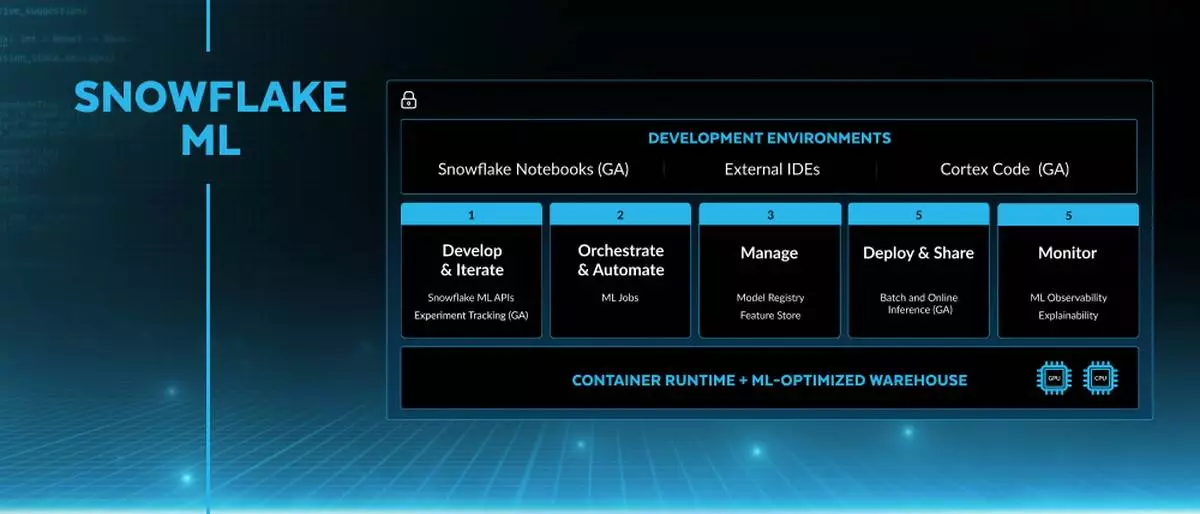
The combined power of Snowflake Notebooks and Cortex Code accelerates the delivery of powerful ML models
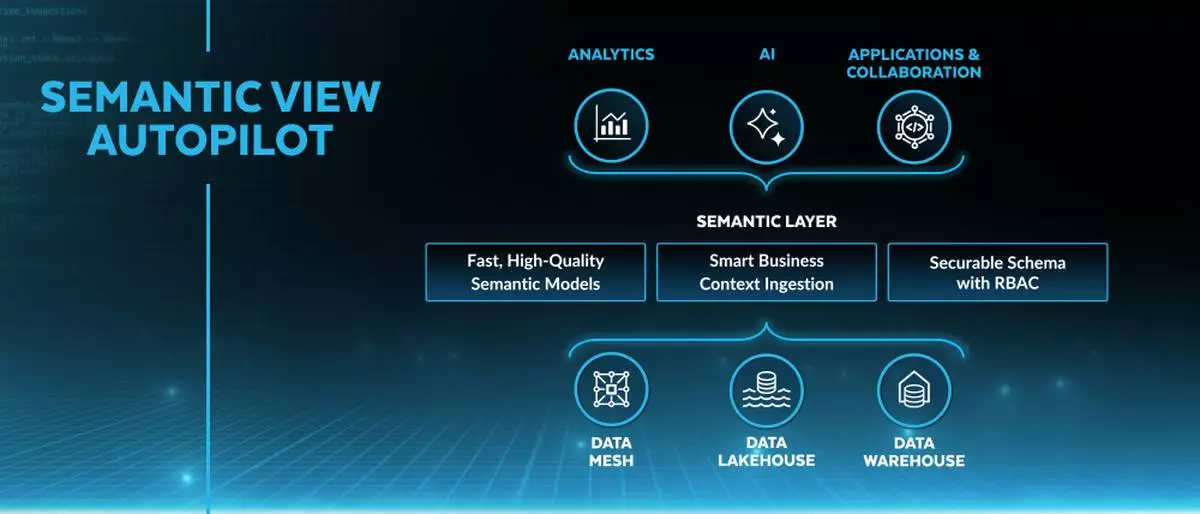
Accelerates time-to-insight across business intelligence tools and AI agents by automatically building, optimizing, and maintaining semantic views