LONDON--(BUSINESS WIRE)--Feb 3, 2026--
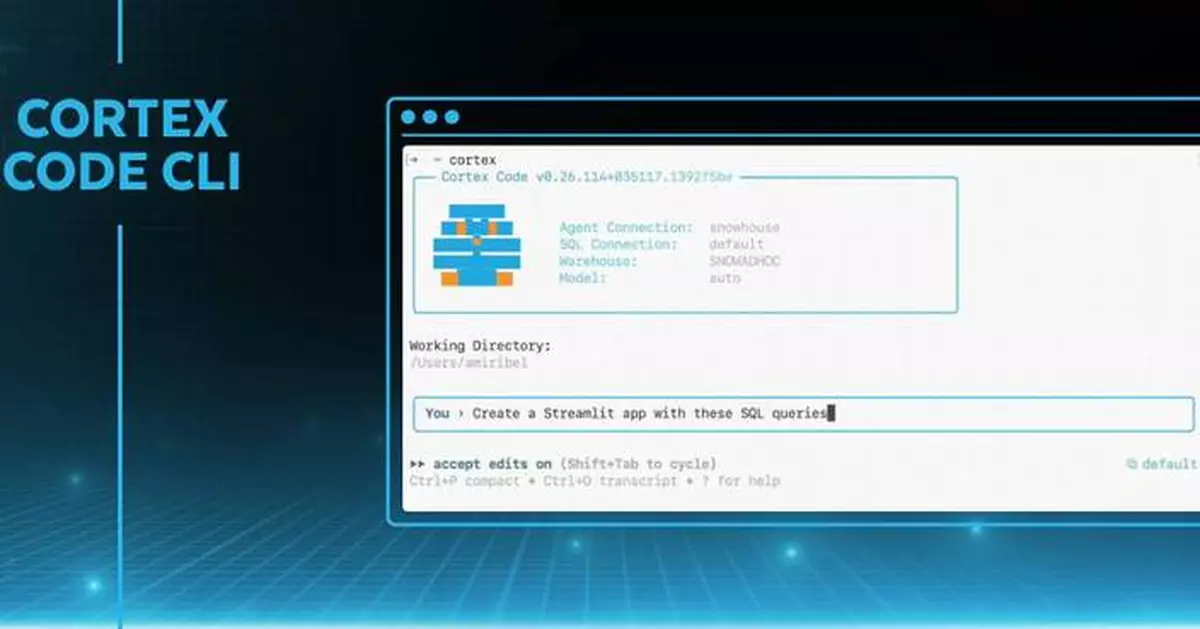
Snowflake (NYSE: SNOW), the AI Data Cloud company, today unveiled a new Snowflake-native AI coding agent and other tools purpose-built to help organizations move data and AI projects from idea to production faster. With Cortex Code, a data-native AI coding agent that automates and accelerates end-to-end enterprise development, users gain an agent that deeply understands and operates within their enterprise data context. Cortex Code empowers everyone, regardless of their technical expertise, from data experts to domain experts, to build data pipelines, analytics, and AI apps faster, while maintaining enterprise-grade security and governance controls. Cortex Code joins Snowflake Intelligence as a part of the Snowflake CortexAI product suite, extending the company’s AI-powered capabilities across the entire enterprise data lifecycle. In addition, Snowflake is introducing new capabilities for vibe coding and a collaborative development environment, so users can innovate more seamlessly.
This press release features multimedia. View the full release here: https://www.businesswire.com/news/home/20260203694963/en/
“For AI to truly deliver value, it must move beyond experimentation and become an integral part of the systems that teams rely on every day,” said Christian Kleinerman, EVP of Product, Snowflake. “With Cortex Code, we’re reimagining how teams build and operate by embedding AI directly into the development lifecycle with critical data context and controls teams can trust. This materially shifts how organizations build with data and AI, drastically reducing the effort required for users to build solutions that are reliable, governed, and ready to run at enterprise scale.”
Cortex Code: The AI Coding Agent Purpose-Built for the Enterprise Data Stack
As businesses race to deliver real impact with AI, teams across organizations face growing pressure to move faster without impacting trust, accuracy, or scale. Yet many coding tools lack the deep, end-to-end understanding of an organization’s data, processes, and constraints, which is required to move quickly from experimentation to real business impact. Existing solutions often focus narrowly on code generation, without understanding the context of enterprise data, governance requirements, or the complex workflows that span data engineering, analytics, and app development. To move data and AI initiatives forward faster and more reliably, organizations require purpose-built tooling that understands their data environments, simplifies complex tasks, and enables sophisticated, trusted workflows through natural language.
Powering this shift is Cortex Code. By translating complex data engineering, analytics, machine learning, and agent-building tasks into simple, natural language workflows, Cortex Code helps teams deliver production-ready outcomes faster. It enables leading organizations like Braze, Decile, dentsu, FYUL, LendingTree, Shelter Mutual Insurance, TextNow, United Rentals, and WHOOP to accelerate time to value and confidently move even the most advanced use cases from idea to production with speed and accuracy.
Unlike generic coding assistants, Cortex Code understands users’ Snowflake data, compute, governance, and operational semantics – while remaining secure by design and strictly governed. Cortex Code is customizable and interoperable, designed to work wherever users operate across Snowflake experiences and local developer environments. It fits naturally into existing workflows and supports the entire development lifecycle, from design and implementation to optimization and operations. Teams can use Cortex Code within the Snowflake platform through Cortex Code in Snowsight (generally available soon) or within their preferred terminal or code editor like VS Code or Cursor with Cortex Code CLI (now generally available).
Accelerating AI Development Across the Data Lifecycle
To further reduce the friction that slows enterprise AI adoption and delivery, Snowflake is also advancing how users build, deploy, and manage AI-powered data workflows across the stack, from app development to collaboration:
What Snowflake Customers Are Saying About Cortex Code:
“Our teams operate in an industry where the demand for high-quality, data-driven marketing solutions is accelerating rapidly. To keep pace, we need tools that let us scale efficiently while maintaining consistency and governance,” said Joe Tobey, Head of Data Products Engineering, dentsu. “Cortex Code CLI aligns naturally with how our teams work, enabling them to translate data and evolving requirements into AI-powered solutions on Snowflake faster, supporting our ability to meet growing market expectations without disrupting established workflows.”
“Cortex Code is fundamentally changing how our teams build on Snowflake,” said Miks Lūsītis, Senior Director of Data, FYUL. “By bringing context-aware AI directly into our development workflows, Cortex Code has helped us move from experimentation to production faster without having to switch between tools or question if the agent understands our business context.”
“As we look at how agentic AI can accelerate our data and analytics roadmap, speed and iteration are critical,” said Srinivas Madabushi, Senior Vice President, Technology, LendingTree. “Cortex Code gives our teams a simple, in-platform way to move quickly from exploring ideas to delivering AI-driven workflows directly on Snowflake. It has the power to help us shape how we roll out AI-powered capabilities for more personalized consumer experiences and smarter financial decisioning.”
“What stands out about Cortex Code is how naturally it fits into the way our teams already work,” said Vibhor Gupta, Vice President of Enterprise Data & AI, Shelter Mutual Insurance. “It helps us reduce friction in everyday data and AI development while maintaining the controls and oversight we need in a regulated environment. With Cortex Code, our teams can build faster with the context they need to be successful.”
“Powering connectivity for millions of users requires a technology stack that can keep pace with the business and enables our teams to make smart, data-driven decisions at scale,” said Ganesan Saminathan, Head of Data Engineering, TextNow. "Cortex Code enables our teams to move faster from data to action by supporting AI-powered capabilities directly in our data workflows. That agility is key as we continue expanding access to free and flexible wireless services for millions.”
“Snowflake Intelligence is already helping our teams make faster, better decisions across the business, and Cortex Code is extending that intelligence into the AI experiences we build for our team,” said Tony Leopold, Chief Technology and Strategy Officer, United Rentals. “Cortex Code helps our engineers improve the performance of our business intelligence tools, meaningfully reducing the time it takes to improve quality and speed of Natural Language Query responses.”
“Cortex Code has quickly improved how we build and operate AI across Snowflake, from day-to-day development to the production-grade agents we deliver to our teams,” said Matt Luizzi, Senior Director of Business Analytics, WHOOP. “Using Cortex Code, we've been able to optimize our existing Cortex Agents and benchmark against different Evaluation Sets to improve performance and accuracy. It’s accelerated how we turn knowledge into usable AI experiences while maintaining the operational rigor we need.”
Learn More:
Forward Looking Statements
This press release contains express and implied forward-looking statements within the meaning of Section 27A of the Securities Act of 1933, as amended, and Section 21E of the Securities Exchange Act of 1934, as amended, including statements regarding (i) Snowflake’s business strategy, plans, opportunities, or priorities (ii) the release, adoption, and use of Snowflake’s new or enhanced products, services, and technology offerings, including those that are under development or not generally available, (iii) market growth, trends, and competitive considerations, (iv) Snowflake’s vision, strategy, and expected benefits relating to artificial intelligence and other emerging product areas, including the expected benefits and network effects of the AI Data Cloud, and (v) the integration, interoperability, and availability of Snowflake’s products, services, and technology offerings with and on third-party platforms. Other than statements of historical fact, all statements contained in this press release are forward-looking statements. These forward-looking statements are subject to a number of risks, uncertainties and assumptions, including those described under the heading “Risk Factors” and elsewhere in the Quarterly Reports on Form 10-Q and the Annual Reports on Form 10-K that Snowflake files with the Securities and Exchange Commission. In light of these risks, uncertainties, and assumptions, actual results could differ materially and adversely from those anticipated or implied in the forward-looking statements. As a result, you should not rely on any forward-looking statements as predictions of future events. Forward-looking statements speak only as of the date the statements are made and are based on information available to Snowflake at the time those statements are made and/or Snowflake management's good faith belief as of that time with respect to future events. Except as required by law, Snowflake undertakes no obligation, and does not intend, to update these forward-looking statements to reflect events that occur or circumstances that exist after the date on which they were made.
© 2026 Snowflake Inc. All rights reserved. Snowflake, the Snowflake logo, and all other Snowflake product, feature and service names mentioned herein are registered trademarks or trademarks of Snowflake Inc. in the United States and other countries. All other brand names or logos mentioned or used herein are for identification purposes only and may be the trademarks of their respective holder(s). Snowflake may not be associated with, or be sponsored or endorsed by, any such holder(s).
About Snowflake
Snowflake is the platform for the AI era, making it easy for enterprises to innovate faster and get more value from data. More than 12,600 customers around the globe, including hundreds of the world’s largest companies, use Snowflake’s AI Data Cloud to build, use and share data, apps and AI. With Snowflake, data and AI are transformative for everyone. Learn more at snowflake.com (NYSE: SNOW).
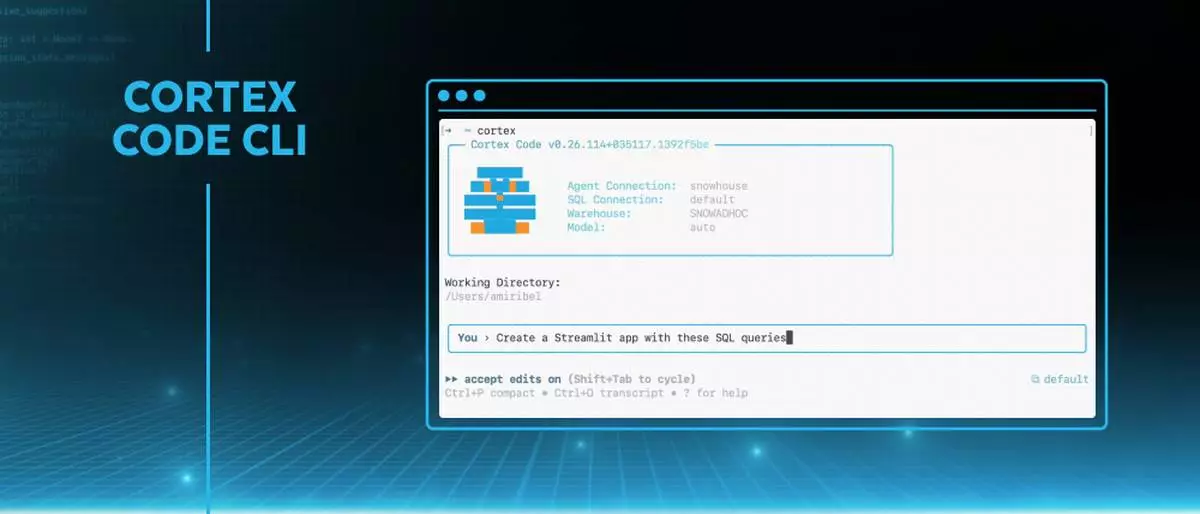
Cortex Code delivers a dramatic increase in productivity for data teams, simplifying all data operations by bringing secure, context-aware coding assistance to local development environments