China's steel output reached 1.446 billion tonnes in 2025, marking a year-on-year increase of 3.1 percent, thanks to the continuous optimization of production structure, according to the latest data released by the National Bureau of Statistics.
Data also showed that in 2025, China's production of crude steel dropped by 4.4 percent year on year to 961 million tonnes.
"China's cumulative increase in steel production has exceeded 100 million tonnes driven by construction of major national projects and the industrial sector, particularly emerging and future industries such as high-end equipment manufacturing," said Zhang Longqiang, director at China Metallurgical Information and Standardization Institute.
Additionally, China has built the world's cleanest steel production system, with over 80 percent of its production capacity having completed transformation to achieve ultra-low emissions. It has also established an EPD Programme for Steel Industry chain to reveal and share product environmental performance information globally.
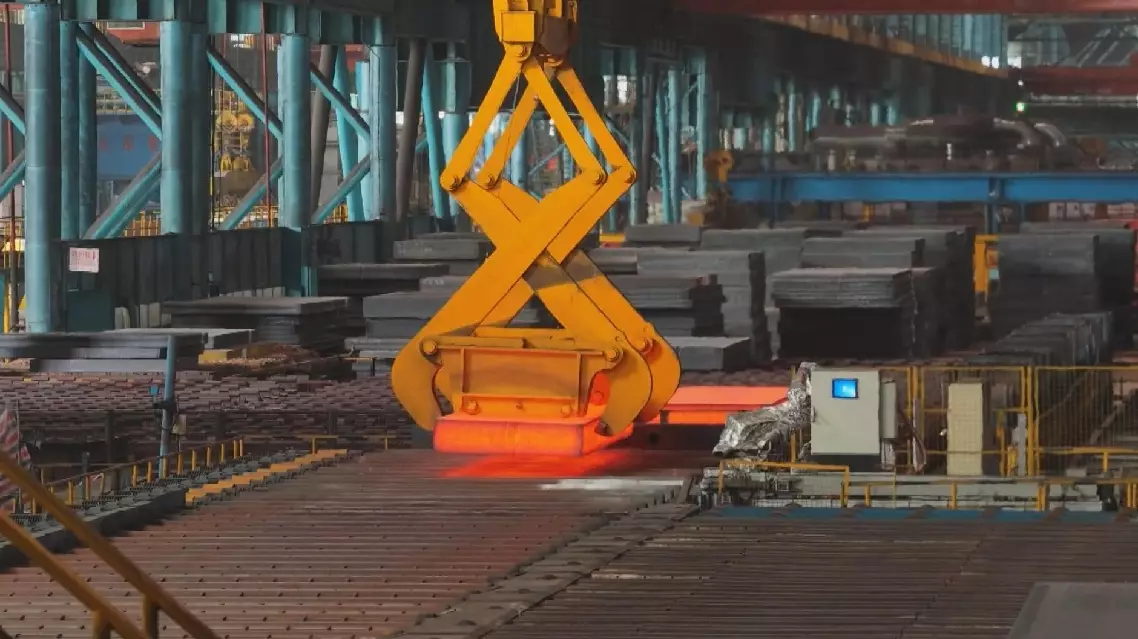
Optimized production structure drives China's steel output growth in 2025
The Langqi passenger terminal in Fuzhou of east China's Fujian Province officially commenced a new departure tax refund initiative for travelers heading on the "mini three links" route on Tuesday, with streamlined measures boosting the efficiency of tax refunds and speeding up customs clearance procedures.
The "mini three links" refers to direct trade, postal and transport services launched in 2001 between Fujian Province and the Taiwan-administered Kinmen and Matsu islands. It serves as a vital, convenient cross-strait passage for personnel exchanges and economic and trade interactions between the Chinese mainland and the Taiwan region.
At the heart of the upgraded service is an optimized procedure dubbed the "one document, one bag, one code" process, a simple and streamlined model designed to shorten clearance time for outbound passengers.
Under this framework, travelers who make purchases at designated pilot tax refund stores can have their qualified goods consolidated into a single sealed bag, with all corresponding tax refund information integrated into a unique QR code printed on the tax refund application form.
When departing via the Langqi passenger terminal, on-site customs officers only need to scan the QR code to retrieve and verify the details relating to the applicant's tax refund application. Travelers can then get quick customs clearance once the information is confirmed to be accurate, with no requirement to open their sealed shopping bags for repeated inspections.
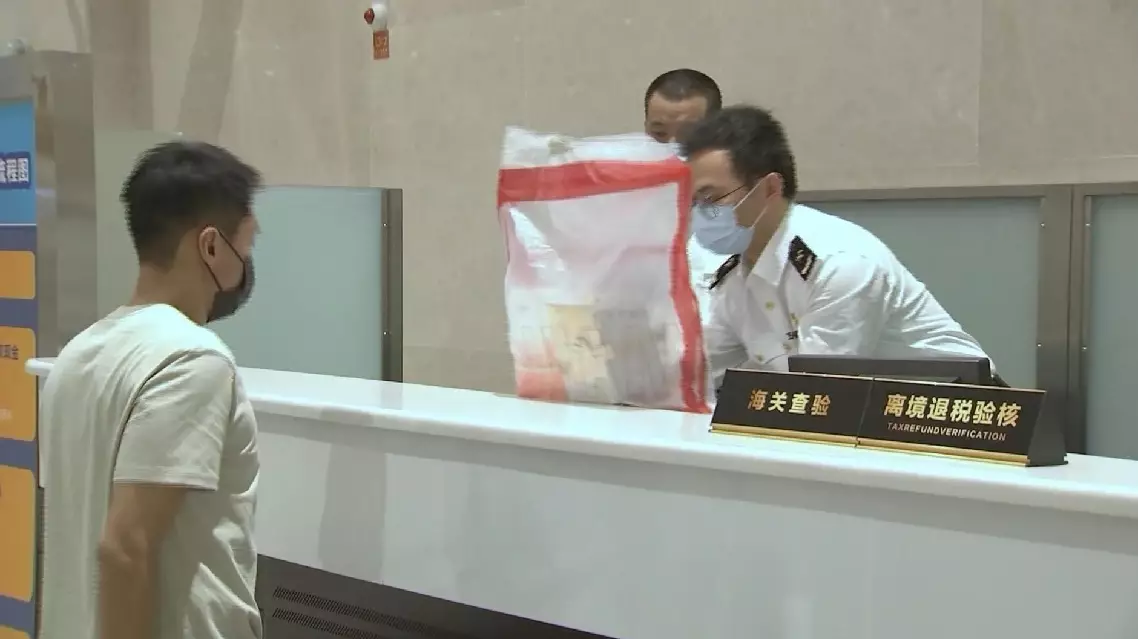
Departure tax refund services launched at "mini three links" port in Fuzhou