PALM BEACH GARDENS, Fla.--(BUSINESS WIRE)--Feb 3, 2026--
As generative AI accelerates across the U.S. healthcare system, a new book provides the first comprehensive blueprint for the multi‑trillion‑dollar transformation ahead. Multi-Trillion Dollar U.S. Healthcare to 2035: Gold Rush II, authored by healthcare strategist and Capacitate, Inc. founder Edmund L. Valentine, introduces the Self‑Care Operating System™ — a governed infrastructure layer designed to safely scale continuous (24/7), reimbursable preventive and predictive self‑care.
This press release features multimedia. View the full release here: https://www.businesswire.com/news/home/20260203966651/en/
With U.S. healthcare spending projected to reach $7 trillion by 2031, Valentine argues that AI is evolving from analytical tools into clinical operating systems, shifting care from episodic encounters to continuous prevention. The book explains why future value will accrue to platforms capable of governing execution across time—clinically, economically, and regulatorily.
“The healthcare system cannot scale continuous AI-driven preventive care without governance before execution,” said Valentine. “Intelligence without control creates risk — clinically, economically, and regulatorily. This book explains where that control layer must live.”
At the center of the thesis is the Self‑Care Operating System, a governed, longitudinal control layer that mediates human input, AI reasoning, automated interventions, and reimbursement readiness before actions occur. Valentine asserts that this layer will determine which platforms can safely scale continuous care and which will face regulatory, clinical, or economic failure.
The Self-Care Operating System™ provides the "governed infrastructure" needed to manage patients continuously. It aligns with CMS’s 2030 Value-Based Care objectives by extending oversight into the patient's daily life through AI-driven, governed interventions. It has the potential to materially reduce healthcare costs through earlier detection of patient destabilization.
Multi-Trillion Dollar U.S. Healthcare to 2035: Gold Rush II is available now on Amazon.com; bulk and institutional distribution available upon request at PR@capacitate-hc.com.
Designed for investors, payers, employers, policymakers, platform architects, AI governance leaders, and healthcare executives, the book offers actionable guidance for navigating what Valentine calls the next U.S. healthcare gold rush.
About the Author
Edmund L. Valentine is a healthcare strategist, industry executive, inventor, and entrepreneur with more than 30 years of global experience advising and operating across all segments of the healthcare industry. He is the founder of Capacitate, Inc. an early‑stage healthcare infrastructure company developing the preventive and predictive Self‑Care Operating System™ through governed pilot partnerships. Valentine is also the award‑winning author of Multi-Trillion Dollar U.S. Healthcare to 2020: Gold Rush and numerous industry reports. A recognized authority on healthcare transformation, he holds patents in health monitoring technologies and has advised on large‑scale system changes emphasizing governance, safety, and value creation.
About Capacitate, Inc.
Capacitate, Inc. is building healthcare’s continuous preventive and predictive Self-Care Operating System™—first introduced and defined in Gold Rush II. Healthcare delivery remains episodic, even though disease progression is continuous. Clinical decisions occur during brief, infrequent encounters, while health destabilization unfolds silently between visits—often detected only after escalation to acute care. Artificial intelligence can identify early deterioration, but without a governed execution layer—the infrastructure that safely turns AI insights into covered, real-world interventions—it cannot act safely, compliantly, or reimbursably at scale. Capacitate is building that execution layer, supported by issued and pending patents and developed in partnership with employers, payers, and care networks. Learn more at www.capacitate-hc.com

Cover of Multi-Trillion Dollar U.S. Healthcare to 2035: Gold Rush II, the new book introducing and defining the Self‑Care Operating System as the next foundational layer of healthcare.
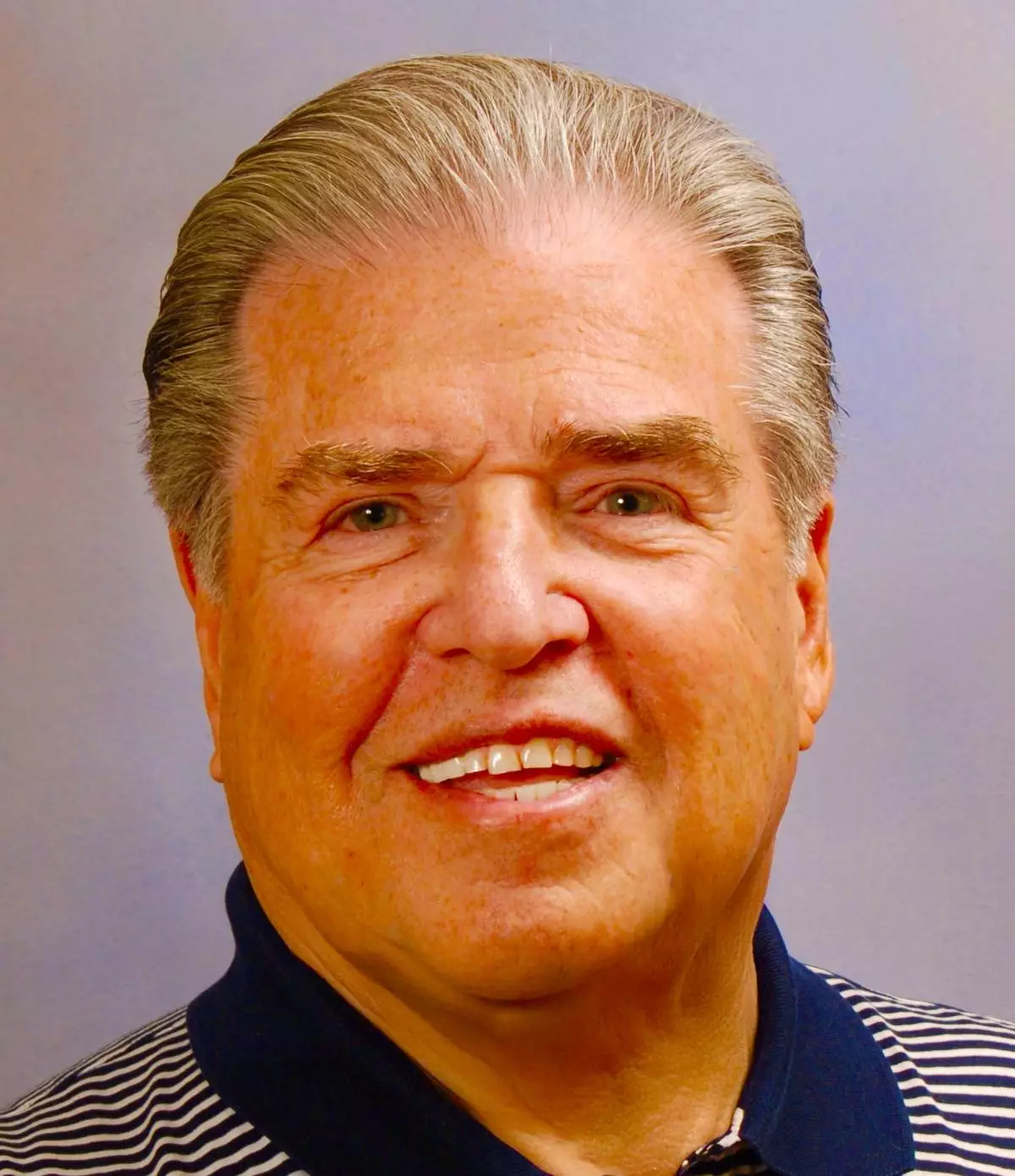
Edmund L. Valentine, healthcare strategist, inventor, entrepreneur, and author of Multi-Trillion Dollar U.S. Healthcare to 2035: Gold Rush II. Valentine is the founder of Capacitate, Inc. and architect of the Self‑Care Operating System™.
Cameron Boozer was at the center of everything for Duke this season.
The 6-foot-9, 250-pound forward proved tough enough to score through physical play. Rangy enough to space the floor and shoot from outside. Deft enough as a passer to find teammates, whether against constant double teams coming for him as the top name on every scouting report or while running the entire offense from up top.
“You just want to affect winning in whatever way you can,” Boozer said.
The high-end NBA prospect did that all season for a team that won 35 games, reached No. 1 in the AP Top 25 poll, claimed the top overall seed for March Madness and reached the NCAA Tournament's Elite Eight. Now he's The Associated Press men’s college basketball national player of the year, only the fifth freshman to earn the honor and the second in a row for a Duke program that keeps adding to the longest list of winners in the country.
“It just goes to show more about what our team has done, just because I think that really helps awards like this, having great team success,” Boozer told the AP. “It’s really just not me.”
Boozer, named unanimous first-team AP all-American last month, received 59 of 61 votes from AP Top 25 voters in results released Friday. BYU freshman AJ Dybantsa, another potential top NBA pick, received the other two votes after averaging a national-best 25.5 points per game.
Boozer, son of Duke and longtime NBA player Carlos Boozer, ranked averaged 22.5 points (ninth in Division I) and 10.2 rebounds (12th) while finishing tied for the national lead with 22 double-doubles. He also averaged 4.1 assists while posting efficient shooting numbers at 55.6% overall and 39.1% from 3-point range.
He joins fellow Blue Devils star Cooper Flagg last year, another Duke player in Zion Williamson (2019), Kentucky’s Anthony Davis (2012) and Texas star Kevin Durant (2007) as freshmen to win the AP award. Each went No. 1 or No. 2 in the NBA draft that year.
“I’m very grateful just that I’m even in those (NBA) conversations,” Boozer said. “I think a lot of people dream of being where I am. Sometimes you’ve got to take a step back and just remember that once upon a time, you were a kid dreaming to be here. So I think it’s very special.”
His coaches think the same of him.
“We’ve been fortunate enough the last two years to have two of the best freshmen to ever play in college basketball back to back,” Duke associate head coach and former Blue Devils player Chris Carrawell said. “And Cam is right up there.
Boozer is Duke's ninth AP winner, each coming from a different player. UCLA is the next closest with five winners, though that included Kareem Abdul-Jabbar (1967 and 1969) and Bill Walton (1972 and 1973) as two-time selections.
UCLA, Ohio State and Duke rival North Carolina are the only other programs with as many as three different players to win the award.
Boozer arrived at Duke alongside twin brother Cayden after the two led Miami's Columbus High to four straight state championships. By late February, the Blue Devils were starting a four-week reign atop the AP Top 25 that would carry to March Madness. Boozer — who said he looks at winning as a skill — routinely posted top performances in Duke's biggest games, including during a rugged nonconference slate.
He matched a season high with 35 points in a November win against Arkansas. He followed with 29 points against defending national champion Florida. He also had big performances at Michigan State (18 points, 15 rebounds) and flirted with a triple-double (18 points, 10 rebounds, seven assists) in a February win against Michigan.
Along the way, he pushed through bumps and shoves. He closed Sunday's season-ending loss to UConn with 27 points and his right eye swollen from a first-half blow.
“There’s no agenda other than figuring out a way to win,” Wolverines coach Dusty May said. “I’ve seen him play a number of times this year where there’s six guys in the paint, and it’s not as if he’s jumping 40, 50 inches off the floor. His desire to rebound the ball, to set physical screens, to play to his advantages, is as impressive as any freshman that I can recall.”
The other challenge was managing the scrutiny that comes from expectations for greatness. A missed shot. A turnover. The 3-for-17 shooting while battling rising frustration and Virginia shot-blocker Ugonna Onyenso in the ACC title game.
“He does a great job of flushing it and not letting it dwell on him too much,” Cayden said. “That’s something he’s always been able to do since we were younger. Obviously I talk to him when he needs me to. And I sometimes just understood that, hey, he’s going through something, give him some space for a little bit and he’ll figure it out.”
Cameron said getting away for time alone and putting down the phone helps. He points to prayer and even a recent effort to read more.
The rest of the time, though, he'll throw himself into becoming a better player. There's comfort in that routine, the results yet to fail him.
“I think just being prepared alleviates pressure," Cameron said. "Being ready for a game, watching film, working out, knowing you put your time in, being confident in yourself — I think all that takes away a lot of the pressure that people talk about. At the end of the day, pressure really is what you put on yourself.”
AP March Madness bracket: https://apnews.com/hub/ncaa-mens-bracket and coverage: https://apnews.com/hub/march-madness
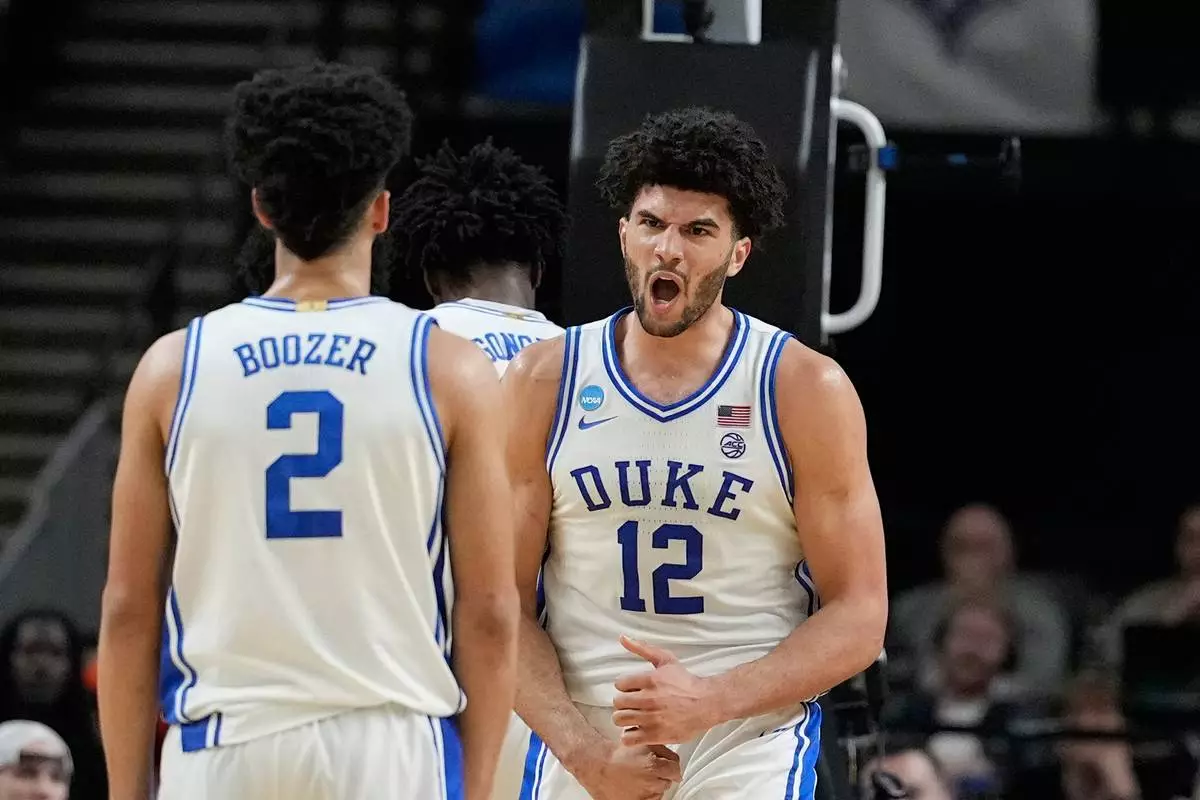
Duke forward Cameron Boozer (12) reacts after scoring during the second half in the second round of the NCAA college basketball tournament against TCU, Saturday, March 21, 2026, in Greenville, S.C. (AP Photo/Brynn Anderson)
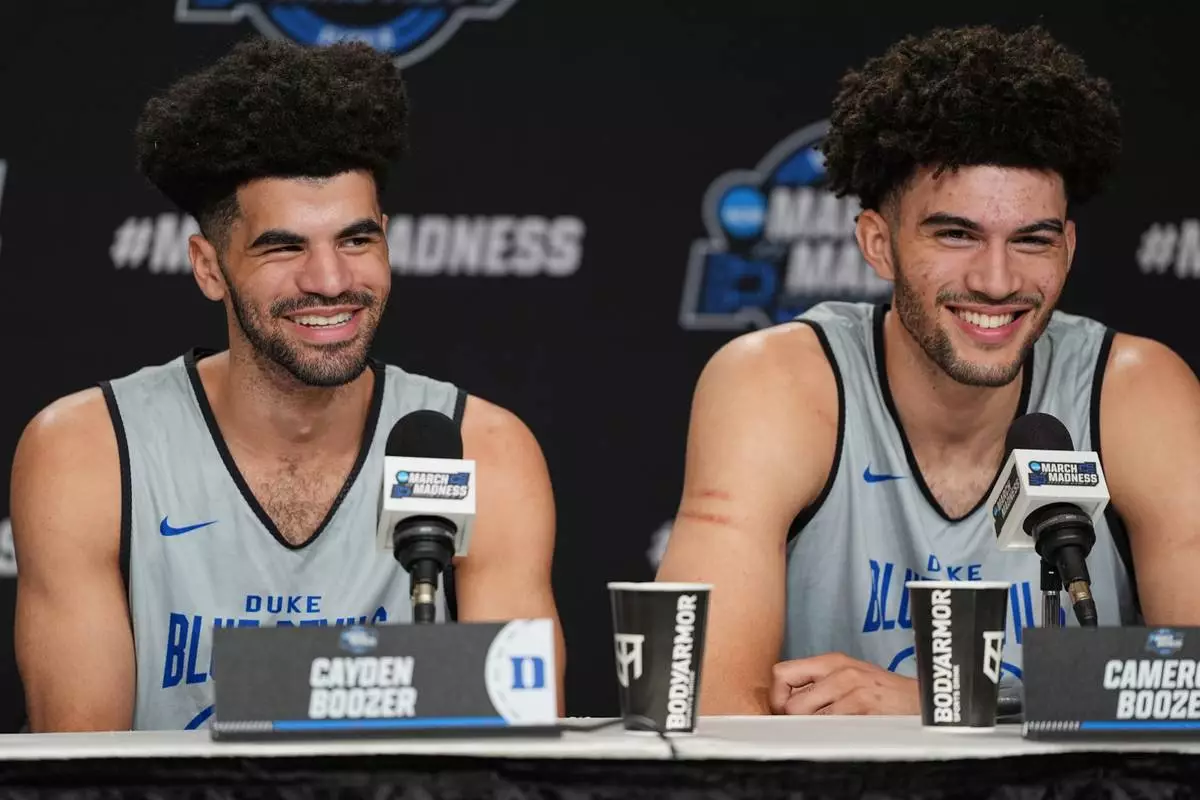
Duke guard Cayden Boozer, left, and Duke forward Cameron Boozer, right, share a laugh during a press conference ahead of a game against UConn in the Elite Eight of the NCAA college basketball tournament Saturday, March 28, 2026, in Washington. (AP Photo/Abbie Parr)
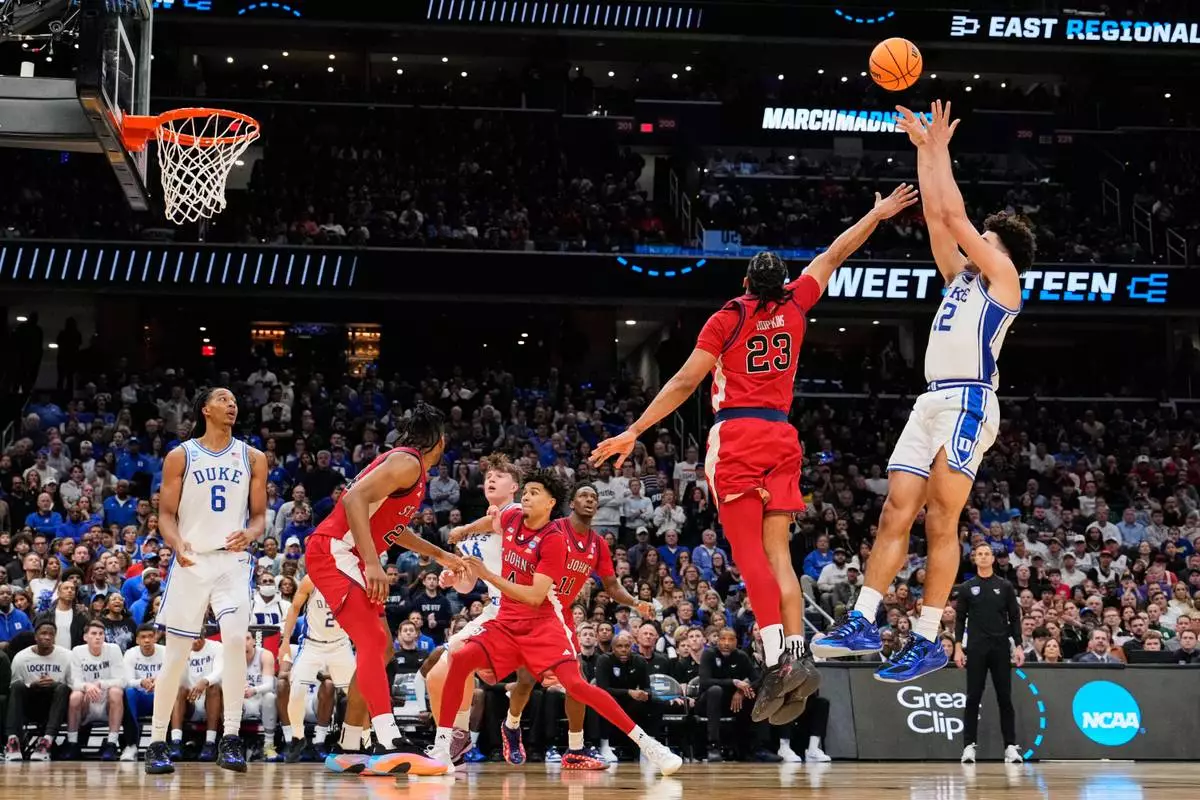
Duke forward Cameron Boozer (12) shoots over St. John's forward Bryce Hopkins (23) during the second half in the Sweet 16 of the NCAA college basketball tournament, Friday, March 27, 2026, in Washington. (AP Photo/Abbie Parr)
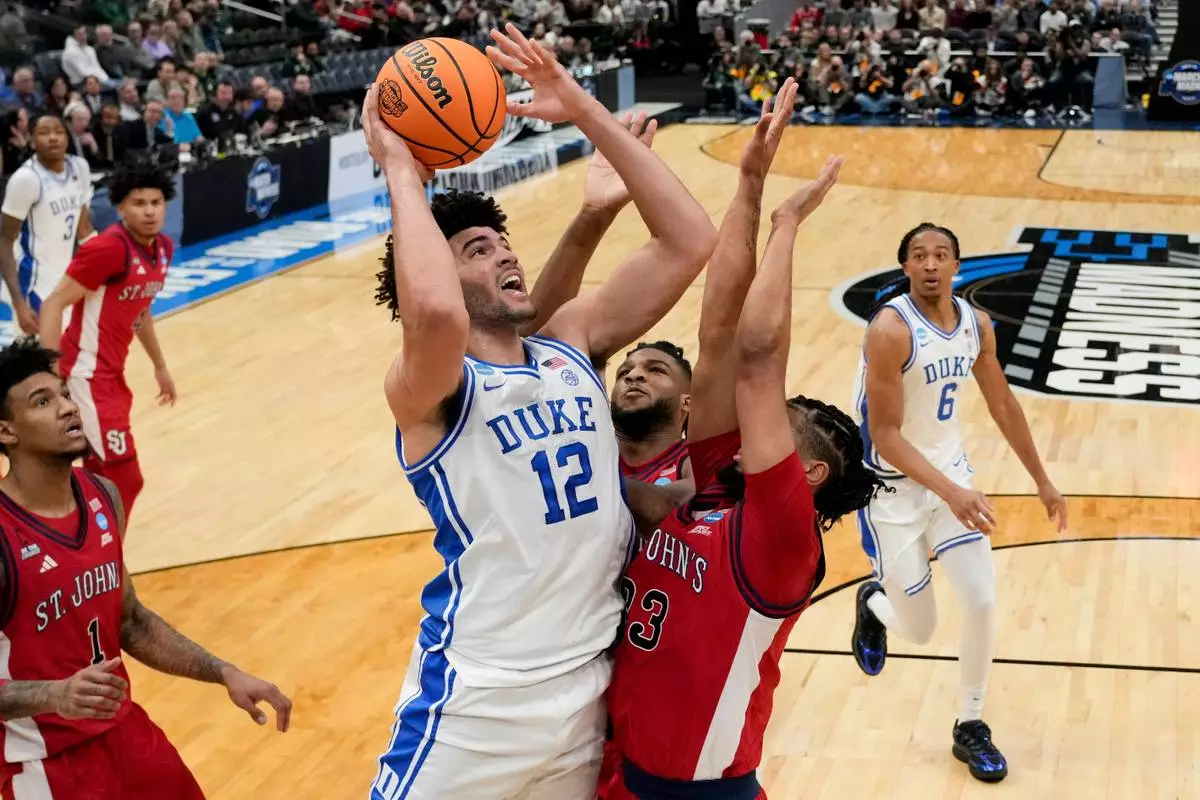
Duke forward Cameron Boozer (12) shoots over St. John's forward Bryce Hopkins (23) during the first half in the Sweet 16 of the NCAA college basketball tournament, Friday, March 27, 2026, in Washington. (AP Photo/Stephanie Scarbrough)