Disney has named its parks chief Josh D’Amaro to succeed Bob Iger as the entertainment giant's top executive.
D’Amaro is the Disney Experiences Chairman, spearheading efforts for the company’s theme parks, cruises and resorts.
Click to Gallery
The logo for The Walt Disney Company is displayed above a trading post on the floor of the New York Stock Exchange, Monday, Feb. 2, 2026. (AP Photo/Richard Drew)

Workers dock The Disney Adventure cruise ship at the Agua Clara locks of the Panama Canal in Colon, Panama, Monday, Feb. 2, 2026. (AP Photo/Matias Delacroix)

FILE - A Disney logo forms part of a menu for the Disney Plus movie and entertainment streaming service on a computer screen in Walpole, Mass, Nov. 13, 2019. AP Photo/Steven Senne, File)

FILE - Disney CEO Bob Iger arrives at the premiere of "Avengers: Endgame" at the Los Angeles Convention Center on Monday, April 22, 2019. (Photo by Jordan Strauss/Invision/AP, File)
He steps into the position at a time when Disney is flush with box-office hits like “Zootopia 2” and “Avatar: Fire and Ash” and its streaming business is strong. But the company is also dealing with a decline in foreign visitors to its domestic theme parks, with tourism to the U.S. falling during an aggressive immigration crack down by the Trump administration, as well as clashes with almost all of country's trading partners.
The decision on the next chief executive at Disney comes almost four years after the company's choice to replace Iger went badly, forcing Iger back into the job.
Only two years after stepping down as CEO, Iger returned to Disney in 2022 after a period of clashes, missteps and a weakening financial performance under his hand-picked successor, Bob Chapek.
“We wont’ have the same drama we had last time, that I can assure you,” Disney Chairman James Gorman said Tuesday in an interview on CNBC.
Disney meticulously and methodically sought out its next CEO this time. The company created a succession planning committee in 2023, but the search began in earnest in 2024 when Disney enlisted Gorman, who previously served as Morgan Stanley's executive chairman, to lead the effort. That still gave it ample opportunity to vet candidates, as Iger agreed to a contract extension.
While external candidates were considered, it was widely expected that Disney would choose an internal candidate to become its next CEO. Internal candidates were mentored by Iger, interacted with the company’s 15 board members (including Iger) and received external coaching.
Attention soon focused on D’Amaro and Disney Entertainment Co-Chairman Dana Walden as the front runners among Disney’s internal candidates.
D’Amaro, who has been with Disney since 1998, has been leading the charge on Disney’s multiyear $60 billion investment into its cruise ships, resorts and theme parks. He also oversees Walt Disney Imagineering, which is in charge of the design and development of the company’s theme parks, resorts, cruise ships, and immersive experiences worldwide. In addition, D’Amaro has been leading Disney’s licensing business, which includes its partnership with Epic Games.
In her most recent role, Walden has helped oversee Disney’s streaming business, along with its entertainment media, news and content businesses. She joined Disney in 2019. Before that, Walden spent 25 years at 21st Century Fox and was CEO of Fox Television Group.
Walden will now step into the newly created role of chief creative officer of The Walt Disney Co. She will report to D'Amaro.
There had been speculation that Disney might go the route of naming co-CEOs, a move that has started to become more popular with companies. Oracle and Spotify are among those who named co-CEOs in 2025.
D’Amaro and Walden's appointments are effective on March 18.

Disney shares rose more than 1% in early trading.
The logo for The Walt Disney Company is displayed above a trading post on the floor of the New York Stock Exchange, Monday, Feb. 2, 2026. (AP Photo/Richard Drew)
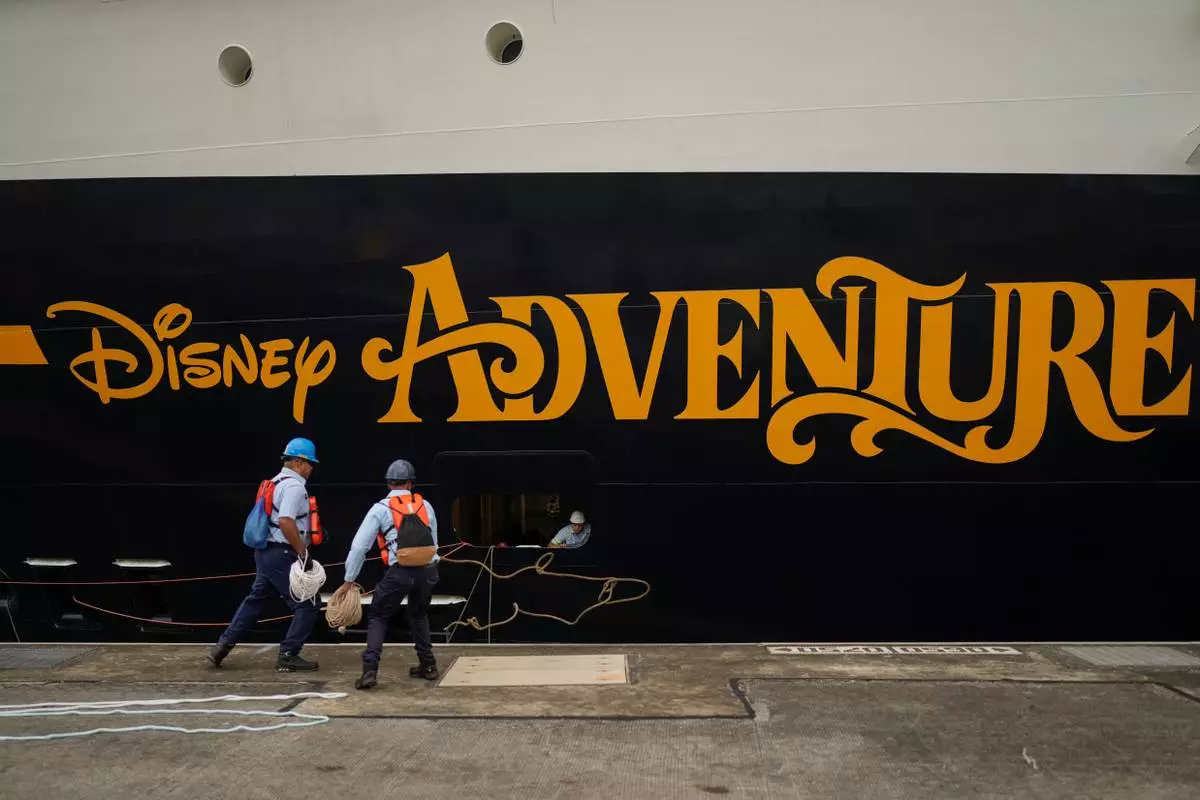
Workers dock The Disney Adventure cruise ship at the Agua Clara locks of the Panama Canal in Colon, Panama, Monday, Feb. 2, 2026. (AP Photo/Matias Delacroix)

FILE - A Disney logo forms part of a menu for the Disney Plus movie and entertainment streaming service on a computer screen in Walpole, Mass, Nov. 13, 2019. AP Photo/Steven Senne, File)

FILE - Disney CEO Bob Iger arrives at the premiere of "Avengers: Endgame" at the Los Angeles Convention Center on Monday, April 22, 2019. (Photo by Jordan Strauss/Invision/AP, File)

LOS ALERCES NATIONAL PARK, Argentina (AP) — These days, the majestic, forested slopes of Argentina’s Patagonia look like a war zone.
Mushroom clouds of smoke rise as if from missile strikes. Large flames illuminate the night sky, tainting the moon mango-orange and turning the glorious views that generations of writers and adventurers imprinted on the global psyche into something haunted.
Vast swaths of the Los Alerces National Park, a UNESCO World Heritage site home to 2,600-year-old trees, are now ablaze.
The wildfires, among the worst to hit the drought-stricken Patagonia region in decades, have devastated more than 45,000 hectares (174 square miles) of Argentina’s forests in the last month and a half, forcing the evacuation of thousands of residents and tourists. As of Monday, the inferno was still spreading.
The crisis, with most of Argentina's fire season still ahead, has reignited anger toward the country’s radical libertarian president, Javier Milei, whose harsh austerity drive in the last two years has slashed spending on programs and agencies that not only work to combat fires but also protect parks and prevent blazes from igniting and spreading in the first place.
“There has been a political decision to dismantle firefighting institutions,” said Luis Schinelli, one of 16 park rangers covering the 259,000 hectares (1,000 square miles) of Los Alerces National Park. “Teams are stretched beyond their limits.”
After coming to office on a campaign to rescue Argentina’s economy from decades of staggering debt, Milei slashed spending on the National Fire Management Service by 80% in 2024 compared to the previous year, gutting the agency responsible for deploying brigades, maintaining air tankers, purchasing extra gear and tracking hazards.
The service faces another 71% reduction in funds this year, according to an analysis of the 2026 budget by the Environment and Natural Resources Foundation, or FARN, an Argentine environmental research and advocacy group.
The retrenchment arrives at a time when climate change is making extreme weather more frequent and severe, increasing the risk of wildfires.
“Climate change is something that's undeniable. This is us living it,” said firefighter Hernán Mondino, his face smeared with sweat and soot after a backbreaking day battling blazes in Los Alerces National Park. “But we see no sign that the government is concerned about our situation.”
The Ministry of Security, which assumed oversight of firefighting efforts after Milei downgraded the Ministry of Environment, did not respond to requests for comment.
Milei’s deep spending cuts have stabilized Argentina's crisis-stricken economy and driven annual inflation down from 117% in 2024 to 31% last year — the lowest rate in eight years.
His battles against government bloat and “woke” culture have helped him cozy up to U.S. President Donald Trump, whose own war on federal bureaucracy has similarly rippled through scientific research and disaster response programs.
After Trump announced last year that the U.S. would leave the Paris climate agreement, Milei threatened to do the same. He boycotted U.N. climate summits and referred to human-caused climate change as a “socialist lie,” infuriating Argentines who understand that record-breaking heat and dryness, symptomatic of a warming planet, are fueling the fires in Patagonia.
“There's a lot of anger building up. People here are very uncomfortable with our country's politics,” said Lucas Panak, 41, who piled into a pickup truck with his friends last Thursday to fight the blazes enveloping the small town of Cholila after municipal firefighters were sent elsewhere.
When lightning started a small fire along a lake in the northern fringes of Los Alerces in early December, firefighters struggled to respond, limited by the remote location and a lack of available aircraft to transport crews and douse the hills.
The initial delay forced the resignation of the park's management and led residents to accuse them of negligence in a criminal complaint when the winds picked up and blasted the blaze through the native forest.
But some experts argue the problem wasn't inaction after the fire erupted, but long before.
“Fires are not something you only fight once they exist. They must be addressed beforehand through planning, infrastructure and forecasting,” said Andrés Nápoli, director of FARN. “All the prevention work that's so important to do year-round has essentially been abandoned.”
On top of cutting the National Fire Management Service budget, Milei's government ripped tens of millions of dollars from the National Park Administration last year, leading to the dismissal or resignation of hundreds of rangers, firefighters and administrative workers.
As more tourists descend each year on Argentina's parks, forest rangers say that cutbacks and deregulation measures make it harder to monitor fire dangers, clear trails and educate visitors on caring for the park. Last March the government scrapped a requirement for tourist activities such as glacier treks and rock climbs to be overseen by licensed guides.
“If you increase the number of visitors while cutting staff, you risk losing control,” said Alejo Fardjoume, a union representative for national park workers. “The consequences of these decisions is not always immediate, they will be noticed cumulatively, progressively.”
A 2023 National Park Administration report recommends a minimum deployment of 700 firefighters to cover the land under its purview. The agency employs 391 now, having lost 10% of staff as a result of layoffs and resignations in the last two years under Milei.
Budget cuts to the National Fire Management Service have scaled back training capacity and reduced available equipment, firefighters say, leaving many to rely on secondhand protective suits and donated gear.
Authorities at Los Alerces said that they’ve always been strapped for funds no matter the government and insisted that there were no shortages of resources to battle the blaze.
“Criticizing is always easy,” said Luciano Machado, head of the fire, communications and emergency division at the National Park Administration. “Sometimes adding aircraft doesn't make things better. And in order to add firefighters, you need more food, shelter and rotation.”
But national park firefighters pushed beyond the brink of exhaustion said their ranks are constantly thinning, if not due to layoffs then to resignations over poverty-level wages that have failed to keep pace with inflation.
The average firefighter in Patagonia's parks earns less than $600 a month. In provinces with cheaper living costs, the monthly wage drops below $450. A growing number of firefighters say they've had to pick up extra work as gardeners and farmhands.
“From the outside it looks like everything still functions, but our bodies bear the cost,” said Mondino. “When someone leaves, the rest of us carry more weight, sleep less and work longer hours.”
For a month as the forests burned, Milei said almost nothing about the fires and carried on as usual. Last week, as provincial governors pleaded with him to declare a state of emergency in order to release federal funds, he danced onstage with his ex-girlfriend to Argentine rock ballads.
The split-screen image supplied his critics with powerful political ammunition. “While Patagonia burns, the president is having fun singing,” said centrist lawmaker Maximiliano Ferraro. Left-leaning opposition parties staged protests across provinces.
On Thursday Milei relented, decreeing a state of emergency that unlocked $70,000 for volunteer firefighters and announcing “a historic fight against fire” on social media.
At a base camp this weekend, volunteer medics scurried around bleary-eyed firefighters, tending to scratchy throats, sore legs and irritated sinuses. Some expressed hope that more relief was on the way. Others dismissed the decree as symbolic. All, looking over the smoldering trees that take human generations to regenerate, couldn’t help but dwell on what had already been lost.
“It hurts because it's not just a beautiful landscape, it's where we live,” said Mariana Rivas, one of the volunteers. “There's anger about what could have been avoided, and anger because every year it gets worse.”
Follow AP’s coverage of Latin America and the Caribbean at https://apnews.com/hub/latin-america
Firefighters relax by Futalaufquen Lake after battling wildfires in Los Alerces National Park, Argentina, Saturday, Jan. 31, 2026. (AP Photo/Victor R. Caivano)
Firefighters battle wildfires in Los Alerces National Park, Argentina, Saturday, Jan. 31, 2026. (AP Photo/Victor R. Caivano)
Wildfires burn in Los Alerces National Park in Argentina, Saturday, Jan. 31, 2026. (AP Photo/Victor R. Caivano)
Volunteers massage firefighters resting after battling wildfires in Los Alerces National Park, Argentina, Saturday, Jan. 31, 2026. (AP Photo/Victor R. Caivano)
Firefighters battle wildfires in Los Alerces National Park, Argentina, Saturday, Jan. 31, 2026. (AP Photo/Victor R. Caivano)