As Infobip celebrates 20 years of customer communication innovation, the AI-first company envisions the future of agentic AI
KUALA LUMPUR, Malaysia, Feb. 4, 2026 /PRNewswire/ -- Global AI-first cloud communications platform Infobip, celebrating two decades of innovation, predicts an imminent and seismic shift in brand-consumer engagement. Moving away from the current application-to-person (A2P) messaging, Infobip forecasts a widespread shift to an agent-to-person model, eventually leading to a fully autonomous agent-to-agent future by 2030.
The Evolution of Engagement
Swift AI adoption is driving enterprises toward agentic AI communication models, which drive autonomous customer communications across all touchpoints. This technology enables hyper-personalization across multiple channels, creating highly engaging content tailored to individual needs.
Silvio Kutić, Infobip CEO, comments: "How we communicate with brands is constantly evolving. In this new agentic AI world, brands must seize the opportunity to take a holistic approach to communication. They must capitalize on the hyper-personalization made available through agentic AI and rich communication channels like RCS and WhatsApp."
The Agent-to-Agent Future
Looking ahead to 2030, Infobip envisions personal AI assistants embedded in smartphones handling complex tasks independently. For example, a user's personal AI could autonomously negotiate with a travel company's AI to research, book, and purchase a holiday based on the user's digital habits and preferences.
The Challenge for Brands
To succeed in this new landscape, businesses must eliminate data silos. Effective AI agents require a unified view of customer touchpoints – from marketing to support – to deliver the personalized experience consumers will become accustomed to. Currently, business readiness is low, with only about 5% of enterprise AI agent projects reaching production due to unstructured data and internal barriers.
"Enterprises must act now," Kutić emphasizes. "Organizational structures that facilitate seamless data sharing will be the key to successful AI agent adoption. While a personal AI agent booking a holiday might seem futuristic today, brands unable to meet this future will risk losing their competitive edge."
Find out more about 20 years of Infobip: https://www.infobip.com/20-years-anniversary
ENDS
About Infobip
Infobip is a global cloud communications platform that enables businesses to build connected experiences across all stages of the customer journey, with AI as the driving force of innovation. Through a single, natively built platform, Infobip delivers omnichannel engagement, identity, user authentication and contact centre solutions that help businesses and partners overcome the complexity of consumer communications while driving growth and increasing customer loyalty. Infobip is focused on enabling and accelerating AI adoption as it continues its transformation into an AI-first company. Infobip's technology has the capacity to reach over seven billion mobile devices in 6 continents connected to over 10k+ connections of which 800+ are direct operator connections. The company was established in 2006 and is led by its co-founders, CEO Silvio Kutić and Izabel Jelenić.
** The press release content is from PR Newswire. Bastille Post is not involved in its creation. **
Hyper-personalization at scale: why brands must shift to an Agentic AI strategy
HANGZHOU, China, April 3, 2026 /PRNewswire/ -- A team led by principal investigators Bobo Dang and Ting Zhou at Westlake University/Westlake Laboratory reported in Science a high-throughput platform for engineering fast-acting covalent protein therapeutics. Their work, titled "A high-throughput selection system for fast-acting covalent protein drugs," opens new avenues for next-generation biologics.
Covalent small-molecule drugs have shown great success in cancer therapy by forming irreversible bonds with their targets. This has inspired efforts to extend covalent strategies to protein therapeutics, especially engineered miniproteins. However, their development is limited by a kinetic mismatch: Miniproteins are rapidly cleared in vivo, whereas covalent bond formation is typically slow. In addition, high-throughput platforms for systematically optimizing covalent protein reactivity have been lacking.
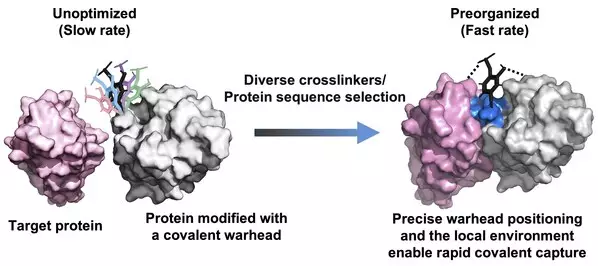
To address this challenge, the researchers proposed that precise spatial positioning of chemical warheads within protein scaffolds could enable molecular preorganization, thereby accelerating covalent bond formation without increasing intrinsic reactivity (Fig. 1).
Based on this concept, the team developed a high-throughput platform that combines yeast surface display with chemoselective protein modification to screen diverse crosslinkers and millions of protein variants. By optimizing warhead placement and the local chemical environment, the platform enables rapid and irreversible target engagement.
Using this platform, the researchers developed a covalent antagonist targeting PD-L1, termed IB101. Structural analysis revealed that IB101 forms a defined binding pocket that precisely positions the warhead in a reactive conformation, greatly accelerating covalent bond formation. Functionally, IB101 effectively blocks the PD-1/PD-L1 immune checkpoint pathway and demonstrates strong antitumor activity in mouse models. Notably, despite its short in vivo half-life, IB101 achieves durable target engagement and tumor suppression, outperforming conventional antibody-based therapies under comparable conditions.
The platform was further applied to cytokine engineering, leading to the development of a covalent IL-18 variant, IB201. This engineered cytokine rapidly forms a covalent interaction with its receptor, enhancing signaling strength and duration. In vivo studies showed that IB201 induces potent antitumor immune responses without detectable systemic toxicity. These results highlight the potential of covalent engineering to improve the efficacy and safety of cytokine-based therapies.
Beyond immunotherapy targets, the platform was also applied to develop a covalent inhibitor targeting the receptor-binding domain (RBD) of SARS-CoV-2. This molecule achieves durable viral neutralization, demonstrating the versatility of the approach across different therapeutic modalities.
This study establishes a general strategy for engineering fast-acting covalent protein therapeutics. By enabling covalent bond formation on timescales compatible with rapid in vivo clearance, the platform overcomes a fundamental limitation in the field.
These findings provide a new framework for designing biologics with both rapid kinetics and sustained target engagement, with broad implications for cancer immunotherapy, antiviral therapy, and beyond.
Media Contact:
Chi Zhang
media@westlake.edu.cn
+86-15659837873
** This press release is distributed by PR Newswire through automated distribution system, for which the client assumes full responsibility. **
Fast-Acting Covalent Protein Drugs From a New High-Throughput Platform