COLORADO SPRINGS, Colo.--(BUSINESS WIRE)--Feb 4, 2026--
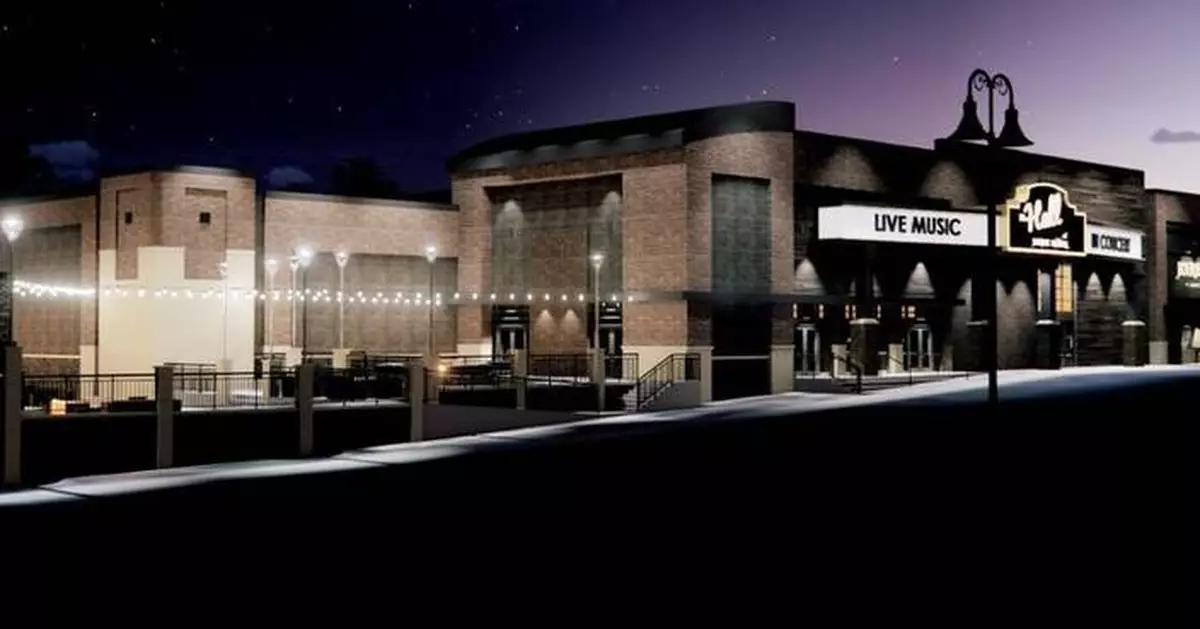
Venu Holding Corporation (“VENU” or the “Company”) (NYSE American: VENU) today announced the successful closing of its $13 million acquisition of a property in Centennial, Colorado, where the Company will develop its first indoor venue to feature Luxe FireSuites. The acquisition marks continued execution of the Company’s strategic expansion across high-demand markets.
This press release features multimedia. View the full release here: https://www.businesswire.com/news/home/20260203259378/en/
VENU plans to complete the entitlement process over the next 180 days and commence construction immediately upon permit issuance. The Centennial venue will bring the company’s proven premium hospitality model, which has driven strong sales and sponsorship revenue at Ford Amphitheater in Colorado Springs, into an indoor format for the very first time.
“Centennial represents a new chapter for VENU,” said JW Roth, Founder, Chairman, and CEO of VENU. “Our FireSuites create a live entertainment experience people can’t get anywhere else, and now we’re bringing that concept to the Denver market year-round. FireSuites are on pace to sell out in the next 75 days, validating both the concept and the market and providing an important source of project financing that reduces our need for capital.”
Development Pipeline Advancing on Multiple Fronts
The Centennial closing comes as VENU continues executing across its broader development portfolio. In Broken Arrow, Oklahoma, construction continues full steam ahead and on schedule. VENU is actively engaged in booking programming and expects to start announcing shows in the next 90 days, a key milestone that will provide visibility into the venue’s inaugural season revenue potential. VENU’s 20,000-seat multi-seasonal amphitheater in McKinney, Texas continues on pace, further extending the Company’s footprint into major metropolitan markets.
“We’re firing on all cylinders,” Roth added. “Centennial is closed, Broken Arrow and McKinney are rising out of the ground, and we’re about to start announcing the artists who will be playing our stages and our key sponsors that will help see these projects through to the finish line. This is what execution looks like.”
About Venu Holding Corporation
Venu Holding Corporation (“VENU”) (NYSE American: VENU) is a premier owner, developer, and operator of luxury, experience-driven entertainment destinations. Founded by Colorado Springs entrepreneur J.W. Roth, VENU has a portfolio of premium brands that includes Ford Amphitheater, Sunset Amphitheaters, Phil Long Music Hall, The Hall at Bourbon Brothers, Bourbon Brothers Smokehouse and Tavern, Aikman Owners Clubs, and Roth’s Sea & Steak. With venues operating and in development across Colorado, Georgia, Oklahoma, and Texas and a nationwide expansion underway, VENU is setting a new standard for live entertainment.
VENU has been recognized nationally by The Wall Street Journal, The New York Times, Billboard, VenuesNow, and Variety for its innovative and disruptive approach to live entertainment. Through strategic partnerships with industry leaders such as AEG Presents, Live Nation, NFL Hall of Famer and Founder of EIGHT Elite Light Beer, Troy Aikman, Aramark Sports + Entertainment, Tixr, Boston Common Golf, Niall Horan, and Dierks Bentley, VENU continues to shape the future of the entertainment landscape. For more information, visit VENU’s website, Instagram, LinkedIn, or X.
Forward Looking Statements
This press release contains “forward-looking statements” that are subject to substantial risks and uncertainties. All statements, other than statements of historical fact, contained in this press release are forward-looking statements. Forward-looking statements contained in this press release may be identified by the use of words such as “anticipate,” “believe,” “contemplate,” “could,” “estimate,” “expect,” “intend,” “seek,” “may,” “might,” “plan,” “potential,” “predict,” “project,” “target,” “aim,” “should,” “will” “would,” or the negative of these words or other similar expressions, although not all forward-looking statements contain these words. Forward-looking statements are based on the Company’s current expectations and are subject to inherent uncertainties, risks and assumptions that are difficult to predict. Further, certain forward-looking statements are based on assumptions as to future events that may not prove to be accurate. These and other risks and uncertainties are described more fully in the sections titled “Risk Factors” in the Company’s Annual Report on Form 10-K for the year ended December 31, 2024, on file with the SEC, as well as in reports subsequently filed by the Company with the SEC. Forward-looking statements contained in this announcement are made as of this date, and the Company undertakes no duty to update such information except as required under applicable law.
VENU's The Hall at Centennial [rendering]

WASHINGTON (AP) — President Donald Trump's administration is expected to unveil its grandest plan yet to rebuild supply chains of critical minerals needed for everything from jet engines to smartphones, likely through purchase agreements with partners on top of creating a $12 billion U.S. strategic reserve to help counter China's dominance.
Vice President JD Vance is set to deliver a keynote address Wednesday at a meeting that Secretary of State Marco Rubio is hosting with officials from several dozen European, Asian and African nations. The U.S. is expected to sign deals on supply chain logistics, though details have not been revealed. Rubio met Tuesday with foreign ministers from South Korea and India to discuss critical minerals mining and processing.
The meeting and expected agreements will come just two days after Trump announced Project Vault, or a stockpile of critical minerals to be funded with a $10 billion loan from the U.S. Export-Import Bank and nearly $1.67 billion in private capital.
Trump's Republican administration is making such bold moves after China, which controls 70% of the world’s rare earths mining and 90% of the processing, choked off the flow of the elements in response to Trump’s tariff war. The two superpowers are in a one-year truce after Trump and Chinese President Xi Jinping met in October and agreed to pull back on high tariffs and stepped-up rare earth restrictions.
But China’s limits remain tighter than they were before Trump took office.
“We don’t want to ever go through what we went through a year ago,” Trump said on Monday when announcing Project Vault.
Other countries might join with the Trump administration in buying up critical minerals and taking other steps to spur industry development because the trade war revealed how vulnerable Western countries are to China, said Pini Althaus, who founded Oklahoma rare earth miner USA Rare Earth in 2019.
“They’re looking at setting up sort of a buyers’ club, if you will,” said Althaus, who now is working to develop new mines in Kazakhstan and Uzbekistan as CEO of Cove Capital. “The key producers and key consumers of critical minerals will sort of get together and work on pricing structures, floor pricing and other things.”
The government last week also made its fourth direct investment in an American critical minerals producer when it extended $1.6 billion to USA Rare Earth in exchange for stock and a repayment agreement.
Seeking government funding these days is like meeting with private equity investors because officials are scrutinizing companies to ensure anyone they invest in can deliver, Althaus said. And the government is demanding terms designed to generate a return for taxpayers as loans are repaid and stock prices increase, he said.
Meanwhile, the U.S. Export-Import Bank's board this week approved the $10 billion loan — the largest in its history — to help finance the setup of the U.S. Strategic Critical Minerals Reserve. It is tasked with ensuring access to critical minerals and related products for manufacturers, including battery maker Clarios, energy equipment manufacturer GE Vernova, digital storage company Western Digital and aerospace giant Boeing, according to the policy bank.
Bank President and Chairman John Jovanovic told CNBC that the project creates a public-private partnership formula that “is uniquely suited and puts America's best foot forward.”
"What it does is it creates a scenario where there are no free riders. Everybody pitches in to solve this huge problem,” he said.
Manufacturers, which benefit the most from the reserve, are making a long-term financial commitment, Jovanovic said, while the government loan spurs private investments.
The stockpile strategy may help spark a “more organic” pricing model that excludes China, which has used its dominance to flood the market with lower-priced products to squeeze out competitors, said Wade Senti, president of the U.S. permanent magnet company AML.
The Trump administration also has injected public money directly into the sector. The Pentagon has shelled out nearly $5 billion over the past year to help ensure its access to the materials after the trade war laid bare just how beholden the U.S. is to China.
A bipartisan group of lawmakers last month proposed creating a new agency with $2.5 billion to spur production of rare earths and the other critical minerals. The lawmakers applauded the steps by the Trump administration.
“It’s a clear sign that there is bipartisan support for securing a robust domestic supply of critical minerals that both reduces our reliance on China and stabilizes the market,” Sens. Jeanne Shaheen, D-N.H., and Todd Young, R-Ind., said in a joint statement Tuesday.
Building up a stockpile will help American companies weather future rare earth supply disruptions, but that will likely be a long-term effort because the materials are still scarce right now with China's restrictions, said David Abraham, a rare earths expert who has followed the industry for decades and wrote the book “The Elements of Power.”
The Trump administration has focused on reinvigorating critical minerals production, but Abraham said it's also important to encourage development of manufacturing that will use them. He noted that Trump’s decisions to cut incentives for electric vehicles and wind turbines have undercut demand for these elements in America.
Secretary of State Marco Rubio, right, meets with South Korea's Foreign Minister Cho Hyun at the State Department in Washington, Tuesday, Feb. 3, 2026. (AP Photo/Nathan Howard)
Secretary of State Marco Rubio, right, shakes hands with India's External Affairs Minister Subrahmanyam Jaishankar at the State Department in Washington, Tuesday, Feb. 3, 2026. (AP Photo/Nathan Howard)