BORMIO, Italy (AP) — American skier Ryan Cochran-Siegle was fastest in the opening downhill training session of the Milan Cortina Games on Wednesday but another racer had to be airlifted off the fearsome Stelvio slope.
Cochran-Siegle was 0.16 seconds faster than the young Italian Giovanni Franzoni, who is having a fantastic season, and 0.40 ahead of Swiss standout Marco Odermatt.
Click to Gallery
Italy's Giovanni Franzoni at the finish area, during the alpine ski, men's downhill first official training, at the 2026 Winter Olympics, in Bormio, Italy, Wednesday, Feb. 4, 2026. (AP Photo/Pier Marco Tacca)
Switzerland's Marco Odermatt at the finish area, during the alpine ski, men's downhill first official training, at the 2026 Winter Olympics, in Bormio, Italy, Wednesday, Feb. 4, 2026. (AP Photo/Pier Marco Tacca)
United States' Ryan Cochran Siegle at the finish area, during the alpine ski, men's downhill first official training, at the 2026 Winter Olympics, in Bormio, Italy, Wednesday, Feb. 4, 2026. (AP Photo/Pier Marco Tacca)
United States' Ryan Cochran Siegle at the finish area, during the alpine ski, men's downhill first official training, at the 2026 Winter Olympics, in Bormio, Italy, Wednesday, Feb. 4, 2026. (AP Photo/Pier Marco Tacca)
Times and placings, however, are all but irrelevant in downhill training. Especially as Wednesday’s session was the first of three ahead of Saturday’s race.
But the way Cochran-Siegle tackled what is probably one of the toughest Olympic slopes of the past 30 years will serve as a confidence boost.
It is Cochran-Siegle’s third Winter Olympics. He won silver at the Beijing Games four years ago, claiming the first Olympic Alpine medal for a U.S. man since 2014.
His mother, Barbara Ann Cochran, was the slalom champion at the 1972 Sapporo Games.
Unrelenting, knee-rattling, complicated by shaded sections and producing speeds touching 140 kph (87 mph), the Stelvio is a notoriously unforgiving track.
It is one of the most physically demanding on the circuit, at almost 3,230 meters long with a 986-meter vertical drop and a maximum gradient of 63%.
With every mistake punished on that slope, Fredrik Møller of Norway had to be taken by helicopter to the hospital after crashing about halfway down as he perhaps rushed the start of a turn and ended up sliding down the slope on his back.
Møller, who has only just returned after breaking three vertebrae in December, swiftly got to his feet but the Norwegian team announced later that he dislocated his left shoulder. The 25-year-old was taken by helicopter to the hospital in nearby Sondrio, at the bottom of the valley.
“The treatment went well, and the medical team will now begin further rehabilitation. Møller did not suffer any other injuries in the crash,” the Norwegian team said.
Bormio is a regular stop on the men’s World Cup circuit. The last time it was raced — in December 2024 — two skiers had to be airlifted to the hospital.
One of those, French standout Cyprien Sarrazin, had to have urgent brain surgery and has not returned to competition.
AP Winter Olympics: https://apnews.com/hub/milan-cortina-2026-winter-olympics

Italy's Giovanni Franzoni at the finish area, during the alpine ski, men's downhill first official training, at the 2026 Winter Olympics, in Bormio, Italy, Wednesday, Feb. 4, 2026. (AP Photo/Pier Marco Tacca)

Switzerland's Marco Odermatt at the finish area, during the alpine ski, men's downhill first official training, at the 2026 Winter Olympics, in Bormio, Italy, Wednesday, Feb. 4, 2026. (AP Photo/Pier Marco Tacca)
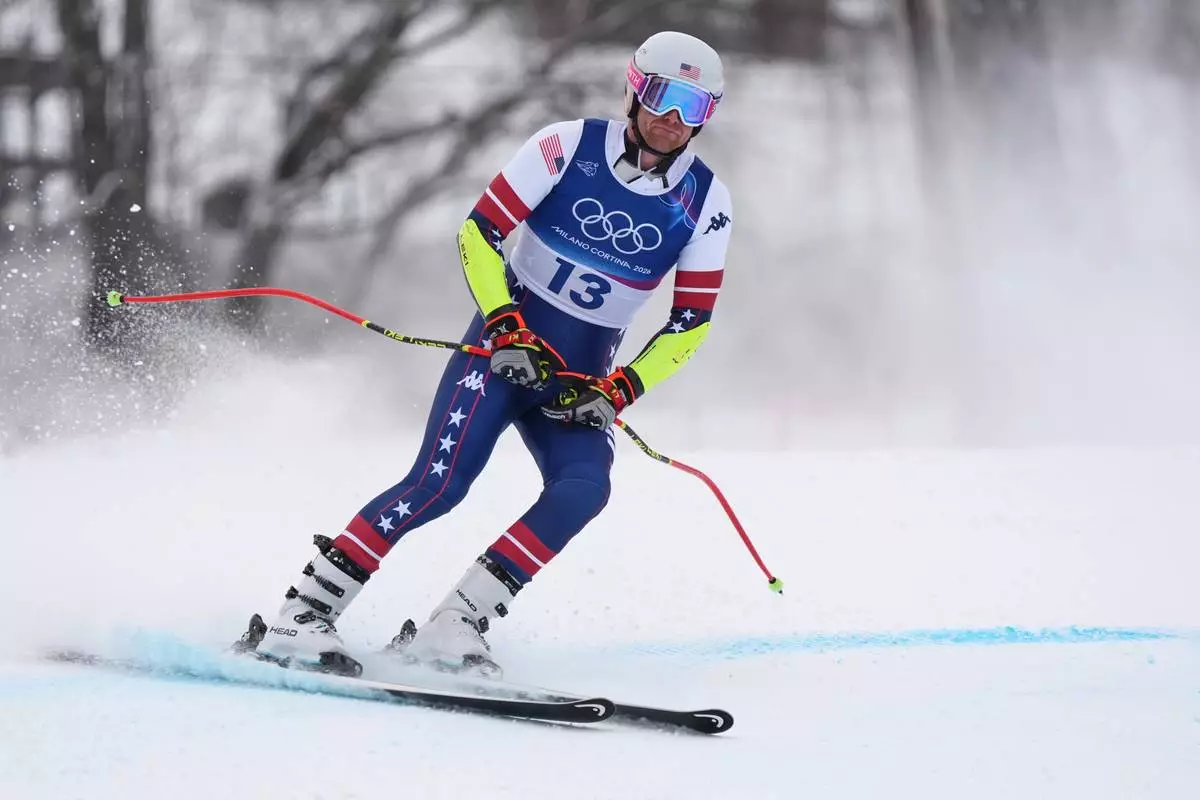
United States' Ryan Cochran Siegle at the finish area, during the alpine ski, men's downhill first official training, at the 2026 Winter Olympics, in Bormio, Italy, Wednesday, Feb. 4, 2026. (AP Photo/Pier Marco Tacca)

United States' Ryan Cochran Siegle at the finish area, during the alpine ski, men's downhill first official training, at the 2026 Winter Olympics, in Bormio, Italy, Wednesday, Feb. 4, 2026. (AP Photo/Pier Marco Tacca)
ATLANTA (AP) — The Georgia General Assembly ended its annual session early Friday without a plan for new equipment to overhaul the state's voting system by a July deadline, plunging into doubt the future of elections in the political battleground.
The lawmakers' failure to offer a solution after months of debate raises uncertainty about how Georgians will vote in November and leaves confusion that could end in the courts or a special legislative session.
“They’ve abdicated their responsibility,” Democratic state Rep. Saira Draper said of inaction by Republicans who control the legislature.
Currently, voters make their choices on Dominion Voting machines, which then print ballots with a QR code that scanners read to tally votes. Those machines have been repeatedly targeted by President Donald Trump following his 2020 election loss, and Trump’s Georgia supporters responded by enacting a law in 2024 that bans using barcodes to count votes.
But state law still requires counties to use the machines. No money has been allocated to reprogram them, and lawmakers failed to agree on a replacement.
“We’ll have an unresolvable statutory conflict come July 1,” said House Governmental Affairs Committee Chairman Victor Anderson, a Cornelia Republican who backed a proposal to keep using the machines in 2026 that Senate Republicans declined to consider.
House Republicans and Democrats backed Anderson's plan, which would have required that Georgia choose a voting process that didn't use QR codes by 2028. Election officials preferred that solution.
“The Senate has shown that they’re not responsible actors,” Draper said. She added that Lt. Gov. Burt Jones, a Trump-endorsed Republican running for governor, seemed more interested in keeping Trump's backing than “doing right by Georgia voters.”
A spokesperson for Jones didn't immediately respond to a request for comment early Friday.
Joseph Kirk, Bartow County election supervisor and president of the Georgia Association of Voter Registration and Election Officials, said he’ll look to the secretary of state for guidance and assumes a judge will rule to instruct election officials how to proceed.
“This is uncharted territory,” he said.
Robert Sinners, a spokesperson for Republican Secretary of State Brad Raffensperger, who is also running for governor, said officials are “ready to follow the law and follow the Constitution.”
Republican House Speaker Jon Burns told reporters that his chamber was seeking to minimize changes this year.
“You can’t change horses in the middle of the stream,” Burns said.
Burns said he would meet with Gov. Brian Kemp and “take his temperature" on the possibility of a special session. A spokesperson for Kemp didn't answer questions about what the outgoing Republican governor would do.
Anderson said without action, the state could be required to use hand-marked and hand-counted paper ballots in November.
Election officials say switching to a new system within just a few months, as advocated by some Republicans, would be nearly impossible.
“They made no way for this to happen except putting a deadline on it," Cherokee County elections director Anne Dover said of the switch away from barcodes. Dover said one problem under some plans is that a very large number of ballots would have to be printed.
Lawmakers seemed more concerned about scoring political points than making practical plans, Paulding County Election Supervisor Deidre Holden said.
“If anyone is resilient and can get the job done, it’s all of us election officials, but the legislators need to work with us, and they need to understand what we do before they go making laws that are basically unachievable for us,” Holden said.
Supporters of hand-marked paper ballots say voters are more likely to trust in an accurate count if they can see what gets read by the scanner.
Right-wing election activists lobbied lawmakers for an immediate switch to hand-marked paper ballots, but the House turned away from a Senate proposal to do so.
Anderson said he wasn’t sure if a special session could escape those political crosswinds, but said Georgia lawmakers must fix the problem.
“This is a legislative problem,” Anderson said. “It’s a legislative solution that has to happen.”
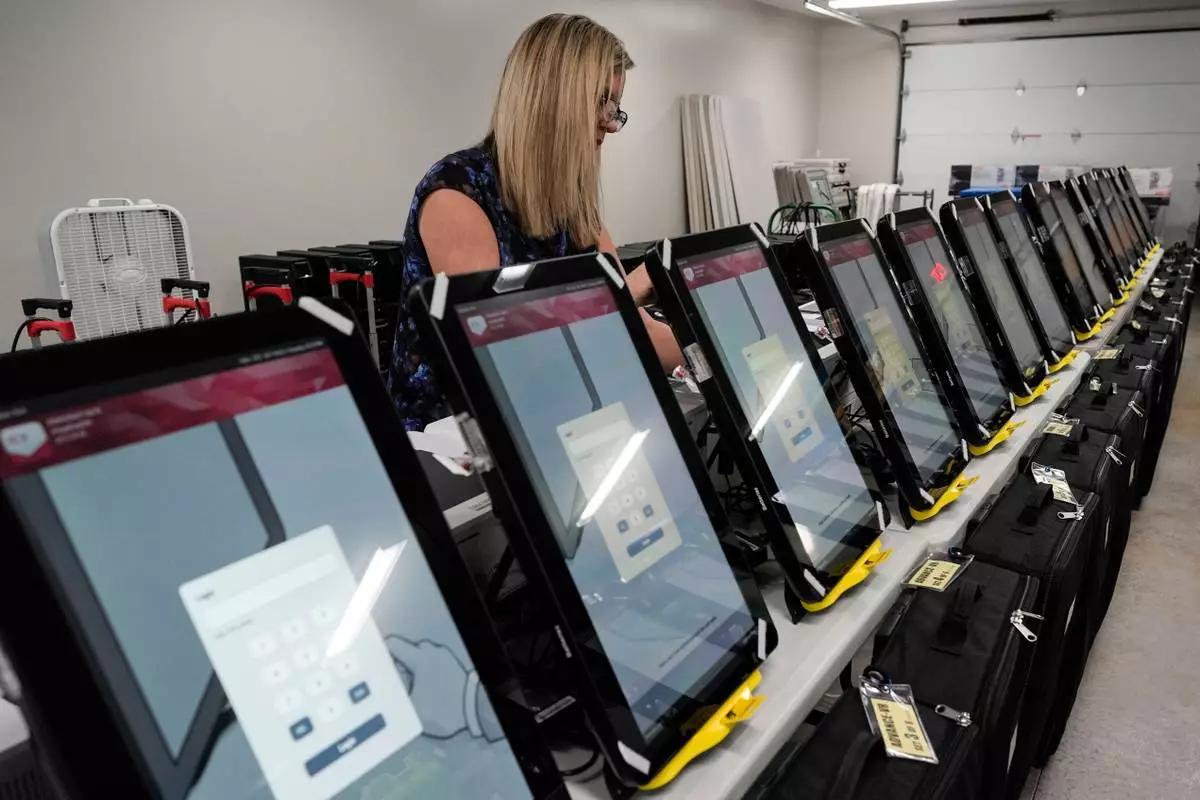
FILE - Voting machines are seen at the Bartow County Election office, Jan. 25, 2024, in Cartersville, Ga. (AP Photo/Mike Stewart, File)