Skip to Content Facebook Feature Image

Annika Malacinski's emotional fight for women's inclusion in Nordic combined

Sport

Annika Malacinski's emotional fight for women's inclusion in Nordic combined
Sport

Sport

Annika Malacinski's emotional fight for women's inclusion in Nordic combined

2026-02-05 18:28 Last Updated At:18:37

MILAN, Italy (AP) — Annika Malacinski remembers the moment the door to the Milan Cortina Winter Olympics was slammed shut.

On a flight from Munich to Denver, she bought airplane Wi-Fi to join a conference call with the International Olympic Committee, certain that Nordic combined competition would at last be opened up to female athletes.

“Then the decision came: ‘no.’ No explanation, no discussion. Just ‘no,’ and then they moved on to the next topic,” she told The Associated Press from her training base in Norway. “I cried for eight hours straight on that flight. When I arrived in Denver, my eyes were swollen shut. It felt like my world had crashed.”

That was in June, 2022. And despite an ongoing campaign led by Malacinski, an athlete from Colorado now aged 24, her sport remains the last to exclude women – even as Milan Cortina is showcasing the highest level of female participation in Winter Games history at 47%.

Malacinski is a frequent top-10 finisher at elite competitions in the sport that combines ski jumping and cross-country skiing and demands rigorous year-round training.

Her younger brother, Niklas, will compete in the men’s event for the United States and she plans to travel to northern Italy to cheer him on.

“It’s bittersweet. I know how hard he works, and he absolutely deserves it,” Malacinski said. “I do the same sport as him. I jump the same ski jumps and ski the same courses. The only difference is that I’m a woman.”

Female skiers racing in Seefeld, Austria, last weekend protested the exclusion by raising their poles overhead to form an X.

Men have competed in the Nordic combined since the first Winter Games more than a century ago, at Chamonix, France in 1924.

The sport is now at risk of being removed from the program at the next Winter Olympics in 2030. The IOC says Nordic combined has struggled to attract participation from enough countries and draws a limited television audience.

Women were excluded entirely from the first modern Olympics in 1896. When they were allowed to compete in Paris four years later, participation was limited to a handful of sports, including tennis, archery and croquet.

Track and field opened to women only in 1928, at the Amsterdam Games – but restrictions were imposed around beliefs of female fragility. Although the 800 meters was originally included, it was later withdrawn for more than three decades.

The first women’s Olympic marathon did not take place until 1984 in Los Angeles – 88 years after the race inspired by an ancient Greek battle debuted.

Nearly all differences have since been eliminated, though some disparities remain. At the Summer Olympics, women compete in the seven-event heptathlon, while men contest the 10-event decathlon.

At the Winter Games, progress arrived even later. Ski jumping was off-limits to women as recently as the 2010 Vancouver Olympics and was introduced four years later at Sochi.

Cross-country skiing’s distance overhaul is the most recent and sweeping change. At Milan Cortina, men and women will race the same distances across all events for the first time in Olympic history.

Previously, the longest women’s race topped out at 30 kilometers, compared with 50 for men. Both will now have 50-kilometer mass start races — like at Nordic Ski World Championships last year.

Malacinski says she will continue her campaign for inclusion, now focused on 2030 Winter Games in the French Alps.

“I’m a very gritty person,” she said. “If I put my mind to something, I know I can do it.”

AP Winter Olympics: https://apnews.com/hub/milan-cortina-2026-winter-olympics
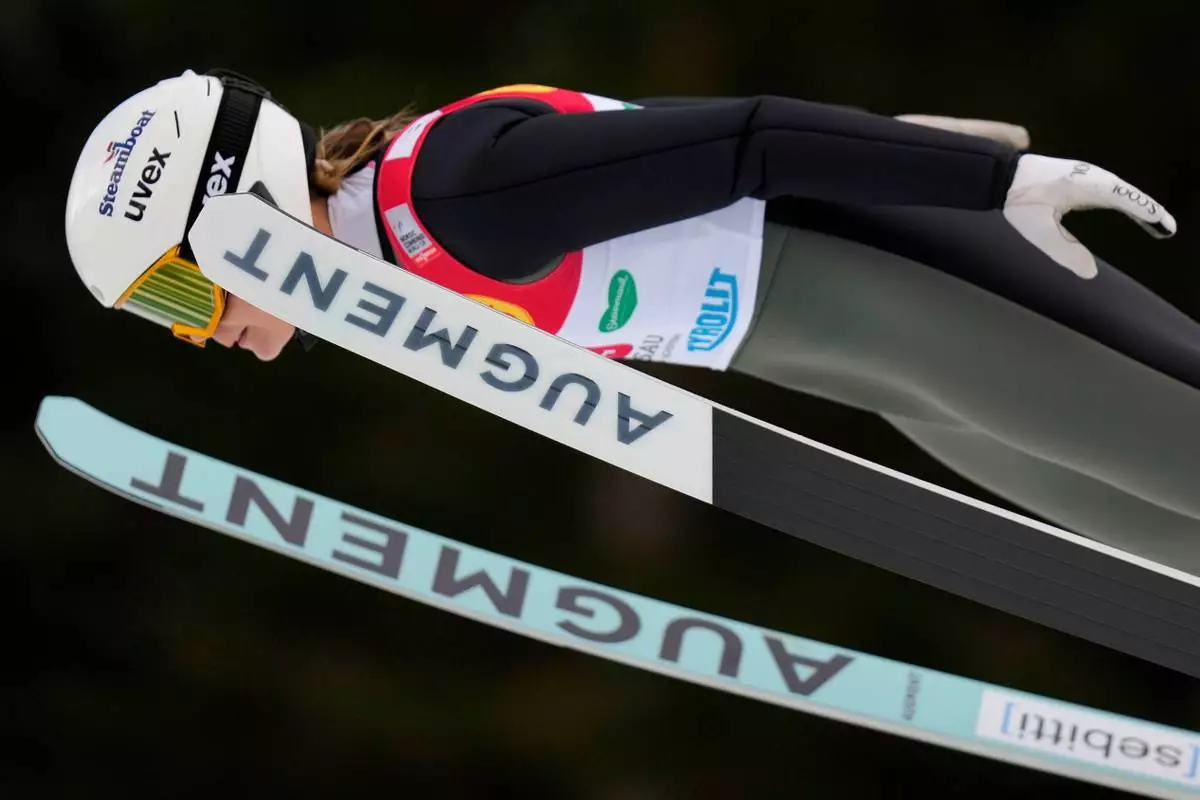
FILE - Annika Malacinski of the United States soars through the air during the women's individual compact NH 5km competition at the Nordic Combined World Cup in Ramsau, Austria, Saturday, Dec.16, 2023. (AP Photo/Matthias Schrader, File)


FILE - Annika Malacinski of the United States soars through the air during the women's individual compact NH 5km competition at the Nordic Combined World Cup in Ramsau, Austria, Saturday, Dec.16, 2023. (AP Photo/Matthias Schrader, File)
From the coffee shops and bars to the local grocery stores, the neighbors know all about Mike Eruzione, Buzz Schneider and John Harrington for their roles in one of the greatest upsets in the history of sports.

They are long since retired, now more focused on their golf games than their legacies. But with the Americans among the favorites to win gold for the first time since 1980, they and their teammates know they will the subject of beloved remembrances across the country even if the young men on the ice know more about the “Miracle on Ice” from a movie than real life.

“It’s been a great run,” Eruzione said. “And it’s going to continue.”

Eruzione and other members of the gold-medal-winning 1980 U.S. Olympic team recently received Congressional Gold Medals, and their legend only grows with time. They are in their 60s and 70s now, long removed from beating the Soviet Union and then gold in Lake Placid, New York, 46 years ago and yet their names are still spoken with reverence because the accomplishment in the middle of the Cold War transcended hockey.

“What’s amazing to me is we still carry this aura,” Rob McClanahan said. “It blows me away what continues to exist."

When Eruzione, McClanahan and the other surviving players get together at an event, a wedding or when their group chat lights up, the conversation is rarely, if ever, about the tournament that made them famous.

“We talk about whose golf game sucks, who’s a sandbagger, who’s fat, who s bald, who’s divorced: stupid, immature stuff,” Eruzione said. “Forty-five years seems like a long time ago, but when we’re together, sometimes it seems like it was yesterday.”

Bill Baker was 23 when he scored the tying goal against against Sweden. Eruzione was 25 when he scored the go-ahead goal against the heavily favored Soviets. McClanahan had turned 22 five weeks before scoring the game-winner against Finland that sealed gold.

In some ways, they are still kids.

“Everybody dumps on everybody, just like you were back 45 years ago: Nothing’s really changed, and everybody’s pretty much the same guy,” said Schneider, the oldest of the bunch, born a month before Eruzione. “Locker room banter is what it is. And it’s great fraternity."

Schneider recalled Jack O'Callahan once saying that no one else really knew what the players on that team went through, and that shared experience is a bond that still connects them. Decades later, numerous players unprompted share the same recollection about when they realized winning was a point of national pride.

That was a visit to the White House to see President Jimmy Carter.

“There’s 3,000 people waiting in the airport,” O'Callahan said in a video interview promoting the new documentary, “Miracle: The Boys of ’80" produced by Netlfix. “We fly to D.C., people have pulled off the highway as the buses are coming into the district — thousands. We get into the district, it’s mayhem, a madhouse, media, people, hanging Russians in effigy. Crazy, right?”

Each February in the years that followed, O'Callahan's phone would ring as the anniversary approached. He and some of his teammates played in the NHL, while others moved on to jobs outside hockey.

“It was always kind of in the background,” O'Callahan said. “People would talk about it. Even when I was playing in Chicago and New Jersey, people would talk to me as much about that as anything.”

Nearly a quarter-century after the flag-waving celebration and Al Michaels' iconic call, “Do you believe in Miracles? Yes!” came a cinematic rebirth. Disney released the feature film “Miracle” in 2004, with Kurt Russell starring as the late coach Herb Brooks.

“The movie resurrected Mike Eruzione’s career as a speaker," McClanahan said. “The movie does a great service to what we did. I think it made Herb look a little softer than he was in reality, but the message is great.”

Schneider, whose son Billy portrayed him, said, “That movie gave us another generation of fans.”

Some of those new fans are wearing “USA” on their jerseys at the Milan Cortina Olympics. Defenseman Noah Hanifin still remembers his parents taking him to the theater to see it when he was 7.

“It had a huge impact on USA Hockey and the youth of the country kind of wanting to play the game,” Hanifin said.

Current U.S. coach Mike Sullivan turned 12 a few days after the “Miracle on Ice." Sullivan has some connections from his time playing college hockey at Boston University, and now his players who weren't born yet have gotten to know the guys from 1980 through visits from players like Eruzione and McClanahan during the 4 Nations Face-Off last year in Montreal.

“When Mike Eruzione came and had dinner with us last year, when he was speaking, the guys were so locked in on him,” U.S. general manager Bill Guerin said. “They’re connected to it, just in a different way. But it’s still something that means something to them.”

The Netflix documentary took players back to Lake Placid to reminisce at the scene of their great triumph. A gala raising money for a cause in Mark Pavelich's memory in October and a return to the White House to receive Congressional Gold Medals from President Donald Trump in December bring them together — and more gatherings are in the offing.

“It’s amazing how it’s flown by,” Harrington said. “It’s crazy to think back that it was that long.”

In daily life, it comes up in passing. McClanahan isn't followed around by paparazzi, but he gets recognized on occasion, as do his old teammates.

“People know who I am around here, but they’re very nice to me,” said Schneider, who now calls Shoreview, Minnesota, home. “They talk a little bit and stuff, but I’m not hounded or anything like that and I just fit right in."

Schneider remembers Pavelich wondering about all the attention by saying, “We just played well for 15 days.” In the thousands of days since, the lore has only grown tenfold.

“As time has gone on, it’s become even bigger,” O'Callahan said. “The putt that I made is a lot longer in memory than it was in reality.”

Whenever the U.S., now a global hockey powerhouse and no longer an underdog, wins gold at the Olympics again, those players will join their counterparts from 1980 in the history books. But the mismatch on the ice and everything the “Miracle on Ice” meant to people who had never watched the sport will keep them on a different level.

“I’m very humbled by it, and I am very proud that I can represent my country and us guys acted like good citizens,” Schneider said. “They did books on us, they did two movies, red carpets, Congressional Gold Medal of Honor, now the Netflix thing. We can’t complain. It’s been pretty special.”

AP Olympics: https://apnews.com/hub/milan-cortina-2026-winter-olympics

FILE - In this Feb. 22, 1980, file photo, U.S. hockey players Mark Johnson, left and Bill Baker, right, battle Soviet Union's Vladimir Petrov (16) for the puck during a medal round match at the 1980 Winter Olympics in Lake Placid, N.Y. (AP Photo/File)

FILE - In this Feb. 22, 1980, file photo, U.S. hockey players Mark Johnson, left and Bill Baker, right, battle Soviet Union's Vladimir Petrov (16) for the puck during a medal round match at the 1980 Winter Olympics in Lake Placid, N.Y. (AP Photo/File)

FILE - In this Feb. 22, 1980, file photo, the U.S. ice hockey team rushes toward goalie Jim Craig after their 4-3 upset win over the Soviet Union in a medal round match at the Winter Olympics in Lake Placid, N.Y. (AP Photo/File)

FILE - In this Feb. 22, 1980, file photo, the U.S. ice hockey team rushes toward goalie Jim Craig after their 4-3 upset win over the Soviet Union in a medal round match at the Winter Olympics in Lake Placid, N.Y. (AP Photo/File)

FILE - In this Feb. 22, 1980, file photo, the U.S. hockey team pounces on goalie Jim Craig after a 4-3 victory against the Soviet Union in a medal round match at the the 1980 Winter Olympics in Lake Placid, N.Y. (AP Photo/File)

FILE - In this Feb. 22, 1980, file photo, the U.S. hockey team pounces on goalie Jim Craig after a 4-3 victory against the Soviet Union in a medal round match at the the 1980 Winter Olympics in Lake Placid, N.Y. (AP Photo/File)

Recommended Articles