Skip to Content Facebook Feature Image

Republicans reject complaint about Gabbard as Democrats question time it took to see it

News

Republicans reject complaint about Gabbard as Democrats question time it took to see it
News

News

Republicans reject complaint about Gabbard as Democrats question time it took to see it

2026-02-06 07:33 Last Updated At:07:40

WASHINGTON (AP) — The Republican leaders of the House and Senate intelligence committees have rejected a top-secret complaint from an anonymous government insider alleging that Director of National Intelligence Tulsi Gabbard withheld classified information for political reasons.

The responses this week from Sen. Tom Cotton and Rep. Rick Crawford mean the complaint is unlikely to proceed further, though Democratic lawmakers who also have seen the document said they continue to question why it took Gabbard's office eight months to refer the complaint to Congress as required by law.

Gabbard's office has rejected any allegations of wrongdoing as well as criticism of the timeframe for the referral, saying the complaint included so many classified details that it necessitated an extensive legal and security review. Select lawmakers were able to view the complaint this week.

Cotton wrote Thursday on X that he agreed with an earlier inspector general's conclusion that the complaint did not appear to be credible. He said he believes the complaint was prompted by political opposition to Gabbard and the Trump administration.

“To be frank, it seems like just another effort by the president’s critics in and out of government to undermine policies that they don’t like,” wrote the Arkansas Republican, who chairs the Senate Intelligence Committee.

When asked about the complaint, Cotton's office referred to his social media post.

Crawford, the House Intelligence Committee chairman, also of Arkansas, said he believes the complaint was an attempt to smear Gabbard’s reputation.

Democrats are pushing for explanations about why it took Gabbard's office months to refer the complaint to the required members of Congress. Sen. Mark Warner of Virginia, the senior Democrat on the Senate Intelligence Committee, said the law requires such a report to be sent within 21 days.

“The law is clear,” Warner said Thursday at the Capitol. “I think it was an effort to try to bury this whistleblower complaint.”

Warner said he also still has questions about the details of the complaint, noting that it was heavily redacted.

The top Democrat on the House Intelligence Committee, Rep. Jim Himes of Connecticut, said in a written statement that he will keep looking into the matter.

In a memo sent to lawmakers this week, the intelligence community’s inspector general said the complaint also accused Gabbard’s office of general counsel of failing to report a potential crime to the Department of Justice. The memo, which contains redactions, does not offer further details of either allegation.

Last June, then-inspector general Tamara Johnson found that the claim Gabbard distributed classified information along political lines did not appear to be credible, according to the current watchdog, Christopher Fox. Johnson was “unable to assess the apparent credibility” of the accusation about the general counsel’s office, Fox wrote in the memo.

Fox said he would have deemed the complaint non-urgent, unlike the previous inspector general, but respected the decision of his predecessor and therefore sent it to lawmakers.

Copies of the top-secret complaint were hand-delivered this week to the “Gang of Eight” — a group comprised of the House and Senate leaders from both parties as well as the four top lawmakers on the House and Senate intelligence committees.

Andrew Bakaj, the attorney for the person who made the complaint, has said that while he cannot discuss the details of the report or the identity of its author, there is no justification for keeping it from Congress since last spring.

A former CIA officer and now the chief legal counsel at Whistleblower Aid, Bakaj said he has heard significant redactions were made to the complaint before it was given to members of Congress.

“Given the extensive redactions we understand exist, even in the version provided to the Gang of Eight, it seems unlikely anyone could reasonably and in a non-partisan manner reach the conclusions issued by Sen. Cotton," Bakaj wrote in a statement to The Associated Press.

Gabbard coordinates the work of the nation’s 18 intelligence agencies. She has recently drawn attention for another matter — appearing on site last week when the FBI served a search warrant on election offices in Georgia that are central to Trump’s disproven claims about fraud in the 2020 election.
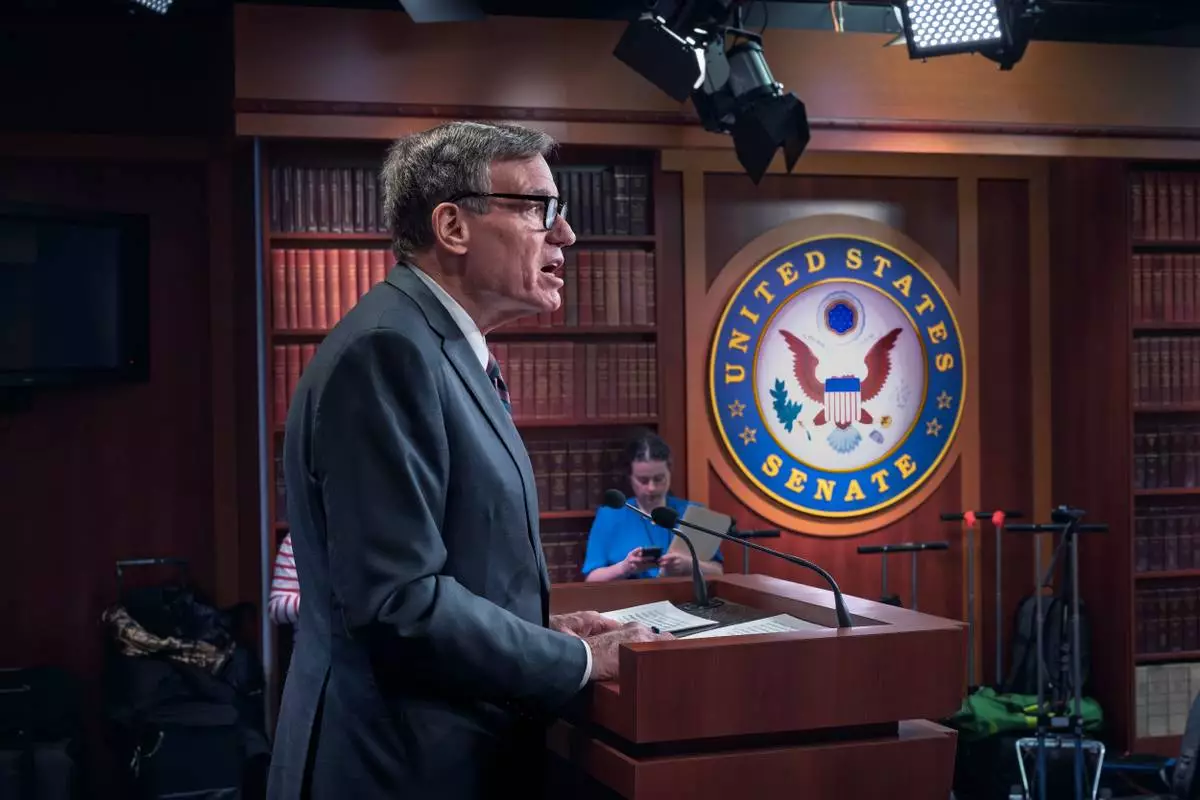
Sen. Mark Warner, D-Va., the vice chair of the Senate Intelligence Committee, speaks out against President Donald Trump's investigation of the 2020 presidential election ballots in Georgia, and the involvement of Trump ally Tulsi Gabbard, director of National Intelligence, during a news conference at the Capitol in Washington, Tuesday, Feb. 3, 2026. (AP Photo/J. Scott Applewhite)
Sen. Mark Warner, D-Va., the vice chair of the Senate Intelligence Committee, speaks out against President Donald Trump's investigation of the 2020 presidential election ballots in Georgia, and the involvement of Trump ally Tulsi Gabbard, director of National Intelligence, during a news conference at the Capitol in Washington, Tuesday, Feb. 3, 2026. (AP Photo/J. Scott Applewhite)

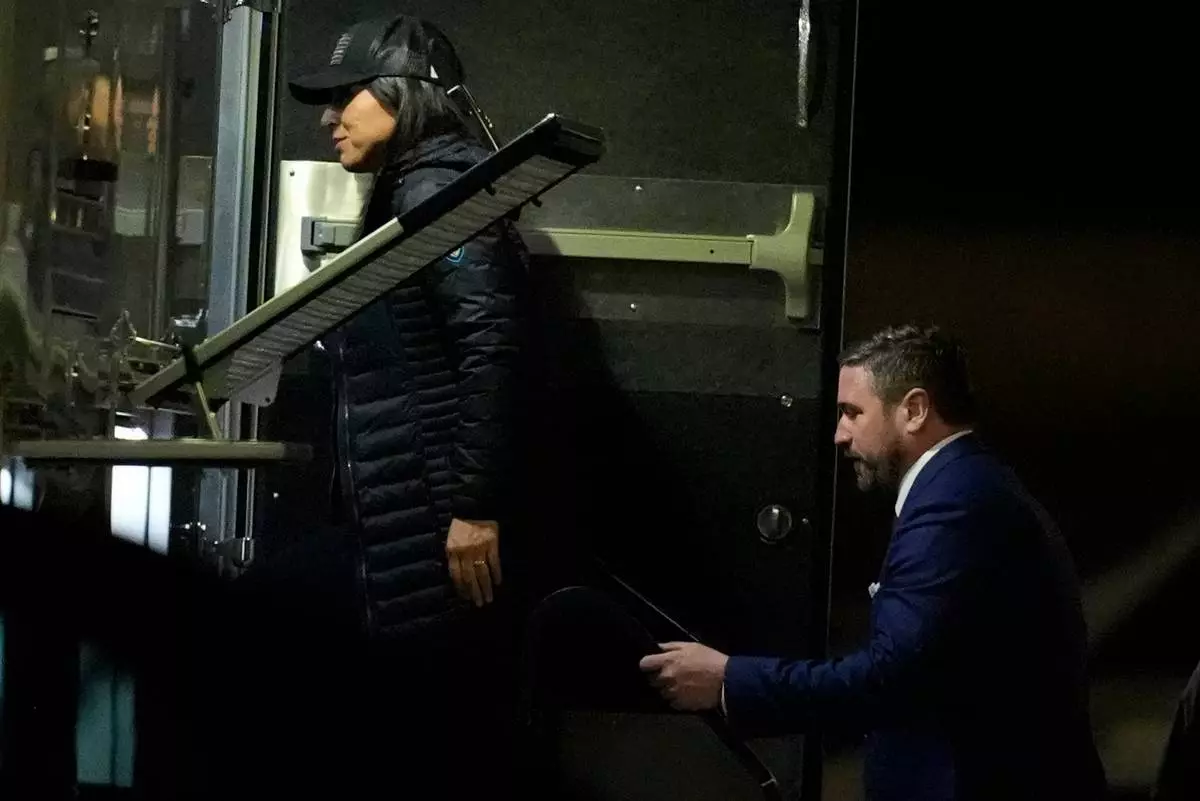
Director of National Intelligence Tulsi Gabbard, left, and FBI Deputy Director Andrew Bailey, enter a command vehicle as the FBI takes Fulton County 2020 Election ballots, Wednesday, Jan. 28, 2026, in Union City, Ga., near Atlanta. (AP Photo/Mike Stewart)


Director of National Intelligence Tulsi Gabbard, left, and FBI Deputy Director Andrew Bailey, enter a command vehicle as the FBI takes Fulton County 2020 Election ballots, Wednesday, Jan. 28, 2026, in Union City, Ga., near Atlanta. (AP Photo/Mike Stewart)

WASHINGTON (AP) — Senate Majority Leader John Thune said Thursday that demands made by Democrats for new restrictions on federal immigration officers are “unrealistic” and warned that the Department of Homeland Security will shut down next week if they do not work with Republicans and the White House.

Democrats say they will not vote for a DHS spending bill when funding runs out unless there are “dramatic changes” at U.S. Immigration and Customs Enforcement and other federal law enforcement agencies in the wake of the fatal shootings of two protesters in Minneapolis last month.

The Democratic leaders, Sen. Chuck Schumer and Rep. Hakeem Jeffries, released an expanded list of 10 detailed proposals on Wednesday night for restraining President Donald Trump’s aggressive campaign of immigration enforcement. Among the demands are a requirement for judicial warrants, better identification of DHS officers, new use of force standards and a stop to racial profiling.

Congress is trying to renegotiate the DHS spending bill after Trump last week agreed to a Democratic request that it be separated from a larger spending measure and extended at current levels for two weeks while the two parties negotiate. The deal came after ICU nurse Alex Pretti was shot and killed by a U.S. Border Patrol officer in Minneapolis on Jan. 24, and some Republicans agreed that new restrictions were necessary.

But with nearly a week gone, a shutdown is becoming increasingly likely starting Feb. 14 as Republicans have been cool to most of the Democrats’ requests.

“This is not a blank check situation where Republicans just do agree to a list of Democrat demands,” said Thune, R-S.D. “The only way to get reforms to ICE is to agree to a bill.”

As of now, Thune said, “we aren’t anywhere close to having any sort of an agreement.”

In addition to ICE and U.S. Customs and Border Protection, the homeland security bill includes funding for the Federal Emergency Management Agency and the Transportation Security Administration. If DHS shuts down, Thune said, “there’s a very good chance we could see more travel problems” similar to the 43-day government closure last year.

Schumer, D-N.Y., said he is “astounded to hear” Republicans say his party’s proposals were political or unworkable.

“It’s about people’s basic rights, it’s about people’s safety,” Schumer said. If Republicans do not like the ideas, he said, “they need to explain why.”

Schumer and Jeffries, D-N.Y., have made several demands, including no masks for officers, judicial warrants and better federal coordination with local authorities. The list they released Wednesday added several new items, including a stricter use-of-force policy, legal safeguards at detention centers and a prohibition on tracking protesters with body-worn cameras.

Democrats say Congress should end indiscriminate arrests, “improve warrant procedures and standards,” ensure the law is clear that officers cannot enter private property without a judicial warrant and require that before a person can be detained, it's verified that the person is not a U.S. citizen.

They also want an end to racial profiling, saying DHS officers should be prohibited from stopping, questioning or searching people "based on an individual’s presence at certain locations, their job, their spoken language and accent or their race and ethnicity.”

For officers conducting immigration enforcement, Democrats say that in addition to officers taking off their masks and showing identification, DHS should regulate and standardize uniforms and equipment to bring them in line with other law enforcement agencies.

Schumer called it a “gut check moment for Congress" as the immigration enforcement operations have rocked Minneapolis and other U.S. cities. But Republicans were dismissive.

Wyoming's John Barrasso, the No. 2 Republican senator, said the demands are “radical and extreme” and a “far-left wish list.”

Sen. Katie Britt, who is helping lead negotiations, said the list is “a ridiculous Christmas list of demands" and warned that time is running out before the deadline.

“I encourage them to talk to the White House,” she said. “We only have one week left.”

Thune has also encouraged Democrats and the White House to talk. It is unclear whether they are or whether Democrats would be willing to back down on any of their demands.

Some Republicans have demands of their own, including adding legislation that would require proof of citizenship before Americans register to vote and restrictions on cities that they say do not do enough to crack down on illegal immigration.

Sen. Chris Murphy, D-Conn., said it is up to Republicans to ensure the government doesn't shut down because they are in charge.

“The American people want this abuse to stop,” Murphy said.

Other lawmakers are searching for options to prevent another partial shutdown.

One idea being floated is to essentially fund some of the other agencies within DHS -– the Coast Guard, airport operations under TSA and disaster assistance from FEMA.

“Why not take that off the table?” said Republican Sen. Thom Tillis of North Carolina, whose state is in need of FEMA funds from recent disasters.

“If it doesn’t look like they can get it done,” he said about the immigration enforcement overhaul. “I really think they should look at a la carte funding of agencies.”

Some Democrats have said they agree, but Thune said Thursday that splitting apart the DHS appropriations bill to single out ICE would “defund law enforcement.”

Splitting the bill would mean essentially cutting ICE loose by allowing it to go without its routine federal funding because the agency already has such a robust budget from Trump’s tax and spending cut bill from last year.

ICE is expected to receive about $10 billion in the annual appropriations bill, a fraction of the $175 billion-plus for homeland security for the administration’s mass deportation agenda.

Associated Press writer Stephen Groves contributed to this report.

Senate Majority Leader John Thune, R-S.D., speaks during a news conference after a policy luncheon on Capitol Hill, Tuesday, Feb. 3, 2026, in Washington. (AP Photo/Mariam Zuhaib)

Senate Majority Leader John Thune, R-S.D., speaks during a news conference after a policy luncheon on Capitol Hill, Tuesday, Feb. 3, 2026, in Washington. (AP Photo/Mariam Zuhaib)

House Minority Leader Rep. Hakeem Jeffries, D-N.Y., speaks during a news conference at the U.S. Capitol, Monday, Feb. 2, 2026, in Washington. (AP Photo/Rod Lamkey, Jr.)

House Minority Leader Rep. Hakeem Jeffries, D-N.Y., speaks during a news conference at the U.S. Capitol, Monday, Feb. 2, 2026, in Washington. (AP Photo/Rod Lamkey, Jr.)

Recommended Articles