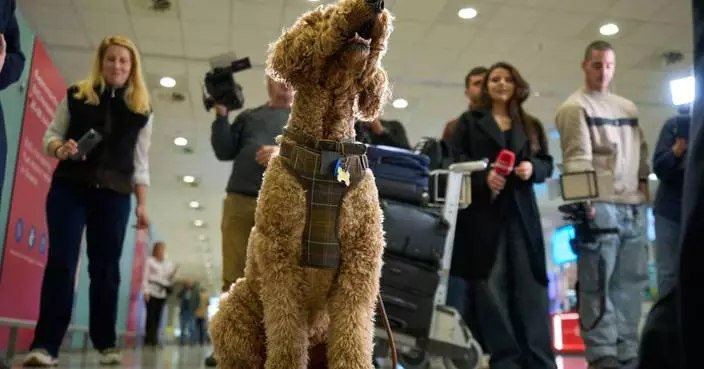
The government will allow dogs into approved eateries, with the first phase of up to 1,000 licenses expected to be issued by the middle of the year. Dog owners will be required to use leashes or keep their dogs tied to designated locations within the eateries, and dogs will be prohibited from going onto the dining tables.
Mr. Wong Ka-wo, the President of the Hong Kong Federation of Restaurants & Related Trades Limited, welcomed the measures on an RTHK program, believing the arrangements will bring new business opportunities. Nevertheless, considering there are nearly 18,000 eateries in Hong Kong, the initial issuance of 500 to 1,000 licenses is relatively limited. He agreed with the government's approach of gradual release, allowing for further review and optimization.

Mr. Wong Ka-wo, Photo source: FB of Mr. Wong Ka-wo
Mr. Wong said that considering hygiene and food safety, the government's regulations, such as prohibiting dogs from using reusable tableware in the eateries, are reasonable and understandable. The requirement for approved restaurants to display signs at their entrances indicating dog access strikes a balance between the demands of dog owners, eateries, and other diners.
Mr. Chan Pok-chi, the Legislative Council Member of the Agriculture and Fisheries Functional Constituency, stated on the same program that the new measures represent a pilot sector for the pet economy. He said the proportion of approved restaurants in the first phase was not high, giving diners more choices, and that the prohibitions on dogs using reusable tableware, etc., were acceptable solutions.
Dr. Lam Tzit-yuen, the Legislative Council Member of the Medical and Health Services Functional Constituency, stated that all pet dogs in Hong Kong have been vaccinated against rabies, making him believe the possibility of infectivity would be quite low. Regarding the regulation's requirement for immediate and thorough cleaning and disinfection if dogs defecate in eateries, Dr. Lam suggested that eateries ought to use easy-to-clean flooring materials, such as tiles, be provided with cleaning supplies, and establish rules regarding whether the dog owner or the eatery is responsible for handling the dog's excrement to avoid disputes.

Dogs can be allowed to enter some approved eateries in Hong Kong. Photo by Bastille Post
BETHESDA, Md.--(BUSINESS WIRE)--Mar 30, 2026--
Walker & Dunlop, Inc. announced today that it has arranged the joint venture partnership between AIP, Pointsfive, and Bridge Investment Group for the landmark $132 million redevelopment of the former Greyhound Bus Station in Richmond, Virginia into a multifamily community. The firm secured the equity, in addition to an $85.6 million construction financing with Madison Realty Capital. Upon completion, the 550,000-square-foot project will deliver 386 Class A residences and over 14,000 square feet of retail in Richmond’s Scott’s Addition District, one of the city’s fastest-growing neighborhoods.
This press release features multimedia. View the full release here: https://www.businesswire.com/news/home/20260330620402/en/
“We are honored to collaborate with this exceptional best-in-class partnership. Together, we will bring a world-class residential experience, with curated urban retail spaces that emphasize street-level activation and urban connectivity, unrivaled amenities, and sustainably focused design to life in this historic location,” said Scott Allen, founder and CEO of AIP.
“This submarket has all the qualities we look for in a multifamily development location: walkability, unique mixed-use urban character, day and night entertainment drivers, and consistently strong renter growth relative to supply,” said Tristan Nadal, founder and CEO of Pointsfive.
Walker & Dunlop Capital Markets Institutional Advisory and Equity & Structured Finance served as exclusive advisor to co-developers, AIP and Pointsfive. Mo Beler, Jonathan Paine, Heather McClure, Cory Elbaum, Michael Williams, and Jackson Irwin arranged the venture equity investment from Bridge Investment Group while Aaron Appel, Jonathan Schwartz, Adam Schwartz, Keith Kurland, Sean Reimer, and Michael Brown secured construction financing with Madison Realty Capital.
“This transaction and development reflect the strength of one of the Mid-Atlantic’s fastest-growing urban submarkets of Richmond, Virginia and the exceptional quality of this multifamily development and sponsorship,” said Beler, senior managing director of Capital Markets and co-head of Equity & Structured Finance at Walker & Dunlop. “Scott’s Addition continues to benefit from strong fundamentals, including steady rent growth, projected household expansion, and a well-documented shortage of quality housing driven by population and employment growth. We’re proud to have partnered with AIP, Pointsfive, Bridge Investment Group, and Madison Realty Capital to capitalize this iconic project and bring it to fruition.”
Scott’s Addition has undergone one of the most remarkable urban transformations on the East Coast, evolving from a quiet industrial warehouse district into Richmond’s most vibrant walkable neighborhood in less than a decade. Today, in less than one square mile, it is home to more than a dozen craft breweries, destination James Beard-nominated restaurants, boutique fitness studios, coffee shops, retailers, creative office spaces, and multifamily housing — all connected by tree-lined sidewalks and a growing network of bike infrastructure. The neighborhood’s industrial bones give it an authenticity that purpose-built mixed-use districts struggle to replicate, attracting a young professional demographic that prioritizes urban lifestyle. With the adjacent $2.4 billion Diamond District redevelopment, the largest redevelopment in the city’s history, and the new minor league ballpark to the east (home to the Double-A Eastern League affiliate of the San Francisco Giants), Scott’s Addition is transitioning from Richmond’s best-kept secret to its most institutionally developed submarket.
The property at 2910 North Arthur Ashe Boulevard is within a federally designated Qualified Opportunity Zone and provides long-term investment benefits. The site, formerly a Greyhound bus terminal and service depot, will be cleared for redevelopment. The development team has created an architectural design that enhances urban connectivity and engagement, with an expansive residential porte-cochere along West Boulevard complementing enlarged sidewalks, corner retail plaza, and over 400 linear feet of retail-forward presence on North Arthur Ashe Boulevard. Residents will benefit from three outdoor open-air courtyards and over 55,000 square feet of indoor and outdoor amenities.
Upon completion, residents will enjoy one of the most walkable urban neighborhoods and, with direct access to I-64, I-95, and Highway 250, will be able to connect to Richmond’s broader network of cultural institutions, outdoor park system, trail networks, and the James River. Construction is set to commence in the second quarter of 2026.
In 2025, Walker & Dunlop’s Capital Markets team sourced over $22 billion from non-Agency capital providers, including nearly $16 billion for multifamily properties. This vast experience has made them a top advisor on all asset classes for many of the industry’s top developers, owners, and operators. To learn more about Walker & Dunlop’s broad financing options, visit our website.
About Walker & Dunlop
Walker & Dunlop (NYSE: WD) is one of the largest commercial real estate finance and advisory services firms in the United States and internationally. Our ideas and capital create communities where people live, work, shop, and play. Our innovative people, breadth of our brand, and our technological capabilities make us one of the most insightful and client-focused firms in the commercial real estate industry.
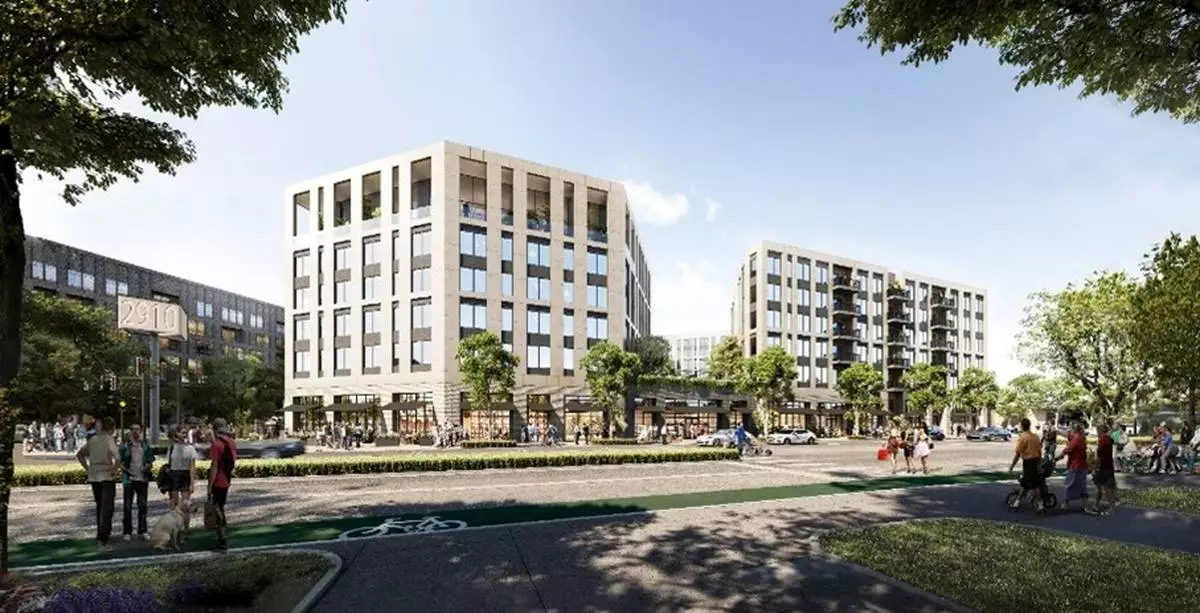
Photo Credit: AIP, Pointsfive, Bridge