PORTLAND, Maine (AP) — The U.S. government wants a judge to dismiss a lawsuit from survivors and relatives of the victims of Maine's deadliest mass shooting, who say the Army failed them by not intervening before the killings.
The families allege the government was negligent in failing to act on warning signs displayed by the shooter, an Army reservist.
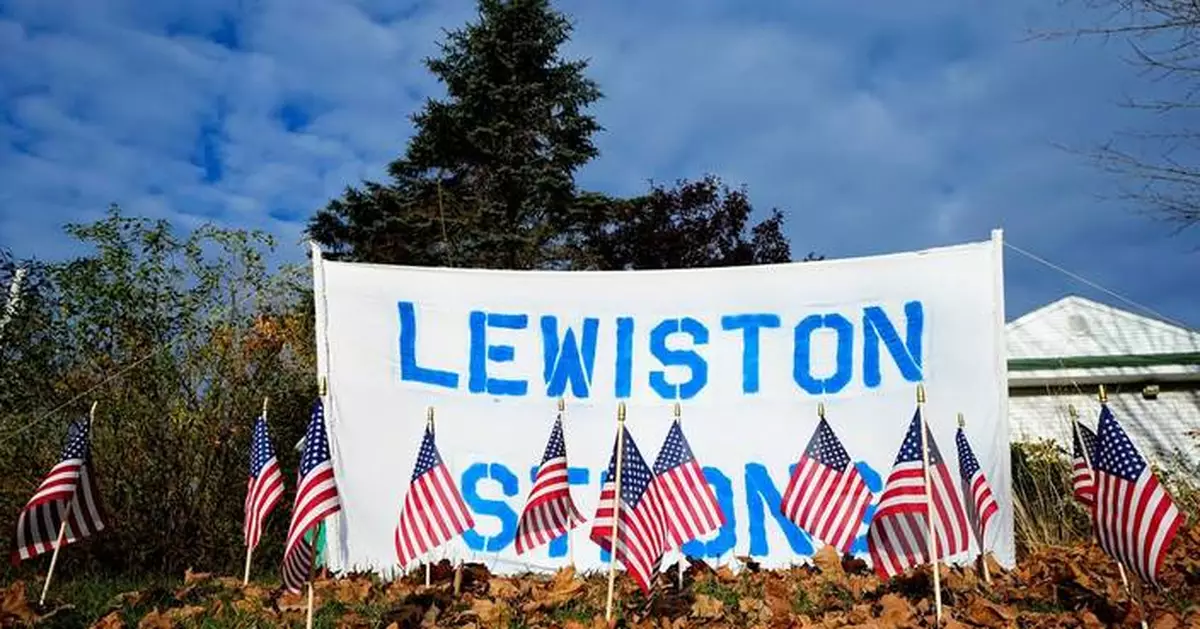
Eighteen people were killed when the 40-year-old reservist opened fire at a bowling alley and a bar and grill in Lewiston in October 2023. An independent commission appointed by Maine's governor later concluded that there were numerous opportunities for intervention by both Army officials and civilian law enforcement.
In a filing Thursday in Maine federal court, the government urged a judge to toss the lawsuit, saying the court lacks the authority to hear the case and that the families’ claims don’t meet the legal standard to move forward.
The lawsuit alleges that the Army was negligent when it failed to properly investigate the shooter’s mental condition. But the government says the shooter was “solely responsible” for the attack and the government should not be held liable for his actions.
Attorneys for 100 survivors and victims' family members announced the filing of the lawsuit last year. They then refiled their lawsuit in September following a U.S. Department of Defense watchdog report that faulted the Army for a high rate of failure to report violent threats by service members.
“Unfortunately, the government’s motion was predictable and expected. The government’s motion is a lengthy denial of any legal responsibility for broken promises to protect the community it pledges to defend. We look forward to filing our response,” said Travis Brennan and Ben Gideon, attorneys for the families, in a Friday statement.
The lawsuit faults the Army, U.S. Department of Defense and Keller Army Community Hospital for negligence, and names the U.S. government as the defendant. The lawsuit said the defendants failed to "respond to warning signs and an explicit threat to commit a mass shooting” by the shooter, Robert Card.
Card was found dead by suicide two days after the shootings.
The attorneys have said the Army did not act despite being aware of Card's mental health decline. Card's mental health spiral led to his hospitalization and left him paranoid, delusional and expressing homicidal ideations, plaintiffs said. He even produced a “hit list” of those he wanted to attack, they said.
The Lewiston shootings led to new guns laws in Maine, a state with a long tradition of hunting and gun ownership. The laws prompted legal action on the part of gun rights advocates in the state and remain a contentious topic more than two years later.
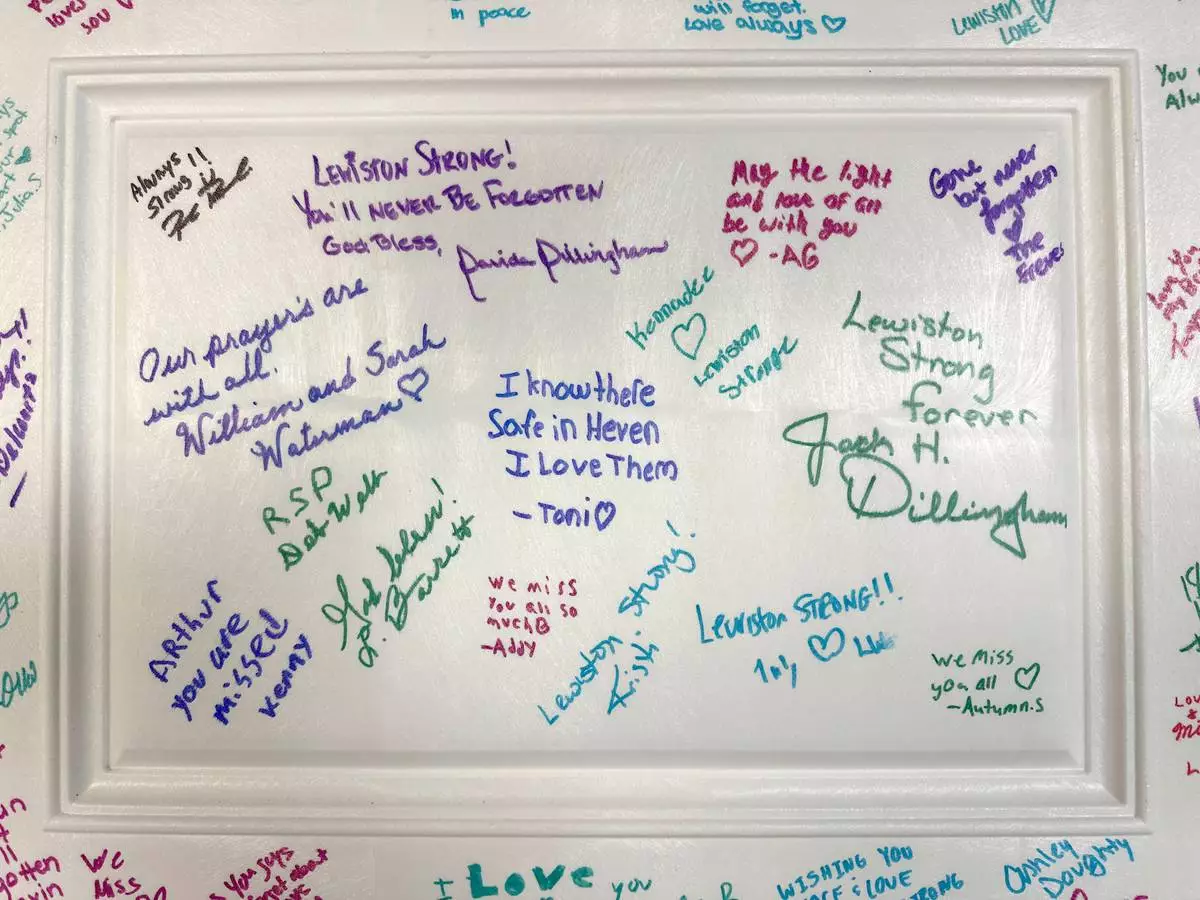
FILE - Messages are written on the cover of a time capsule at a commemoration event to mark the one year anniversary of a mass shooting in Lewiston, Maine, Oct. 25, 2024. (AP Photo/Robert F. Bukaty, File)

FILE - Ben Gideon, an attorney for families of victims the October 2023 mass shooting, speaks at a news conference, Sept. 3, 2025, in Lewiston, Maine. (AP Photo/Robert F. Bukaty, File)
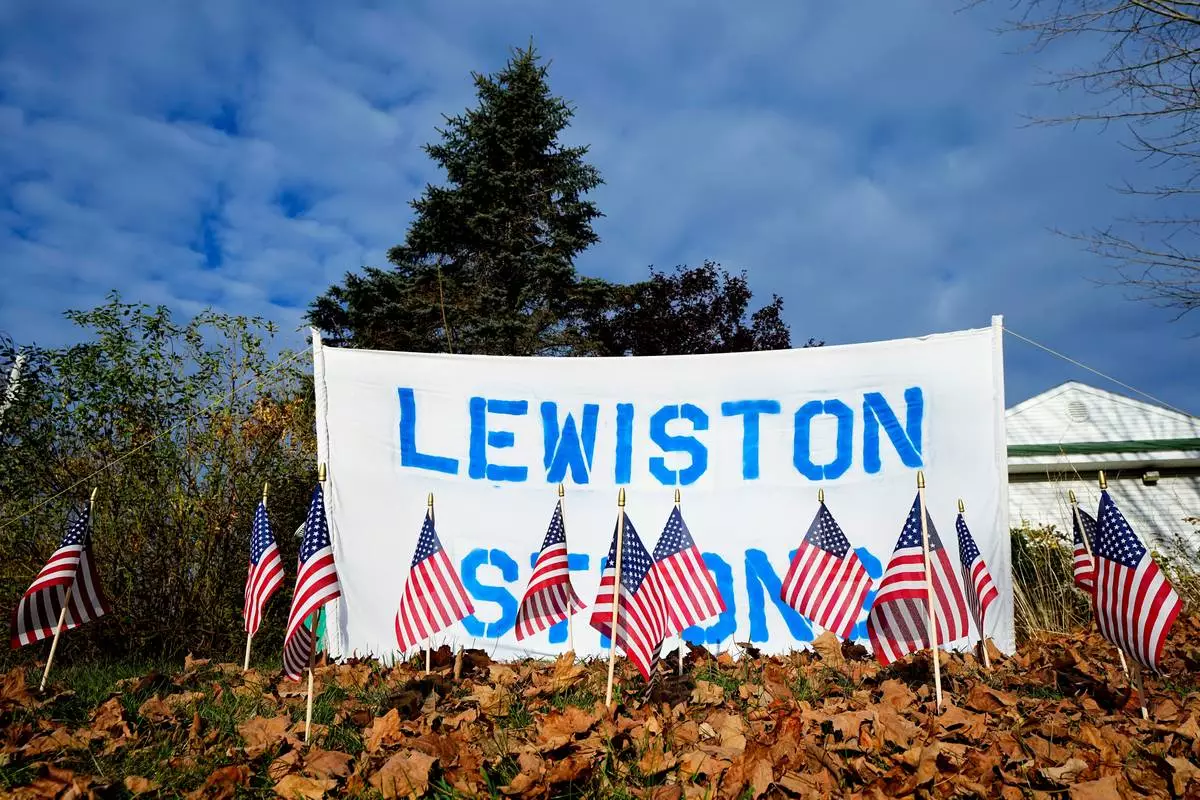
FILE - A make-shift memorial lines Main Street, Nov. 3, 2023, in Lewiston, Maine. (AP Photo/Matt York, File)
Thousands of Catholic devotees commemorated Good Friday across Latin America with processions and ceremonies re-enacting the crucifixion of Jesus.
In Antigua, a colonial-era city in southern Guatemala, dozens dressed in purple and white robes and made their way under the early morning sun, many of them penitents known as “cucuruchos.” Others carried centuries-old images of Jesus through cobblestone streets.
The city hosts more than a dozen processions throughout Holy Week, set against a backdrop of volcanoes.
Marcos Bautista, 63, said he has attended the Good Friday observances since his father brought him along as a baby in his arms.
“To describe Holy Week in Antigua, there are no words that can capture what it feels like," Bautista said. “It’s a feeling that, just by speaking about what Jesus has done in our lives, moves me deeply.”
In Bolivia, President Rodrigo Paz traveled to the southern city of Tarija to participate in Good Friday ceremonies.
The country is a secular state under its constitution and its leaders refrained from engaging in any religious events between 2006 and 2025. But Paz — who took office last November — broke with precedent by attending Palm Sunday Mass carrying a palm frond.
In the capital city of La Paz, government authorities and military bands accompanied Good Friday processions, in which hooded penitents carried the Holy Sepulcher through the streets.
Bolivia remains a predominantly Catholic country, alongside strong Indigenous spiritual traditions. In some households, it is customary to eat only fish on Good Friday and prepare up to 12 dishes representing the apostles of Jesus, a tradition that has declined in recent years amid an economic crisis.
In Ecuador, where about 80% of the population identifies as Catholic, processions were held across major cities.
In Guayaquil, roughly half a million faithful attended the “Cristo del Consuelo” procession. Amid displays of devotion, some participants walked barefoot, while others wore thorn crowns or dragged crosses.
In the capital, Quito, the “Jesús del Gran Poder” procession drew more than 150,000 faithful, who filled the historic center’s streets with chants and prayers as they accompanied an image of Jesus carrying the cross.
Thousands more climbed the Monserrate Hill in neighboring Colombia. At more than 10,200 feet (3,100 meters) above sea level, they reached the summit in the capital city of Bogotá to attend Mass at the basilica. Similar observances, including reenactments of the Stations of the Cross, were held in other parts of the country, including Medellín.
While the share of Catholics in Latin America has declined over the past decade, the faith remains the region’s largest religion.
In several countries, including Mexico, Peru and Argentina, more than 60% of adults still identify as Catholic, according to 2024 surveys by the Pew Research Center and Latinobarómetro.
AP journalists Moisés Castillo in Antigua, Guatemala; Carlos Valdez in La Paz, Bolivia; Gonzalo Solano and Gabriela Molina, in Quito, Ecuador, contributed to this report.
Associated Press religion coverage receives support through the AP’s collaboration with The Conversation US, with funding from Lilly Endowment Inc. The AP is solely responsible for this content.
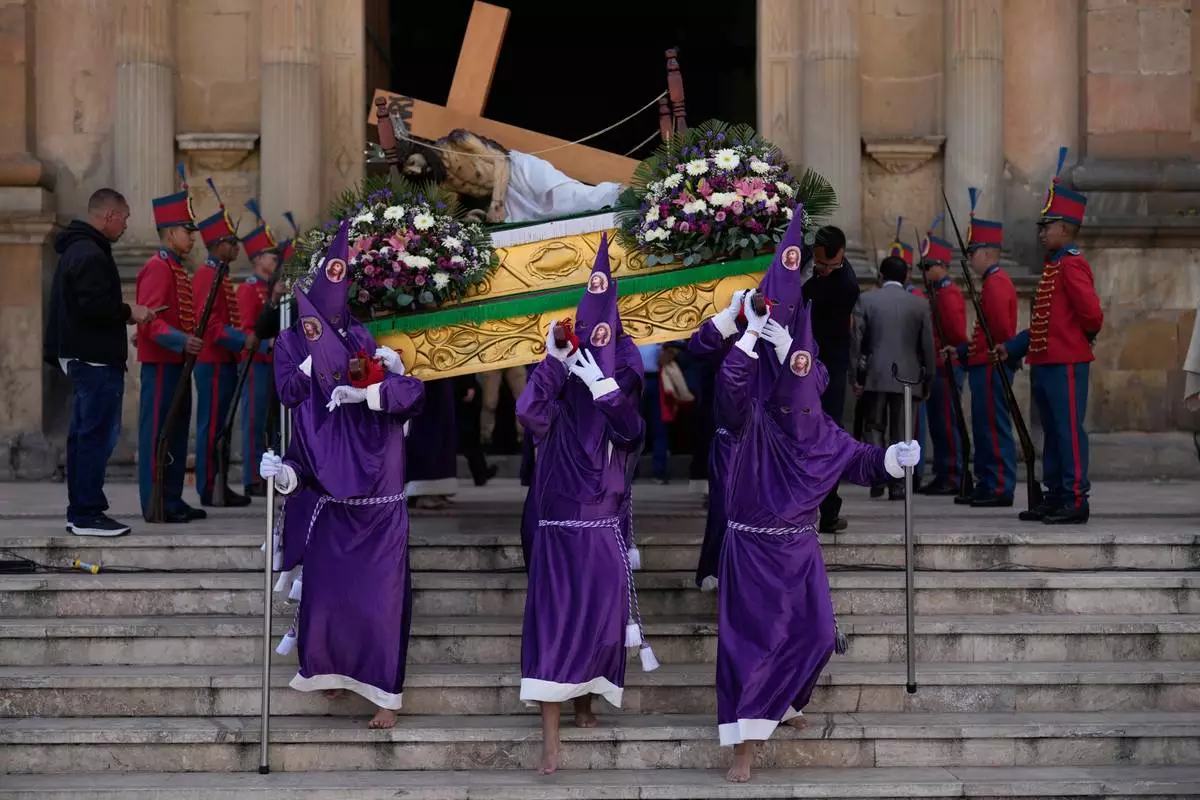
Penitents from the Nazareno brotherhood carry a statue of Jesus down the steps of the Cathedral Basilica of St. James the Apostle for a Good Friday procession during Holy Week in Tunja, Colombia, Friday, April 3, 2026. (AP Photo/Fernando Vergara)
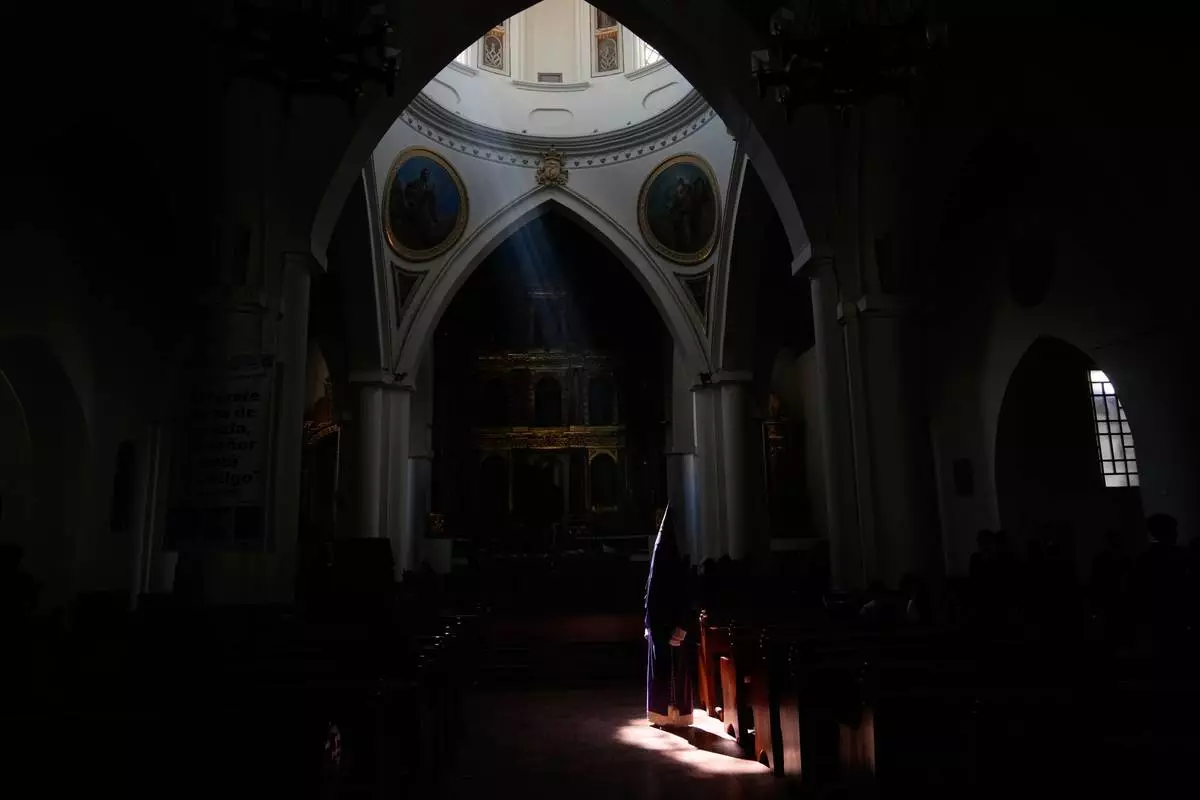
A hooded penitent from the Nazareno brotherhood waits for the Good Friday procession inside the Cathedral Basilica of St. James the Apostle during Holy Week in Tunja, Colombia, Friday, April 3, 2026. (AP Photo/Fernando Vergara)
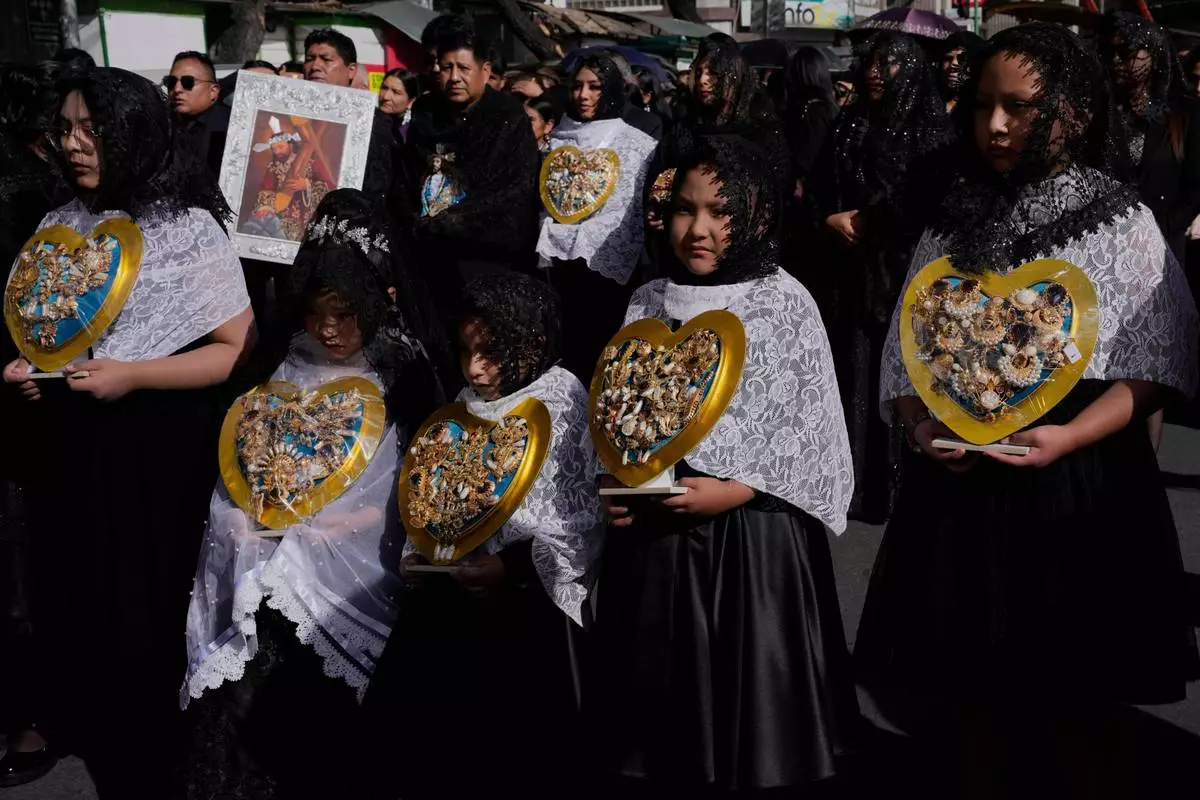
Young women and girls carry jeweled hearts representing the Virgin Mary at a Good Friday procession during Holy Week in La Paz, Bolivia, Friday, April 3, 2026. (AP Photo/Juan Karita)
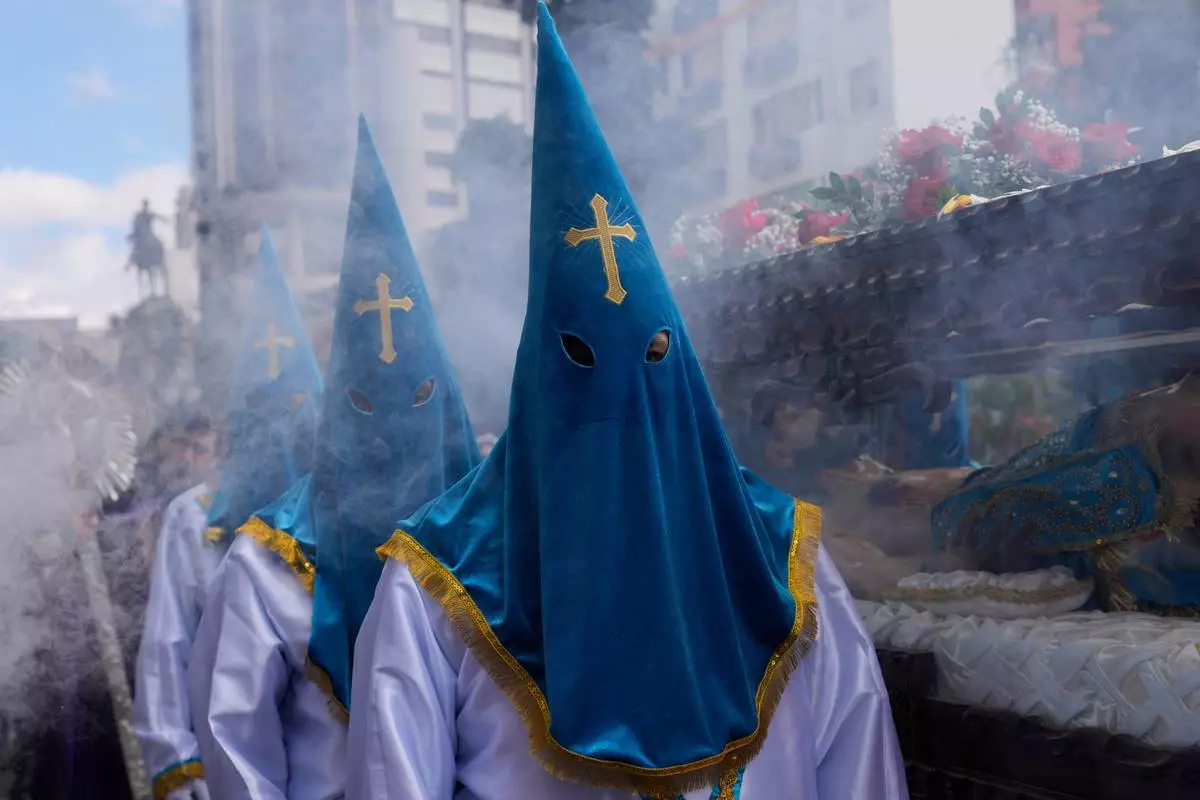
Hooded penitents participate in a Good Friday procession during Holy Week in La Paz, Bolivia, Friday, April 3, 2026. (AP Photo/Juan Karita)
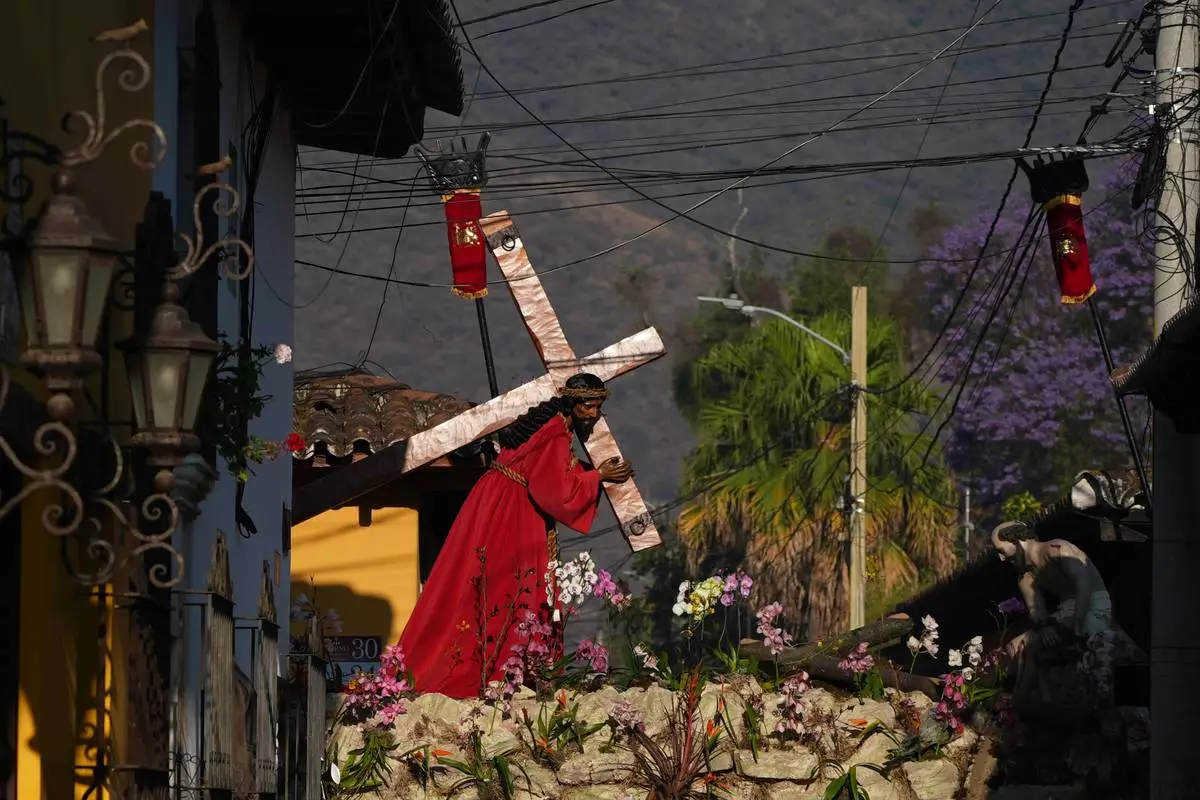
A statue of Jesus Christ with a cross makes its way past electric cables at La Merced church's Good Friday procession during Holy Week in Antigua, Guatemala, Friday, April 3, 2026. (AP Photo/Moises Castillo)
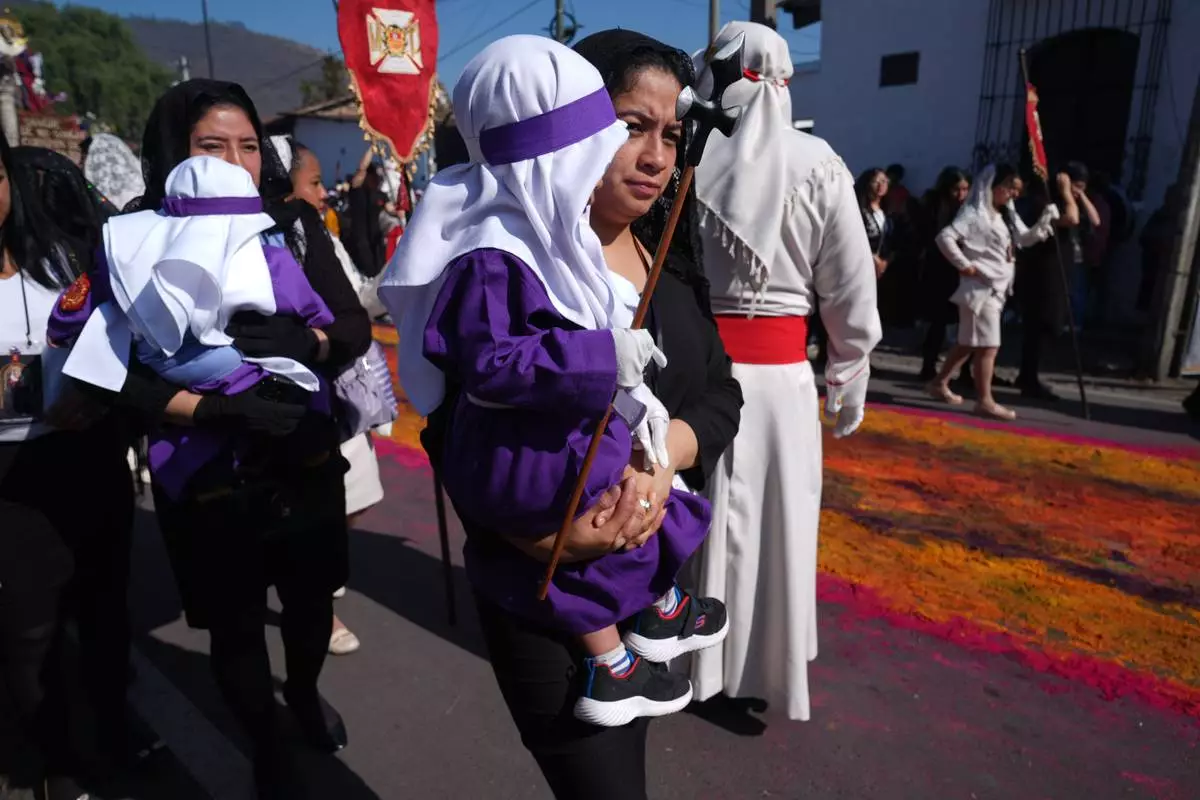
Women carry children dressed as penitents knows as "cucuruchos" on the sidelines of La Merced church's Good Friday procession during Holy Week in Antigua, Guatemala, Friday, April 3, 2026. (AP Photo/Moises Castillo)
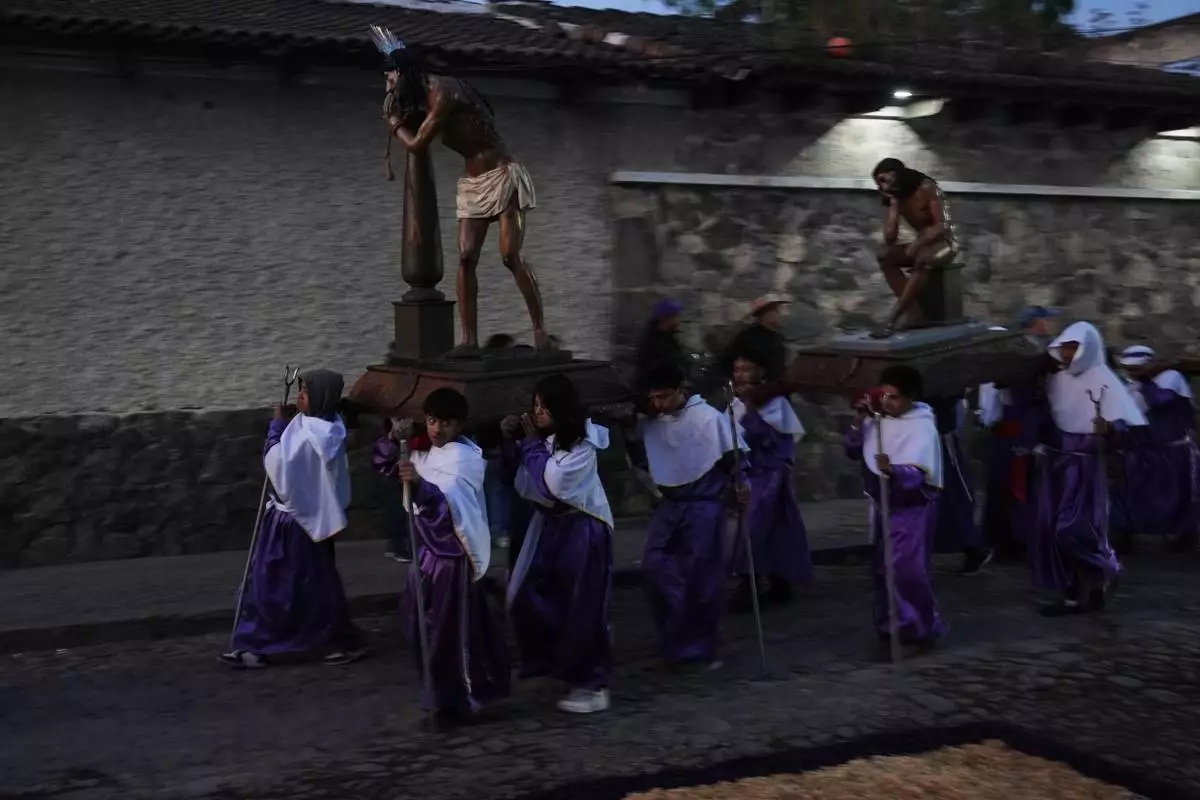
Penitents carry statues of Jesus Christ representing the Stations of the Cross at a Good Friday procession by La Merced church during Holy Week in Antigua, Guatemala, just before sunrise Friday, April 3, 2026. (AP Photo/Moises Castillo)
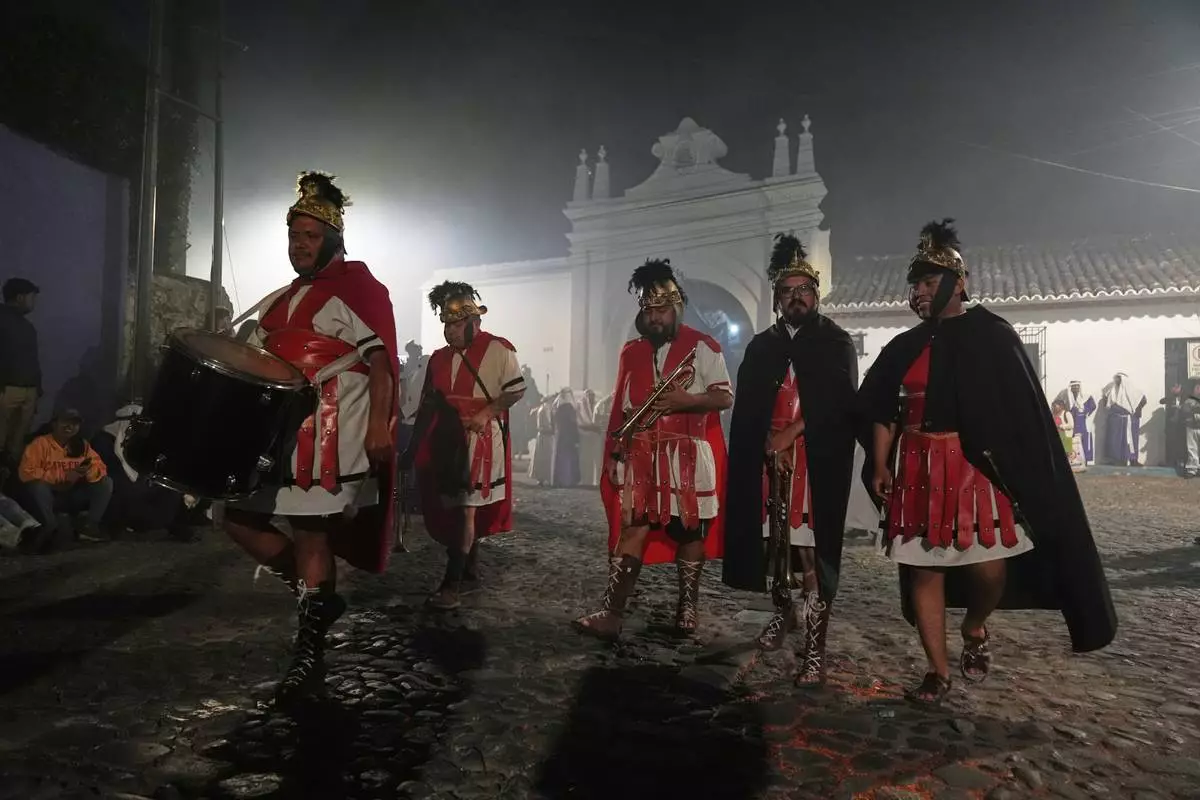
Musicians dressed as Roman soldiers take part in La Merced church's Good Friday procession during Holy Week in Antigua, Guatemala, Friday, April 3, 2026. (AP Photo/Moises Castillo)