Skip to Content Facebook Feature Image

China launches BeiDou-based satellite short messaging service for emergency needs

China

China

China

China launches BeiDou-based satellite short messaging service for emergency needs

2026-02-07 17:37 Last Updated At:19:07

China has launched a new satellite short messaging service leveraging the BeiDou Navigation Satellite System (BDS), designed to provide reliable communication during emergencies when ground-based mobile networks are unavailable.

The service was introduced by China Space-Time Information Co., Ltd., the national operator of the BeiDou services, in collaboration with major domestic telecom carriers, the company announced on Thursday.

The service is poised to serve as a critical supplement to terrestrial mobile networks. It is expected to enhance safety and communication reliability for users across scenarios such as hiking in remote mountains, working at sea, and disaster relief and emergency coordination.

It marks a significant step toward bringing satellite communication technology to the public, the company said, adding that it integrates BeiDou's capabilities into daily life, offering tangible technological protection.

The service uses the short-message service built into the BeiDou system, enabling users with compatible smartphones to send and receive text messages directly via BeiDou satellites in areas without cellular coverage.

China's three primary telecom operators -- China Mobile, China Telecom, and China Unicom -- have all integrated the service. Subscribers can activate the service without changing their SIM cards or phone numbers, according to the company.

Currently, nearly 60 smartphone models from leading Chinese brands already support the functionality, it said.

China Space-Time Information specializes in satellite navigation and communications, big data services, artificial intelligence development, and geospatial remote sensing.

China launches BeiDou-based satellite short messaging service for emergency needs

China launches BeiDou-based satellite short messaging service for emergency needs

China launches BeiDou-based satellite short messaging service for emergency needs

China launches BeiDou-based satellite short messaging service for emergency needs

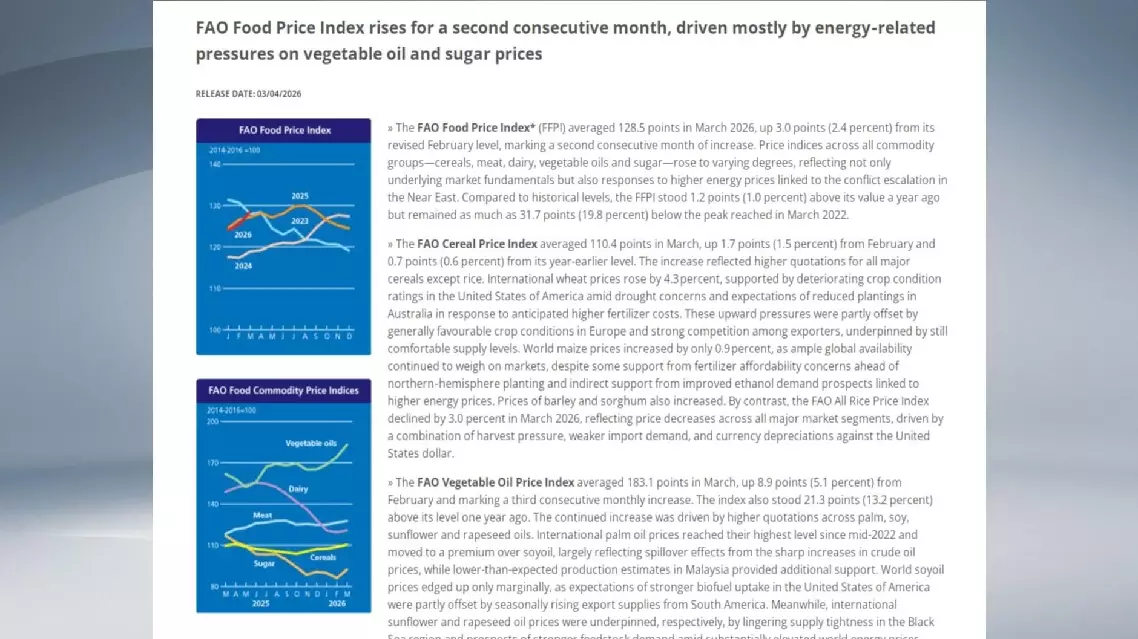
Global food commodity prices climbed for a second consecutive month in March, driven mainly by higher energy costs linked to escalating conflict in the Middle East, the Food and Agriculture Organization of the United Nations (FAO) said in report released on Friday.

The FAO Food Price Index, which tracks monthly changes in the international prices of a basket of globally traded food commodities, averaged 128.5 points in March, up 2.4 percent from February and 1.0 percent above its level a year ago.

According to the report, the FAO Vegetable Oil Index and Sugar Price Index showed the largest increases, up 5.1 percent and 7.2 percent, respectively.

The FAO Cereal Price Index increased by 1.5 percent from the previous month, driven primarily by higher world wheat prices, which rose 4.3 percent.

The FAO Meat Price Index rose by 1.0 percent from the previous month, and the FAO All-Rice Price Index declined by 3.0 percent in March, according to the report.

FAO stated that rising energy and fertilizer prices have been driving up agricultural input costs.

If the conflict stretches beyond 40 days, farmers will have to choose to farm the same with fewer inputs, plant less, or switch to less intensive fertilizer crops, according to FAO Chief Economist Maximo Torero.

These choices will hit future yields and shape food supply and commodity prices for the rest of this year and beyond, Torero said.

Global food prices rise for 2nd consecutive month in March amid Middle East conflict: FAO

Global food prices rise for 2nd consecutive month in March amid Middle East conflict: FAO

Recommended Articles