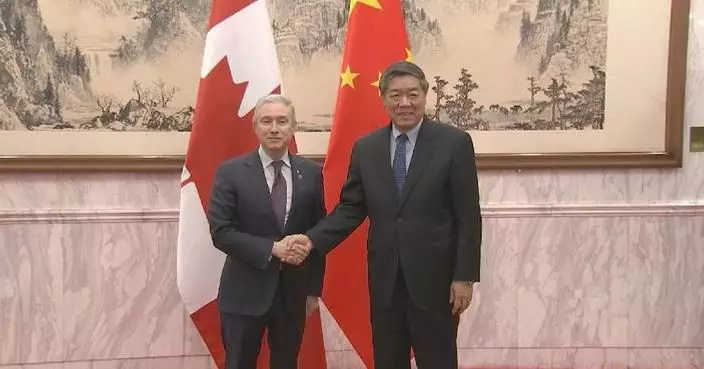
League of Arab States (LAS) Secretary-General Ahmed Aboul-Gheit said the Arab world remains committed to a non-aligned foreign policy amid shifting global power dynamics.
In an interview with China Media Group (CMG) that aired on Friday, Aboul-Gheit, who has visited China six times, said non-alignment has long guided the Arab League's diplomatic stance, tracing back to its early days.
"We adopted that the Arab League is composed of 22 countries. But not all of them were independent in 1945, only seven. The seven agreed on a certain path that was embracing non-alignment. And since the establishment of the movement, the non-aligned movement in 1961, or let's say, since the Bandung Summit in 1955 in Indonesia, the Arab League was following non-alignment between the Western world and the Soviet bloc," said the secretary-general.

Arab League committed to non-alignment since founding: chief
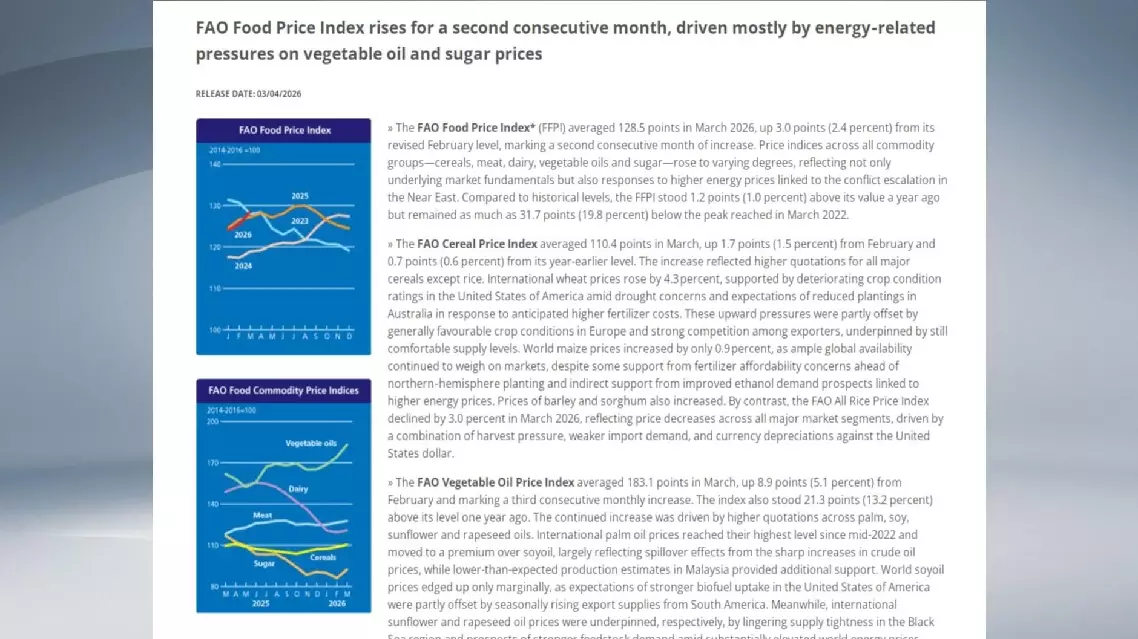
Global food commodity prices climbed for a second consecutive month in March, driven mainly by higher energy costs linked to escalating conflict in the Middle East, the Food and Agriculture Organization of the United Nations (FAO) said in report released on Friday.
The FAO Food Price Index, which tracks monthly changes in the international prices of a basket of globally traded food commodities, averaged 128.5 points in March, up 2.4 percent from February and 1.0 percent above its level a year ago.
According to the report, the FAO Vegetable Oil Index and Sugar Price Index showed the largest increases, up 5.1 percent and 7.2 percent, respectively.
The FAO Cereal Price Index increased by 1.5 percent from the previous month, driven primarily by higher world wheat prices, which rose 4.3 percent.
The FAO Meat Price Index rose by 1.0 percent from the previous month, and the FAO All-Rice Price Index declined by 3.0 percent in March, according to the report.
FAO stated that rising energy and fertilizer prices have been driving up agricultural input costs.
If the conflict stretches beyond 40 days, farmers will have to choose to farm the same with fewer inputs, plant less, or switch to less intensive fertilizer crops, according to FAO Chief Economist Maximo Torero.
These choices will hit future yields and shape food supply and commodity prices for the rest of this year and beyond, Torero said.
Global food prices rise for 2nd consecutive month in March amid Middle East conflict: FAO